About Sporting Park
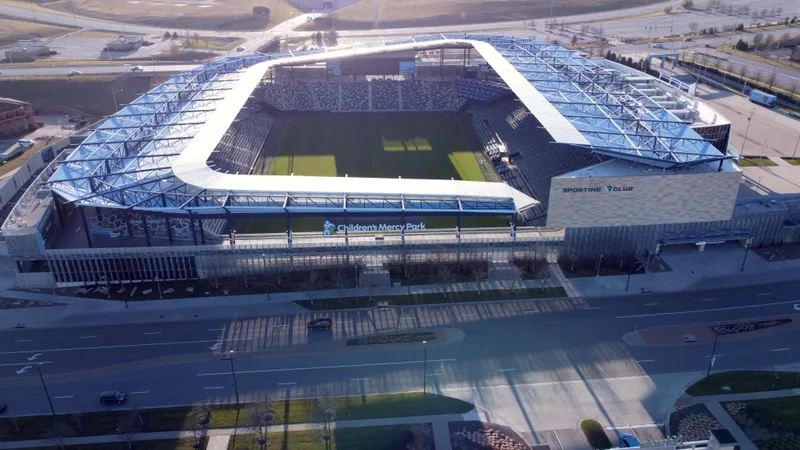
A soccer ball frozen at the top of its arc. That is what Populous set out to build over the north goal in Kansas City, Kansas, and the canopy at Children’s Mercy Park still reads that way from the parking lot. Sporting Kansas City opened the ground in June 2011, an 18,467-seat, soccer-specific stadium tucked into the Village West district on the western edge of Wyandotte County. It is the venue that pulled a drifting franchise back into focus.
For most of the previous decade the club had been the Kansas City Wizards, a tenant in borrowed rooms. Arrowhead Stadium first. Then the minor-league CommunityAmerica Ballpark. A $200 million stadium changed the terms. Alongside it came a full rebrand, from Wizards to Sporting Kansas City, new colors, a new crest, and a purpose-built home that argued MLS could work in a mid-sized American market. The atmosphere did the rest. On match nights the Cauldron supporters group fills the north end with smoke, flags, and noise that has nothing to do with the modest capacity.
The name has changed more than once, which trips up first-time visitors. The stadium opened as LIVESTRONG Sporting Park, part of a partnership with Lance Armstrong’s cancer foundation, then dropped that name in January 2013 when the deal was terminated in the wake of the Armstrong doping fallout. It ran as plain Sporting Park until late 2015, when a ten-year agreement made it Children’s Mercy Park. That deal expired in early 2026, and the venue reverted to Sporting Park ahead of the 2026 season. Locals tend to call it whatever it was called when they started coming.
Whatever the sign out front reads, the building has punched above its size since day one. In 2013 it did something no other venue in league history has matched: it hosted the MLS All-Star Game, a United States men’s World Cup qualifier, and the MLS Cup Final in a single year. Sporting KC won that final at home. The place has been loud ever since.
The Village West setting puts the stadium in unusual company, alongside Kansas Speedway, Legends Outlets, and a casino, a suburban entertainment cluster that draws visitors from across the metro. It is not a downtown ground and never pretended to be. What it offers instead is a compact, covered bowl where 18,000 people sound like far more, which on a good night is exactly the trade a home team wants.
Getting to Sporting Park
Public Transit
Children’s Mercy Park is a suburban ground, and transit reflects that. KCATA’s route 101 bus reaches the Village West area, but service is limited and most fans never consider it. Driving or rideshare is the realistic option.
→ Via Rideshare from Downtown KCMO: The most practical option for visitors without a car. From the Power & Light District, expect $20 to $30 and about 20 minutes via I-70 or I-435.
→ Via KCATA Bus (Route 101): The 101 connects parts of Kansas City, Kansas with the Village West district. Useful in a pinch, but check the schedule carefully, because frequency drops sharply outside peak hours.
The thin transit is the stadium’s biggest drawback for out-of-towners. The upside is that the massive surface lots in Village West make driving about as easy as it gets.
Driving + Parking
The stadium address is One Sporting Way, Kansas City, KS 66111. I-435 and State Avenue are the main approaches.
→ From Downtown Kansas City, MO (~15 mi): I-70 West to I-435 South to the State Avenue exit. About 20 minutes.
→ From Overland Park (~20 mi): I-435 North and West to the Village West exit at State Avenue. About 25 minutes.
→ From Lawrence, KS (~40 mi): K-10 East to I-435 North to State Avenue. About 40 minutes.
The Village West complex offers extensive surface parking at roughly $15 for general lots and $25 to $35 for premium. Tailgating is permitted in designated areas, and many fans arrive early to grill before kickoff. This is not a venue where you fret about finding a spot.
Rideshare
Uber and Lyft serve the area well. The designated pickup zone is on Sporting Way near the main entrance. From downtown Kansas City hotels, expect $20 to $30. Post-match surge is moderate. If rates spike, walk over to Legends Outlets and let the first wave clear before you request a ride.
From the Airport
→ Kansas City International (MCI): 17 miles north of the stadium, about 20 minutes by car via I-435. The airport reopened with a single new terminal in 2023 and remains a Southwest Airlines hub with service from all major carriers. Rideshare runs $25 to $35. No direct transit, so driving or rideshare is the only practical option.
Construction & Design
Turner Construction had roughly sixteen months. The original plan penciled in twenty-two, but the schedule was compressed so the club could open in time for its first Sporting-branded season, and crews broke ground on January 20, 2010, in the Village West entertainment district. Populous handled the design, LANE4 Property Group ran the project, and the finished stadium came in around $200 million, close to $286 million in today’s money, helped along by a $30 million tax rebate from the local government.
The canopy is the whole idea. A 145,000-square-foot roof arcs over the seating bowl, rising from roughly 65 feet on one side to 95 feet on the other (20 to 29 meters), a corkscrew sweep meant to trace the flight of a struck ball. Populous clad it in clear polycarbonate, so daylight still reaches the grass for turf growth while the overhang traps crowd noise and pins it down onto the field. The exterior wears angular metal fins, a stop-motion nod to players caught mid-movement. Crucially, the roof covers every seat, which in a Kansas January or a July thunderstorm is not a small thing.
The rest of the fit-out matched the ambition. Thirty-seven luxury suites. Three Daktronics video boards, the largest of them 20 by 126 feet. A 120-by-75-yard natural-grass pitch laid out to full international dimensions. Kansas Unified Development, LLC owns the building and Sporting Kansas City operates it, a structure that kept the club in control of its own home rather than renting from someone else. When it opened, Populous and the club pitched the stadium as a new benchmark for mid-sized venues in North America, and for a stretch of years the claim held up.
Design choices carried through to the supporters. The Members’ Stand behind the north goal was built for the Cauldron, a standing section engineered to concentrate sound rather than scatter it. Sit anywhere in the lower bowl during a Cauldron chant and the physics of the canopy does the rest. A stadium this size has no business feeling as loud as it does, and that was deliberate from the first sketch.
History of Sporting Park
The Wizards were adrift by the late 2000s. A charter MLS franchise founded in 1996, the club had bounced between Arrowhead Stadium and the minor-league CommunityAmerica Ballpark, its identity blurry and its crowds thin. New ownership decided the fix was total: a new name, a new crest, and a stadium of its own. Everything that Children’s Mercy Park became flowed from that reset.
First match, June 9, 2011: Sporting Kansas City and the Chicago Fire played to a scoreless draw before an over-capacity crowd of 19,925. The result mattered less than the room. The Cauldron’s smoke and chants filled the north end, and the rebranded club instantly felt like a different organization.
The 2013 treble: In a single season the stadium hosted the MLS All-Star Game (A.S. Roma beat the All-Stars 3-1 in front of 21,175), a sold-out U.S. World Cup qualifier, and the MLS Cup Final. No other venue in league history has staged all three in the same year.
MLS Cup, December 7, 2013: Sporting KC edged Real Salt Lake on penalty kicks after a 1-1 draw to claim the franchise’s second MLS Cup. The attendance that night, 21,650, remains the building’s all-time record.
USMNT vs Jamaica, October 11, 2013: A sellout of 18,467 watched the U.S. men win 2-0 in a World Cup qualifier, part of a run that turned Kansas City into one of the national team’s most reliable home crowds.
Other tenants and events: The ground hosted 2011 CONCACAF Gold Cup group matches, a 2024 Copa America fixture (Canada beat Peru 1-0 before 15,625), and two women’s pro teams, FC Kansas City from 2015 to 2017 and the Kansas City Current from 2022 to 2023. Sporting Kansas City II has played here in the lower divisions since 2018.
From a rebrand to a Cup to a national-team fortress, the stadium proved that a mid-market MLS club could build a big-league atmosphere in a suburban entertainment district. The sign out front has changed several times, most recently back to Sporting Park in 2026. What happens under the canopy has not.
Sources & Further Reading
- Sporting Kansas City official site: sportingkc.com. Club-run guide to the stadium, tickets, parking, and the Cauldron supporters sections.
- Populous project page: populous.com. The design firm’s own account of the canopy, capacity, and the soccer-ball concept.
- ESPN report on the venue’s debut: espn.com. Contemporary coverage of the $200 million stadium’s 2011 unveiling.
- Wikipedia entry: en.wikipedia.org. Reference with construction details, naming history, tenants, and event results.
Quick Facts
Everything you need at a glance.
Stadium specs
- Capacity
- 18,467
- Opened
- 2011
- Cost
- $200 million (~$286 million in 2025 dollars today)
- Roof
- Canopy (covers all seats)
- Surface
- Natural Grass
- Tenants
- Sporting Kansas City (MLS)
Construction & location
- Groundbreaking
- January 20, 2010
- General contractor
- Turner Construction
- Address
- One Sporting Way, Kansas City, KS 66111, USA
- GPS
- 39.1216°N, 94.8232°W
Photo Gallery
Fun Facts
In 2013 the stadium hosted the MLS All-Star Game, a United States men's national team World Cup qualifier, and the MLS Cup Final all in the same year, the only venue in league history to pull off that treble.
The Cauldron, Sporting KC's supporters group, has stood behind the north goal since the franchise's 1996 founding, and its 'Always Stand, Never Sit' rule turns the Members' Stand into a wall of noise that has helped build one of the best home records in MLS.
Sporting KC's 2011 move from the minor-league CommunityAmerica Ballpark to a purpose-built stadium coincided with a full rebrand, from the Kansas City Wizards to Sporting Kansas City, that turned an afterthought into one of the league's model clubs.
Stadium Location
Frequently Asked Questions
- What is the seating capacity of Children's Mercy Park?
- The stadium seats 18,467 for MLS matches and can expand to around 25,000 for concerts and larger events. It is one of the smaller, more intimate soccer-specific grounds in MLS, and that is part of the point: the canopy and steep bowl keep the noise close to the field.
- Is the stadium called Children's Mercy Park or Sporting Park?
- Both names are correct, depending on when you last visited. It opened as LIVESTRONG Sporting Park in 2011, became plain Sporting Park in 2013, and carried the Children's Mercy Park name from late 2015 under a ten-year deal. That agreement expired in early 2026, and the venue reverted to Sporting Park ahead of the 2026 season. Many fans and search results still use Children's Mercy Park.
- Where is Children's Mercy Park located?
- The stadium is at One Sporting Way in Kansas City, Kansas 66111, in the Village West entertainment district in western Wyandotte County. It sits next to Kansas Speedway and Legends Outlets, about 15 miles west of downtown Kansas City, Missouri.
- How do I get to Children's Mercy Park by public transit?
- Transit is thin. KCATA's route 101 bus serves the Village West area, but frequency is limited and most fans do not rely on it. Driving or rideshare is the practical choice. Rideshare from downtown Kansas City, Missouri runs about $20 to $30 for the roughly 15-mile trip.
- Is there parking at Children's Mercy Park?
- Yes, and plenty of it. The Village West complex wraps the stadium in surface lots shared with Legends Outlets and Kansas Speedway. General lots run about $15 on match days, premium lots closer to the gates $25 to $35. Tailgating is allowed in designated areas, and finding a spot is rarely the worry it is at bigger venues.
- Who are the Cauldron?
- The Cauldron is Sporting Kansas City's supporters group, tracing its roots to the club's 1996 founding, when it was known as the Mystics. They fill the Members' Stand behind the north goal, lead the chants, hang the tifos, and follow one rule above all: always stand, never sit. The section is a big reason visiting teams dread the trip.
- Has Children's Mercy Park hosted the U.S. national team?
- Yes, several times. The most memorable was October 11, 2013, when a sold-out crowd of 18,467 watched the U.S. men beat Jamaica 2-0 in a World Cup qualifier. The stadium also hosted 2011 CONCACAF Gold Cup group games and a 2024 Copa America match, and it has become one of the national team's favorite mid-market venues.
- Is Children's Mercy Park a 2026 FIFA World Cup venue?
- No. Kansas City's World Cup 2026 matches are being played at Arrowhead Stadium across the state line in Missouri, not at this soccer-specific ground. Sporting KC's home is far below the capacity FIFA requires for tournament matches.
- When did the stadium open and who designed it?
- It opened on June 9, 2011, after breaking ground on January 20, 2010. Populous designed it, Turner Construction built it in a compressed sixteen-month schedule, and the project cost roughly $200 million, close to $286 million in today's money.
- Who plays at Children's Mercy Park besides Sporting KC?
- Sporting Kansas City (MLS) is the main tenant. Sporting Kansas City II has played here in the lower divisions since 2018, and the ground previously hosted two women's pro teams, FC Kansas City (NWSL) from 2015 to 2017 and the Kansas City Current from 2022 to 2023, before the Current moved into their own downtown stadium.
- How far is the airport from Children's Mercy Park?
- Kansas City International Airport (MCI) is about 17 miles north of the stadium, roughly 20 minutes by car via I-435. Rideshare runs $25 to $35. There is no direct transit connection, so driving or rideshare is the only real option.
Last updated: 2026-07-10