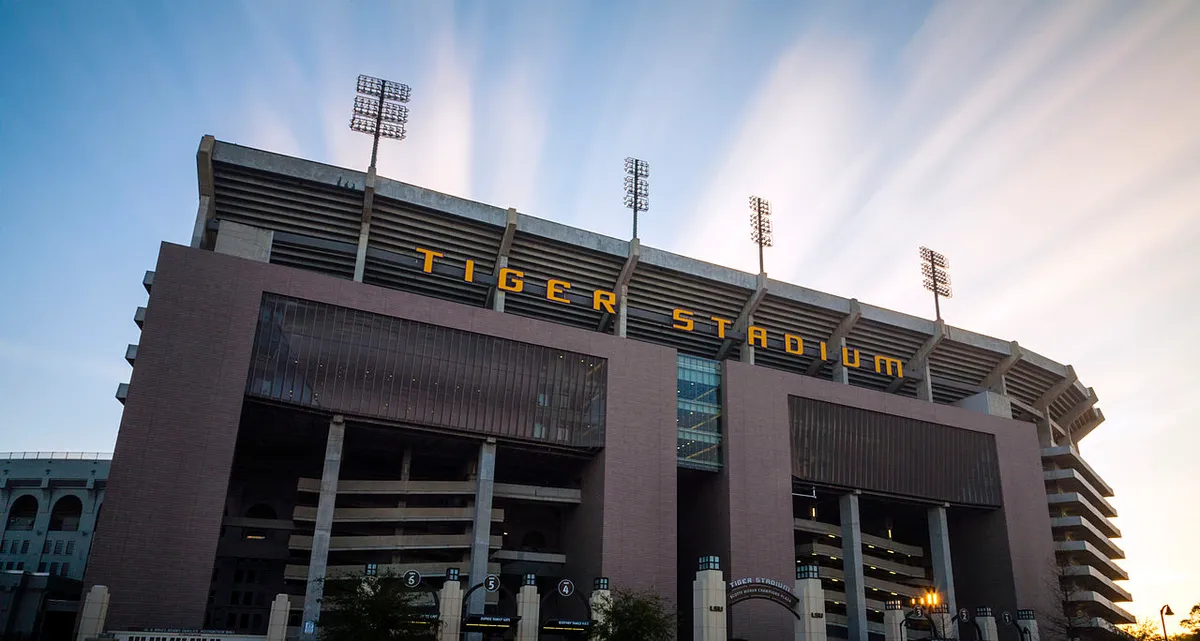
About Tiger Stadium
Tiger Stadium sits on the southern edge of LSU’s campus in Baton Rouge, Louisiana — a city that lives and dies with its football team. With 102,321 seats, it’s the fifth-largest college football stadium in the country and known universally as Death Valley. On Saturday nights in the fall, there is no louder, more hostile environment in American sports.
The stadium is home to the LSU Tigers, one of the most dominant programs in SEC history. What makes Tiger Stadium unique isn’t just its size — it’s the acoustics. The steep, enclosed bowl traps the humid Louisiana night air and funnels crowd noise onto the field. Opposing quarterbacks have called timeouts before their first snap. Visiting coaches have worn earplugs on the sideline. A seismograph once registered the crowd.
The original structure opened on November 25, 1924, with 12,000 seats. A century of expansions — from Governor Huey Long’s Depression-era additions to the $80 million south end zone project completed in 2014 — have transformed it into a colossus. The natural grass field (Celebration Bermuda) sits below a towering bowl that blocks out the surrounding city and creates the feeling of being inside a concrete canyon.
Tiger Stadium has hosted far more than football. The New Orleans Saints played four home games here in 2005 after Hurricane Katrina. Garth Brooks drew 102,000 for a concert in 2022. But the building’s identity is college football, and specifically Saturday night college football — a tradition dating back to 1931 that has become LSU’s greatest competitive advantage.
Getting to Tiger Stadium
Public Transit
Baton Rouge has limited public transit, and as of the 2024 season, CATS no longer operates gameday shuttle service to Tiger Stadium. There is no rail service to the area.
→ From Downtown Baton Rouge: Private charter buses and limousine services run gameday routes. Check local operators like Jazzy Transportation for availability.
→ From New Orleans: Private shuttle companies offer round-trip gameday service from New Orleans (~80 miles). Book well in advance — these fill up fast.
For most fans, driving is the default. Plan to arrive early and tailgate.
Driving + Parking
Tiger Stadium is on LSU’s campus in south Baton Rouge, accessible from I-10 and I-12. GPS: “West Stadium Road, Baton Rouge, LA 70803.”
→ From New Orleans (~80 mi): I-10 West, about 1 hour 20 minutes. The most common route for visiting fans.
→ From Houston (~271 mi): I-10 East, about 4 hours. Cross the Atchafalaya Basin Bridge and follow signs to LSU.
→ From Jackson, MS (~161 mi): I-55 South to I-10/I-12, about 2 hours 45 minutes.
LSU uses five color-coded parking zones. Season passes run $600-$1,500 depending on lot proximity. Individual game parking at the Old Front Nine lots is $50 per game (first-come, first-served). Tailgating is the main event — fans set up on Thursday and Friday with Cajun cooking that puts most restaurants to shame. Boudin, gumbo, crawfish boils, and jambalaya are everywhere.
Rideshare
Uber and Lyft operate in Baton Rouge, but LSU does not have an officially designated rideshare zone. Drivers pick up and drop off on the perimeter of campus. Post-game contra-flow traffic makes it difficult for cars to reach you — walk away from the stadium before requesting a ride.
Pro tip: Head toward Nicholson Drive or Highland Road before opening the app. You’ll avoid the worst gridlock and cut your wait time significantly.
From the Airport
→ Baton Rouge Metropolitan Airport (BTR): 9 miles north, about 15 minutes by car. Limited direct flights, but connections through Dallas, Atlanta, Houston, and Charlotte cover most routes.
→ New Orleans International (MSY): 72 miles southeast, about 1 hour 15 minutes by car. Far more flight options and often better fares — a realistic option for traveling fans.
Saturday Night in Death Valley
The tradition of night football at Tiger Stadium dates back to October 3, 1931, when lights were installed so working-class fans and farmers across Louisiana could attend games after a day in the fields. LSU beat Spring Hill 35-0 that night, and something clicked. The combination of humid air, a steep bowl, and a crowd that has been tailgating since morning creates an atmosphere that borders on supernatural.
The numbers back it up. Since 1960, LSU is 201-59-3 (.773) in night games at Tiger Stadium versus 21-22-3 (.488) during the day. Bear Bryant called it “the worst place in the world for a visiting team.” ESPN named it the scariest place to play. The university fights to protect night kickoffs whenever possible, even at the cost of TV revenue — that’s how much the advantage matters.
History of Tiger Stadium
Tiger Stadium opened on November 25, 1924, as a 12,000-seat venue on the southern edge of campus. Governor Huey Long championed early expansions in the 1930s, reportedly insisting on dormitories beneath the stands so students would have no excuse to miss games. By 1953, the south end zone was enclosed, turning the horseshoe into a full bowl and making Tiger Stadium the largest on-campus venue in the SEC.
- Opening Day (November 25, 1924): LSU hosts Tulane in the stadium’s inaugural game before a capacity crowd of 12,000.
- First Night Game (October 3, 1931): LSU defeats Spring Hill 35-0 under newly installed lights — the birth of Saturday Night in Death Valley.
- Billy Cannon’s Halloween Run (October 31, 1959): No. 1 LSU defeats No. 3 Ole Miss 7-3 on an 89-yard punt return touchdown by Heisman winner Billy Cannon.
- The Earthquake Game (October 8, 1988): LSU beats No. 4 Auburn 7-6 on a last-second touchdown. The crowd reaction registers on a seismograph 1,000 feet away.
- Upset of No. 1 Florida (October 11, 1997): LSU stuns top-ranked Florida 28-21. Goalposts are torn down by celebrating fans.
- Joe Burrow’s 2019 Season (October 12, 2019): No. 2 LSU defeats No. 9 Florida 42-28 in a sellout during what became a perfect 15-0 national championship season.
Photo Gallery
Fun Facts
On October 8, 1988, the crowd reaction to a last-second touchdown against Auburn registered on a seismograph at LSU's Geoscience Complex, roughly 1,000 feet from the stadium — the 'Earthquake Game.'
LSU's live Bengal tiger mascot, Mike VII, lives in a $3.7 million, 15,000-square-foot habitat adjacent to Tiger Stadium, complete with a waterfall and wading pool.
Since 1960, LSU is 201-59-3 (.773) in night games at Tiger Stadium versus just 21-22-3 (.488) during the day — a staggering gap that makes Saturday Night in Death Valley one of the most feared phrases in college football.
Stadium Location
Frequently Asked Questions
- What is the capacity of Tiger Stadium?
- Tiger Stadium holds 102,321 fans, making it the fifth-largest college football stadium in the U.S. and seventh-largest in the world. The capacity has been at this level since the 2014 south end zone expansion.
- Why is Tiger Stadium called Death Valley?
- The nickname evolved from 'Deaf Valley,' a term coined because the roar of gameday crowds shook a nearby gas station. After LSU beat Clemson 7-0 in the 1959 Sugar Bowl, fans adopted 'Death Valley.' Athletic director Bob Brodhead aggressively branded the name starting in 1982.
- What was the Earthquake Game at LSU?
- On October 8, 1988, LSU beat No. 4 Auburn 7-6 on a last-second touchdown. The crowd celebration registered on a seismograph at LSU's Geoscience Complex, about 1,000 feet from the stadium.
- Where should I park for an LSU game?
- LSU uses five color-coded parking zones. Season passes range from $600-$1,500. Individual game parking at the Old Front Nine lots costs $50. Tailgating is permitted in most lots — LSU's tailgating culture is legendary.
- Can you tailgate at Tiger Stadium?
- Yes. LSU has one of the most famous tailgating cultures in college football. Fans set up days in advance with Cajun cooking — crawfish boils, gumbo, jambalaya, and boudin are staples.
- How do I get to Tiger Stadium from New Orleans?
- Take I-10 West for approximately 80 miles, about a 1 hour 20 minute drive. The nearest airports are Baton Rouge Metropolitan (BTR, 9 miles) and New Orleans International (MSY, 72 miles).
- Is there public transit to Tiger Stadium?
- As of the 2024 season, CATS (Baton Rouge's transit authority) no longer operates gameday shuttles. Fans should plan to drive, use rideshare, or book private shuttle services.
- What is Saturday Night in Death Valley?
- It refers to LSU's tradition of playing night games at Tiger Stadium, dating back to the first night game on October 3, 1931. The Tigers have a .773 winning percentage in night games since 1960 — the atmosphere is widely regarded as the most intimidating in college football.
Last updated: 2026-02-26