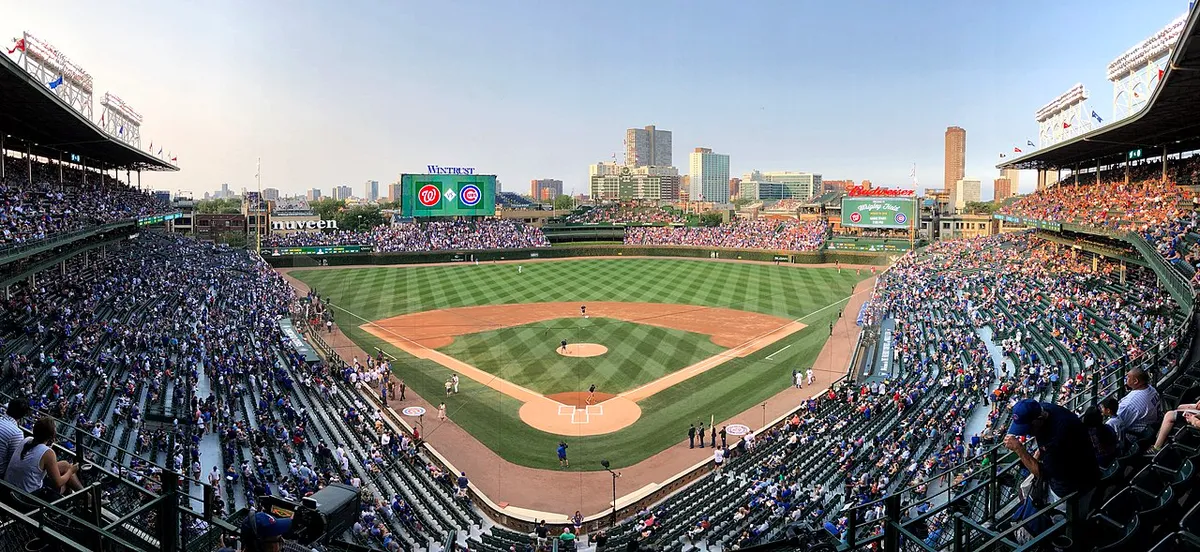
About Wrigley Field
Wrigley Field sits in Chicago’s Wrigleyville neighborhood, five miles north of the Loop and two blocks west of Lake Michigan’s shoreline winds. With 41,649 seats, it’s one of the smaller parks in Major League Baseball — and that’s exactly why it feels the way it does. Every seat is close to the action.
Home to the Chicago Cubs since 1916, Wrigley is the second-oldest active ballpark in MLB behind Fenway Park. The two share a kinship as pre-war relics that survived the concrete-donut era of the 1960s and 70s. But Wrigley has something no other park has: ivy-covered outfield walls, a hand-turned scoreboard that still operates without electronics, and rooftop bleachers on the apartment buildings along Waveland and Sheffield Avenues.
The original park was built in 1914 as Weeghman Park for the Chicago Whales of the Federal League. Chewing gum magnate William Wrigley Jr. took ownership of the Cubs in the 1920s and began expanding. The upper deck went up in 1927-28, and the iconic bleachers and scoreboard followed in 1937-38, designed by Holabird and Root in an Art Moderne style. The $575 million 1060 Project renovation (2014-2019) modernized the infrastructure while preserving the historic character.
Wrigley has hosted three MLB All-Star Games (1947, 1962, 1990) with a fourth coming in 2027. It was home to the Chicago Bears from 1921 to 1970. And on November 2, 2016, the Cubs won the World Series for the first time in 108 years — a moment that made grown adults weep on Addison Street.
Getting to Wrigley Field
Public Transit
The CTA Red Line is the best way to reach Wrigley Field. The Addison station sits directly across the street from the ballpark — you’ll see the marquee the moment you come up the stairs.
→ From Downtown Chicago (The Loop): Board the Red Line heading north from any State Street subway station. The ride to Addison takes about 20 minutes. Trains run every 5-10 minutes on game days.
→ From the North Side suburbs: Take the Purple or Yellow Line to Howard, then transfer to the Red Line heading south. The Park & Ride lot at Howard has 550+ spaces for $5.
CTA buses #152 (Addison) and #22 (Clark) both stop at Clark and Addison, right at the ballpark entrance. On busy game days, the Red Line is faster and more predictable than the bus.
Driving + Parking
Wrigley Field sits in a dense residential neighborhood with almost no dedicated stadium parking. This is not a stadium you want to drive to without a plan.
→ From the south (I-90/94): Exit at Addison Street, head east to the ballpark. Allow 30-45 minutes from the Loop on game days.
→ From the north (I-94): Exit at Irving Park Road, head east to Clark Street, then south to Addison.
Street parking is heavily restricted by residential permits on game days. Private lots and garages in the area charge $30-60. Pre-book a spot online through SpotHero or ParkWhiz — showing up and circling the neighborhood is a recipe for frustration.
Rideshare
Uber and Lyft have designated pickup and drop-off zones on Addison Street (between Broadway and Halsted) and Irving Park Road (between Clark and Seminary). You cannot be picked up on Clark Street or Addison Street directly adjacent to the ballpark — those blocks are strictly no-stopping zones.
Post-game tip: Walk a few blocks away from the immediate stadium area. You’ll get a faster pickup, lower surge pricing, and skip the traffic bottleneck.
From the Airport
→ O’Hare International (ORD): 14 miles northwest, 20-40 minutes by car. By transit, take the Blue Line to Belmont, transfer to the Red Line northbound to Addison — about 60-70 minutes total.
→ Midway International (MDW): 16 miles southwest, 25-45 minutes by car. By transit, take the Orange Line to Roosevelt, transfer to the Red Line northbound to Addison — about 50 minutes total.
Legacy of Wrigley Field
Wrigley Field is more than a ballpark — it’s a neighborhood institution. The bars on Clark Street, the rooftop bleachers on Sheffield Avenue, the W flag flying after a win — these aren’t just traditions, they’re the fabric of Chicago’s North Side identity.
The park hosted the NFL’s Chicago Bears for nearly five decades. George Halas brought his team to Wrigley in 1921 and didn’t leave until 1970. Some of pro football’s most iconic moments played out on the same grass where Ernie Banks hit his 500th home run.
The Cubs’ 108-year World Series drought — the longest championship drought in professional sports — defined Wrigley’s identity for generations. The Curse of the Billy Goat, the Bartman Game in 2003, the black cat in 1969. When the Cubs finally won it all in 2016 against Cleveland, the celebration spilled out of the stadium and into the streets. The victory parade drew an estimated 5 million people, one of the largest public gatherings in human history.
History of Wrigley Field
Charles Weeghman hired architect Zachary Taylor Davis to design a steel-and-concrete ballpark for his Federal League team, the Chicago Whales. Weeghman Park opened on April 23, 1914, with 14,000 seats built at a cost of $250,000. When the Federal League folded in 1915, Weeghman bought the Cubs and moved them in the following season.
- Upper Deck Addition (1927-28): William Wrigley expanded the park to 38,000 seats, establishing its current footprint.
- Bleachers and Scoreboard (1937-38): Holabird and Root designed the iconic center-field bleachers and the hand-turned scoreboard that still operates today. Bill Veeck planted the ivy that same year.
- Lights Installed (1988): After 74 years of day-only baseball, Wrigley finally got lights. The first scheduled night game on August 8 was rained out after 3.5 innings — the first official night game was August 9.
- Rooftop Agreements (2004): The Cubs formalized revenue-sharing deals with the rooftop clubs on Waveland and Sheffield that had been selling views of the field for decades.
- World Series Championship (2016): The Cubs beat the Cleveland Indians in seven games, ending a 108-year title drought. Game 7 drew 40 million TV viewers.
- 1060 Project Renovation (2014-2019): A $575 million privately funded overhaul added video boards, new clubhouses, the Hotel Zachary, and Gallagher Way plaza while preserving the park’s historic character.
- National Historic Landmark (2020): Wrigley received the designation, recognizing its architectural and cultural significance.
Photo Gallery
Fun Facts
Wrigley Field was the last Major League Baseball park to install lights for night games, finally adding them in 1988 — 74 years after the stadium opened.
The ivy-covered outfield walls were planted in 1937 by Bill Veeck, who used 350 Japanese bittersweet plants and 200 Boston ivy plants. If a ball gets lost in the ivy, it's ruled a ground-rule double.
Wrigley Field was designated a National Historic Landmark in 2020, one of only a handful of active sports venues to receive the honor.
Stadium Location
Frequently Asked Questions
- What is the seating capacity of Wrigley Field?
- Wrigley Field seats 41,649 for baseball. It's one of the smaller MLB parks, which contributes to its famously intimate atmosphere. Rooftop seating on surrounding buildings adds roughly 1,000 additional views.
- Where is Wrigley Field located?
- Wrigley Field is at 1060 West Addison Street in the Lakeview neighborhood of Chicago, commonly known as Wrigleyville. It sits about 5 miles north of downtown Chicago.
- How do I get to Wrigley Field by public transit?
- Take the CTA Red Line to Addison station — it's directly across the street from the ballpark. From downtown, the ride takes about 20 minutes. CTA buses #152 (Addison) and #22 (Clark) also stop right at the intersection of Clark and Addison.
- Is there parking at Wrigley Field?
- Wrigley Field sits in a residential neighborhood with very limited parking. There's no stadium-owned lot. Nearby private lots and garages charge $30-60 on game days. The CTA Red Line Park & Ride at Howard station offers 550+ spaces for $5. Pre-booking a spot online is strongly recommended.
- Why does Wrigley Field have ivy on the walls?
- The ivy was planted in 1937 by Bill Veeck using Boston ivy and Japanese bittersweet. It's become one of baseball's most iconic features. If an outfielder can't find a ball lost in the ivy, they raise their hands and it's ruled a ground-rule double.
- When was Wrigley Field built?
- Wrigley Field opened on April 23, 1914, as Weeghman Park for the Chicago Whales of the Federal League. The Cubs moved in two years later. It's the second-oldest active MLB park after Fenway Park (1912).
- Can I visit Wrigley Field without attending a game?
- Yes. The Cubs offer official ballpark tours year-round that include the dugout, press box, field, and visitor's clubhouse. Tours run daily during the season and on a reduced schedule in the offseason. Tickets are available at mlb.com/cubs.
Last updated: 2026-02-23