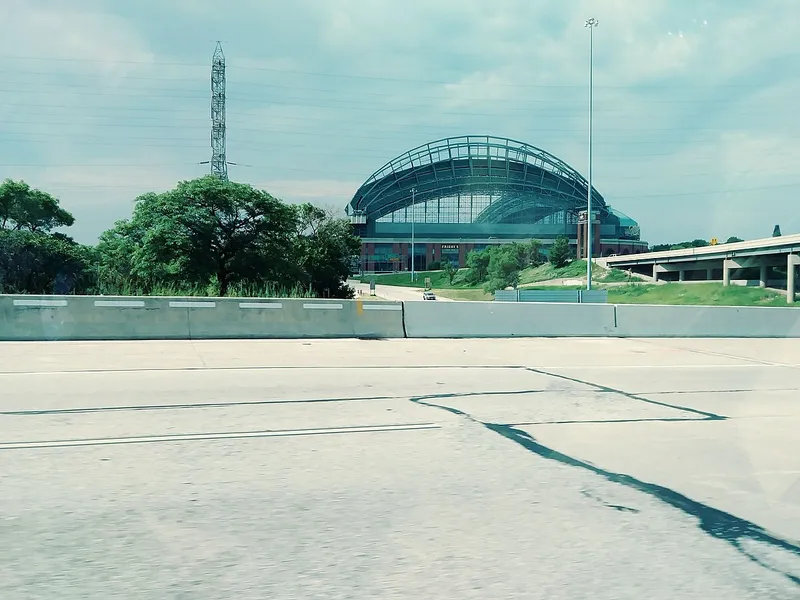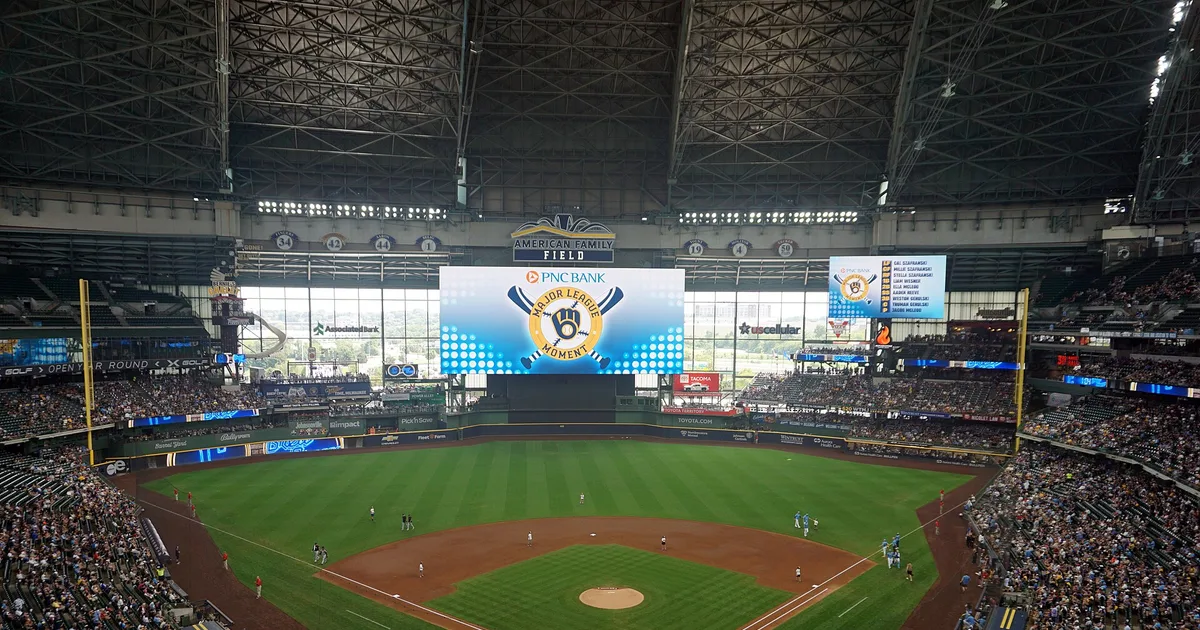
American Family Field has 41,900 seats. On Friday night it admitted 43,250 people for Game 1 of the World Series, and on Saturday it admitted 43,245 for Game 2. Two nights, two crowds, both bigger than the building’s published capacity.
That isn’t a misprint. It’s a clean demonstration of what a capacity figure actually measures, and what it doesn’t. A published seat count was never a ceiling on people.
Two nights over the seat count
The Milwaukee Brewers opened the 2026 World Series at home on Friday, October 23, beating Tampa Bay 3-2 in front of 43,250. The Milwaukee Journal Sentinel, Baseball-Reference’s box score and Baseball Almanac all carry that number. Saturday, October 24, brought Game 2, a 5-4 Milwaukee win and a crowd of 43,245, five fewer than the night before. Put the two gates together and you get 86,495 across the two nights, on our arithmetic.
43,250 Through the gates for Game 1, in a ballpark with 41,900 seats.
The ballpark opened in 2001 with a retractable roof, and it seats 41,900. That’s the figure on our own page for American Family Field, and the Journal Sentinel states the same number independently. So Game 1 put 1,350 more people in the building than it has seats, on our arithmetic. For Game 2 the Journal Sentinel ran the subtraction itself, describing a crowd figure “indicating about 1,345 guests had standing room only tickets.”
That’s the whole explanation, and it’s a short one. Caden Perry, reporting for the Journal Sentinel, attributed the overflow on both nights to standing-room-only tickets. A World Series ballpark sells them. People buy them. The turnstile count climbs past the number of chairs.
For scale, this was a big year in Milwaukee before October arrived. The Brewers went 103-59, a franchise record for wins, and drew 2,788,934 fans across 81 regular-season home games, an average of 34,431 a game, per Baseball-Reference. That ranked 11th in MLB. Friday’s crowd was 8,819 above that average, or about a quarter more than a normal night, by our calculation.
Seats are not people
MeetStadium lists 181 stadiums with a verified capacity. American Family Field’s 41,900 puts it 110th of 181. Swap in Friday’s crowd for the seat count and the building would rank 106th. For two nights in October it held more people than four stadiums we list above it.
| Rank | Stadium | Listed capacity |
|---|---|---|
| 106 | Nueva Romareda | 43,184 |
| 107 | Citizens Bank Park | 42,901 |
| 108 | Estadio Universitario | 42,000 |
| 109 | Citi Field | 41,922 |
| 110 | American Family Field | 41,900 |
Citizens Bank Park and Citi Field are both bigger buildings than Milwaukee’s on paper, and on Friday both of them were smaller in practice.
349 How far Friday’s crowd cleared Citizens Bank Park’s entire listed capacity, by our calculation.
None of this means anyone’s number is wrong. The 41,900 is right. The 43,250 is right. They measure different things. A capacity figure is a seat count, not an occupancy limit, and every ranking of stadiums by size, ours included, is really a ranking of chairs. The seat count tells you how the building was drawn. The gate tells you how it got used on one particular night, and a World Series night is not an average one.
What’s left to play
Milwaukee leads the series 3-0. Game 3 moved to Tropicana Field in St. Petersburg on Monday, October 26, where the Brewers won 10-1 in front of 40,388. Game 4 is tonight, Tuesday, October 27, at Tropicana Field. Game 5, if it’s needed, is Wednesday, October 28, at the same venue.
Games 6 and 7 are on the schedule for American Family Field on Friday, October 30, and Saturday, October 31. Both are played only if the series goes that far. MLB.com is the source of record for the schedule, and for the history: this is Milwaukee’s second World Series appearance. The first was 1982, when the club played in the American League and lost to the Cardinals in seven games.
Whether or not the series comes back, the two nights Milwaukee has already had did something useful. They put one number next to another and showed the gap between them. How many seats a building has, and how many people it holds, turn out to be two different questions. On Friday and Saturday, American Family Field answered the second one with 43,250 and 43,245.