About BC Place
BC Place sits on the north shore of False Creek in the heart of downtown Vancouver — one of the most spectacularly located stadiums on Earth. Behind the retractable roof, the North Shore mountains rise in snow-capped ridgelines. Ahead, the Pacific Ocean channels into English Bay and Burrard Inlet. The city skyline of glass towers reflects both the water and the mountains, and on clear evenings, the sunset paints everything gold. This is not a suburban parking-lot stadium. This is a venue embedded in a living, walkable, world-class city — and for the 2026 FIFA World Cup, it becomes the tournament’s Pacific gateway.
BC Place holds approximately 54,500 fans and serves as home to the Vancouver Whitecaps FC (MLS) and the BC Lions (CFL), along with the annual HSBC SVNS Vancouver rugby sevens tournament and the BC Sports Hall of Fame. For the World Cup, it hosts 7 matches — five group stage games including two Canada matches, a Round of 32, and a Round of 16 — making it the busier of Canada’s two host venues and the only Canadian stadium hosting knockout-round matches beyond the Round of 32.
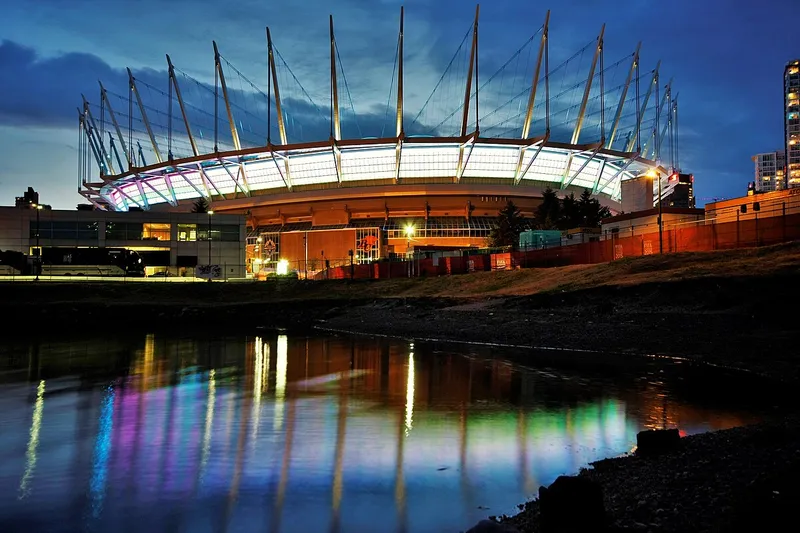
What makes BC Place architecturally unique is the roof. The current structure — the world’s largest cable-supported retractable roof — replaced the original air-supported dome in 2011 after a $514-million revitalization. It is held in place by 36 steel masts standing 47 metres tall, connected by 35 kilometres of cable, with a retractable centre section that opens or closes in 20 minutes. At night, the “Northern Lights Display” transforms the exterior into a glowing, colour-shifting beacon — 1,700 translucent ETFE panels illuminated by over 26,000 programmable LED elements, visible across the entire False Creek basin. It is, without exaggeration, one of the most visually striking stadium exteriors in the world.
The stadium was built at a cost of $126 million and opened on June 19, 1983, designed by Phillips Barratt with structural engineering by Geiger Berger Associates — the same firm behind many of the world’s air-supported dome structures. Its original Teflon-coated fiberglass roof was the largest air-supported dome on the planet, pressurized by 16 jet engine fans and spanning 10 acres. That roof became iconic — and infamous — before its replacement. But the story of BC Place is much larger than its engineering: this is a stadium that has hosted a World’s Fair, an Olympics, a FIFA Women’s World Cup final, ten Grey Cups, and now a men’s World Cup. Few venues anywhere can match that resume.
Getting to BC Place
Public Transit (SkyTrain)
BC Place has some of the best public transit access of any World Cup 2026 venue — and it’s not even close to most NFL stadiums in this regard. Vancouver’s SkyTrain rapid transit system delivers you directly to the stadium’s doorstep.
Expo Line — Stadium-Chinatown Station: This is your station. It sits directly adjacent to BC Place — exit the SkyTrain, walk up the stairs to Beatty Street, turn left, and Gates A, B, and H are a 2-minute walk. Alternatively, exit to Expo Boulevard and walk right to the stadium entrance. The Expo Line connects to Waterfront Station (downtown hub), Commercial-Broadway (transfer point), and runs east to Burnaby, New Westminster, and Surrey. Trains run every 3-5 minutes during peak times.
Canada Line — from Vancouver International Airport (YVR): This is the connection that makes BC Place exceptional for international visitors. The Canada Line runs directly from the airport terminal to downtown Vancouver in approximately 25 minutes — no transfers, no buses, no taxi negotiation in a foreign city. From YVR, ride the Canada Line to Waterfront Station or Commercial-Broadway, then transfer to the Expo Line for one stop to Stadium-Chinatown. Total travel time from YVR to BC Place: approximately 30-35 minutes, for about CAD $10. For the World Cup, TransLink will increase train frequency and capacity on all SkyTrain lines.
Canada Line — Yaletown-Roundhouse Station: If you’re staying in Yaletown or South False Creek, the Yaletown-Roundhouse station on the Canada Line is a 10-minute walk to BC Place along Pacific Boulevard — a pleasant waterfront stroll.
Pro tip: After matches, Stadium-Chinatown station will be packed. Walk 10 minutes north to Waterfront Station or east to Main Street-Science World station for a less crowded boarding experience. Or walk south to Yaletown-Roundhouse on the Canada Line.
Driving + Parking
Driving to BC Place is possible but strongly discouraged for match days. This is a downtown Vancouver stadium — transit and walking are far better options. GPS: “777 Pacific Boulevard, Vancouver, BC V6B 4Y8.”
→ From downtown Vancouver: BC Place is downtown. If you’re staying in the West End, Gastown, or Yaletown, walk. It’s 10-20 minutes from most downtown hotels. If driving from elsewhere downtown, head south on Beatty Street or Cambie Street to Pacific Boulevard.
→ From North Vancouver / North Shore: Take the Lions Gate Bridge or Second Narrows Bridge (Ironworkers Memorial) to Highway 1 West, then follow signs to downtown Vancouver. Exit at Hastings Street or Prior Street and head south to the stadium. Allow 30-45 minutes with traffic.
→ From Surrey / South of the Fraser: Take Highway 99 North across the Alex Fraser Bridge or the Massey Tunnel, connect to Highway 1 West, then follow signs to downtown Vancouver. Alternatively, take the SkyTrain from King George or Surrey Central stations. Allow 40-60 minutes by car.
→ From BC Ferries (Tsawwassen Terminal): From the Tsawwassen ferry terminal (serving Victoria and the Gulf Islands), take Highway 17 North to Highway 99 North into Vancouver, approximately 35 km. Allow 40-60 minutes depending on traffic. BC Ferries is opening summer bookings earlier than usual and adding expanded sailing schedules in anticipation of World Cup demand — book early. Alternatively, take public transit from the terminal via bus connections to the Canada Line.
Parking near BC Place ranges from CAD $20-40 on match days. Pay parking lots are adjacent to the stadium and scattered through Yaletown and the surrounding blocks. The Parq Casino hotel complex next door offers parking. However, spaces are limited, road closures and security perimeters will be enforced within 2 km of the stadium on match days, and downtown Vancouver traffic is congested even on normal days. Take the SkyTrain.
Rideshare
Uber and Lyft operate in Vancouver with designated pickup and drop-off zones near BC Place. From downtown Vancouver hotels, expect to pay CAD $10-20; from the airport, CAD $30-45. Post-match surge pricing is inevitable — walk a few blocks toward Yaletown or Gastown before requesting a ride to escape the immediate stadium congestion and reduce your fare. Vancouver also has a robust taxi fleet available throughout downtown.
From the Airport
→ Vancouver International Airport (YVR): 15 km (9 miles) south of BC Place, and the transit connection is outstanding. The Canada Line SkyTrain runs directly from the airport terminal to downtown in 25 minutes — transfer to the Expo Line at Waterfront or Commercial-Broadway for one stop to Stadium-Chinatown. Total trip: 30-35 minutes, about CAD $10. By car or rideshare: 20-35 minutes, CAD $35-45. YVR is a major international hub with direct flights from Asia, Europe, the US, and across Canada — Vancouver’s Pacific Rim location means exceptional connectivity to East Asian markets, and the airport consistently ranks among North America’s best.
→ Bellingham International Airport (BLI): 95 km (60 miles) south across the US border in Washington State. A budget alternative for travellers from the US — Allegiant Air and others serve BLI. The drive to Vancouver takes 1.5-2.5 hours depending on the Canada-US border crossing wait. Not practical for casual visitors, but an option for budget-minded fans from the Pacific Northwest.
Walking
This is a downtown stadium. Walking is the best way to get there for most visitors.
→ From Yaletown: 5-10 minutes along Pacific Boulevard. Flat, scenic, waterfront the whole way.
→ From Gastown / Waterfront: 10-15 minutes south along Beatty Street or Cambie Street. Pass through the entertainment district.
→ From the West End / English Bay: 15-20 minutes east along Pacific Street or the False Creek seawall. One of the most beautiful urban walks in North America — mountains, water, glass towers.
→ From Granville Island: 15-20 minutes via the Cambie Bridge or take the Aquabus mini-ferry to the False Creek dock near Science World, then walk 10 minutes west.
FIFA World Cup 2026 at BC Place
BC Place will host 7 FIFA World Cup 2026 matches — five group stage games, a Round of 32, and a Round of 16 — making Vancouver the busiest Canadian host city and the only Canadian venue with knockout-round matches beyond the first elimination stage. Canada plays two of its three group matches here, giving the tournament a genuine home-team atmosphere in the Pacific time zone.
The confirmed match schedule (all times Eastern):
| Date | Match | Group / Stage | Time (ET) | Time (PT) |
|---|---|---|---|---|
| Fri, June 13 | Australia vs UEFA Playoff C | Group D | 10:00 PM | 7:00 PM |
| Thu, June 18 | Canada vs Qatar | Group B | 6:00 PM | 3:00 PM |
| Sun, June 21 | New Zealand vs Egypt | Group G | 9:00 PM | 6:00 PM |
| Wed, June 24 | Switzerland vs Canada | Group B | 3:00 PM | 12:00 PM |
| Fri, June 26 | New Zealand vs Belgium | Group G | 11:00 PM | 8:00 PM |
| Thu, July 2 | 1st Group B vs 3rd Place qualifier | Round of 32 | 5:00 PM | 2:00 PM |
| Tue, July 7 | Winner R32 Match 85 vs Winner R32 Match 87 | Round of 16 | 8:00 PM | 5:00 PM |
The two Canada matches are the headline draws. Canada vs Qatar on June 18 will be the first time the Canadian men’s national team plays a home World Cup match since the tournament was awarded — a genuinely historic moment for Canadian soccer. The June 24 Switzerland vs Canada match is Canada’s final group game, likely a must-win for advancement. Belgium, Egypt, Australia, and New Zealand add strong international fan bases and high-quality football to the mix.
Pitch and renovations: BC Place is undergoing $171-181 million in upgrades ahead of the World Cup, funded by provincial and federal governments. The FieldTurf synthetic surface will be replaced with natural grass grown in the Fraser Valley — cultivated for nearly a year under controlled conditions for optimal strength and density. Additional upgrades include a new centre video board replacing the aging scoreboard, modernized VIP suites and hospitality spaces, renovated locker rooms and change rooms, new and improved elevators and accessibility features, upgraded washrooms including gender-neutral facilities, improved food and beverage outlets, a new premium entrance and connection to the adjacent Parq hotel and casino, and enhanced security infrastructure.
Weather: Vancouver in June and July is glorious — and that’s not an exaggeration from a city known for rain. Average highs of 19-23°C (66-73°F) with long daylight hours (sunset after 9 PM) and low humidity. Summer is Vancouver’s dry season, with average rainfall well below winter months. The retractable roof provides flexibility for weather management, though FIFA treats the venue as open-air regardless of roof position. Pack layers for evening matches — temperatures can dip to 13-15°C (55-59°F) after sunset, especially with the roof open.
Fan zone: The FIFA Fan Festival Vancouver will centre around downtown, with giant screens, live entertainment, and food and beverage areas. Vancouver’s compact, walkable downtown — with False Creek, Yaletown restaurants, Gastown pubs, and the seawall all within walking distance of the stadium — creates one of the most naturally festive host city environments in the entire tournament.
History of BC Place
The story of BC Place begins with a World’s Fair and ends — for now — with a World Cup. Between those bookends lies one of the most eventful histories of any stadium in North America: a revolutionary air-supported dome, a dramatic roof collapse, a $514-million reinvention, an Olympics, a Women’s World Cup final, ten Grey Cups, and the slow, steady rise of professional soccer in a city that the beautiful game was always going to conquer.
The origins (1978-1983): In 1978, British Columbia’s Minister of Recreation and Conservation, Sam Bawlf, proposed a world exposition to celebrate Vancouver’s centennial in 1986. The fair needed a signature venue — a large indoor stadium that could host the opening ceremony and serve as the crown jewel of the exposition. Construction began in February 1981 on a site on the north shore of False Creek, an industrial waterfront area that the provincial government envisioned transforming into a new urban district. Phillips Barratt designed the stadium with structural engineering by Geiger Berger Associates, the world’s leading firm for air-supported structures. The cost: $126 million.
By November 1982, the roof was being inflated — a Teflon-coated fiberglass membrane held aloft by 16 jet engine fans pressurizing the stadium interior. At 10.25 acres, it was the largest air-supported dome in the world, with a circumference of 760 metres (2,500 feet). The fabric was 1/30 of an inch thick — two gossamer layers that somehow held up a roof the size of 7.5 football fields.
Grand opening and first years (1983): BC Place officially opened on June 19, 1983. The first major event was actually a soccer match: on June 20, the Vancouver Whitecaps hosted the Seattle Sounders in a North American Soccer League game — a fitting omen for the stadium’s eventual World Cup destiny. Three days later, the BC Lions played their first CFL game at BC Place, a preseason 41-19 victory over the Calgary Stampeders. Later that year, BC Place hosted its first Grey Cup — the 71st — before a packed house. The stadium had arrived.
Expo 86 — the World’s Fair (1986): This was the moment BC Place became internationally famous. Expo 86 — officially the 1986 World Exposition on Transportation and Communication — opened on May 2, 1986, with Prince Charles and Princess Diana presiding over the ceremony at BC Place before 54,000 invited guests and 7,200 performers. The five-month fair drew over 22 million visitors, transforming Vancouver from a regional Pacific Northwest city into a globally recognized destination. BC Place served as the exposition’s centrepiece venue, hosting both the opening and closing ceremonies. The legacy of Expo 86 extends far beyond the fair itself: it catalyzed the complete redevelopment of the False Creek waterfront, created the SkyTrain rapid transit system, and repositioned Vancouver as Canada’s gateway to the Pacific Rim.
The air-supported era and the Grey Cups (1983-2007): For a quarter century, BC Place’s billowing white dome was an icon of the Vancouver skyline — visible from across the harbour, from the North Shore mountains, from ferry approaches. The stadium hosted the Grey Cup ten times (1983, 1986, 1987, 1990, 1994, 1999, 2005, 2011, 2014, and 2024), establishing Vancouver as one of the CFL’s premier championship destinations. Major concerts — from U2 to the Rolling Stones — filled the dome. International soccer, rugby, and trade shows kept the calendar full year-round.
The roof collapse (January 5, 2007): On a cold, snowy January night, BC Place’s air-supported roof suffered the incident that would ultimately seal its fate. Snow accumulated on the roof despite five separate alarms — nobody activated the snow-melting system. The weight tore the Teflon-coated fabric near Gate G on the south side. As air escaped through the growing tear, maintenance staff performed a controlled deflation to protect the remaining panels. The roof came to rest on its emergency steel support cables, 6 metres above the seating and the field. Rain and melted snow flooded the bowl and had to be pumped out. No one was injured. A temporary panel was installed within two weeks, and the roof was re-inflated by January 19 — but the structural vulnerability was now public knowledge, and the clock was ticking on the air-supported era.
The 2010 Winter Olympics (February 2010): Before the old roof came down for good, BC Place had one more moment on the world stage. On February 12, 2010, the stadium hosted the opening ceremony of the XXI Olympic Winter Games — the first Olympic opening ceremony ever held indoors. Directed by David Atkins, the “Landscape of a Dream” ceremony celebrated Canada’s geography and Indigenous heritage before approximately 55,000 spectators and a global television audience of over 3 billion. The ceremony produced one of the Olympics’ most memorable glitches: a hydraulic malfunction prevented the fourth arm of the indoor cauldron from rising, leaving speed skater Catriona Le May Doan unable to light her pillar. Wayne Gretzky was dispatched to light a second, outdoor cauldron at the Vancouver Convention Centre. The closing ceremony on February 28 took a self-deprecating, humorous approach, mocking Canadian stereotypes and featuring a final, repaired cauldron lighting. Combined, the two ceremonies cost $48.5 million and featured approximately 5,000 performers — the largest theatrical productions in Vancouver’s history.
The great reinvention (2010-2011): On May 3, 2010, the air-supported roof was intentionally deflated for the last time. BC Place closed for 16 months of intensive renovation — the centrepiece of which was the installation of a revolutionary cable-supported retractable roof, engineered specifically for Vancouver’s coastal climate. The project replaced the iconic but aging dome with a structure of extraordinary scale: 36 steel masts (47 metres tall, 120 tons each), 36 compression beams (160 tons each), and 35 kilometres of steel cable up to 125mm in diameter. The retractable centre section — approximately 100m x 85m, covering the entire playing surface — opens or closes in about 20 minutes. The renovation also added the Northern Lights LED display, new premium seating, updated concourses, and modern amenities. The final price tag: $514 million. BC Place reopened on September 30, 2011, with the BC Lions hosting the Edmonton Eskimos under a roof that was, at that moment, the largest cable-supported retractable roof ever built.
The FIFA Women’s World Cup (2015): BC Place hosted nine matches during the 2015 FIFA Women’s World Cup, including the championship final on July 5, where the United States defeated Japan 5-2 behind Carli Lloyd’s extraordinary hat trick — she scored three goals in the first 16 minutes, including a stunning strike from midfield. The tournament generated $59 million in net economic activity (GDP) for British Columbia and proved that Vancouver could deliver a world-class FIFA tournament experience. It was, in many ways, the audition for 2026.
The modern era (2011-present): Since the renovation, BC Place has continued to accumulate signature moments. The Vancouver Whitecaps FC joined MLS in 2011 and have built one of the league’s most passionate fan bases, with the Southsiders supporters’ group creating an atmosphere that fills the cavernous lower bowl with noise and colour. The Canada Sevens rugby tournament — part of the World Rugby Sevens Series — has become one of BC Place’s most beloved annual events, drawing over 77,000 fans across three days in 2018 and consistently ranking as one of the loudest, most festive stops on the global circuit (the closed roof transforms the stadium into an acoustic thunderdome). The stadium has hosted Taylor Swift, Beyonce and Jay-Z, Paul McCartney, Coldplay, Metallica, Guns N’ Roses, and dozens of other major concert tours. And on November 17, 2024, BC Place hosted its tenth Grey Cup — the 111th — as Toronto defeated Winnipeg.
Cultural Significance of BC Place and Vancouver
BC Place sits on the unceded traditional territories of the xʷməθkʷəy̓əm (Musqueam), Sḵwx̱wú7mesh (Squamish), and səlilwətaɬ (Tsleil-Waututh) Nations — three Coast Salish peoples who have lived in the region since time immemorial, long before any stadium, any city, any colonial border. The land was never ceded, never surrendered by treaty. This acknowledgment is not a formality in Vancouver — it is woven into the city’s public life, civic events, and the 2010 Olympics’ opening ceremony that BC Place itself hosted. For the 2026 World Cup, this Indigenous context adds a layer of meaning that few other venues can claim.
Vancouver is Canada’s gateway to the Pacific — a city that faces west toward Asia as much as it faces east toward the rest of Canada. The city is one of the most multicultural in the world, shaped by generations of immigration from China, India, the Philippines, Korea, Japan, Iran, Latin America, and Europe. This extraordinary diversity makes Vancouver a natural host for a global tournament: when New Zealand plays Egypt, or Belgium faces a crowd rooting for Canada, the stands will be filled with fans who carry genuine connections to the teams on the pitch. Soccer is the largest participatory sport in Canada and the fastest-growing — and in Vancouver, where year-round mild weather supports football culture and the city’s Asian, European, and Latin American communities bring deep football traditions, the World Cup will feel at home in a way that few North American cities can replicate.
The setting itself is part of the story. Vancouver sits at the meeting point of ocean, mountains, and temperate rainforest — a city where you can ski in the morning, sail in the afternoon, and walk through old-growth forest before dinner. The North Shore mountains form a dramatic backdrop visible from the stadium’s upper decks. False Creek wraps around the south side of downtown, its seawall connecting BC Place to Science World, Granville Island, and English Bay in a continuous waterfront loop. This is not a city where the stadium is located in an industrial zone or a highway interchange — BC Place is embedded in a neighbourhood of restaurants, parks, and pedestrian life, and the walk to and from a match is genuinely enjoyable.
The 2010 Winter Olympics cemented Vancouver’s identity as a city capable of hosting the world’s biggest events — and doing so with warmth, organization, and a distinctive Pacific Northwest character. The World Cup continues that legacy. For Canadian soccer, the tournament represents a generational milestone: a men’s national team that qualified for the 2022 World Cup in Qatar for the first time in 36 years, now playing group matches on home soil in front of their own fans. When Canada takes the pitch against Qatar on June 18 and Switzerland on June 24, BC Place will be the loudest it has ever been — louder than any Grey Cup, any rugby sevens, any concert. The roof may be open, but the noise will not escape.
Photo Gallery
Fun Facts
BC Place hosted the opening and closing ceremonies of the 2010 Vancouver Winter Olympics — the first Olympic opening ceremony ever held indoors. The ceremony featured a dramatic malfunction when only three of the four hydraulic arms of the indoor Olympic cauldron rose, leaving speed skater Catriona Le May Doan unable to light her pillar. A second outdoor cauldron at the Vancouver Convention Centre was lit by Wayne Gretzky as a backup. The stadium held approximately 55,000 people for each ceremony, with a combined production budget of $48.5 million and a cast of about 5,000 performers.
The stadium's original air-supported roof — held aloft by 16 giant fans pressurizing the interior — was the largest air-supported dome in the world when it was inflated in November 1982. On January 5, 2007, after five snow accumulation alarms were ignored and nobody activated the snow-melting system, the weight of accumulated snow tore the Teflon-coated fiberglass fabric. Maintenance staff performed a controlled deflation, and the roof came to rest on its emergency cables 6 metres above the seats. The damaged panel was replaced within two weeks, and the roof was re-inflated — but the incident sealed its fate, accelerating plans for a permanent replacement.
When BC Place reopened in September 2011 after a 16-month, $514-million revitalization, it debuted the world's largest cable-supported retractable roof. The structure is held in place by 36 steel masts standing 47 metres tall (each weighing 120 tons) and 36 compression beams (160 tons each), connected by 35 kilometres of steel cable up to 125mm in diameter. The retractable centre section spans approximately 100m x 85m and opens or closes in about 20 minutes — essentially 18 suspension bridges arranged in a circle, each about 200 metres long.
The 'Northern Lights Display' — a 360-degree exterior LED lighting system — transforms BC Place into the largest programmable light display in Vancouver. The system uses 1,700 translucent ETFE (ethylene tetrafluoroethylene) panels stacked four rows high around a 36-foot facade, illuminated by 6,800 linear feet of Lumenpulse LED projectors with over 26,000 individually programmable lighting elements. The stadium lights up nightly from sunset to 11 PM, changing colours for causes, holidays, and events — turning the roof into a glowing beacon visible across False Creek and the downtown skyline.
BC Place was built as the centrepiece venue for Expo 86 — the 1986 World's Fair themed 'World in Motion — World in Touch,' celebrating transportation and communication. Prince Charles and Princess Diana opened the exposition on May 2, 1986, before 54,000 invited guests and 7,200 performers at BC Place. Expo 86 drew over 22 million visitors over its five-month run, transforming Vancouver's international reputation and catalyzing the redevelopment of the entire False Creek waterfront that surrounds the stadium today.
Stadium Location
Frequently Asked Questions
- What is the seating capacity of BC Place?
- BC Place has a current seating capacity of approximately 54,500 for sporting events. The original stadium held up to 60,000 when it opened in 1983 with its air-supported dome, but the 2011 retractable roof renovation reduced capacity to create more premium seating and improve sightlines. For the 2026 FIFA World Cup, the stadium will seat approximately 54,000 with natural grass installed on the playing surface.
- Where is BC Place located?
- BC Place is located at 777 Pacific Boulevard, Vancouver, British Columbia, Canada, on the north shore of False Creek in the heart of downtown Vancouver. The stadium sits in the Yaletown/False Creek neighbourhood, surrounded by restaurants, hotels, and waterfront walkways. It is directly adjacent to the Stadium-Chinatown SkyTrain station.
- What World Cup 2026 matches will be played at BC Place?
- BC Place will host 7 FIFA World Cup 2026 matches — five group stage games, a Round of 32 match, and a Round of 16 match. Group stage: Australia vs UEFA Playoff C (June 13), Canada vs Qatar (June 18), New Zealand vs Egypt (June 21), Switzerland vs Canada (June 24), and New Zealand vs Belgium (June 26). The Round of 32 is on July 2 and the Round of 16 on July 7. Canada plays two of its three group matches here.
- How do I get to BC Place by public transit?
- BC Place has outstanding transit access. Take the SkyTrain Expo Line to Stadium-Chinatown station, which is directly adjacent to the stadium — a 2-minute walk to the gates. From Vancouver International Airport (YVR), take the Canada Line to Waterfront or Commercial-Broadway, then transfer to the Expo Line — total travel time is about 30-35 minutes. Alternatively, the Canada Line's Yaletown-Roundhouse station is a 10-minute walk. Dozens of TransLink bus routes also serve the area.
- Does BC Place have a retractable roof?
- Yes. BC Place features the world's largest cable-supported retractable roof, installed during a major renovation completed in September 2011. The retractable centre section measures approximately 100m x 85m and can open or close in about 20 minutes. The roof is supported by 36 steel masts standing 47 metres tall, connected by 35 kilometres of steel cable. For World Cup matches, the roof position will be determined based on weather conditions — the stadium should be considered an open-air facility regardless of roof position.
- How much is parking at BC Place?
- Parking near BC Place ranges from CAD $20-40 on event days. Pay parking lots are located adjacent to the stadium and throughout the surrounding Yaletown and False Creek area. However, parking is limited and traffic congestion is significant on match days — public transit via the SkyTrain is strongly recommended. For World Cup matches, temporary road closures and security zones within 2km of the stadium are expected.
- How far is BC Place from Vancouver Airport?
- Vancouver International Airport (YVR) is approximately 15 kilometres (9 miles) south of BC Place. The Canada Line SkyTrain connects YVR to downtown Vancouver in about 25 minutes, making it one of the best airport-to-stadium transit connections of any World Cup venue. By car or rideshare, the drive takes 20-35 minutes depending on traffic. A taxi or rideshare from YVR to BC Place costs approximately CAD $35-45.
- Will BC Place have natural grass for the World Cup?
- Yes. FIFA mandates natural grass or hybrid grass surfaces for all World Cup venues. BC Place normally uses FieldTurf synthetic turf for its MLS and CFL tenants, but a natural grass pitch grown in the Fraser Valley will be installed for the 2026 tournament. The grass will have been cultivated for nearly a year at an off-site location and treated under controlled conditions for optimal density and durability. After the World Cup, the grass may be removed and replaced with new synthetic turf, though a decision on permanent retention is still being evaluated.
Last updated: 2026-02-18