About Inter&Co Stadium
Drop into the Parramore blocks just west of downtown Orlando on a match night and you hear Inter&Co Stadium before you see it. The purple smoke and the drums give it away. This is a 25,500-seat, soccer-specific bowl where Orlando City SC and the Orlando Pride play, and where The Wall, a 3,811-capacity safe-standing supporters’ section behind the north goal, turns a mid-size venue into one of the loudest rooms in American soccer.
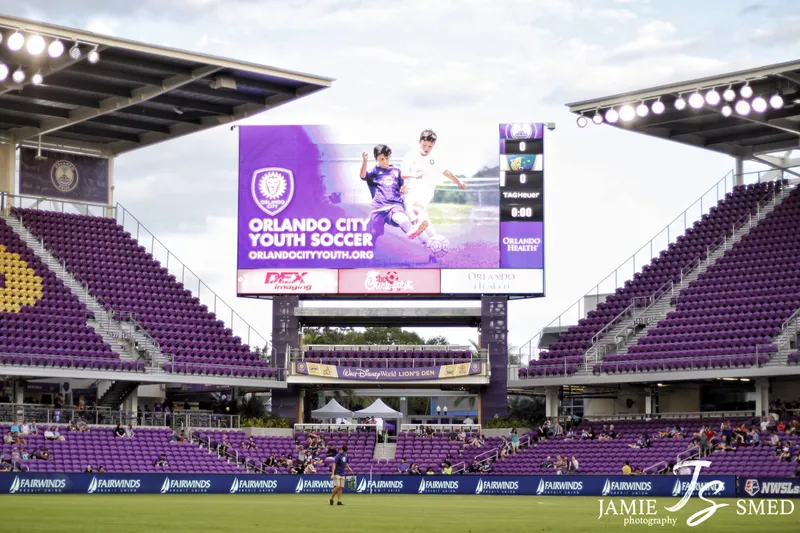
Orlando City moved in for the 2017 season after two years at the old Citrus Bowl, now Camping World Stadium. The club built here for $155 million, hired Populous to design it, and paid for the whole thing privately. That last part matters. While most of the MLS stadium wave of the 2010s leaned on public money and suburban land, Orlando bought a downtown-adjacent site and dropped the field 8 feet (2.4 m) below street level, so the walk up to the plaza opens onto a bowl already in full voice. A four-sided canopy caps the stands and traps the sound.
The stadium carries a solemn distinction. Forty-nine rainbow-colored seats sit together in Section 12, one for each victim of the June 2016 Pulse nightclub shooting in Orlando. The seats are a permanent memorial, in place from the first season, and the club’s response to Pulse, from the early tributes to the installation itself, bound Orlando City to the wider city in a way few expansion clubs ever manage.
The Orlando Pride share the building. They joined the NWSL as an expansion club in 2016 and moved into the new stadium in 2017, and they have built a loyal following of their own. The dual tenancy gives the venue year-round soccer in a city where the Magic, the theme parks, and a permanent tourist economy are all competing for the same attention. Not every stadium earns its atmosphere. This one did it fast.
Getting to Inter&Co Stadium
Public Transit
The downtown-adjacent location makes transit a real option, which is not something you can say about most MLS stadiums.
→ Via SunRail: Church Street station is about a 10-minute walk east of the stadium. SunRail runs from DeBary in the north to Poinciana in the south, straight through downtown Orlando. Weekend service is limited, so confirm match-day trains before you rely on it.
→ Via LYNX Bus and Lymmo: LYNX routes, including 21 and 319, serve stops near the stadium. The free Lymmo Grapefruit Line circles downtown and connects to the SunRail and bus hubs. From the International Drive tourist corridor, the I-Ride Trolley links to a LYNX connection.
For a lot of fans, the easiest approach is simply to walk over from the bars and restaurants around Church Street. If you are staying out by the theme parks, budget 20 to 30 minutes for the drive or rideshare.
Driving + Parking
The address is 655 W. Church Street, Orlando, FL 32805. I-4 is the primary approach.
→ From the Tourist Corridor / Theme Parks (~15 mi): I-4 East to the South Street or Anderson Street exit. About 20 to 30 minutes.
→ From Tampa (~85 mi): I-4 East into downtown Orlando. About 1 hour 15 minutes.
→ From Daytona Beach (~60 mi): I-4 West to the South Street exit. About 1 hour.
On-site parking is limited. Downtown garages run $10 to $25 on match days, with the Geico Garage on Church Street and the SunTrust Center Garage on Pine Street among the closest. Metered street parking fills early. This is urban parking, so expect to walk a few blocks and factor that into your timing.
Rideshare
Uber and Lyft use designated zones on W. Church Street near the main entrance. From International Drive, expect $12 to $18. From downtown hotels, more like $5 to $8. Post-match surge is moderate, and the smartest move is to walk to Church Street for a drink and let the first wave clear before you request a car.
From the Airport
→ Orlando International Airport (MCO): 12 miles southeast, about 20 to 25 minutes by car. A major domestic and international hub with service from nearly every carrier. No direct transit connection to the stadium. Rideshare runs $15 to $22. A rental car makes sense if theme parks are also on your itinerary.
Construction & Design
The stadium almost landed a block away. Orlando City broke ground in October 2014, then paused and shifted the footprint one block west that same year to sidestep a legal challenge over the original parcel. When the club unveiled a revised plan the following summer, it added seats at the south end to push capacity to 25,500 without the redesign that would have cost another year. The team also decided, in May 2015, to fund the whole project privately rather than chase public dollars, a rare call for a stadium of this era.
Populous drew it up. The firm known for NFL and MLS venues gave Orlando a compact, single-tier lower bowl wrapped 360 degrees around the pitch, then topped the stands with a sweeping metal-deck canopy carried on structural masts and cables. The canopy does two jobs at once: it keeps rain off spectators and, by capping the bowl, it holds the crowd noise in. Walter P Moore engineered the structure and Barton Malow served as general contractor, with ICON Venue Group managing the project. The final bill came to roughly $155 million, up from an early estimate near $110 million.
The signature design move is underground. The field sits about 8 feet (2.4 m) below street level, so fans arrive at plaza height and look down into the action, and the seating tiers pull in tight to the touchlines. Behind the north goal, the club built The Wall, a single-deck safe-standing section for 3,811 supporters that Orlando City bills as North America’s first safe-standing section in a soccer stadium. Rail seating, steep rake, one continuous block of supporters. It is the loudest corner of the building and the one that shows up in every highlight package.
Ownership has changed hands, but the stadium has not. Orlando City and the Pride were bought by Zygi and Mark Wilf, who also own the Minnesota Vikings, in a sale completed in July 2021 valued at a reported $400 to $450 million. The club owns and operates the stadium and the land under it, having purchased the downtown site outright. Naming rights, though, have turned over three times, which is the one thing about this building that refuses to sit still.
History of Inter&Co Stadium
Orlando City needed a home of its own. The club spent its first two MLS seasons, 2015 and 2016, renting the aging Citrus Bowl, and the new downtown ground was the whole point of the expansion pitch. It delivered in 2017, and it delivered loud.
First match (March 5, 2017): Orlando City beat New York City FC 1–0 in front of a sellout crowd of 25,550. Cyle Larin scored the stadium’s first goal. The March in from Church Street, the purple smoke, The Wall at full cry, it all arrived fully formed on day one.
Pulse memorial (2017): The 49 rainbow seats went into Section 12 before the first season, a permanent tribute to the victims of the June 2016 Pulse nightclub shooting. It remains the club’s most meaningful gesture to the city and the reason the stadium reads as more than a sports venue.
Women’s soccer takes root (2017 onward): The Orlando Pride, an NWSL expansion side from 2016, moved in for 2017 and made the ground one of the few in the country hosting top-flight men’s and women’s professional soccer under one roof. The stadium also staged the 2017 NWSL Championship, won 1–0 by the Portland Thorns over the North Carolina Courage.
Silverware and big nights (2019–2022): The venue hosted the 2019 MLS All-Star Game before 25,527 fans, then handed Orlando City its first major trophy in 2022, a 3–0 win over Sacramento Republic in the U.S. Open Cup Final in front of another packed house. During the pandemic it staged CONCACAF Champions League knockout matches behind closed doors in 2020.
Onto the global stage (2025): The stadium was one of the host venues for the expanded 2025 FIFA Club World Cup, putting international sides on its pitch and giving downtown Orlando a taste of tournament soccer.
Naming history: It opened as Orlando City Stadium, became Exploria Stadium in June 2019 under a deal with Exploria Resorts, and was renamed Inter&Co Stadium on January 18, 2024, when the Brazilian digital bank Inter&Co took the naming rights in a reported 10-year agreement. Three names in seven years, and through every one of them The Wall never once quieted down.
From the smoke behind the north goal to the 49 seats in Section 12 to a pitch sunk below the streets of Parramore, Inter&Co Stadium is where Orlando’s soccer culture actually lives. It is proof that you do not need 40,000 seats to build one of the best atmospheres in American sports.
Sources & Further Reading
- Inter&Co Stadium official site: interco-stadium.com. Capacity, private-funding figure, The Wall, the sunken field, and the Section 12 Pulse memorial.
- Populous project page: populous.com. Confirms Populous as architect and describes the canopy and downtown Sports Corridor siting.
- MLSSoccer.com on the Inter&Co renaming: mlssoccer.com. Date and terms of the January 2024 naming-rights deal.
- Wikipedia entry on Inter&Co Stadium: en.wikipedia.org. Groundbreaking date, cost, design team, tenants, and attendance records.
Quick Facts
Everything you need at a glance.
Stadium specs
- Capacity
- 25,500
- Opened
- 2017
- Cost
- $155 million (~$200 million today)
- Roof
- Open (canopy over seating)
- Surface
- Natural Grass
- Tenants
- Orlando City SC (MLS), Orlando Pride (NWSL)
Construction & location
- Groundbreaking
- October 16, 2014
- Architects
- Populous
- Engineering
- Walter P Moore
- General contractor
- Barton Malow
- Address
- 655 W. Church Street, Orlando, FL 32805, USA
- GPS
- 28.5411°N, 81.3891°W
Photo Gallery
Fun Facts
The Wall is a 3,811-capacity safe-standing supporters' section behind the north goal, billed by Orlando City as North America's first safe-standing section in a soccer stadium. It generates the purple smoke, tifo, and noise that have become the visual identity of Orlando City game days.
The stadium was built with 49 rainbow-colored seats grouped in Section 12, one for each of the 49 victims of the 2016 Pulse nightclub shooting in Orlando, a permanent memorial that ties the club to one of the darkest days in the city's history.
The playing field sits 8 feet (2.4 m) below street level, so fans walking up to the plaza look down into the bowl, and a four-sided canopy over the stands traps the sound and keeps the weather off spectators without enclosing the pitch.
Stadium Location
Frequently Asked Questions
- What is the seating capacity of Inter&Co Stadium?
- Inter&Co Stadium holds 25,500 for Orlando City SC and Orlando Pride matches. That figure includes The Wall, a 3,811-capacity safe-standing supporters' section behind the north goal. The design allows for a modest future expansion at the south end if demand warrants it.
- Where is Inter&Co Stadium located?
- The stadium is at 655 W. Church Street in Orlando, Florida 32805, in the Parramore neighborhood just west of the downtown core. It sits about half a mile from the Amway Center and the Church Street entertainment district, a short walk east.
- When did Inter&Co Stadium open and who built it?
- It opened for its first event on February 24, 2017, with the first MLS match on March 5, 2017. Populous designed it, Barton Malow was the general contractor, and Walter P Moore handled the structural engineering. Construction cost about $155 million, all privately funded by the club's ownership.
- Why has the stadium had three different names?
- It opened as Orlando City Stadium in 2017, became Exploria Stadium in June 2019 under a deal with Exploria Resorts, and was renamed Inter&Co Stadium on January 18, 2024, when the Brazilian digital bank Inter&Co took the naming rights in a reported 10-year agreement. The Wall and the atmosphere stayed the same through every rebrand.
- How do I get to Inter&Co Stadium by public transit?
- SunRail commuter trains stop at Church Street station, about a 10-minute walk east of the stadium. LYNX bus routes, including 21 and 319, serve nearby stops, and the free Lymmo Grapefruit Line circles downtown. Weekend SunRail service is limited, so check the schedule before a match.
- Is there parking at Inter&Co Stadium?
- On-site parking is limited. Surrounding downtown garages and surface lots run $10 to $25 on match days, with the Geico Garage on Church Street and the SunTrust Center Garage on Pine Street among the closest. Street metered parking exists but fills early.
- What is The Wall?
- The Wall is a 3,811-capacity safe-standing supporters' section behind the north goal, billed by the club as North America's first safe-standing section in a soccer stadium. It houses Orlando City's supporter groups, including The Ruckus and Iron Lion Firm, and produces the smoke, tifo, and noise that define game days.
- What are the rainbow seats?
- There are 49 rainbow-colored seats grouped in Section 12, one for each of the 49 victims of the 2016 Pulse nightclub shooting in Orlando. They serve as a permanent memorial and were in place for the stadium's first season.
- Why is the field below street level?
- The pitch was sunk about 8 feet (2.4 m) below street level so spectators arriving at the plaza look down into the bowl, and so the seating tiers could be pulled in tight. A four-sided canopy over the stands keeps rain off fans and, by design, holds the crowd noise inside.
- How far is the airport from Inter&Co Stadium?
- Orlando International Airport (MCO) is about 12 miles southeast, roughly 20 to 25 minutes by car. MCO is a major domestic and international hub. Rideshare runs $15 to $22, and there is no direct transit link from the airport to the stadium.
Last updated: 2026-07-10