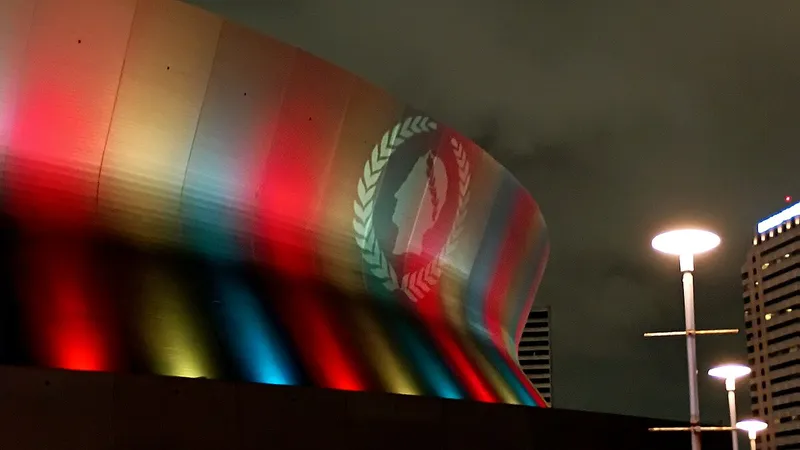
About Caesars Superdome
Caesars Superdome rises from the heart of downtown New Orleans like a spacecraft that landed and never left. With 73,208 seats under the largest fixed dome on earth, this is where the NFL’s New Orleans Saints have played since 1975 — and where more Super Bowls have been played than at any other stadium in history.
Located in the Central Business District, the Superdome sits just 15 minutes on foot from the French Quarter. That proximity to world-class food, music, and nightlife makes game day in New Orleans unlike anything else in professional sports. You don’t just attend an event here — you build a weekend around it.
The dome was designed by New Orleans architects Curtis and Davis and opened on August 3, 1975. Originally budgeted at $46 million, the 1973 oil crisis pushed the final cost to $165 million. The structure spans 680 feet in diameter, covers 13 acres, and required over 20,000 tons of steel. A $560 million renovation completed in 2024 by Trahan Architects modernized every corner — new atriums, reclaimed public space, and upgraded premium areas — without altering the iconic exterior.
The Superdome’s résumé is unmatched: 8 Super Bowls, 6 NCAA Final Fours, WrestleMania, the Essence Festival, and concerts from the Rolling Stones to Taylor Swift (who drew 191,000 fans over three nights in 2024). Muhammad Ali won his third Heavyweight title here in 1978. This building has seen everything.
Getting to Caesars Superdome
Public Transit
The Loyola Avenue streetcar line is your best bet. The Poydras Street Station is a 6-minute walk from the stadium, and the Loyola-UPT stop near Union Passenger Terminal is even closer.
→ From the French Quarter: Walk west along Canal Street or Poydras Street — it’s about 15 minutes on foot. Or hop on any RTA bus heading toward the CBD.
→ From Uptown/Garden District: Take the St. Charles streetcar to Lee Circle, then walk 10 minutes north along Loyola Avenue.
Multiple RTA bus routes also serve the area, including lines 3, 16, 52, 57, 61, 84, and 91. On event days, expect heavier service along Poydras and Loyola corridors.
Driving + Parking
The stadium address is 1500 Sugar Bowl Drive, New Orleans, LA 70112. I-10 runs directly past the Superdome — look for the Superdome/Claiborne Avenue exit.
→ From Baton Rouge (80 mi): I-10 East straight into downtown. Take the Poydras Street exit, merge right, turn right on Clara Street, then left on Sugar Bowl Drive.
→ From the Mississippi Gulf Coast (90 mi): I-10 West through Slidell into New Orleans. Same Superdome exit.
→ From Lafayette (135 mi): I-10 East the whole way. Budget 2 hours without traffic.
There are 7 parking garages and 2 surface lots (Lot 3 and Lot 4) managed by Legends Global. Expect to pay $40–$100 depending on the event. No tailgating is allowed in stadium lots — Champions Square across the street is the official pregame gathering spot, opening 4 hours before kickoff.
Rideshare
Uber and Lyft are widely available in New Orleans. Designated rideshare zones are on Poydras Street (between Clara Street and Loyola Avenue) and along Loyola Avenue near Duncan Plaza. Pickups and drop-offs are not allowed at the stadium itself — the zones are geo-fenced.
From the French Quarter, expect a ride of about $8–$15 and 5 minutes. After events, walk a few blocks away from the dome before requesting a pickup to avoid surge pricing and long waits.
From the Airport
→ Louis Armstrong New Orleans International (MSY): 13 miles west of the stadium, about 20–25 minutes by car. Taxi fare is a flat $35 to the CBD. JP Transit runs a bus from Kenner Terminal to Tulane @ Loyola for $1–$3 (about 40 minutes). Airport Shuttle service is also available daily 7am–7pm at 504-522-3500.
Katrina and the Rebirth
When Hurricane Katrina struck on August 29, 2005, the Superdome became the most desperate shelter in American history. Between 25,000 and 30,000 people took refuge inside as the storm ripped away sections of the roof and floodwaters knocked out power, plumbing, and hope. Photos of the torn dome became defining images of the disaster.
The damage was staggering — 80% of the roof destroyed, mold spreading through every level, electrical systems gutted. Initial estimates said rebuilding could take over two years. Instead, Trahan Architects led 35 contractors and 850 workers through an accelerated $200 million restoration. On September 25, 2006, the Saints played their first home game since the storm — a 23–3 victory over the Atlanta Falcons that remains one of the most emotional nights in NFL history.
History of Caesars Superdome
The Louisiana Superdome was conceived in 1967 by architects Curtis and Davis as a bold bet on New Orleans’ future. Construction began in August 1971, and after delays and cost overruns from the oil crisis, the dome opened on August 3, 1975 — the largest enclosed stadium the world had ever seen.
Super Bowl XII (1978): The first Super Bowl played in prime time, putting the Superdome on the national stage as Dallas defeated Denver 27–10.
Muhammad Ali vs. Leon Spinks (1978): Ali won his third and final Heavyweight Championship in front of 65,000 fans — a moment that transcended sports.
Super Bowl XX (1986): The Bears demolished the Patriots 46–10 in what many consider the most dominant Super Bowl performance ever.
Super Bowl XLVII — The Blackout Bowl (2013): A partial power outage halted play for 34 minutes in the third quarter as Baltimore beat San Francisco. It became one of the most talked-about Super Bowls in history.
Super Bowl LIX (2025): The Superdome’s eighth Super Bowl, capping a $560 million renovation that brought the 50-year-old building fully into the modern era.
Taylor Swift’s Eras Tour (2024): Three sold-out nights drew 191,000 fans — the highest-attended concert series in Superdome history.
Through name changes — Louisiana Superdome (1975), Mercedes-Benz Superdome (2011), Caesars Superdome (2021) — and through the worst natural disaster to hit an American city, this building has endured. It is New Orleans distilled into architecture: resilient, defiant, and always ready for a celebration.
Photo Gallery
Fun Facts
The Caesars Superdome has hosted 8 Super Bowls — more than any other stadium in NFL history.
The dome spans 680 feet in diameter and covers 13 acres, making it the largest fixed domed structure in the world.
In 1978, Muhammad Ali won his third and final world Heavyweight Championship inside the Superdome, defeating Leon Spinks in front of 65,000 fans.
Stadium Location
Frequently Asked Questions
- What is the seating capacity of Caesars Superdome?
- Caesars Superdome seats 73,208 for NFL games. Expanded configurations can reach 76,468, and concert setups push capacity to around 83,000.
- Where is Caesars Superdome located?
- Caesars Superdome is at 1500 Sugar Bowl Drive, New Orleans, Louisiana 70112. It sits in the Central Business District, about a 15-minute walk from the French Quarter.
- How do I get to Caesars Superdome by public transit?
- Take the Loyola Avenue streetcar — the Poydras Street Station is a 6-minute walk from the stadium. Multiple RTA bus routes (3, 16, 52, 57, 61, 84, 91) also serve the area.
- Is there parking at Caesars Superdome?
- Yes, there are 7 parking garages and 2 surface lots managed by Legends Global. Pricing ranges from $40 to $100 depending on the event. Pre-purchase through JustPark EventPass is recommended.
- Does Caesars Superdome have a roof?
- Yes, the Superdome is a fully enclosed dome — the largest fixed domed structure in the world at 680 feet in diameter. All events are climate-controlled regardless of weather.
- What happened to the Superdome during Hurricane Katrina?
- During Hurricane Katrina in August 2005, the Superdome served as a shelter for 25,000-30,000 people. About 80% of the roof was damaged by high winds. After a $200 million restoration, it reopened on September 25, 2006, for the Saints' emotional 23-3 victory over the Atlanta Falcons.
- How many Super Bowls has the Superdome hosted?
- Eight — more than any other stadium. Super Bowls XII (1978), XV (1981), XX (1986), XXIV (1990), XXXI (1997), XXXVI (2002), XLVII (2013), and LIX (2025).
- When was Caesars Superdome built?
- The Superdome opened on August 3, 1975, as the Louisiana Superdome. It was designed by the New Orleans firm Curtis and Davis. Construction cost $165 million after delays from the 1973 oil crisis pushed costs well above the original $46 million budget.
Last updated: 2026-02-19