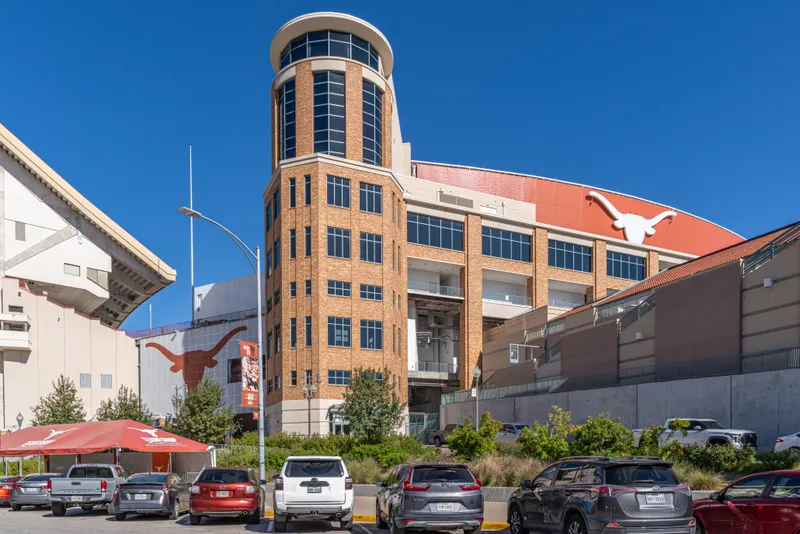
About DKR-Texas Memorial Stadium
DKR-Texas Memorial Stadium sits on the eastern edge of the University of Texas campus in Austin — a 100,119-seat colossus that has been the home of Longhorns football for more than a century. It is the seventh-largest stadium in America and one of the most intimidating venues in college football, where burnt orange fills every sightline and the “Hook ‘em Horns” salute is the only signal you need.
The stadium is the home of the Texas Longhorns, now competing in the Southeastern Conference after their historic move from the Big 12 in 2024. On fall Saturdays, Bevo Boulevard transforms San Jacinto Boulevard into a pregame festival while the 400-member Longhorn Band marches to the stadium. Inside, the student section and Bevo the live longhorn steer hold court in the south end zone.
Built in 1924 as a World War I memorial, the original 27,000-seat stadium was designed by Herbert M. Greene of Dallas and funded entirely by student and alumni donations. It has expanded repeatedly — the north horseshoe in 1926, an upper deck in 1948, a north end zone expansion to 94,113 in 2008, and a $175 million south end zone project completed in 2021 that added a 106,000-square-foot football operations facility beneath the stands.
DKR has hosted some of the biggest moments in college football: Vince Young’s legendary Rose Bowl run started with dominant home performances here, and the stadium set its all-time attendance record of 105,215 on October 19, 2024, when Texas hosted Georgia in their inaugural SEC season. The 2025 Texas-Texas A&M rivalry game returned to DKR for the first time in 15 years, reigniting one of college football’s fiercest traditions.
Getting to DKR-Texas Memorial Stadium
Public Transit
DKR is walkable from downtown Austin — about 20 minutes on foot from the Sixth Street district — but Capital Metro buses also serve the campus.
→ Via Capital Metro Bus: Routes 642, 670, 7, and 837 stop near the stadium. The nearest stop is at 2031 San Jacinto/21st Street, a 3-minute walk to the gates.
→ Via UT Game Day Shuttle: Texas Athletics runs a free round-trip shuttle from the UT Athletics Fields across Guadalupe Street directly to the stadium on game days.
Austin’s Capital MetroRail commuter line does not pass directly by campus. If arriving by rail, exit at the Downtown Station and walk or transfer to a bus.
Driving + Parking
The stadium address is 2139 San Jacinto Boulevard, Austin, TX 78712. I-35 runs along the east side of campus.
→ From Dallas (~195 mi): I-35 South directly to Austin. Exit at MLK Jr. Blvd or 26th Street for the stadium. About 3 hours.
→ From Houston (~165 mi): US-290 West to Austin, then I-35 North to the campus exits. About 2.5 hours.
→ From San Antonio (~80 mi): I-35 North to Austin. About 1 hour 15 minutes.
Most stadium lots require pre-purchased permits that sell out months in advance. A limited number of cash lots are available at $30. State parking garages downtown open for game days at varying rates. Third-party lots through SpotHero start around $15–$25. Tailgating is permitted in designated lots.
Rideshare
Uber and Lyft are widely used for Texas game days. The designated pickup and drop-off zone is in Lot 40 at the corner of Dean Keeton Street and Red River Street. From downtown Austin, a ride runs $10–$20 before surge pricing. Post-game surges are significant — expect $30–$50 immediately after the final whistle. Walk to Sixth Street or Guadalupe and wait 20–30 minutes for rates to settle.
From the Airport
→ Austin-Bergstrom International (AUS): 11 miles south of the stadium, about 15–20 minutes by car. Rideshare from AUS runs $25–$35. The airport is a major hub with direct flights from most U.S. cities.
→ San Antonio International (SAT): 80 miles south, about 1 hour 15 minutes. Can offer cheaper fares on some routes, especially Southwest.
Legacy of DKR-Texas Memorial Stadium
DKR-Texas Memorial Stadium is more than a football venue — it is one of the oldest and most continuously significant stadiums in American sports. The stadium has hosted Longhorns football without interruption since 1924, making it one of the longest-tenured college football grounds in the country.
The coaching legacy is towering. Darrell K Royal, for whom the stadium was renamed in 1996, won three national championships (1963, 1969, 1970) and defined a culture that still shapes the program. Mack Brown’s tenure brought Vince Young, the 2005 national championship, and the north end zone expansion that pushed capacity past 94,000.
The stadium’s role as a war memorial endures. It was originally funded by 10,000 donors to honor the 198,520 Texans who served in World War I. Plaques and dedications throughout the stadium preserve that founding purpose. The Freddie Steinmark Scoreboard, dedicated in 1972, honors the Longhorns safety who was diagnosed with bone cancer days after the 1969 “Game of the Century” and died in 1971.
History of DKR-Texas Memorial Stadium
DKR-Texas Memorial Stadium was commissioned in the early 1920s when athletics director L. Theo Bellmont and benefactor Henry Jacob Lutcher Stark launched a fundraising drive to build a proper football home on campus. Architect Herbert M. Greene of Dallas designed a 27,000-seat concrete bowl on the eastern edge of the Forty Acres. The first game was played on November 8, 1924, against Baylor, though the west stands were still incomplete.
Stadium Dedication (November 27, 1924): Texas hosted Texas A&M before 33,000 fans — then the largest crowd to witness an athletic event in Texas history. The student body dedicated the stadium to the Texans who served in World War I.
North Horseshoe (1926): A 13,500-seat enclosure on the north end was added for $125,000, bringing capacity to 40,500.
Upper Deck Expansion (1948): Capacity grew to 60,136 as the stadium added an upper deck to meet postwar demand.
Renamed for Darrell K Royal (1996): The stadium was renamed to honor the legendary coach upon his retirement from public life.
Track Removal and Field Lowering (1999): The running track was removed, the field lowered six feet, and new rows added, bringing capacity to 80,082 and moving fans closer to the action.
North End Zone Expansion (2008): A new upper deck, 47 luxury suites, and 2,100 club seats raised capacity to 94,113 at a cost of approximately $150 million.
South End Zone Expansion (2019–2021): A $175 million project added a 106,000-square-foot football operations center — including coaching offices, a strength center, and athletic training facilities — beneath new south end zone seating, pushing capacity to 100,119.
SEC Attendance Record (October 19, 2024): Texas hosted Georgia before 105,215 fans — the largest crowd in stadium history — marking the Longhorns’ first season as an SEC member.
A century after its dedication, DKR-Texas Memorial Stadium remains one of the cathedrals of college football — a place where “The Eyes of Texas” echoes off concrete walls that were built to honor sacrifice and have been filled with passion ever since.
Photo Gallery
Fun Facts
DKR-Texas Memorial Stadium set its all-time attendance record of 105,215 on October 19, 2024, when Texas hosted Georgia in their first season as an SEC member.
The Longhorns season-ticket waiting list has more than 130,000 names — the estimated wait is over 30 years, longer than most mortgages.
The stadium was originally built in 1924 as a World War I memorial: students, alumni, and friends donated the money to honor the 198,520 Texans who served and the 5,280 who died in the war.
Stadium Location
Frequently Asked Questions
- What is the seating capacity of DKR-Texas Memorial Stadium?
- The official capacity is 100,119, making it the seventh-largest stadium in the United States and the ninth-largest in the world. The all-time attendance record is 105,215, set on October 19, 2024, for a Texas vs. Georgia SEC matchup.
- Where is DKR-Texas Memorial Stadium located?
- The stadium is at 2139 San Jacinto Boulevard on the eastern edge of the University of Texas at Austin campus, about a mile north of the Texas State Capitol and a 20-minute walk from downtown.
- How do I get to DKR-Texas Memorial Stadium by public transit?
- Capital Metro bus routes 642, 670, 7, and 837 stop within a few minutes' walk of the stadium. The nearest bus stop is at 2031 San Jacinto/21st Street. UT also provides a free round-trip shuttle from the UT Athletics Fields across Guadalupe Street on game days.
- Is there parking at DKR-Texas Memorial Stadium?
- Most lots near the stadium require pre-purchased permits and sell out early. A limited number of cash lots are available at $30 per game. State parking garages downtown also sell spaces on game days. Third-party options through SpotHero or ParkMobile start around $15-$25.
- Who is Darrell K Royal?
- Darrell K Royal coached the Texas Longhorns from 1957 to 1976, compiling a 167-47-5 record, three national championships (1963, 1969, 1970), and 11 Southwest Conference titles. The stadium was renamed in his honor in 1996. He passed away in 2012.
- What surface does DKR-Texas Memorial Stadium use?
- The stadium currently uses FieldTurf, an artificial surface installed in 2021. Texas has announced plans to return to natural grass once the new indoor practice facility is completed, which would mark the first natural grass surface at DKR since 2009.
- Is tailgating allowed at DKR-Texas Memorial Stadium?
- Yes, tailgating is permitted in designated parking lots. Bevo Boulevard on San Jacinto Boulevard opens hours before kickoff with live music, food vendors, and family-friendly activities — it's the main pregame gathering spot.
- What is the Bevo Boulevard experience?
- Bevo Boulevard is the Longhorns' official pregame fan zone on San Jacinto Boulevard, closed to traffic on game days. It features live music stages, food trucks, sponsor activations, and appearances by Bevo the live longhorn steer mascot.
Last updated: 2026-03-04