About Estadio Cuauhtémoc
Estadio Cuauhtémoc stands in the northeast corner of Puebla, about 7 kilometers from the colonial center of one of Mexico’s most beautiful cities. With 51,726 seats, it is the fourth-largest football stadium in the country and the home of Club Puebla, the Liga MX side known as La Franja for the distinctive blue stripe on their white jersey.
The stadium opened on October 6, 1968, just days before the Mexico City Olympics began. Designed by Pedro Ramírez Vázquez — the architect behind both Estadio Azteca and the Basilica of Our Lady of Guadalupe — it was built to serve as a football venue for the 1968 Summer Olympics tournament. The Cuauhtémoc-Moctezuma brewery bankrolled most of the 10 million peso construction, giving the stadium its name and establishing one of Mexico’s earliest corporate sponsorship deals in sports.
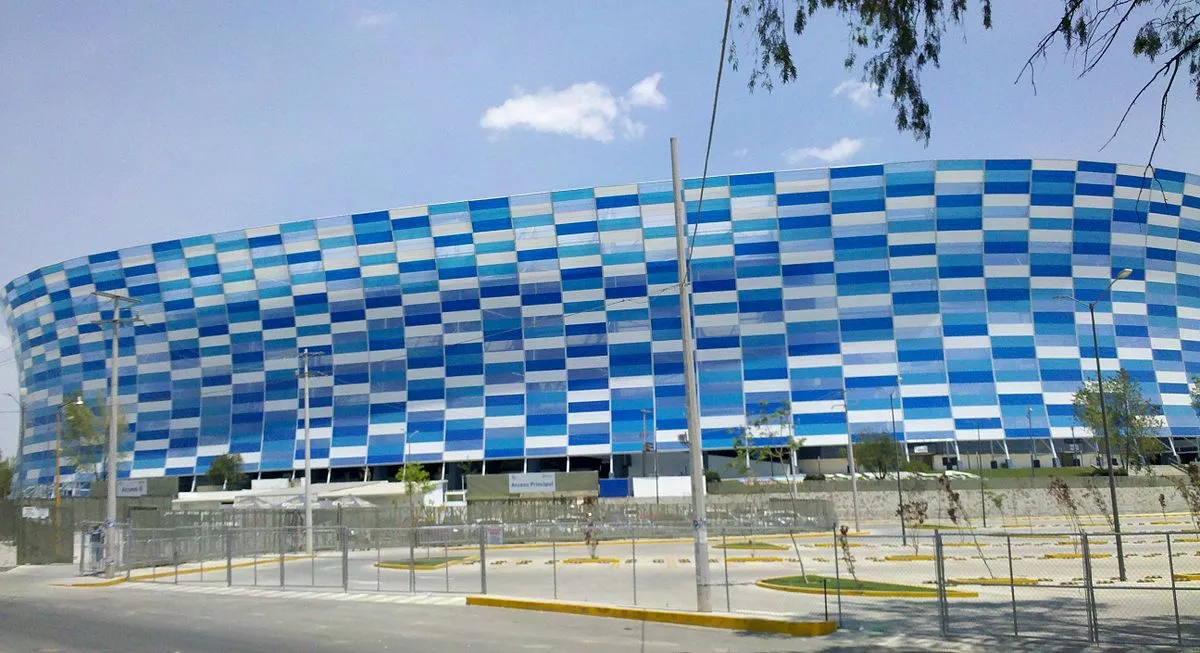
What sets this stadium apart today is its skin. A 2015 renovation wrapped the entire exterior in 124 ETFE panels spanning 30,000 square meters — the first stadium in Latin America to use this lightweight, translucent material across its full facade. The panels are tinted in the blue tones of Puebla’s famous talavera pottery, connecting the modern venue to the city’s centuries-old ceramic tradition. At night, the facade glows with an electric blue that you can spot from the autopista as you approach the city.
Estadio Cuauhtémoc has hosted matches in two FIFA World Cups, survived earthquakes, and been rebuilt more than once. Through every transformation, it has remained the beating heart of football in Puebla — a city of 1.7 million people that lives and dies with La Franja.
Getting to Estadio Cuauhtémoc
Public Transit
Puebla does not have a metro system, but its bus network covers the stadium well. From the CAPU central bus terminal, the easiest routes are the Ruta JBS “Morados” and the Ruta Libertad Cuauhtémoc — both stop directly across Boulevard Norte from the terminal and run to the stadium area.
→ From Mexico City (TAPO): Take an Estrella Roja or ADO bus from the TAPO terminal to Puebla’s CAPU terminal. The ride takes about 2 hours and costs 130–200 MXN. From CAPU, board the Ruta JBS or take a taxi (10 minutes) to the stadium.
→ From Puebla Historic Center: Catch a local bus heading northeast on Calzada Ignacio Zaragoza. Several routes serve the Unidad Deportiva area. Allow 20–30 minutes depending on traffic.
On match days, expect crowded buses and heavier-than-usual traffic approaching the stadium. Arriving at least an hour before kickoff keeps things manageable.
Driving + Parking
The stadium sits along the Mexico-Puebla autopista (Highway 150D), making it one of the most highway-accessible stadiums in the country. GPS users should enter “Calzada Ignacio Zaragoza 666, Colonia Unidad Deportiva, Puebla.”
→ From Mexico City: Take the Autopista México-Puebla (150D) east. The drive is about 130 km and takes roughly 2 hours. The stadium is visible from the highway as you enter the city from the northwest.
→ From Tlaxcala: Head south on the Tlaxcala-Puebla highway. About 35 km, 40 minutes.
→ From Cholula: Drive east on the Recta a Cholula toward Puebla center, then north on the Periférico Ecológico. About 20 km, 30 minutes.
Parking at the stadium is limited and fills up fast on match days. The Parque Puebla shopping mall lot is about 1 km away and charges 20 MXN per hour. The Expositor Center in the Los Fuertes area offers parking for 50 MXN. Street parking disappears early, so plan accordingly or skip the car entirely.
Rideshare
Uber and DiDi both operate in Puebla and will drop you right at the stadium gates. A ride from the historic center costs about 60–100 MXN ($3–6 USD). After matches, expect surge pricing and 15–25 minute waits as crowds pour out.
Pro tip: Walk a few blocks toward Boulevard Valsequillo or Calzada Zaragoza to escape the post-match surge and get a faster pickup.
From the Airport
→ Puebla International Airport (PBC): Located 25 km northwest of the city in Huejotzingo. The drive takes about 40 minutes via Highway 150D. A taxi from the airport runs 350–500 MXN ($20–30 USD). There is no direct public transit between the airport and the stadium.
→ Mexico City International Airport (MEX): About 145 km west, roughly 2–2.5 hours by car or bus via the autopista. ADO and Estrella Roja run direct buses from the airport to Puebla’s CAPU terminal.
Legacy of Estadio Cuauhtémoc
Estadio Cuauhtémoc is woven into the identity of Puebla in a way that goes beyond football. The city — Mexico’s fourth largest — has always had a fierce sense of independence from Mexico City, and the stadium is a physical expression of that pride. When Club Puebla takes the pitch, the blue-and-white striped La Franja faithful fill the stands with a passion that rivals any ground in Liga MX.
The stadium’s two World Cup campaigns gave Puebla a place on the global football map. In 1970 and 1986, international fans descended on this colonial city and discovered a place as rich in culture as it is in football atmosphere. The third-place match of the 1986 World Cup — France’s dramatic 4-2 extra-time win over Belgium — remains one of the most memorable matches ever played here.
Today, the ETFE facade has transformed Estadio Cuauhtémoc into a modern architectural landmark. The talavera-inspired blue panels are a deliberate nod to the city’s ceramic heritage, blending centuries of tradition with cutting-edge stadium design. It is a venue that honors where Puebla has been while pointing toward where it is going.
History of Estadio Cuauhtémoc
1965–1968: Architect Pedro Ramírez Vázquez designed the stadium as part of Mexico’s preparations for the 1968 Olympics. The Cuauhtémoc-Moctezuma brewery provided the bulk of the 10 million peso budget. The stadium was inaugurated on October 6, 1968, hosting Olympic football tournament matches in its opening weeks.
1970 FIFA World Cup: Estadio Cuauhtémoc hosted three Group 2 matches — Uruguay vs. Israel (2-0), Uruguay vs. Italy (0-0), and Sweden vs. Uruguay (1-0). It was one of five venues used in the tournament.
1986 FIFA World Cup: The stadium’s finest hour. Five matches played out here, including Italy vs. Argentina (1-1, with a Maradona goal on June 5), Italy vs. South Korea (3-2), the quarterfinal between Spain and Belgium (1-1, Belgium advancing on penalties with 45,000 in attendance), and the third-place match where France beat Belgium 4-2 in extra time on June 28.
1999 Earthquake Damage: The devastating Puebla earthquake caused significant structural damage, forcing major repairs and partial reconstruction of the stadium’s upper sections.
2014–2015 Renovation: The most transformative period in the stadium’s history. An 688 million peso project expanded capacity from 42,648 to 51,726, installed the iconic ETFE facade, added new ramps on the north and south sides, and modernized all concourses. The stadium reopened on November 18, 2015, with a friendly match against Boca Juniors.
December 2024: Estadio Cuauhtémoc hosted the first leg of the Liga MX Apertura 2024 Final between Club América and CF Monterrey — a sign that the venue remains one of Mexico’s premier football grounds nearly six decades after opening.
Photo Gallery
Fun Facts
Estadio Cuauhtémoc was designed by Pedro Ramírez Vázquez, the same architect behind Estadio Azteca and the Basilica of Our Lady of Guadalupe — making him responsible for three of Mexico's most iconic structures.
After its 2015 renovation, the stadium became the first and only venue in Latin America with a facade entirely covered in ETFE — 124 panels spanning 30,000 square meters, designed in the blue tones of Puebla's famous talavera pottery.
The stadium is named after the Cuauhtémoc-Moctezuma brewery, which funded the majority of the original 10 million peso construction cost in the 1960s — one of Mexico's earliest examples of corporate sports sponsorship.
Stadium Location
Frequently Asked Questions
- What is the seating capacity of Estadio Cuauhtémoc?
- Estadio Cuauhtémoc has a current seating capacity of 51,726. The stadium was expanded from its original 42,648 seats during a major renovation completed in November 2015, making it the fourth-largest football stadium in Mexico.
- Where is Estadio Cuauhtémoc located?
- Estadio Cuauhtémoc is located at Calzada Ignacio Zaragoza 666, Colonia Unidad Deportiva, in the northeast section of Puebla, Mexico. It sits about 7 kilometers from the historic city center, adjacent to the Mexico-Puebla autopista (Highway 150D).
- How do I get to Estadio Cuauhtémoc from Mexico City?
- Take a bus from Mexico City's TAPO terminal with Estrella Roja or ADO to Puebla's CAPU bus terminal (about 2 hours, 130-200 MXN). From CAPU, the stadium is a 10-minute taxi ride or you can take the Ruta JBS or Ruta Libertad Cuauhtémoc bus directly from outside the terminal.
- Is there parking at Estadio Cuauhtémoc?
- Parking at the stadium is limited and fills up quickly on match days. Nearby alternatives include the Parque Puebla shopping mall lot (about 1 km away, 20 MXN per hour) and the Expositor Center parking in the Los Fuertes area (50 MXN flat rate). Public transit or rideshare is recommended.
- What major events has Estadio Cuauhtémoc hosted?
- The stadium hosted three 1970 FIFA World Cup matches and five 1986 FIFA World Cup matches including the third-place match (France 4-2 Belgium). It also hosted the 2024 Liga MX Apertura Final first leg and has served as a venue for international friendlies and major concerts.
- When was Estadio Cuauhtémoc built?
- Estadio Cuauhtémoc was inaugurated on October 6, 1968, as part of Mexico's preparations for the 1968 Summer Olympics football tournament. It was designed by architect Pedro Ramírez Vázquez and funded primarily by the Cuauhtémoc-Moctezuma brewery.
- Who designed the ETFE facade on Estadio Cuauhtémoc?
- The distinctive ETFE facade was designed by Dünn Lightweight Architecture and installed during the 2014-2015 renovation. It consists of 124 panels covering 30,000 square meters, making Estadio Cuauhtémoc the first stadium in Latin America with a fully ETFE-clad exterior. The panels feature blue tones inspired by Puebla's traditional talavera pottery.
Last updated: 2026-03-01