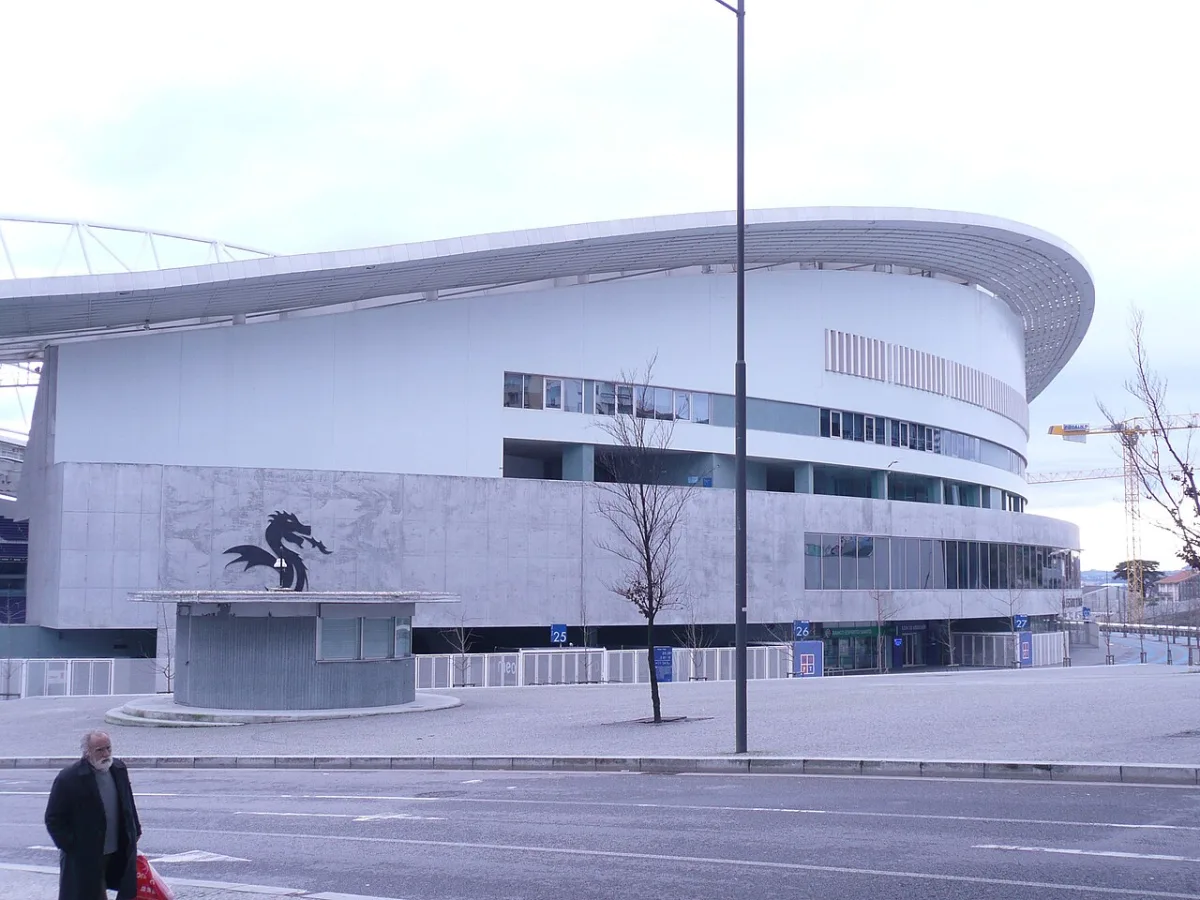
About Estádio do Dragão
Look down on Estádio do Dragão from the air and the roof reads like the spine of the beast the ground is named for. This is FC Porto’s home in the Antas district on the eastern edge of the city, a 50,033-seat bowl that replaced the club’s beloved old stadium and announced Porto as a modern European force the same season the team won the Champions League. Dragão means dragon, the creature that sits on the club crest and the city’s coat of arms.
The stadium is not covered like a dome. A translucent polycarbonate roof shelters the two long side stands, while the north and south corners stay open to the sky, framing views out across Porto and letting the ground breathe. The pitch is natural grass, 105 metres by 68. Behind one goal the concrete is dug into the hillside, which is why the building looks lower and calmer from the street than its 50,000 seats suggest.
FC Porto own it outright and have played here since November 2003. At 50,033 seats it is the third-largest football ground in Portugal, behind only the two Lisbon giants, and it doubles as a regular home for the national team. In the years since it opened, it has hosted a European Championship opener, a Nations League final, and a Champions League final, which is a heavy trophy cabinet for a stadium barely two decades old. On a European night, with the whole bowl in blue and white, it is one of the loudest grounds on the continent.
Getting to Estádio do Dragão
Porto makes this easy: the metro literally ends at the stadium. Here is how to reach the Dragão whichever way you are traveling.
Public Transit
The metro is the obvious answer, because the Estádio do Dragão station is the eastern terminus of three lines, A (blue), B (red), and E (violet), and its exit opens right onto the ground. You cannot overshoot it. From the central Trindade interchange it is a direct ride of about ten minutes with no change, tapping in with the rechargeable Andante card. STCP buses in the 700 and 800 series also serve the Antas area if you are coming from somewhere the metro misses.
Driving + Parking
The VCI, Porto’s inner ring motorway, runs right along the stadium, so the drive from the A1, A3, or A4 is short and well signed. Parking is the catch. The stadium has its own underground car park and the neighbouring Alameda Shop & Spot center has more, but the ground’s own parking closes to the general public on match and event days. Arrive early, use the shopping-center decks, and expect the surrounding streets to clog after the final whistle. On a big night the metro will beat the car home.
Rideshare
Both Uber and Bolt operate across Porto, and Bolt often comes in a little cheaper. Drivers usually drop off along Alameda das Antas or at the shopping-center frontage beside the stadium rather than at the gates themselves. As anywhere, expect a surge in price and a slow crawl out of the area once the crowd spills onto the streets after full time.
From the Airport
Francisco Sá Carneiro Airport sits on the north-western edge of the city, roughly 18 kilometres from the stadium on the far side of Porto. The clean public option is the violet Line E, the dedicated airport line, which reaches Trindade in about thirty minutes on a two-euro Andante ticket, where you connect for the short final leg to the Dragão. A taxi or Bolt covers it in twenty to twenty-five minutes for around twenty to thirty euros, with a night and weekend surcharge after 9pm.
Construction & Design
Porto needed a new home for Euro 2004, and the club used the deadline to leave behind the aging Estádio das Antas, the club’s home since the 1950s and for decades one of the great cauldrons of Portuguese football. Rather than patch up the old ground, Porto built fresh a short distance away and let the wrecking crews take the rest. The commission went to the Lisbon architect Manuel Salgado and his firm RISCO, with structural work by GEG and construction by Somague. The build ran from 2001 to 2003 and was not without friction, including a months-long standoff in early 2002 with the city over the surrounding land that briefly threatened the tournament timetable.
Salgado’s trick was restraint. Rather than pile a huge object onto the site, the lower tiers were sunk into the terrain, which RISCO says roughly halved the stadium’s visible mass from the street. The translucent polycarbonate roof, some 34,000 square metres of it on a steel frame engineered for winds up to about 160 kilometres per hour, covers only the two side stands and glows softly at night. Leaving the north and south corners open was deliberate, giving spectators sightlines out to the city and keeping the bowl from feeling sealed. There is a nod to Porto tradition too: a frame of roughly 21,000 square metres of blue-and-white azulejo tiling, the painted ceramic the city is known for, wraps parts of the concourse. The whole complex sprawls across some 132,000 square metres.
The reported price tag is where the record gets murky. FC Porto and Wikipedia cite about 125 million euros, of which some 18 million came from the Portuguese state; RISCO’s own project page lists roughly 97 million, most likely the construction contract without the wider complex. Either way it was a substantial public and private investment, and the finished ground opened to a full house in November 2003.
History of Estádio do Dragão
The opening night was a statement. On 16 November 2003 Porto beat Barcelona 2-0 in a friendly before a record 52,004 fans, a match now best remembered for the debut of a 16-year-old Lionel Messi off the Barcelona bench. There was an awkward postscript: the new turf failed almost immediately, forcing Porto back to Antas until the grass was replanted the following February.
Euro 2004 put the stadium on the world stage within a year. It hosted the tournament’s opening match and ceremony, a shock 2-1 win for Greece over the host nation, and later the Greece against Czech Republic semifinal, settled by the only silver goal in European Championship history. Porto, meanwhile, were busy winning the Champions League that same 2003-04 season under a young José Mourinho.
The big occasions kept coming. In June 2019 the Dragão staged the finals of the inaugural UEFA Nations League, hosting a semifinal and then the final itself, where Portugal beat the Netherlands 1-0 with Cristiano Ronaldo lifting the trophy on home soil. Then in May 2021 it inherited the Champions League final at short notice, moved from Istanbul because of pandemic travel rules; Chelsea beat Manchester City 1-0 before a crowd capped near 14,000, one of the smallest to watch a European Cup final in decades. Add the concerts and that 2009 motor race across the pitch, and this ground has packed a remarkable amount of history into two short decades.
Sources & Further Reading
- FC Porto official site: fcporto.pt. The club’s own pages on the stadium, tickets, and tours.
- Wikipedia entry on Estádio do Dragão: en.wikipedia.org/wiki/Estádio_do_Dragão. Construction history, capacity, and the full events record with sourcing.
- RISCO project page: risco.org. The design firm’s own account of the architecture and the sunk-in-the-terrain concept.
- Metro do Porto: metrodoporto.pt. Line maps and fares for the Estádio do Dragão terminus.
- UEFA Champions League: uefa.com. The 2021 final record and relocation details.
Quick Facts
Everything you need at a glance.
Stadium specs
- Capacity
- 50,033
- Opened
- 2003
- Cost
- €125 million
- Roof
- Roof over side stands (open corners)
- Surface
- Natural grass
- Tenants
- FC Porto (Primeira Liga)
Construction & location
- Groundbreaking
- 2001
- Architects
- Manuel Salgado (RISCO)
- Engineering
- GEG - Gabinete de Estruturas e Geotecnia
- General contractor
- Somague
- Address
- Via Futebol Clube do Porto, 4350-415 Porto, Portugal
- GPS
- 41.1617°N, 8.5836°W
Photo Gallery
Fun Facts
A 16-year-old Lionel Messi played here in the stadium's very first match, coming on for Barcelona in a 2-0 friendly loss to Porto on 16 November 2003 in front of a record 52,004 crowd.
In 2009 the pitch was ripped up and paved over: the stadium hosted the Race of Champions motorsport event, turning the football field into an asphalt racetrack for a weekend.
The brand-new turf failed within weeks of opening, and Porto had to slink back to their old Estádio das Antas until the grass could be replanted in February 2004.
Stadium Location
Frequently Asked Questions
- What is the capacity of Estádio do Dragão?
- The stadium holds 50,033, making it the third-largest football ground in Portugal. An older figure of 50,431 still circulates, but 50,033 is the current all-seater number.
- Who plays at Estádio do Dragão?
- It is the home of FC Porto, who own the stadium and have played there since 2003. The Portugal national team also hosts selected home matches here.
- Why is it called Estádio do Dragão?
- Dragão means dragon, the beast on FC Porto's crest and the coat of arms of the city. The name translates to Stadium of the Dragon, and the ground has no title sponsor.
- When did Estádio do Dragão open?
- It opened on 16 November 2003 with a friendly against Barcelona, replacing the old Estádio das Antas in time for Portugal to co-host Euro 2004.
- What role did the stadium play at Euro 2004?
- It hosted the opening match and ceremony, Portugal against Greece, plus several other games including the Greece versus Czech Republic semifinal decided by a silver goal.
- Did Estádio do Dragão host a Champions League final?
- Yes. The 2021 final between Chelsea and Manchester City was moved here from Istanbul because of pandemic travel rules, with Chelsea winning 1-0 in front of a reduced crowd.
- How do I get to Estádio do Dragão by metro?
- Take Porto Metro lines A, B, or E to the Estádio do Dragão terminus, which is right at the stadium. From central Trindade the ride is about 10 minutes with no change.
- Is the pitch covered by a roof?
- No. A translucent roof shelters the two long side stands, but the north and south corners are left open to the sky, so the pitch and the end stands are uncovered.
Last updated: 2026-07-13