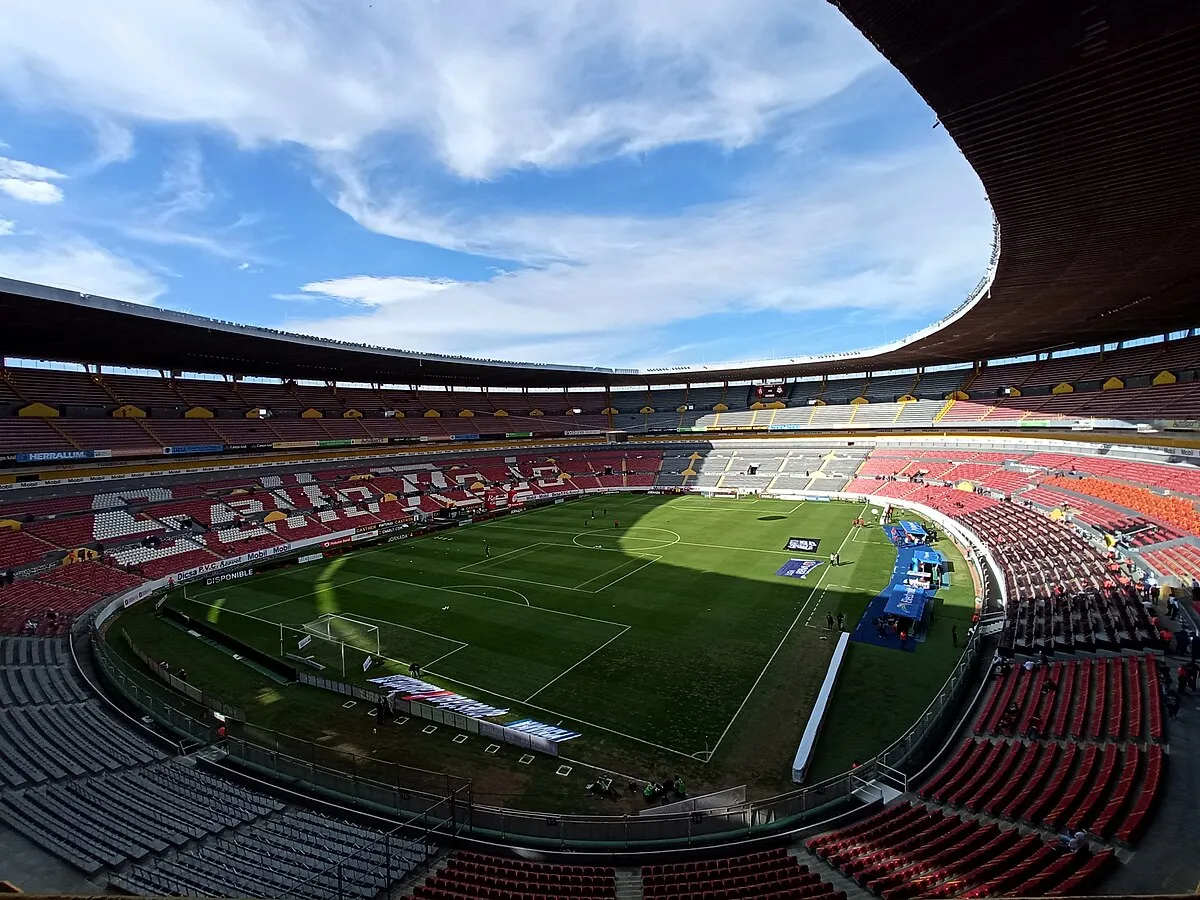
About Estadio Jalisco
Estadio Jalisco sits in the Colonia Independencia neighborhood of Guadalajara, Mexico’s second-largest city, along Calzada Independencia about 4 kilometers north of the historic center. At 56,713 seats, it’s the third-largest football stadium in Mexico — and one of the most historically significant stadiums in the Americas.
Home to Atlas FC since 1960 and Leones Negros UdeG since 1970, Estadio Jalisco was also home to C.D. Guadalajara (Chivas) for half a century before they moved to Estadio Akron in 2010. The stadium’s true claim to fame, though, is its World Cup heritage: it hosted matches at both the 1970 and 1986 FIFA World Cups, serving as Brazil’s base stadium in both tournaments.
The original bowl was built between 1952 and 1959 at a cost of 34 million pesos, with an initial capacity of 30,000. In 1969, capacity was expanded to 70,000 for the 1970 World Cup. Modern all-seater safety requirements have since reduced it to 56,713. A 2017 renovation replaced all seating, upgraded the roof structure, and installed new LED lighting. The playing field is natural grass at 105 x 70 meters.
Atlas FC’s back-to-back Liga MX titles in 2021 and 2022 — ending a 70-year championship drought — brought Estadio Jalisco back into the national spotlight. The celebrations that poured out of this stadium when Atlas clinched against León on penalties in December 2021 were some of the most emotional scenes in Mexican football history.
Getting to Estadio Jalisco
Public Transit
Guadalajara’s bus rapid transit system makes getting to Estadio Jalisco straightforward. The Mi Macro Calzada line stops at the Monumental station directly in front of the stadium on Calzada Independencia.
→ From Centro Histórico: Take the Mi Macro Calzada northbound. The ride takes about 10 minutes. Any bus traveling along Calzada Independencia also passes the stadium — ask for “Estadio Jalisco.”
→ By Light Rail: SITEUR Line TL-1 serves the area near the stadium along Calzada Independencia. Trains run from approximately 5 AM to 11 PM.
Multiple local bus routes also serve the stadium area, including T18-A and the PARADOR line. For visitors unfamiliar with the bus network, rideshare is the simplest alternative.
Driving + Parking
Estadio Jalisco sits directly on Calzada Independencia, one of Guadalajara’s main north-south boulevards. Getting here by car is simple — the challenge is parking.
→ From Centro Histórico (~4 km): Head north on Calzada Independencia. The stadium is on your right in Colonia Independencia. About 10-15 minutes.
→ From Zapopan (~7 km): Head southeast along Avenida Ávila Camacho toward Guadalajara, then continue onto Calzada Independencia heading south. About 20-28 minutes.
→ From the Airport (GDL, ~24 km): Take the Autopista Guadalajara-Chapala toward the city center. Merge onto Calzada González Gallo, then Calzada Independencia heading north. About 23-30 minutes.
The official Estacionamiento Estadio Jalisco parking lot is on Avenida Fidel Velázquez Sánchez, but spaces are limited. Informal street parking and small private lots operate in the surrounding residential streets on match days. Arrive 1-2 hours early if you’re driving.
Rideshare
Uber and DiDi both operate widely in Guadalajara and are popular for getting to Estadio Jalisco. DiDi is often cheaper. A ride from the centro histórico typically costs 50-80 MXN ($3-5 USD).
Pro tip: After the match, walk several blocks west along a side street before requesting a ride. The area immediately outside the gates gets extremely congested.
From the Airport
→ Guadalajara Miguel Hidalgo International (GDL): 24 km (15 miles) southeast, about 23-30 minutes by car or rideshare. By public transit, expect about 60 minutes with bus transfers. A taxi from the airport costs approximately 350-450 MXN ($20-25 USD).
World Cup Legacy at Estadio Jalisco
Estadio Jalisco is one of only a handful of stadiums worldwide to host matches at two separate FIFA World Cups. In 1970, it was Brazil’s home ground — and the setting for one of the most iconic moments in World Cup history.
1970 World Cup (8 matches): Brazil played every group stage match here, including the legendary June 7 encounter with England. That match featured Gordon Banks’ miraculous save against Pelé’s header — widely considered the greatest save ever. Jairzinho scored the only goal in a 1-0 Brazil win. The Seleção went on to beat Uruguay 3-1 in the semifinal at Estadio Jalisco before lifting the trophy in Mexico City.
1986 World Cup (6 matches): Brazil returned to Guadalajara for the 1986 tournament. The quarterfinal between Brazil and France on June 21 is remembered as one of the greatest World Cup matches ever — a 1-1 draw settled 4-3 on penalties in France’s favor. West Germany then defeated France 2-0 in the semifinal at this same venue.
History of Estadio Jalisco
The idea for Estadio Jalisco emerged in 1954, when a local derby between Chivas and Atlas exposed that Guadalajara’s existing venues couldn’t handle demand. The city granted planning permission on October 8, 1954, and construction began under Constructora Jalisco S.A. de C.V. Cardinal José Garibi Rivera blessed the stadium on January 24, 1959, and the first competitive match was played on January 31, 1960 — Atlas vs. San Lorenzo of Argentina.
- 1969 Expansion: Capacity doubled from 30,000 to 70,000 for the 1970 FIFA World Cup, making Estadio Jalisco one of the largest stadiums in the Americas.
- 1970 FIFA World Cup: Hosted 8 matches including group stage, quarterfinal, and semifinal. Brazil’s base stadium.
- 1986 FIFA World Cup: Hosted 6 matches including the iconic Brazil-France quarterfinal and West Germany-France semifinal.
- Chivas Departure (2010): C.D. Guadalajara moved to the new Estadio Akron after 50 years at Estadio Jalisco.
- Atlas Apertura 2021 Title (December 12, 2021): Atlas defeated Club León on penalties (4-3) to win their first league title in 70 years. The stadium exploded with decades of pent-up emotion.
- Atlas Clausura 2022 Title (May 26, 2022): Atlas won the first leg 2-0 at home, then clinched 3-2 on aggregate against Pachuca to become back-to-back champions.
- 2017 Renovation: All seating replaced, roof refurbished, LED lighting installed, and a 360-degree video screen added above the field.
Photo Gallery
Fun Facts
Estadio Jalisco hosted 14 FIFA World Cup matches across 1970 and 1986 — more than almost any other stadium in the world outside of a host-country capital.
During both the 1970 and 1986 World Cups, Estadio Jalisco served as Brazil's base stadium — 13 of the 14 World Cup matches at the venue featured the Seleção.
The stadium's capacity more than doubled in just 9 years — from 30,000 seats at opening in 1960 to 70,000 after the 1969 expansion for the 1970 World Cup.
Stadium Location
Frequently Asked Questions
- What is the capacity of Estadio Jalisco?
- Estadio Jalisco has an official capacity of 56,713, making it the third-largest football stadium in Mexico behind Estadio Azteca and Estadio Olímpico Universitario. At its peak in the 1970s, capacity reached 70,000.
- What teams play at Estadio Jalisco?
- Atlas FC of Liga MX and Leones Negros UdeG of Liga de Expansión MX currently call Estadio Jalisco home. C.D. Guadalajara (Chivas) also played there from 1960 until moving to Estadio Akron in 2010.
- Did Estadio Jalisco host World Cup matches?
- Yes. Estadio Jalisco hosted 8 matches during the 1970 FIFA World Cup and 6 during the 1986 FIFA World Cup — 14 total. It served as Brazil's base stadium during both tournaments.
- How do I get to Estadio Jalisco by public transit?
- The Mi Macro Calzada bus rapid transit stops at the Monumental station directly in front of the stadium. Light rail Line TL-1 also serves the area, and multiple bus routes travel along Calzada Independencia past the stadium.
- Is there parking at Estadio Jalisco?
- There is an official parking area on Avenida Fidel Velázquez Sánchez, but spaces are limited and fill quickly on match days. Arriving 1-2 hours early is recommended. Uber and DiDi are popular alternatives.
- How far is Estadio Jalisco from the Guadalajara airport?
- Guadalajara Miguel Hidalgo International Airport (GDL) is approximately 24 km (15 miles) from the stadium. The drive takes about 23-30 minutes by car, taxi, or rideshare.
- When was Estadio Jalisco built?
- Construction began in 1952, the stadium was inaugurated on January 24, 1959, and the first match was played on January 31, 1960 (Atlas vs. San Lorenzo of Argentina). The original capacity was 30,000.
- Is Estadio Jalisco being used for the 2026 World Cup?
- No. The 2026 World Cup matches in Guadalajara are scheduled for Estadio Akron (Chivas' home). However, Estadio Jalisco retains its legacy as a two-time World Cup venue from 1970 and 1986.
Last updated: 2026-02-25