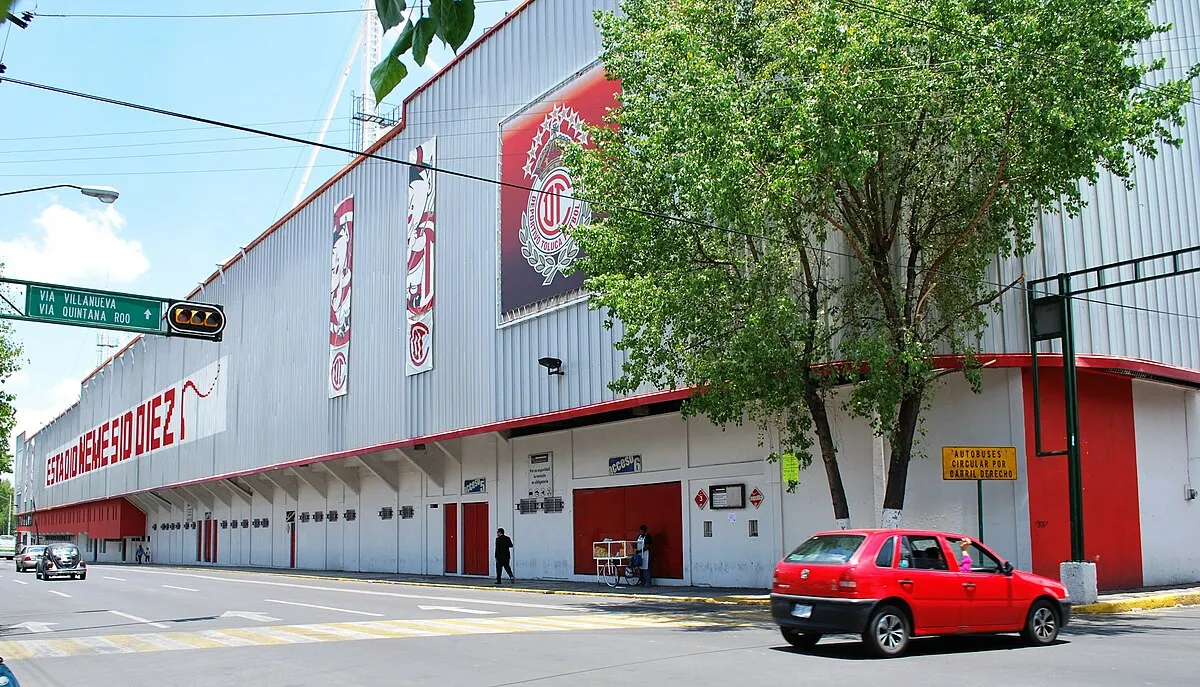
About Estadio Nemesio Díez
Estadio Nemesio Díez stands in the heart of Toluca, the capital of the State of Mexico, just southwest of the city center on Felipe Villanueva 300 in Colonia San Bernardino. With 30,000 seats at 2,670 meters above sea level, this is one of the highest-altitude professional football stadiums in North America — and one of the most feared venues in Mexican football.
Home to Deportivo Toluca F.C. since 1954, the Diablos Rojos (Red Devils) have built a dynasty from this ground. Toluca has claimed 10 Liga MX titles, making them one of the most decorated clubs in the country. The altitude is a genuine weapon: visiting teams struggle to maintain pace in the thin air of the Toluca Valley, and the locals know exactly how to exploit it.
The stadium was completely transformed between 2015 and 2017 in an 800-million-peso renovation. Architects added upper tiers on top of the original single-tier bowl, installed a modern roof supported by four corner columns, and upgraded the venue with LED screens and ambient sound technology. The playing surface is natural grass at 105 x 68 meters. Despite the modernization, the stadium kept its English-style intimacy that makes the atmosphere feel like it is pressing in from all sides.
Two nicknames tell you everything about this place. La Bombonera — The Chocolate Box — describes the compact, steep-walled shape that amplifies noise. El Infierno — Hell — describes what it is like to play here as an opponent. The venue has hosted 7 FIFA World Cup matches across 1970 and 1986, the 1975 Pan American Games, and the 1983 FIFA World Youth Championship.
Getting to Estadio Nemesio Díez
Public Transit
Toluca does not have a metro or light rail system, so intercity buses are your primary transit option. From Mexico City, buses to Toluca depart frequently from the Terminal Poniente (Western Bus Terminal) near the Observatorio metro station on Line 1.
→ From Mexico City (Terminal Poniente): Take a Toluca-bound bus from the western terminal near Observatorio metro. The journey takes approximately 75 minutes and buses leave every 10-15 minutes throughout the day. At the Toluca bus terminal, take a local taxi or rideshare to the stadium — about 3 km.
→ From Toluca City Center: The stadium is a 15-minute walk southwest from the main plaza (Plaza de los Mártires). Head down Calle Santos Degollado or Avenida Hidalgo toward Colonia San Bernardino.
Local buses within Toluca also run along routes passing near the stadium. Ask any driver for “El Estadio” or “La Bombonera” and they will point you to the right stop.
Driving + Parking
Toluca is approximately 65 km west of Mexico City via the Mexico City-Toluca highway (Highway 15D). The toll road cuts through the mountains and takes about an hour without traffic.
→ From Mexico City: Take Highway 15D (the autopista to Toluca). Exit toward Toluca Centro and follow signs to Colonia San Bernardino. The stadium sits on Felipe Villanueva, south of the city center. About 60-90 minutes depending on traffic.
→ From Querétaro (~150 km): Take Highway 55 south through Atlacomulco to Toluca. Continue to the city center and follow signs toward Colonia San Bernardino. Approximately 2 hours.
A nine-level parking structure sits 75 meters east of the stadium with over 500 spaces, connected by two pedestrian bridges. This is the main parking option since the dense residential neighborhood around the stadium leaves no room for surface lots. Arrive at least an hour early — the structure fills up fast on match days.
Rideshare
Uber and DiDi both operate in Toluca. A ride from the Toluca bus terminal to the stadium costs approximately 40-70 MXN ($2-4 USD). From Mexico City, expect to pay significantly more (around 400-600 MXN / $20-35 USD) due to the intercity distance.
Pro tip: After the match, walk a few blocks away from the stadium before requesting a ride. The narrow streets around La Bombonera get extremely congested.
From the Airport
→ Toluca International Airport (TLC): 14 km northwest, about 20-25 minutes by car or rideshare. Limited commercial flights — primarily Volaris domestic routes and some international charters.
→ Mexico City International Airport (MEX): 80 km east, approximately 90 minutes by car. This is the main arrival point for international visitors. Take a taxi or bus to Terminal Poniente, then a bus to Toluca (see Public Transit above).
Playing at Altitude: The Toluca Advantage
At 2,670 meters above sea level, Estadio Nemesio Díez sits higher than Denver’s Mile High Stadium, higher than Mexico City’s Estadio Azteca, and higher than virtually every other Liga MX venue. The thin air here contains roughly 25% less oxygen than at sea level, and the effects on unacclimatized athletes are real and immediate: faster fatigue, heavier breathing, and a ball that moves differently through the thinner atmosphere.
Toluca’s players train at this altitude year-round. They’re adapted. Their opponents are not. Over the decades, this advantage has helped the Diablos Rojos compile one of the strongest home records in Mexican football. Visiting teams from coastal cities like Veracruz or Acapulco feel the altitude within 20 minutes. Even clubs from Mexico City — already at 2,240 meters — notice the additional 430-meter jump.
For fans, the altitude is noticeable but manageable. Stay hydrated, take it easy walking up the stands, and don’t be surprised if you feel slightly lightheaded after climbing to the upper tier. The intensity of the atmosphere inside La Bombonera more than compensates.
History of Estadio Nemesio Díez
The site has been Toluca’s sporting home since 1919, but the modern stadium was inaugurated on August 8, 1954, as Estadio Club Deportivo Toluca. The club had purchased the ground a year earlier and transformed it into their first private venue.
- Name Changes (1954-2000): The stadium cycled through six names — Estadio Héctor Barraza (1955), Estadio Luis Gutiérrez Dosal (1959), Estadio Toluca 70 (1970), and Estadio Toluca 70-86 (1986). After the death of club owner Nemesio Díez Riega in June 2000, it received its current name.
- 1970 FIFA World Cup: Hosted 4 matches including the quarterfinal between Italy and Mexico, which Italy won 4-1 in front of heartbroken Mexican fans. Also hosted three Group 2 matches featuring Israel, Sweden, Italy, and Uruguay.
- 1986 FIFA World Cup: Hosted 3 Group F matches — Paraguay vs. Iraq (1-0), Belgium vs. Iraq (2-1), and Paraguay vs. Belgium (2-2).
- 1975 Pan American Games: Served as a venue for the football tournament held in Mexico City and surrounding cities.
- 1983 FIFA World Youth Championship: Hosted youth tournament matches, continuing the stadium’s tradition of international football.
- 2015-2017 Renovation: An 800-million-peso overhaul added upper tiers, a four-column roof, LED technology, and expanded capacity to 30,000. The remodeled stadium reopened on January 15, 2017, with a Liga MX match against Club América — which Toluca won.
Through seven decades, Estadio Nemesio Díez has witnessed Toluca’s rise from a provincial club to one of Mexican football’s most successful franchises. The Diablos Rojos have lifted 10 Liga MX trophies, and every one of those championship runs was built on the foundation of this high-altitude fortress. La Bombonera isn’t just a stadium — it’s the heartbeat of Toluca.
Photo Gallery
Fun Facts
Estadio Nemesio Díez sits at 2,670 meters (8,750 feet) above sea level — making it one of the highest-altitude professional football stadiums in North America and a nightmare for visiting teams.
The stadium has gone through six different names since 1954 and earned two nicknames: La Bombonera (The Chocolate Box) for its shape and atmosphere, and El Infierno (Hell) for how difficult it is to win here.
StadiumDB's 2017 public vote named Estadio Nemesio Díez the second-best remodeled stadium in the world, after an 800-million-peso renovation that added upper tiers and a modern roof.
Stadium Location
Frequently Asked Questions
- What is the capacity of Estadio Nemesio Díez?
- Estadio Nemesio Díez has a current capacity of 30,000 following a major renovation completed in January 2017. The renovation added upper tiers on top of the original single-tier stands and installed a modern roof supported by four corner columns.
- Why is Estadio Nemesio Díez called La Bombonera?
- The stadium earned the nickname La Bombonera (The Chocolate Box) due to its compact, steep-sided shape and intense atmosphere — similar to the famous Boca Juniors stadium in Buenos Aires. Its full nickname is La Bombonera de Toluca.
- How do I get to Estadio Nemesio Díez from Mexico City?
- Take a bus from Mexico City's Terminal Poniente (near the Observatorio metro station). Buses to Toluca depart very frequently and the journey takes about 75 minutes. From the Toluca bus terminal, take a taxi or rideshare to the stadium (about 3 km), or catch a local bus toward the city center and walk.
- What is the altitude of Estadio Nemesio Díez?
- The stadium sits at approximately 2,670 meters (8,750 feet) above sea level in the Toluca Valley. The thin air at this altitude significantly affects physical performance, giving the home team a notable advantage over visiting clubs not accustomed to the elevation.
- Is there parking at Estadio Nemesio Díez?
- Yes. A nine-level parking structure with over 500 spaces is located 75 meters east of the stadium, connected by two pedestrian bridges. Arrive early on match days as spaces fill up quickly. Limited street parking is also available in surrounding neighborhoods.
- Did Estadio Nemesio Díez host FIFA World Cup matches?
- Yes. The stadium hosted 3 group stage matches plus the Italy-Mexico quarterfinal (4-1) during the 1970 FIFA World Cup, and 3 group stage matches during the 1986 FIFA World Cup — 7 World Cup matches in total.
- When was Estadio Nemesio Díez renovated?
- The stadium underwent a major renovation from 2015 to 2017, costing approximately 800 million Mexican pesos (~40 million USD). The project added upper tiers, a new roof, upgraded technology with LED screens and ambient sound systems, and increased capacity to 30,000.
- What teams play at Estadio Nemesio Díez?
- Deportivo Toluca F.C., known as the Diablos Rojos (Red Devils), is the sole tenant. Toluca is one of the most successful clubs in Mexican football with 10 Liga MX titles. The stadium has been their home since 1954.
Last updated: 2026-03-01