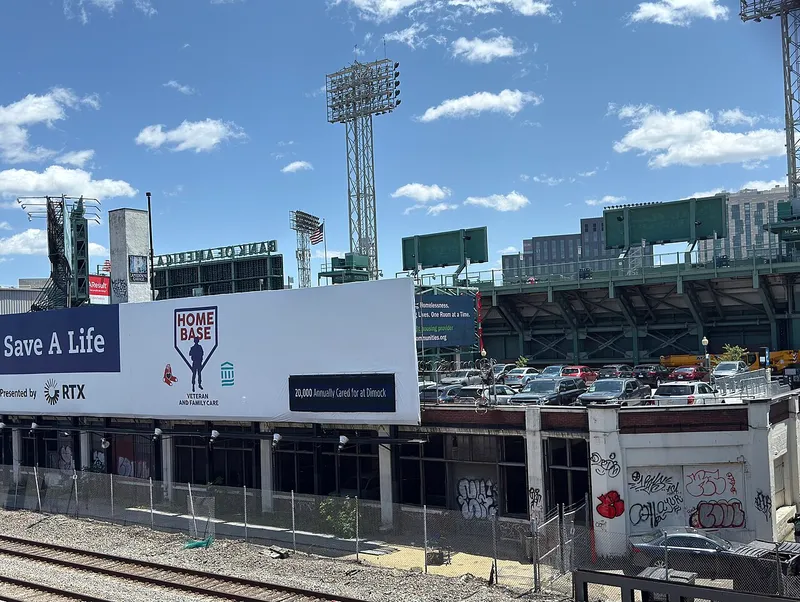
About Fenway Park
Fenway Park sits in the heart of Boston’s Fenway-Kenmore neighborhood, wedged between Lansdowne Street and Jersey Street on land that was marshland a century ago. With 37,755 seats, it’s one of the smallest parks in Major League Baseball — and that intimacy is exactly the point. There is no bad seat here, just varying degrees of closeness to something legendary.
The park is home to the Boston Red Sox, who have played here since April 20, 1912 — five days after the Titanic sank. That makes Fenway the oldest active ballpark in Major League Baseball, now in its 114th year of continuous operation. It was added to the National Register of Historic Places in 2012.
The defining feature is the Green Monster: a 37-foot-2-inch left-field wall that turns routine fly balls into doubles and line drives into outs. The wall still houses a hand-operated scoreboard — one of only two remaining in MLB — where operators work inside the wall, sliding 2-pound metal number plates by hand. Premium seating atop the Monster, added in 2003, quickly became the most coveted tickets in baseball.
The field is 100% Kentucky Bluegrass, completely replaced in 2005 with new sand-based growing medium and laser-leveled drainage. The outfield dimensions are wildly asymmetric: 310 feet down the left-field line, 390 to center, and just 302 to Pesky’s Pole in right — creating a playing surface unlike any other in the sport.
Getting to Fenway Park
Public Transit
The MBTA is the best way to reach Fenway Park. Two stations serve the park directly, and the Green Line gets you there from almost anywhere in Boston.
→ From Downtown Boston: Take the Green Line (B, C, or D branch) to Kenmore Station, a 5-minute walk from the main gates on Jersey Street.
→ Via Commuter Rail: The Framingham/Worcester Line stops at Lansdowne Station, directly across the street from the park. One of the most convenient commuter rail-to-stadium connections in baseball.
The Green Line gets extremely crowded on game days. Arriving early makes a real difference — and gives you time to walk Lansdowne Street, which comes alive with bars and street vendors on game nights.
Driving + Parking
Fenway Park is located at 4 Jersey Street, Boston, MA 02215. The park sits in a dense urban neighborhood — street parking is essentially nonexistent on game days.
→ From the West (I-90): Take I-90 East (Mass Turnpike) to the Cambridge/Allston exit. Bear right toward Storrow Drive East, take the Fenway exit.
→ From the North (I-93): Take I-93 South to Storrow Drive West. Continue to the Fenway exit, turn left onto Boylston Street.
The closest garages are the Fenway Triangle Garage (180 Brookline Ave, $45-55) and Lansdowne Garage on Lansdowne Street ($40-55). Both fill quickly. The Prudential Center Garage (800 Boylston St) offers a $20 rate when you scan a same-day Red Sox ticket at exit — it’s a mile walk but the best deal around. Pre-book through SpotHero to guarantee a spot.
Rideshare
Uber and Lyft have designated pickup and drop-off zones at Boylston Street and Kilmarnock Street, enforced 5:00 PM to 8:00 AM daily. A ride from downtown Boston runs $12-20; from Logan Airport, $25-40. Post-game surge pricing is common — grabbing a meal on Lansdowne Street first can save you real money.
From the Airport
→ Boston Logan (BOS): 5 miles, 15-25 minutes by car. By transit: Blue Line from Airport station to Government Center, transfer to Green Line to Kenmore — about 35 minutes total.
→ T.F. Green Airport (PVD): 62 miles, approximately 75 minutes by car from Providence.
→ Manchester-Boston Regional (MHT): 55 miles, approximately 70 minutes by car from New Hampshire.
Legacy of Fenway Park
Fenway Park is more than a ballpark — it’s the longest-running drama in American sports. The same walls that watched Babe Ruth pitch for the Red Sox in 1914 saw David Ortiz lift the curse 90 years later. No other active stadium carries that kind of weight.
The Curse and the Comeback: When Harry Frazee sold Babe Ruth to the Yankees in 1920 — using Fenway Park itself as collateral for the loan — he set off 86 years of heartbreak. The Red Sox reached the World Series four times between 1946 and 1986, losing each time in seven games. The 2004 ALCS changed everything: down 3-0 to the Yankees, Boston became the first team in MLB history to win a series after such a deficit. They swept the Cardinals to win their first championship since 1918, and the celebrations on Jersey Street lasted until dawn.
The Save Fenway Movement: In 1999, ownership announced plans to demolish the park and build new. The grassroots “Save Fenway Park!” campaign fought back. When John Henry’s group purchased the Red Sox in 2002, they committed to preservation over demolition. Architect Janet Marie Smith led a decade-long, $270 million renovation that added the Monster Seats, expanded concourses, and modernized infrastructure — all while keeping what makes Fenway irreplaceable.
The Concert Tradition: Since Bruce Springsteen played the first major concert here in 2003, Fenway has become one of the premier concert venues in the Northeast. The annual summer series has hosted the Rolling Stones, Paul McCartney, Taylor Swift, and Lady Gaga, who became the first woman to headline in 2017.
History of Fenway Park
Fenway Park was built in the winter of 1911-12 on a plot of filled marshland in Boston’s Fenway neighborhood. Architect James E. McLaughlin designed the park for owner John I. Taylor at a cost of $650,000. It opened on April 20, 1912, with the Red Sox defeating the New York Highlanders 7-6 in 11 innings — a game that barely made the papers because the Titanic had sunk five days earlier.
The park’s early decades were marked by fire, transformation, and one catastrophic transaction. A 1934 fire during renovations led owner Tom Yawkey to rebuild the flammable wooden left-field wall as the concrete and tin structure that became the Green Monster. The hand-operated scoreboard went in. “Duffy’s Cliff” — a 10-foot slope at the wall’s base — was leveled. Night baseball arrived in 1947, and that same year the left-field wall was painted green for the first time.
Notable events at Fenway Park:
- Carlton Fisk’s Walk-Off (October 21, 1975): His 12th-inning home run in World Series Game 6, waved fair with frantic body language, remains one of baseball’s most iconic moments.
- Ted Williams Farewell (September 28, 1960): Williams homered in his final career at-bat, then refused to tip his cap — “Gods do not answer letters,” wrote John Updike.
- 1999 All-Star Game (July 13, 1999): Ted Williams, in a wheelchair, threw out the first pitch in an emotional ceremony. Pedro Martinez struck out 5 of 6 batters and won MVP.
- 2004 ALCS Games 4 & 5 (October 17-20, 2004): Dave Roberts’ stolen base, David Ortiz’s walk-off hits, and Curt Schilling’s bloody sock began the greatest comeback in postseason history.
- 2013 World Series (October 30, 2013): The Red Sox defeated the Cardinals 6-1 in Game 6, clinching on home soil for the first time since 1918.
Fenway was added to the National Register of Historic Places on March 7, 2012, during its centennial year. A $1.6 billion mixed-use development called Fenway Corners is now planned for adjacent land, with construction beginning in 2026. The park itself isn’t going anywhere. It’s survived fires, floods of tears, and 86 years between championships. It will outlast us all.
Photo Gallery
Fun Facts
The Green Monster stands 37 feet 2 inches tall and still features a hand-operated scoreboard — one of only two remaining in MLB — with the initials of former owners Tom and Jean Yawkey encoded in Morse code.
Section 42, Row 37, Seat 21 — the lone red seat in a sea of green — marks the landing spot of Ted Williams' 502-foot home run on June 9, 1946, the longest ever hit at Fenway.
Pesky's Pole, the right-field foul pole, sits just 302 feet from home plate — one of the shortest home run distances in Major League Baseball — named after Johnny Pesky, who hit only 6 career home runs at Fenway.
Stadium Location
Frequently Asked Questions
- How old is Fenway Park?
- Fenway Park opened on April 20, 1912, making it over 113 years old. It is the oldest active Major League Baseball stadium in the United States.
- What is the Green Monster?
- The Green Monster is Fenway Park's iconic 37-foot-2-inch left-field wall. Built of concrete and tin in 1934, it features a hand-operated scoreboard and premium seating added in 2003.
- How do I get to Fenway Park by public transit?
- Take the MBTA Green Line (B, C, or D branches) to Kenmore Station, a 5-minute walk from the park. The Framingham/Worcester Commuter Rail stops at Lansdowne Station directly across the street.
- Are Fenway Park tours available?
- Yes. Tours depart daily from Gate D on the hour, starting at 9:00 AM. Tours last about 50 minutes and cost $25 for adults and $17 for children ages 3-12.
- Can you bring bags into Fenway Park?
- Bags must be single-compartment and no larger than 12 by 12 by 6 inches. Backpacks, multi-compartment bags, and duffel bags are not permitted.
- Is Fenway Park the smallest MLB stadium?
- Fenway is one of the smallest but not the absolute smallest. With a capacity of 37,755, it ranks among the five smallest MLB parks. Its intimate size creates one of the most electric atmospheres in baseball.
- What is Pesky's Pole?
- Pesky's Pole is the right-field foul pole, located just 302 feet from home plate. It is named after Red Sox player and coach Johnny Pesky and was officially dedicated in 2006.
- How much does parking cost near Fenway Park?
- Parking near Fenway on game days ranges from $40 to $55 at nearby garages. The Prudential Center Garage offers a $20 rate with a same-day Red Sox ticket. Pre-booking through SpotHero is recommended.
Last updated: 2026-02-20