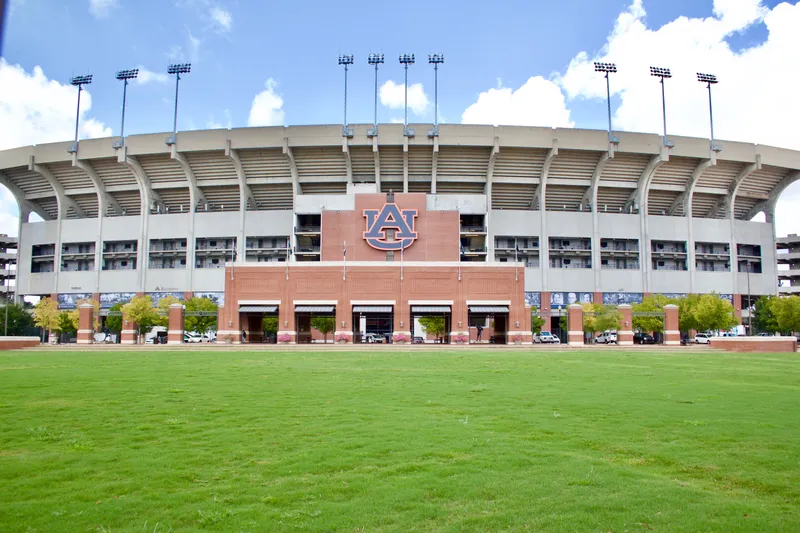
About Jordan-Hare Stadium
Jordan-Hare Stadium sits on the Auburn University campus in eastern Alabama — an 88,043-seat fortress where the Auburn Tigers play football and where two of the most famous plays in college football history have unfolded. On game days, the stadium’s capacity exceeds the population of the city itself, turning Auburn into Alabama’s fifth-largest city for three and a half hours every Saturday in the fall.
The stadium opened in 1939 as Auburn Stadium with just 7,500 seats, built on a hillside that would grow through nearly a century of expansions into one of the 15 largest stadiums in America. It was renamed Cliff Hare Stadium in 1949 and became Jordan-Hare Stadium in 1973 — the first stadium in the United States named for an active coach, honouring Ralph “Shug” Jordan while he was still on the sideline. The playing surface was named Pat Dye Field in 2005.
The Iron Bowl — Auburn vs. Alabama — defines this place. For decades, the rivalry was played exclusively at Legion Field in Birmingham. On December 2, 1989, the Iron Bowl finally came to Jordan-Hare, and Auburn christened the occasion with a 30-20 upset of undefeated #2 Alabama. The “Prayer at Jordan-Hare” (2013, Ricardo Louis’s tipped Hail Mary against Georgia) and the “Kick Six” (2013, Chris Davis’s 109-yard return of a missed Alabama field goal as time expired) cemented this stadium as a place where the impossible happens.
From Shug Jordan’s coaching legacy to the Kick Six to 88,000 fans rolling Toomer’s Corner after every win, Jordan-Hare Stadium is where Auburn football lives — loud, loyal, and capable of producing moments that change the sport.
Getting to Jordan-Hare Stadium
Public Transit
Auburn has no public rail transit. The university operates free shuttle buses and a paid shuttle service on game days.
→ Via Tiger Transit: Free game-day shuttle buses run from remote parking areas across campus to stadium drop-off points. Service begins 4 hours before kickoff and continues for 2 hours after the game.
→ Via Slidr Shuttle: Paid shuttle service ($3/person) operates within the stadium security perimeter. Available via the Slidr app. Service begins 3 hours before kickoff.
There is no practical public transit from Atlanta, Birmingham, or Montgomery to Auburn. Everyone drives. On game days, the two-lane roads into Auburn create severe bottlenecks — arrive at least 3 hours before kickoff.
Driving + Parking
The stadium is at 251 South Donahue Drive, Auburn, AL 36849. I-85 is the primary approach from all directions.
→ From Atlanta (~108 mi): I-85 South to Auburn exits. About 1 hour 40 minutes.
→ From Birmingham (~109 mi): US-280 East to Auburn. About 2 hours.
→ From Montgomery (~55 mi): I-85 North to Auburn. About 55 minutes.
Free lots include Hayfields, Community Gardens, and Research Park — first-come, first-served, opening Friday before home games. Reserved passes average ~$81 per game. RV parking is available at Hayfields and Community Gardens. Tailgating is permitted in free lots on Fridays; open-flame grills are generally prohibited.
Rideshare
Uber and Lyft operate in Auburn with designated pickup/drop-off zones at Wire Road and War Eagle Way, and at Duncan Drive and Samford Drive. Expect $8–$15 from nearby hotels. Post-game surge pricing is heavy — walk away from the stadium before requesting a ride.
From the Airport
→ Hartsfield-Jackson Atlanta International (ATL): 108 miles east, about 1 hour 40 minutes by car on I-85. The closest major hub with extensive domestic and international service. Rental car required.
→ Montgomery Regional (MGM): 57 miles south, about 55 minutes by car. Limited commercial service with connecting flights through Dallas and Charlotte. Rideshare runs $50–$70.
History of Jordan-Hare Stadium
Jordan-Hare Stadium opened in 1939 as Auburn Stadium — a 7,500-seat venue built on the Auburn University campus. The first varsity game, on November 30, 1939, ended in a 7-7 tie against Florida on Thanksgiving Day. The stadium was renamed Cliff Hare Stadium in 1949 after a former faculty chairman of athletics, and decades of expansions turned it from a modest grandstand into one of the largest stadiums in the South.
Jordan-Hare Naming (1973): The stadium was renamed for coach Ralph “Shug” Jordan while he was still active — the first stadium in American history named for a sitting head coach. Jordan coached Auburn for 25 seasons and compiled a 176-83-6 record.
First Iron Bowl at Jordan-Hare (December 2, 1989): Auburn defeated undefeated #2 Alabama 30-20 in the first Iron Bowl ever played on Auburn’s campus, ending decades of the rivalry being held exclusively at Legion Field in Birmingham.
Prayer at Jordan-Hare (November 16, 2013): Ricardo Louis caught a tipped Hail Mary pass for a last-second touchdown, and Auburn defeated #5 Georgia 43-38 in one of the wildest finishes in SEC history.
Kick Six (November 30, 2013): Chris Davis returned a missed 57-yard Alabama field goal 109 yards for a touchdown as time expired. #4 Auburn upset #1 Alabama 34-28 in what is widely considered the greatest single play in college football history.
From Shug Jordan’s 25 seasons to the first Iron Bowl on campus to the Kick Six, Jordan-Hare Stadium is where Auburn’s identity lives — a place where the impossible has happened more than once, where 88,000 fans in orange and blue create one of the most hostile environments in the SEC, and where the toilet paper at Toomer’s Corner is always ready.
Photo Gallery
Fun Facts
On game days, Jordan-Hare Stadium becomes Alabama's fifth-largest city — its 88,043 capacity exceeds the population of Auburn itself (~65,000 residents) and surpasses cities like Hoover, Tuscaloosa, and Decatur.
In 1973, Jordan-Hare became the first stadium in the United States named for an active coach — Ralph 'Shug' Jordan was still coaching when the university added his name, setting a precedent no other school had attempted.
The 'Kick Six' — Chris Davis's 109-yard return of a missed Alabama field goal as time expired on November 30, 2013 — is widely considered the greatest single play in college football history and it happened right here in Jordan-Hare.
Stadium Location
Frequently Asked Questions
- What is the seating capacity of Jordan-Hare Stadium?
- Jordan-Hare Stadium seats 88,043 fans, making it one of the 15 largest stadiums in the United States. The record attendance of 88,043 was set in September 2023 during the Auburn vs. UMass game. The stadium has expanded multiple times from its original 7,500 seats in 1939.
- Where is Jordan-Hare Stadium located?
- Jordan-Hare Stadium is at 251 South Donahue Drive on the Auburn University campus in Auburn, Alabama 36849. It sits in the centre of campus, about 55 miles northeast of Montgomery and 108 miles southwest of Atlanta on I-85.
- What is the Kick Six?
- On November 30, 2013, Auburn's Chris Davis returned a missed 57-yard Alabama field goal attempt 109 yards for a touchdown as time expired, giving #4 Auburn a 34-28 upset over #1 Alabama. It is widely considered one of the greatest plays in college football history.
- When was the first Iron Bowl at Jordan-Hare?
- The first Iron Bowl played at Jordan-Hare was December 2, 1989. Auburn defeated undefeated #2 Alabama 30-20, ending decades of the rivalry being played exclusively at Legion Field in Birmingham. It was a watershed moment for the Auburn program.
- How do I get to Jordan-Hare Stadium?
- Most fans drive via I-85 — Auburn is 108 miles from Atlanta, 109 miles from Birmingham, and 55 miles from Montgomery. Tiger Transit runs free game-day shuttles starting 4 hours before kickoff. Rideshare pickup/drop-off zones are at Wire Road and War Eagle Way.
- Is there parking at Jordan-Hare Stadium?
- Free lots include Hayfields, Community Gardens, and Research Park on a first-come, first-served basis. They open Friday before home games. Reserved passes average about $81 per game. RV parking is available at Hayfields and Community Gardens. Arrive early — roads into Auburn are two-lane and congest severely.
- How far is the airport from Jordan-Hare Stadium?
- Hartsfield-Jackson Atlanta International Airport (ATL) is 108 miles east, about 1 hour 40 minutes by car on I-85. Montgomery Regional Airport (MGM) is 57 miles south, about 55 minutes. Most visitors fly into Atlanta for the best flight options.
Last updated: 2026-03-06