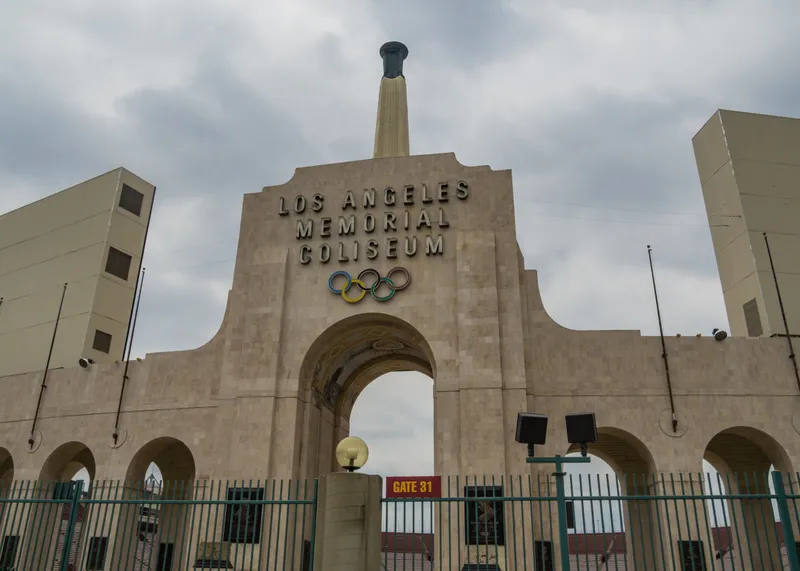
About the LA Memorial Coliseum
The Los Angeles Memorial Coliseum stands in Exposition Park on the edge of the USC campus — the most historically significant stadium in America. Built in 1923 as a memorial to World War I veterans, it is the only venue on earth to have hosted two Olympic Games, two Super Bowls, a World Series, and a Papal Mass. When the 2028 Olympics arrive, it will become the first stadium to host three.
The Coliseum is home to the USC Trojans, one of college football’s most storied programs. On fall Saturdays, 77,500 fans fill the peristyle-crowned bowl while the iconic Olympic cauldron flickers above the east colonnade. The stadium has also served as home to the LA Rams (most recently 2016-2019), the LA Dodgers during their first four seasons after moving from Brooklyn, and the LA Raiders from 1982 to 1994.
Designed by architects John and Donald Parkinson, the original Coliseum was built in just 16 months at a cost of $954,873 and opened on May 1, 1923. A $315 million renovation completed in 2019 — funded entirely by USC — added 42 luxury suites, 1,100 club seats, loge boxes, a rooftop terrace, and new HD video boards while preserving the historic character that earned it National Historic Landmark status in 1984.
The Coliseum’s resume of events is unmatched. The 1932 and 1984 Olympics, Super Bowls I and VII, the 1959 World Series (Game 5 drew 92,706 — still a record), JFK’s acceptance speech, Billy Graham’s record-setting 134,254 attendance, and NASCAR races built inside the stadium bowl. No other venue comes close.
Getting to the LA Memorial Coliseum
Public Transit
The Coliseum is one of the best transit-connected stadiums in the country, with a Metro station steps from the gates.
→ Via Metro E Line: Take the E Line to Expo Park/USC station — a 5-minute walk to the entrance gates. The E Line runs from East LA to Santa Monica, connecting at 7th St./Metro Center in Downtown LA. Fare: $1.75 per ride.
→ Via Metro J Line (Silver): Exit at 37th St./USC station along the I-110 ExpressLanes, then walk a few blocks via Flower Street.
→ Via Metrolink Regional Rail: Take any Metrolink line to LA Union Station, then transfer to the Metro E Line. Serves Los Angeles, Orange, Riverside, San Bernardino, and Ventura counties.
Enhanced Metro service runs 2–3 hours before kickoff and 1–2 hours post-game. Last E Line trains depart Expo Park around 11:50 PM eastbound and 12:10 AM westbound.
Driving + Parking
The Coliseum is at 3911 S. Figueroa Street, Los Angeles, CA 90037, just off the I-110 and I-10 freeways.
→ From Downtown LA (~4 mi): Head south on I-110 to the Exposition Blvd exit. Turn right on Exposition, then left on Figueroa. About 10–15 minutes without traffic.
→ From Anaheim / Orange County (~27 mi): Take I-5 North to CA-60 West, merge onto I-110 North. Exit at MLK Jr. Blvd or Exposition Blvd. About 35–45 minutes.
→ From Pasadena (~14 mi): Take I-110 South through Downtown LA. Exit at Exposition Blvd. About 18–30 minutes.
For USC games and major events, Exposition Park lots require pre-purchased permits ($30–$50+). Third-party lots are available via ParkWhiz or SpotHero. The Coliseum strongly encourages taking Metro to avoid LA traffic.
Rideshare
Uber and Lyft drop-off is available along Expo Park Drive from Figueroa Street. Post-event pickup is at Vermont Avenue between Exposition Blvd and Downey Way. Rideshare services cannot enter Exposition Park until 45–60 minutes after events. A ride from Downtown LA runs $12–$20; from LAX about $25–$40.
From the Airport
→ Los Angeles International (LAX): 12 miles, about 20–30 minutes by car. Rideshare from LAX averages $25–$40. Public transit from LAX takes about 1 hour 20 minutes via Metro connections.
→ Hollywood Burbank (BUR): 18 miles, about 25–35 minutes. Good for Southwest Airlines and JetBlue travelers.
→ Long Beach (LGB): 22 miles, about 25–35 minutes. Budget-friendly option via JetBlue and Southwest.
→ Ontario International (ONT): 45 miles, about 45–60 minutes. Serves the Inland Empire and offers competitive fares.
Legacy of the LA Memorial Coliseum
No stadium in America has hosted more historically significant events across more decades. The Coliseum’s resume transcends sports: it is where JFK accepted the Democratic presidential nomination in 1960, where Martin Luther King Jr. spoke, where Pope John Paul II celebrated Mass before 103,854 in 1987.
The Olympic connection is unbreakable. The 1932 Games brought the peristyle and Olympic cauldron. The 1984 Games brought a National Historic Landmark designation. The 2028 Games will make this the only three-time Olympic venue in the world. Today, the cauldron is still lit during the fourth quarter of every USC home game — a living link to the stadium’s Olympic heritage.
Beyond the Olympics, the Coliseum has also reinvented itself in recent years. NASCAR built a quarter-mile track inside the bowl for the Busch Light Clash in 2022, 2023, and 2024 — the first NASCAR race inside a stadium since 1956. It remains a concert venue for the biggest acts in the world, from Depeche Mode to Metallica.
History of the LA Memorial Coliseum
The Los Angeles Memorial Coliseum was commissioned in 1921 as a memorial to LA veterans of World War I. Architects John and Donald Parkinson designed an elliptical bowl inspired by ancient Roman amphitheaters, built with reinforced concrete — 1,038 feet long, 738 feet wide, with the field excavated 32 feet below grade. It was completed in just 16 months at a cost of $954,873 and opened on May 1, 1923.
1932 Summer Olympics (July 30 – August 14, 1932): The Coliseum was expanded to 101,574 seats. The iconic peristyle colonnade and Olympic cauldron were added for these Games.
1959 World Series: The Dodgers hosted the White Sox at the Coliseum. Game 5 drew 92,706 fans — a World Series attendance record that still stands and likely can never be broken in a modern baseball park.
Super Bowl I (January 15, 1967): Green Bay Packers defeated the Kansas City Chiefs 35-10 in the first AFL-NFL championship before 61,946 fans.
Super Bowl VII (January 14, 1973): Miami Dolphins beat Washington 14-7, completing the NFL’s only perfect season (17-0).
1984 Summer Olympics (July 28 – August 12, 1984): The Coliseum hosted its second Olympic Games. Designated a National Historic Landmark one day before the opening ceremony.
$315M Renovation (2018-2019): DLR Group led a two-year modernization funded by USC: all new seating, 42 luxury suites, club seats, loge boxes, a rooftop terrace, and HD jumbotrons — all while preserving the historic peristyle.
The Coliseum endures because it refuses to become a relic. A century after its opening, it remains LA’s grandest stage — and in 2028, the world will return here once more.
Photo Gallery
Fun Facts
The LA Memorial Coliseum will become the only stadium in the world to host three Olympic Games when the 2028 Games arrive (1932, 1984, 2028).
The iconic Olympic cauldron atop the peristyle is lit during the fourth quarter of every USC home game and on special occasions when Olympic Games are held elsewhere.
The all-time Coliseum attendance record is 134,254, set on September 8, 1963, for the final day of Reverend Billy Graham's crusade — not a sporting event.
Stadium Location
Frequently Asked Questions
- What is the seating capacity of the LA Memorial Coliseum?
- The current capacity is 77,500, which includes 42 luxury suites, 1,100 club seats, 24 loge boxes, and a 500-person rooftop terrace following the $315 million renovation completed in 2019.
- Is the LA Memorial Coliseum hosting the 2028 Olympics?
- Yes. The Coliseum will host the opening and closing ceremonies of the 2028 Los Angeles Olympic Games, making it the first stadium in history to host three Olympic Games (1932, 1984, and 2028).
- How do I get to the LA Coliseum by public transit?
- Take the Metro E Line to the Expo Park/USC or Expo/Vermont station, both less than a 5-minute walk from the stadium. The E Line connects to Downtown LA at 7th St./Metro Center. A one-way TAP fare is $1.75.
- How much does parking cost at the LA Coliseum?
- For USC football games, most Exposition Park lots require pre-purchased permits at $30-$50+. For smaller events, public parking ranges from $15-$30. The Coliseum strongly recommends taking public transit.
- Who plays at the LA Memorial Coliseum?
- The USC Trojans football team (NCAA/Big Ten) is the primary tenant. The stadium has also hosted the LA Rams (most recently 2016-2019), NASCAR Busch Light Clash races, and major concerts.
- Why is the LA Coliseum a National Historic Landmark?
- The Coliseum was designated a National Historic Landmark on July 27, 1984, for its architectural significance (designed by John and Donald Parkinson in 1923), its role as a World War I memorial, and its unmatched history of hosting globally significant events.
Last updated: 2026-02-26