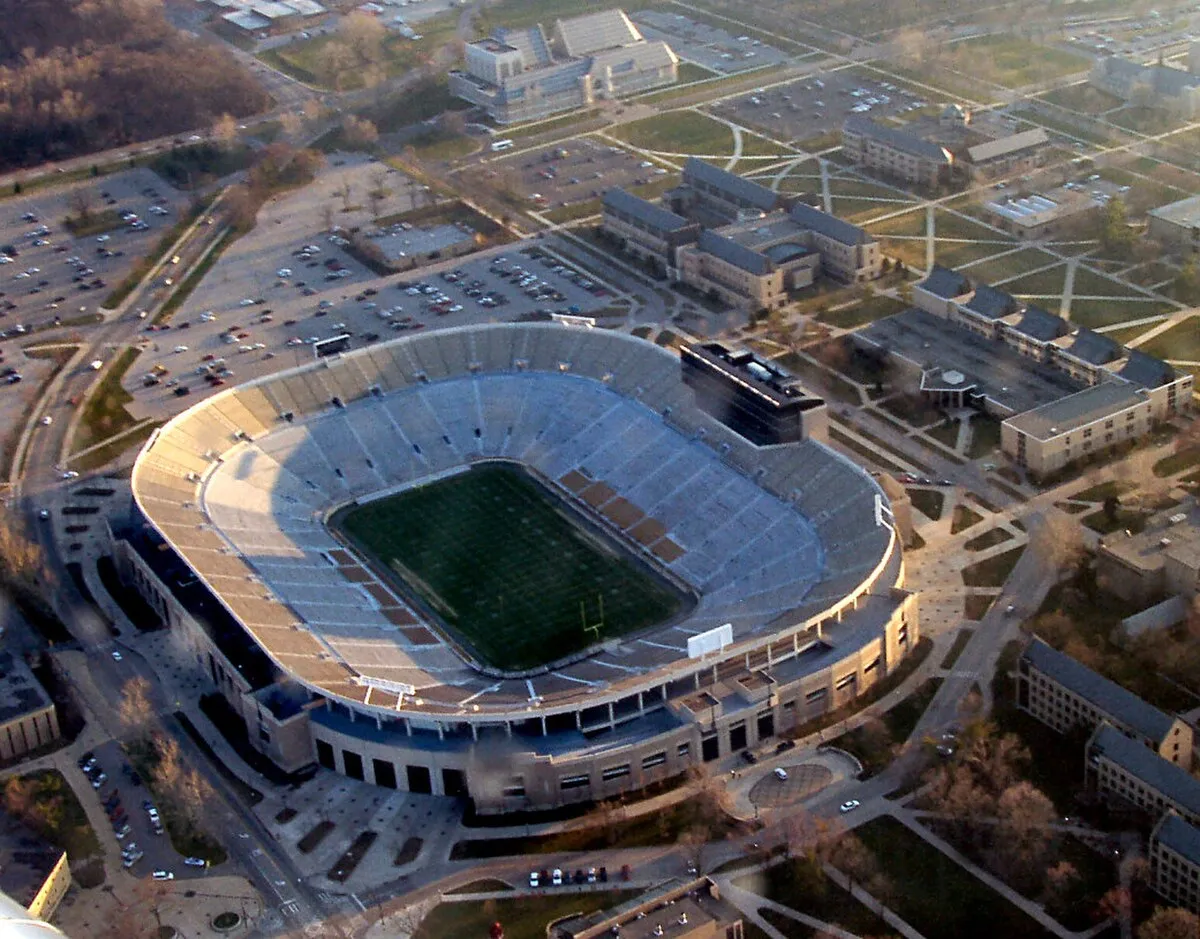
About Notre Dame Stadium
Notre Dame Stadium sits at the heart of one of the most beautiful college campuses in America, in the small community of Notre Dame, Indiana, about four miles north of downtown South Bend and 95 miles east of Chicago. At 77,622 seats, it’s not the biggest stadium in college football — but it might be the most storied.
Known as The House That Rockne Built, the stadium was designed in 1929 at the direction of legendary coach Knute Rockne, who insisted that every seat be as close to the field as possible. Osborn Engineering — the same firm behind Yankee Stadium and the original Comiskey Park — drew up the plans, modeling it after Michigan Stadium on a smaller scale. Construction took just six months. Rockne never saw a full season in his stadium — he died in a plane crash on March 31, 1931.
The $400 million Campus Crossroads project (2014-2017) transformed the stadium’s exterior by anchoring three buildings to the south, east, and west sides: O’Neill Hall, Corbett Family Hall, and Duncan Student Center. Together they added 800,000+ square feet of academic, student life, and hospitality space. Inside the bowl, bench seating was widened from 16 to 18 inches, actually reducing capacity from 80,795 to 77,622. The field was converted from natural grass to FieldTurf in 2014 after 84 seasons on real turf.
And then there’s Touchdown Jesus. The Word of Life mural on the south wall of the Hesburgh Library — 134 feet tall, 68 feet wide, 324 granite panels — is visible from inside the stadium and appears in every television broadcast of a Notre Dame home game. Its arms raised, it looks like Christ is calling a touchdown.
Getting to Notre Dame Stadium
Public Transit
South Bend isn’t a transit metropolis, but the options on game day are solid. South Bend Transpo runs a free Game Day Express shuttle every Notre Dame home Saturday.
→ From Downtown South Bend: The free shuttle stops at the Aloft Hotel, Century Center/Courtyard by Marriott, and DoubleTree along Washington Street, delivering you to McKenna Hall on campus. Runs for 3 hours pre-game, last departure 1 hour before kickoff.
→ From Chicago (~95 mi): The South Shore Line offers special football service from Millennium Station to South Bend Airport station — roughly 2.5 hours. From there, you’ll need a rideshare to campus.
Free flag-down courtesy cart service, driven by green-jacketed Guest Services staff, operates on campus Friday and Saturday before the game.
Driving + Parking
Notre Dame is accessible from I-80/I-90 (Indiana Toll Road). GPS users should enter “2010 Moose Krause Circle, Notre Dame, IN 46556.”
→ From Chicago (~95 mi): Take I-90 East to the Indiana Toll Road (I-80/I-90). Exit 77 (South Bend/Notre Dame). Turn left onto SR 933/US-31 Bus heading north. At Cleveland Road, turn right. At Juniper Road, turn right to reach parking.
→ From Indianapolis (~150 mi): Take US-31 North through South Bend. Continue north past Angela Boulevard to Cleveland Road, turn right. At Juniper Road, turn right.
→ From South Bend (~4 mi): Head north on US-31 Bus/SR-933 to Cleveland Road, turn right, then right on Juniper Road.
Campus lots open at 8 AM. General public parking is available at White Field, Burke Golf Course, Saint Mary’s College, and Holy Cross College for $20-40. Tailgating is a major tradition — lots fill up early, and the scene across campus on a Saturday morning is something every college football fan should experience. Gas grills are allowed; charcoal and deep fryers are not.
Rideshare
Uber and Lyft serve the Notre Dame campus. Post-game pickup is at the Trader Joe’s parking lot south of campus — set your destination to 1140 Howard Street, South Bend, IN 46617.
Pro tip: Pre-game drop-offs work smoothly. Post-game is the challenge — 77,000 fans all leaving at once. Give it 20-30 minutes after the final whistle for the initial crush to clear.
From the Airport
→ South Bend International (SBN): 4 miles south, about 15 minutes by car. Limited carrier service but the most convenient option. Rideshare to campus costs $10-15.
→ Chicago O’Hare (ORD): 90 miles west, about 2.5 hours by car depending on Chicago traffic. Full international carrier service.
→ Chicago Midway (MDW): 95 miles west, about 1 hour 50 minutes by car. Southwest Airlines hub with domestic coverage.
History of Notre Dame Stadium
Knute Rockne wanted a stadium that put fans on top of the action. He worked with Osborn Engineering to design a bowl patterned after Michigan Stadium but more compact, using 2 million bricks, 400 tons of steel, and 15,000 cubic yards of concrete. Sollitt Construction of South Bend broke ground in April 1930 and finished in six months at a cost of over $750,000.
- First Game (October 4, 1930): Notre Dame defeated SMU 20-14. “Jumping Joe” Savoldi scored on a 98-yard kickoff return — the first hero of the new stadium.
- Catholics vs. Convicts (October 15, 1988): No. 4 Notre Dame upset No. 1 Miami 31-30. Pat Terrell knocked down a two-point conversion with 45 seconds left. Notre Dame went on to win the national championship.
- Game of the Century (November 13, 1993): No. 2 Notre Dame upset No. 1 Florida State 31-24 before 80,795 fans. The first remote ESPN College GameDay broadcast.
- The Bush Push (October 15, 2005): No. 1 USC escaped 34-31 when Reggie Bush pushed Matt Leinart into the end zone on 4th-and-goal with 3 seconds left.
- $50 Million Expansion (1994-1997): Added an upper bowl with 21,000+ seats, pushing capacity to 80,795.
- First Concert (October 20, 2018): Garth Brooks performed the first concert in the stadium’s 88-year history, selling out in under two hours.
- NHL Winter Classic (January 1, 2019): Boston defeated Chicago 4-2 before 76,126 fans at Notre Dame Stadium.
- $400 Million Campus Crossroads (2014-2017): Three buildings anchored to the stadium’s exterior, adding 800,000+ sq ft of academic and hospitality space.
Photo Gallery
Fun Facts
Notre Dame Stadium was built in just 6 months in 1930 using over 2 million bricks, 400 tons of steel, and 15,000 cubic yards of concrete — and over 300 workers on site daily.
The home sellout streak lasted 273 consecutive games from 1973 to 2019 — the second-longest in NCAA history behind Nebraska's 373-game streak.
Touchdown Jesus — the Word of Life mural on the Hesburgh Library — stands 134 feet tall and 68 feet wide with 324 individually shaped granite panels, visible from inside the stadium.
Stadium Location
Frequently Asked Questions
- What is the seating capacity of Notre Dame Stadium?
- Notre Dame Stadium holds 77,622 fans following the 2014-2017 Campus Crossroads renovation. Wider seats (expanded from 16 to 18 inches) reduced capacity from the previous 80,795.
- Where is Notre Dame Stadium located?
- Notre Dame Stadium is at 2010 Moose Krause Circle on the University of Notre Dame campus in Notre Dame, Indiana, about 4 miles north of downtown South Bend and 95 miles east of Chicago.
- How do I get to Notre Dame Stadium without a car?
- South Bend Transpo runs a free Game Day Express shuttle from downtown hotels and the Century Center. The South Shore Line offers special football service from Chicago's Millennium Station to South Bend Airport station, about 2.5 hours.
- Is there parking at Notre Dame Stadium?
- Yes. Campus lots open at 8 AM on game day. General public pay-to-park lots are available at White Field, Burke Golf Course, Saint Mary's College, and Holy Cross College for $20-40. Premium lots can run $100+ on resale. RV parking costs $150-275.
- What is Touchdown Jesus?
- Touchdown Jesus is the nickname for the Word of Life mural on the Hesburgh Library's south facade, visible from inside the stadium. The 134-foot-tall mosaic depicts Christ with arms raised, resembling a referee signaling a touchdown. Completed in 1964.
- Why is it called The House That Rockne Built?
- The nickname honors legendary coach Knute Rockne, who played a key role in designing the stadium in 1929-1930. He insisted on keeping fans as close to the field as possible. Rockne died in a plane crash on March 31, 1931, just months after the stadium's first season.
- When was Notre Dame Stadium built?
- Notre Dame Stadium was designed by Osborn Engineering and built by Sollitt Construction in just 6 months in 1930 at a cost of over $750,000. The first game was October 4, 1930 (Notre Dame defeated SMU 20-14). A $400 million Campus Crossroads renovation was completed in 2017.
- Can you bring bags into Notre Dame Stadium?
- Only clear bags no larger than 12x6x12 inches and one-gallon clear zip bags are permitted. Small non-clear clutches no larger than 4.5x6.5 inches are also allowed. Express entry lanes are available for fans with no bags.
Last updated: 2026-02-25