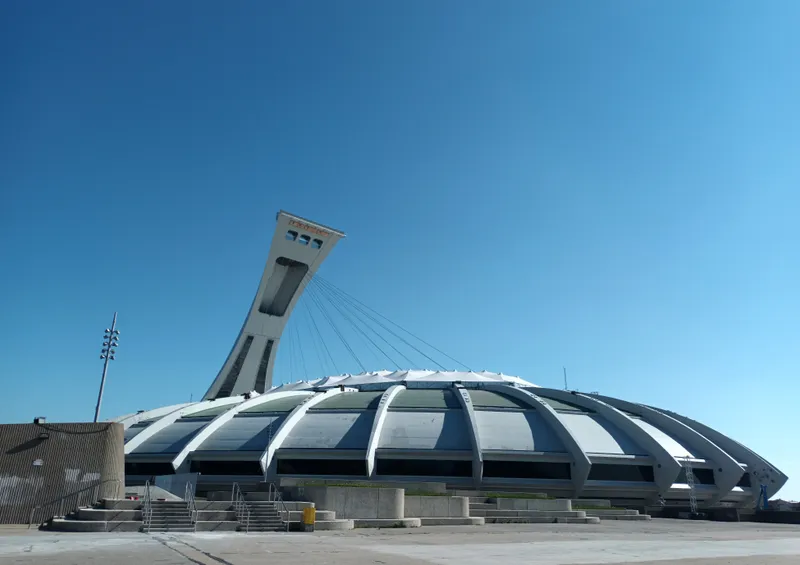
About Olympic Stadium
Olympic Stadium rises from Montreal’s Hochelaga-Maisonneuve neighbourhood — a 56,000-seat concrete colossus built for the 1976 Summer Olympics and topped by the world’s tallest inclined tower. It is one of the most architecturally ambitious and financially controversial stadiums ever built, and nearly fifty years after the Games, it remains one of the most recognizable structures in Canada.
Designed by French architect Roger Taillibert, the stadium was the centrepiece of the 1976 Montreal Olympics. It hosted the opening and closing ceremonies, track and field events, and football matches. After the Games, the Montreal Expos played here from 1977 to 2004, and the Montreal Alouettes of the CFL and CF Montréal of MLS have used it as a home venue. The stadium has also hosted concerts, international soccer, monster truck rallies, and papal visits.
The original budget was C$134 million. The final cost exceeded C$1.5 billion — a debt that Quebec taxpayers did not pay off until November 2006, thirty years after the Games. The retractable Kevlar roof, meant to be supported by cables from the 175-metre inclined tower, was not completed until 1987. It tore repeatedly in high winds and was permanently removed in 1998. The tower — completed eleven years late — remains the tallest inclined structure in the world.
Olympic Stadium closed in 2024 for a C$870 million renovation that will add a new permanent roof, modernize seating and infrastructure, and prepare the venue for its next era. Reopening is expected in 2028.
Getting to Olympic Stadium
Public Transit
Olympic Stadium is excellently served by the Montreal Metro — one of the easiest stadiums in North America to reach by public transit.
→ Via Montreal Metro (Green Line): Take the Green Line to Pie-IX station, which exits directly into the Olympic Park complex. The walk from the Metro exit to the stadium entrance is about 3 minutes. Trains run every 3–5 minutes during events.
→ Via STM Bus: Routes 97 (Pie-IX), 139 (Pie-IX Express), and 185 (Sherbrooke) all stop within steps of the stadium. The 139 Express is the fastest option from the north.
The Metro is by far the best way to reach the stadium. Downtown Montreal to Pie-IX station takes about 12 minutes on the Green Line.
Driving + Parking
The stadium address is 4545 Avenue Pierre-De Coubertin, Montreal, QC H1V 0B2. Autoroute 25 and Rue Sherbrooke are the primary approaches.
→ From Ottawa (~200 km): Autoroute 417 East (Trans-Canada) to Autoroute 40 East into Montreal, then south to Sherbrooke. About 2 hours.
→ From Quebec City (~255 km): Autoroute 20 West into Montreal. About 2 hours 30 minutes.
→ From Toronto (~540 km): Autoroute 401 East to Autoroute 20 West into Montreal. About 5 hours 15 minutes.
The Olympic Park complex has approximately 4,000 parking spaces in surface lots at $15–$25 CAD per event. The P1 and P2 lots on Pierre-De Coubertin are closest. Street parking is available in the Hochelaga-Maisonneuve neighbourhood, but the Metro is strongly recommended.
Rideshare
Uber is widely available in Montreal. Drop-off zones are along Pierre-De Coubertin Avenue near the main entrance. From downtown Montreal, expect $12–$18 CAD. Post-event surge pricing is moderate — walk to Pie-IX Metro station instead if you prefer to avoid the wait.
From the Airport
→ Montreal-Trudeau International (YUL): 22 kilometres west of the stadium, about 25–35 minutes by car. Major hub for Air Canada with extensive domestic and international service. The 747 Express bus runs between the airport and downtown ($11 CAD, about 45 minutes), then transfer to the Metro Green Line at Berri-UQAM to Pie-IX. Rideshare runs $35–$50 CAD.
The Olympic Tower
The Montreal Tower — the inclined structure rising from the stadium’s north side — is the tallest inclined tower in the world at 175 metres (574 feet). Designed by Roger Taillibert as an integral part of the stadium, it was intended to support the retractable roof via a system of steel cables. The tower was not completed until 1987, eleven years after the Olympics.
A two-level funicular carries visitors to the observation deck, which offers panoramic views up to 80 kilometres on a clear day — including the Laurentian Mountains to the north and the St. Lawrence River to the south. The tower remains open during the current stadium renovation.
The tower and its cable system represent one of the most audacious engineering feats in stadium history — a structure that pushed the limits of what was possible and remains visually stunning nearly five decades later.
History of Olympic Stadium
Olympic Stadium was built as the centrepiece of the 1976 Montreal Summer Olympics. French architect Roger Taillibert designed an elliptical concrete bowl with a retractable roof supported by cables from an inclined tower — a vision so ambitious that neither the roof nor the tower was completed in time for the Games.
1976 Summer Olympics (July 17 – August 1, 1976): The stadium hosted the opening and closing ceremonies, track and field, and football. Nadia Comăneci scored the first perfect 10 in Olympic gymnastics history at the nearby Montreal Forum, while the stadium saw victories from Edwin Moses, Alberto Juantorena, and Lasse Virén.
Montreal Expos (1977–2004): The Expos moved from Jarry Park to the Olympic Stadium in 1977. The cavernous venue was never ideal for baseball — poor sightlines, a distant feel, and a concrete aesthetic contributed to declining attendance. The Expos’ final seasons saw crowds under 10,000. The team relocated to Washington, D.C. in 2005 to become the Nationals.
Roof Saga (1987–1998): The retractable Kevlar roof was finally installed in 1987 but tore repeatedly in high winds. It was replaced three times before being permanently removed in 1998. The stadium has been open-air for most of its existence.
Pope John Paul II (September 11, 1984): The Pope celebrated Mass before over 55,000 people at the stadium during his 12-day Canadian tour.
From Olympic glory to Expos heartbreak to an engineering saga that lasted decades, Olympic Stadium is one of the most complex, controversial, and unforgettable venues in sports history — a monument to ambition that is still being finished.
Photo Gallery
Fun Facts
The inclined tower rising from the stadium's north side stands 175 metres (574 feet) tall at a 45-degree angle — making it the tallest inclined structure in the world, surpassing the Leaning Tower of Pisa by over 400 feet.
The Olympic Stadium's original budget was C$134 million, but cost overruns, design changes, and decades of debt payments pushed the total cost past C$1.5 billion — a debt that Quebec taxpayers did not finish paying off until November 2006, thirty years after the Games.
The retractable Kevlar roof, finally installed in 1987, tore so frequently in high winds that it was replaced three times before being permanently removed in 1998 — the stadium has been open-air for most of its existence despite being designed as a covered venue.
Stadium Location
Frequently Asked Questions
- What is the seating capacity of Olympic Stadium?
- Olympic Stadium seats approximately 56,000 for most events. During the 1976 Olympics, capacity was 73,000 with temporary seating. For Montreal Expos baseball games, the configuration held about 46,000. The stadium has hosted crowds exceeding 60,000 for special events.
- Where is Olympic Stadium located?
- Olympic Stadium is at 4545 Avenue Pierre-De Coubertin in Montreal, Quebec H1V 0B2. It sits in the Hochelaga-Maisonneuve neighbourhood, about 5 kilometres east of downtown Montreal, within the Olympic Park complex.
- How do I get to Olympic Stadium by public transit?
- Take the Montreal Metro Green Line to Pie-IX station, which exits directly into the Olympic Park complex — about a 3-minute walk to the stadium entrance. The Metro runs frequently and connects to all major Montreal transit hubs. Bus routes 97, 139, and 185 also serve the area.
- Is there parking at Olympic Stadium?
- The Olympic Park complex offers approximately 4,000 parking spaces in surface lots surrounding the stadium at $15–$25 CAD per event. The P1 and P2 lots on Pierre-De Coubertin Avenue are closest to the main entrance. Street parking is available in the surrounding neighbourhood.
- Can you visit the Olympic Tower?
- Yes. The Montreal Tower Observatory offers a funicular ride to the observation deck at 175 metres, with panoramic views up to 80 kilometres on a clear day. Hours and pricing are available at parcolympique.qc.ca. The tower was completed in 1987, eleven years after the Olympics.
- Is Olympic Stadium currently open?
- Olympic Stadium closed in 2024 for a major C$870 million renovation led by the Régie des installations olympiques (RIO). The project includes a new permanent roof, modernized seating, and structural upgrades. Reopening is expected in 2028. The tower observatory and Biodome remain accessible during renovation.
- Did the Montreal Expos play here?
- Yes. The Montreal Expos played at Olympic Stadium from 1977 to 2004. The team struggled with attendance in the cavernous stadium — averaging just 9,000 fans in their final seasons — before relocating to Washington, D.C. to become the Nationals.
- How far is the airport from Olympic Stadium?
- Montreal-Trudeau International Airport (YUL) is 22 kilometres west of the stadium, about 25–35 minutes by car depending on traffic. The 747 Express bus runs between the airport and downtown ($11 CAD), then transfer to the Metro Green Line to Pie-IX station. Rideshare runs $35–$50 CAD.
Last updated: 2026-03-04