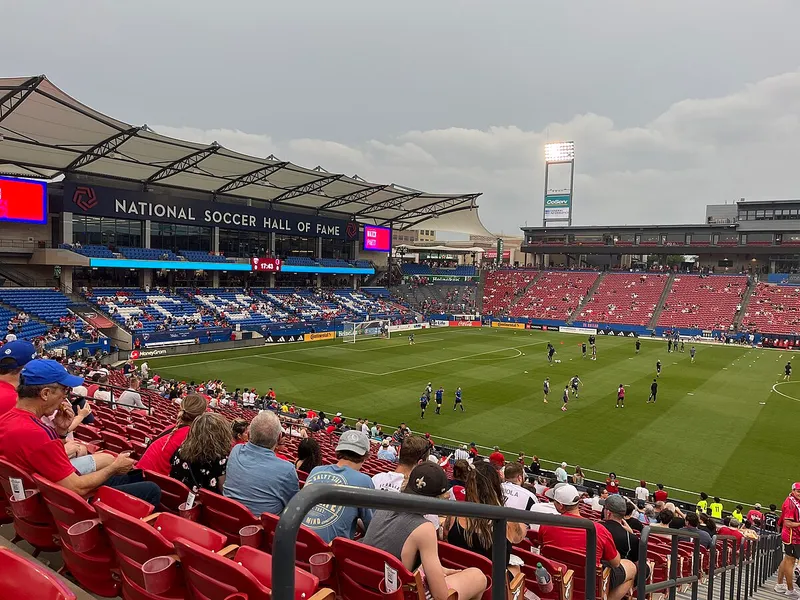
About Toyota Stadium
Toyota Stadium sits at 9200 World Cup Way in Frisco, Texas — a name that reflects both the stadium’s soccer identity and Frisco’s relentless ambition. With 20,500 permanent seats expandable to 27,000, it’s been FC Dallas’s home since 2005 and one of the most event-heavy soccer venues in North America, having hosted everything from MLS Cup to 15 consecutive NCAA FCS Championship games.
The stadium anchors Frisco’s emerging sports corridor. The Dallas Cowboys’ Star headquarters is 2.5 km away, Dr Pepper Ballpark (home of the Frisco RoughRiders) sits next door, and the National Soccer Hall of Fame relocated here from Oneonta, New York in 2018 — making Toyota Stadium the only active MLS venue with a national hall of fame built into its structure.
FC Dallas’s youth academy complex sits adjacent to the stadium, and it’s produced more US Men’s National Team players than any other MLS academy. Weston McKennie, Chris Richards, Reggie Cannon, and others all developed on these training fields before moving to European clubs. The pipeline from academy to first team to national team makes this campus one of the most important player development sites in American soccer.
A $182 million renovation launched in 2025 will transform the venue by 2028, adding a canopy roof, new premium seating, expanded concourses, and upgrades to the Hall of Fame. The project signals FC Dallas’s commitment to staying competitive with the wave of new MLS stadiums — and to Frisco’s status as one of the fastest-growing cities in Texas.
The National Soccer Hall of Fame is worth a visit on its own. The 15,000-square-foot museum features interactive exhibits, trophies from the USMNT and USWNT, and memorabilia dating back to the 1800s. Admission is free on FC Dallas match days, and the Hall hosts induction ceremonies annually in the stadium. Having a national hall of fame integrated into an active MLS venue is unique in American sports — it connects the sport’s history to its present in a way few facilities can.
Getting to Toyota Stadium
Public Transit
Toyota Stadium has no direct public transit connection. DART light rail does not extend to Frisco.
→ From Dallas: The closest DART station is Parker Road in Plano (Red/Orange Line), about 15 km south of the stadium. From there, you’ll need a rideshare or taxi.
→ From Fort Worth: There is no practical transit option. Driving or rideshare is necessary.
Frisco has been exploring transit options, including a potential Cotton Belt Trail commuter rail extension, but for now, this is a drive-in venue. Plan to arrive by car or rideshare.
Driving + Parking
GPS address: 9200 World Cup Way, Frisco, TX 75033.
→ From downtown Dallas (50 km): Dallas North Tollway north to Main Street/Frisco exit. Turn right on Main Street, then left on World Cup Way. About 35-45 minutes.
→ From Fort Worth (75 km): TX-121 North (Sam Rayburn Tollway) to Dallas North Tollway north. About 50-60 minutes.
→ From DFW Airport (40 km): TX-121 North to Dallas North Tollway. About 30-40 minutes.
Free parking is available in stadium lots for most FC Dallas matches — a major perk for a suburban venue. Premium lots closer to the gates cost $10-20. Tailgating is permitted in designated areas starting 2.5 hours before kickoff.
Rideshare
Uber and Lyft operate throughout the DFW metroplex. Drop-off at 9200 World Cup Way. From downtown Dallas, expect $30-50; from Plano about $15-25. Post-match surge can be significant — walk to the Dr Pepper Ballpark area for quicker pickups.
From the Airport
→ Dallas/Fort Worth International Airport (DFW): 40 km southwest, about 30-40 minutes by car. Take TX-121 North to Dallas North Tollway. Uber/Lyft fare about $35-55.
→ Dallas Love Field (DAL): 35 km south, about 30 minutes by car via Dallas North Tollway. Uber/Lyft fare about $30-45.
History of Toyota Stadium
FC Dallas — then known as the Dallas Burn — spent their first decade playing at the Cotton Bowl, a cavernous 92,000-seat venue that made MLS crowds look sparse. The move to a purpose-built stadium in Frisco in 2005 transformed the franchise’s identity and set the stage for one of MLS’s most successful development programs.
The Hunt Sports Group (Clark Hunt and the Lamar Hunt family) drove the project, continuing the family’s foundational role in American soccer — Lamar Hunt coined the term “Super Bowl” and was instrumental in founding both the old NASL and MLS. The initial build cost was $80 million, funded through a public-private partnership between the city of Frisco, which contributed infrastructure and land, and the Hunt family, which financed the stadium construction. HKS Architects — the same firm behind AT&T Stadium and SoFi Stadium — designed the 20,500-seat venue, which opened as Pizza Hut Park on August 6, 2005.
Key moments in the stadium’s history:
- August 6, 2005: Inaugural match as Pizza Hut Park — FC Dallas 2-1 MetroStars.
- November 14, 2010: Hosts MLS Cup 2010 — Colorado Rapids defeat FC Dallas 2-1 in extra time before 21,700 fans.
- 2010-2025: Hosts 15 consecutive NCAA FCS Championship games, the longest single-venue streak for any NCAA football championship.
- 2013: Renamed Toyota Stadium under a multi-year deal with Toyota North America, which relocated its US headquarters to nearby Plano.
- October 20, 2018: National Soccer Hall of Fame opens inside the stadium, making it the only active MLS venue housing a national hall of fame.
- 2025: $182 million renovation begins — canopy roof, premium seating, expanded concourses, and Hall of Fame upgrades to be completed by 2028.
The stadium’s suburban location in Frisco was a gamble in 2005 — but the city has since become one of the fastest-growing in America, with a population that quadrupled from 33,000 to over 230,000. What was once a stadium on the edge of the metroplex is now squarely in the middle of the action, surrounded by the Cowboys’ Star, a minor-league ballpark, and a booming suburban downtown. With the $182 million renovation underway, Toyota Stadium’s best years may still be ahead of it — a fitting trajectory for a venue that helped define what a soccer-specific stadium could be.
Photo Gallery
Fun Facts
Toyota Stadium houses the National Soccer Hall of Fame, which relocated from Oneonta, New York in 2018 — making it the only active MLS venue with a national hall of fame integrated into its structure.
The stadium hosted 15 consecutive NCAA FCS Championship games from 2010 to 2025 — the longest single-venue streak for any NCAA football championship event.
FC Dallas's youth academy, based adjacent to the stadium, has produced more US Men's National Team players than any other MLS academy, including Weston McKennie, Chris Richards, and Reggie Cannon.
Stadium Location
Frequently Asked Questions
- Where is Toyota Stadium located?
- At 9200 World Cup Way in Frisco, Texas — about 50 km north of downtown Dallas in the rapidly growing northern suburbs.
- What is the capacity of Toyota Stadium?
- 20,500 permanent seats. The stadium can expand to approximately 27,000 for major events with temporary seating on the berm areas.
- What teams play at Toyota Stadium?
- FC Dallas (MLS) and North Texas SC (MLS NEXT Pro). The stadium also hosted the NCAA FCS Championship annually from 2010 to 2025.
- Is there public transit to Toyota Stadium?
- There is no direct public transit to the stadium. DART light rail does not extend to Frisco. Driving or rideshare from Dallas is the primary option.
- Is there parking at Toyota Stadium?
- Yes. Free parking is available in the stadium lots for most FC Dallas matches. Premium parking closer to the gates is $10-20. Tailgating is permitted in designated lots.
- When did Toyota Stadium open?
- August 6, 2005, as Pizza Hut Park. It was renamed FC Dallas Stadium in 2012, then Toyota Stadium in 2013 under a long-term naming rights deal with Toyota North America.
- What is the National Soccer Hall of Fame?
- The official hall of fame for American soccer, relocated from Oneonta, NY to Toyota Stadium in 2018. It features interactive exhibits, trophies, and memorabilia. Open year-round with free entry on FC Dallas match days.
- Is Toyota Stadium being renovated?
- Yes. A $182 million renovation began in 2025, running through 2028. The project adds a canopy roof, new premium seating, expanded concourses, and upgrades to the National Soccer Hall of Fame.
Last updated: 2026-03-11