About Tropicana Field
Tropicana Field sits in downtown St. Petersburg, Florida, about a mile west of Tampa Bay — a fixed-dome stadium that has been baseball’s most polarizing venue since the Tampa Bay Rays arrived in 1998. With 25,025 seats, it’s the smallest stadium in Major League Baseball and the only one played under a permanent dome that doesn’t retract.
The Rays are the sole tenants. The stadium was not built for them — it was originally constructed in 1990 as a speculative bid to attract an MLB expansion team or lure an existing one to the Tampa Bay area. The Florida Suncoast Dome (as it was first called) sat empty for years before the Devil Rays were awarded an expansion franchise in 1995 and played their first game here on March 31, 1998.
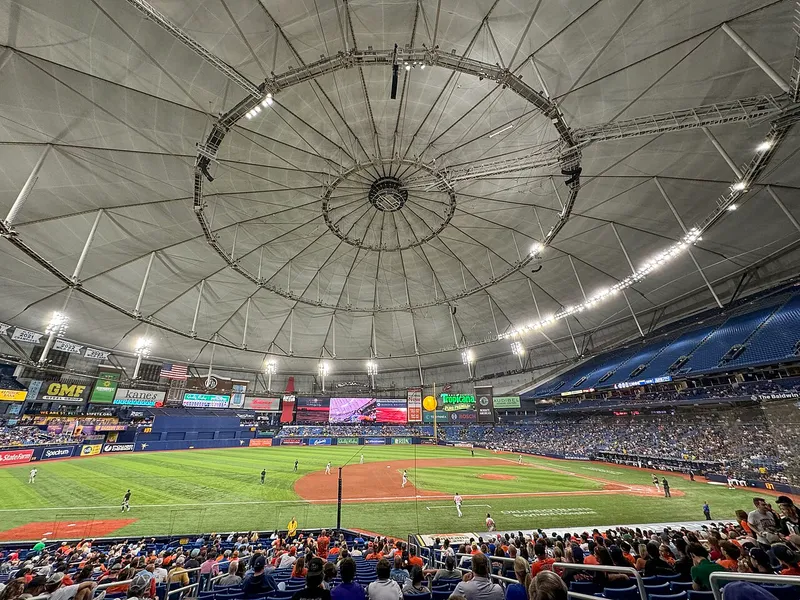
The tilted dome is the building’s defining feature — and its biggest liability. HOK Sport designed the cable-stayed roof with a distinctive slant, rising from 85 feet at the south wall to 225 feet at the center. Four catwalk rings hang inside, creating ground rules found nowhere else in baseball: balls hitting the two lowest catwalks (C and D) in fair territory are automatic home runs, while balls hitting the upper rings (A and B) remain in play. The catwalks have produced some of the sport’s strangest plays — pop flies hitting Ring C for accidental homers, and routine fly balls deflecting off Ring B to confuse fielders.
The Touch Tank in right-center field holds 10,000 gallons of water and houses cownose rays that fans can pet during games — the only live marine animal exhibit in any MLB stadium. It costs nothing beyond your game ticket.
The dome’s most dramatic chapter came on October 9, 2024, when Hurricane Milton — a Category 3 storm at landfall — ripped open a massive section of the Teflon-coated fiberglass roof. The stadium had been set up as a staging base for emergency responders at the time. Repairs took over a year, but by November 2025 the dome was sealed and the Rays returned for the 2026 season. The interior stays climate-controlled year-round at roughly 72°F, a significant advantage in a city where summer temperatures regularly hit the low 90s with stifling humidity.
Getting to Tropicana Field
Public Transit
St. Petersburg’s bus network and the newer SunRunner BRT are the main transit options.
→ From downtown St. Petersburg: PSTA bus routes 4, 11, 14, 18, and the Central Avenue Trolley serve stops within a few blocks of the stadium. The SunRunner BRT runs along 1st Avenue S with a stop near the dome.
→ From Tampa: PSTA cross-bay express bus 300X connects downtown Tampa to St. Petersburg. Travel time about 45-60 minutes depending on traffic on the Howard Frankland Bridge.
The Looper downtown trolley (free) circulates through the waterfront district and reaches within walking distance of the stadium on game days.
Driving + Parking
GPS address: 1 Tropicana Drive, St. Petersburg, FL 33705.
→ From Tampa (34 km): I-275 South across the Howard Frankland Bridge, exit at 22 (I-175) or 23A (5th Avenue S). About 30 minutes.
→ From Orlando (170 km): I-4 West to I-275 South. About 1 hour 50 minutes.
→ From Sarasota (93 km): I-275 North across the Sunshine Skyway Bridge. About 1 hour.
Lots 1 through 8 surround the stadium with approximately 6,300 on-site spaces. General parking is $25-35 depending on proximity. Lots 1 and 6 (closest to gates) fill first. Additional private lots and metered street parking are available along 1st Avenue S and in the EDGE District.
Rideshare
Uber and Lyft drop off and pick up at the 1st Avenue S entrance, near Lot 1. From downtown St. Pete, expect $8-12; from Tampa about $25-40; from Tampa International Airport about $30-45. After games, walk a block south for faster pickups with less congestion.
From the Airport
→ Tampa International Airport (TPA): 30 km northeast, about 25-35 minutes by car across the Howard Frankland Bridge. Uber/Lyft $30-45.
→ St. Pete-Clearwater International Airport (PIE): 20 km north, about 20-25 minutes. A smaller airport with budget carrier service. Uber/Lyft $20-30.
History of Tropicana Field
The stadium’s history is a story of waiting. The Florida Suncoast Dome was built in 1990 at a cost of $138 million, purely as a speculative play to land an MLB franchise. Tampa Bay spent nearly a decade trying — courting the Chicago White Sox, Seattle Mariners, and San Francisco Giants — before the expansion Devil Rays were finally awarded in 1995. The dome was renamed Tropicana Field in 1996 under a 30-year, $50 million naming rights deal with Tropicana Products.
The Devil Rays’ first game on March 31, 1998 drew 45,369 fans, but the honeymoon was short. The team lost 99 games that year and wouldn’t post a winning season until 2008, when they dropped “Devil” from the name and rode a young roster to the World Series — losing to Philadelphia in five games, but electrifying a fanbase that had endured a decade of futility.
Key moments in the stadium’s history:
- March 31, 1998: First MLB game — Tampa Bay Devil Rays 11, Detroit Tigers 6 before 45,369 fans. Wilson Alvarez throws the first pitch.
- October 19, 2008: ALCS Game 7 — Rays defeat Red Sox 3-1 to reach their first World Series.
- August 7, 2011: Matt Garza throws the first no-hitter in Rays history against the Tigers.
- October 9, 2024: Hurricane Milton tears open the dome roof while the stadium serves as a first responder staging area.
- March 2026: Rays return to a fully repaired Tropicana Field for the 2026 season.
The Rays’ future lies across the bay. A new $2.3 billion, 30,842-seat stadium in Tampa’s Ybor City neighborhood is expected to open by 2029, ending the franchise’s three-decade run in St. Petersburg. Tropicana Field’s tilted dome — baseball’s most criticized and most distinctive venue — will likely be demolished as part of a massive mixed-use redevelopment of the 85-acre site. Love it or hate it, there has never been another stadium quite like it.
Photo Gallery
Fun Facts
Tropicana Field's four catwalk rings hang between 63 and 225 feet above the playing field, creating unique ground rules: a ball hitting the two lowest rings (C or D) in fair territory is a home run, while a ball hitting the upper rings (A or B) is in play — leading to some of baseball's strangest plays.
The Rays Touch Tank behind the right-center field wall holds 10,000 gallons of water and houses cownose rays that fans can pet during games — making Tropicana Field the only MLB stadium where you can interact with live marine animals.
Hurricane Milton ripped open a massive section of the Teflon-coated fiberglass roof on October 9, 2024, while the stadium was being used as a staging base for first responders. Repairs were completed by November 2025, and the Rays returned for the 2026 season.
Stadium Location
Frequently Asked Questions
- What is the capacity of Tropicana Field?
- 25,025 seats for baseball. The stadium originally held over 43,000 for football configurations but was significantly reduced when the Rays arrived in 1998.
- Does Tropicana Field have a roof?
- Yes. It has a fixed, non-retractable dome made of Teflon-coated fiberglass supported by a tilted steel cable system. It was damaged by Hurricane Milton in October 2024 and repaired by November 2025.
- What are the Tropicana Field catwalk rules?
- Balls hitting rings C or D (the two lowest, 63-85 feet) in fair territory are home runs. Balls hitting rings A or B (higher up) remain in play. A ball lodged in a catwalk is a ground-rule double.
- How do I get to Tropicana Field by public transit?
- The SunRunner BRT connects St. Pete Beach to downtown St. Petersburg with a stop near the stadium. PSTA bus routes 4, 11, 14, 18, and others serve the area. From Tampa, take the cross-bay express bus 300X.
- Is there parking at Tropicana Field?
- Yes. The stadium has approximately 6,300 on-site spaces in Lots 1-8. General parking is $25-35. Lots 1 and 6 fill first. Additional street parking and private lots are available along 1st Avenue S.
- Are the Rays leaving Tropicana Field?
- Yes. The Rays plan to move to a new $2.3 billion, 30,842-seat stadium in Tampa's Ybor City district, expected to open by 2029. The team returned to Tropicana Field for the 2026 season after Hurricane Milton repairs.
- What happened to Tropicana Field during Hurricane Milton?
- Hurricane Milton struck on October 9, 2024, tearing open a large section of the Teflon-coated fiberglass roof. The stadium had been set up as a staging base for first responders. Repairs were completed by November 2025.
Last updated: 2026-03-12