Europe’s biggest stadiums are a moving target right now
Ranking the largest stadiums in Europe in 2026 is harder than it should be, and the reason is a wave of construction.
Camp Nou, the biggest of them all, is half torn open for a rebuild. Real Madrid finished a four-year renovation of the Santiago Bernabeu and then never officially confirmed the new capacity. Milan’s two giant clubs got permission to knock down San Siro and build a new ground next door. German stadiums shrink by tens of thousands of seats depending on whether their standing terraces are open. So the honest answer to “what is Europe’s biggest stadium” depends on whether you mean on paper, or the one you could actually walk into and fill tonight.
This ranking handles both. The numbers below are registered or headline capacities, the figures you would see quoted officially, but every moving target gets a clear note on what it really seats in 2026. For the global picture, see our largest stadiums in the world ranking, and for the American giants that dominate the upper end of any worldwide list, our biggest stadium in every US state breakdown.
So which is the biggest stadium in Europe? On paper, Camp Nou, at roughly 105,000 once the Espai Barça rebuild is finished. In use today, Wembley, at 90,000. Everything below is ranked by registered capacity, with a note wherever the real 2026 number is smaller.
The 15 largest stadiums in Europe by capacity (2026):
- Camp Nou: ~105,000 target / ~62,652 usable now (Barcelona, Spain)
- Wembley Stadium: 90,000 (London, England). Europe’s largest fully usable stadium.
- Santiago Bernabeu: 83,186 listed (Madrid, Spain). Never confirmed by the club.
- Croke Park: 82,300 (Dublin, Ireland). Gaelic games.
- Allianz Stadium Twickenham: 82,000 (London, England). Rugby union.
- Signal Iduna Park: 81,365 domestic / ~65,829 for UEFA (Dortmund, Germany)
- Stade de France: ~81,000 (Saint-Denis, France)
- Luzhniki Stadium: 81,000 (Moscow, Russia)
- San Siro: ~75,800 to 80,000 (Milan, Italy)
- Allianz Arena: 75,024 (Munich, Germany)
- Olympiastadion Berlin: 74,475 (Berlin, Germany)
- Old Trafford: 74,310 (Manchester, England)
- Principality Stadium: 73,931 (Cardiff, Wales). Rugby union.
- Stadio Olimpico: 70,634 (Rome, Italy)
- Riyadh Air Metropolitano: 70,460 (Madrid, Spain)
Full breakdown, renovation notes, and the football-only ranking below.
1. Camp Nou: ~105,000 target (Barcelona, Spain)
The biggest stadium in Europe is also, right now, the most complicated one to talk about.
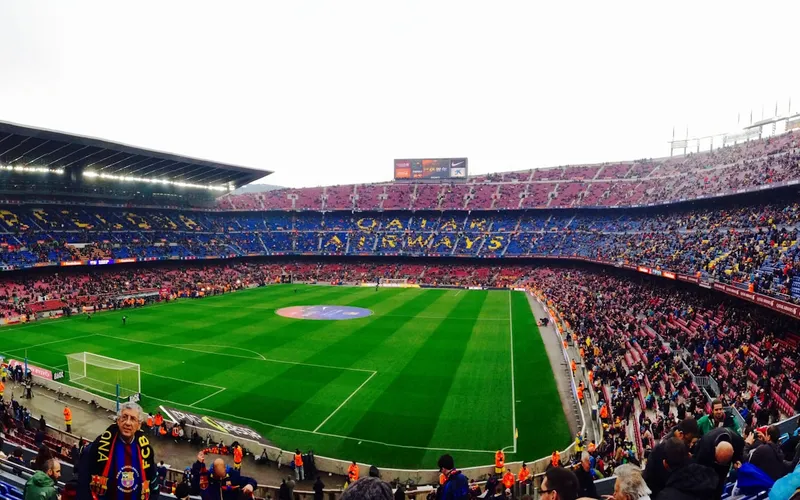
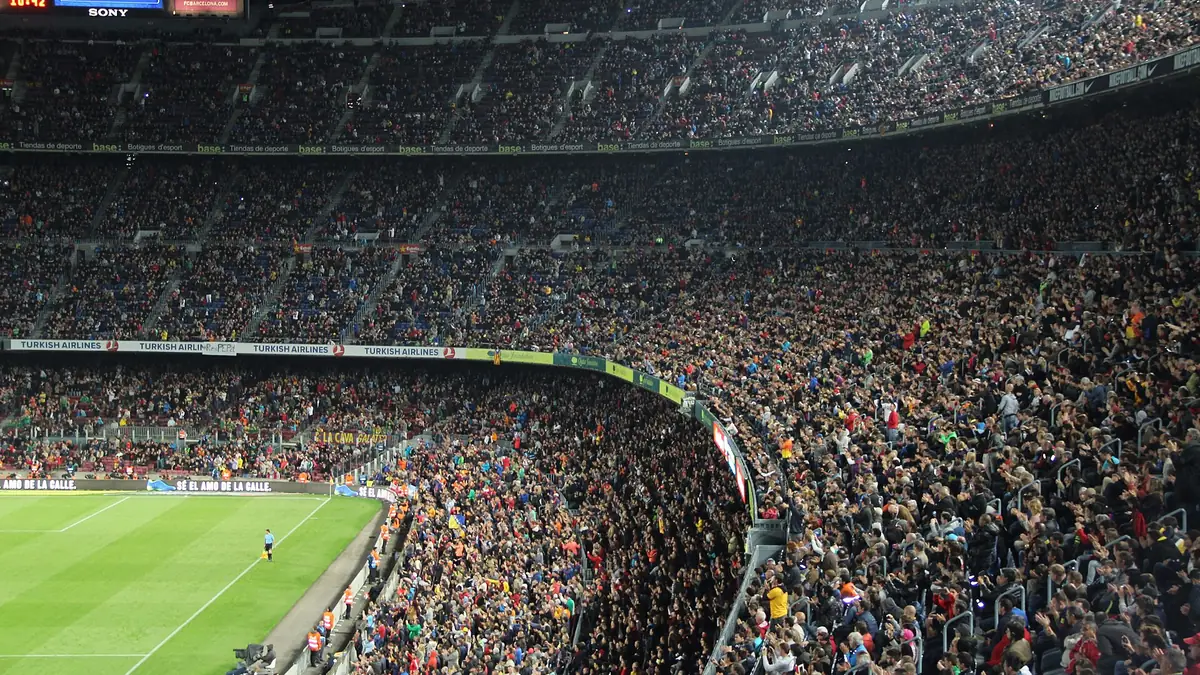
Camp Nou held a registered 99,354 before FC Barcelona started its Espai Barca rebuild, the largest stadium project in European football history at well over 1.5 billion euros. The plan adds a third tier and a full roof, pushing the target to roughly 105,000, which would make it comfortably the biggest stadium on the continent. Some projections go as high as 111,000.
Here is the catch. As of 2026 the stadium is only partly reopened. Barcelona played through 2025 at the Olympic stadium on Montjuic while work continued, and the phased return to Camp Nou has crept up from around 45,000 seats to roughly 62,652 under the current construction licence. The third tier and roof were supposed to be finished in 2026, but now look more like 2027.
So Camp Nou is Europe’s largest stadium by registered capacity and will be again by usable capacity once it is finished. Today, mid-build, it cannot crack the top ten of stadiums you could actually fill. Both things are true.
Three numbers, all real: Camp Nou is quoted at 99,354 (old registered), about 62,652 (usable during the 2026 rebuild), and roughly 105,000 (target on completion). Make sure you know which one a ranking is using.
2. Wembley Stadium: 90,000 (London, England)
With Camp Nou half shut, the largest stadium you can actually fill in Europe is Wembley.
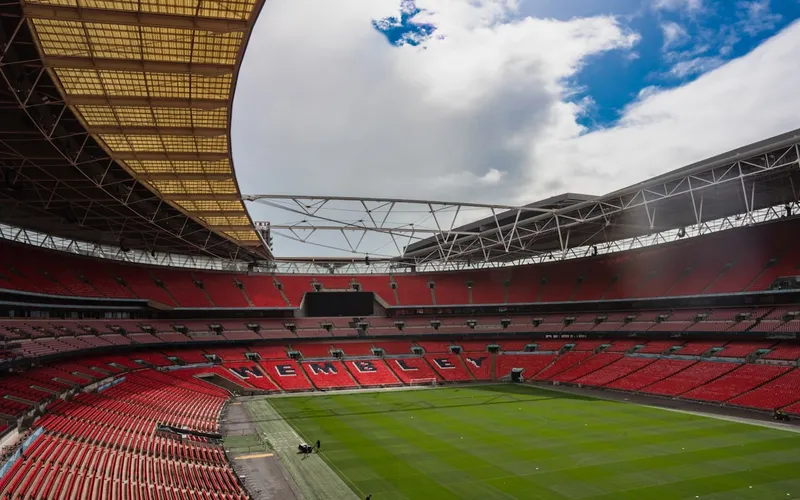
The current Wembley opened in 2007, holds 90,000 for football, and is the home of the England national team and the traditional stage for FA Cup finals. Its arch is one of the most recognizable structures in world sport, visible across north-west London. It is the biggest stadium in the United Kingdom by a wide margin.
Wembley is also Europe’s busiest big venue. It hosts England internationals, cup finals, NFL London games, Champions League finals when UEFA sends them there, and some of the largest concerts on the continent. Camp Nou is bigger on paper, but Wembley is the largest operating stadium in Europe in 2026, and it earns that spot by actually being open.
90,000 and open: With Camp Nou stuck mid-rebuild, Wembley is the largest stadium in Europe you can actually fill in 2026.
3. Santiago Bernabeu: 83,186 (Madrid, Spain)
Real Madrid spent four years and close to 1.8 billion euros turning the Bernabeu into a covered, retractable-pitch spectacle. Then they declined to tell anyone exactly how many seats it now has.
The listed figure is 83,186, the number in La Liga’s technical listings. Other counts put the real number closer to 78,297. The honest answer is that the capacity is configuration-dependent, somewhere in the high 70,000s to low 80,000s, and the club has never confirmed a single official figure. That is unusual, and slightly maddening for anyone trying to rank it.
What is not in doubt is that the renovated Bernabeu is one of the most advanced stadiums on Earth, with a retractable pitch stored underground and a wraparound metallic skin. It sits third in Europe whichever capacity number you trust.
4. Croke Park: 82,300 (Dublin, Ireland)
The largest stadium in Europe that has nothing to do with football is in Dublin.
Croke Park holds 82,300 and is the headquarters of the Gaelic Athletic Association, home to hurling and Gaelic football, two amateur sports that fill it to the brim for the All-Ireland finals. It is bigger than almost every soccer ground on the continent, which surprises people who have never been to Ireland on a September final day.
People who do try to rank it run into a small dispute, with the GAA’s own matchday figure sometimes quoted at 83,200. Either way it slots in around fourth in Europe, and it is a reminder that the biggest crowds are not always watching the sports that get the global coverage.
5. Allianz Stadium Twickenham: 82,000 (London, England)
Rugby’s cathedral is the fifth-largest stadium in Europe.
The ground long known simply as Twickenham took the Allianz Stadium name in 2024, and at 82,000 it is the largest dedicated rugby union venue in the world. It is the home of the England rugby team and the Rugby Football Union, and on a Six Nations Saturday it generates an atmosphere that rivals any football ground in the country.
It belongs on an all-sports list of Europe’s biggest stadiums, but it is worth being clear about what it is. If your interest is football, the largest soccer ground in London is Wembley, and Twickenham does not host club football at all.
6. Signal Iduna Park: 81,365 (Dortmund, Germany)
Borussia Dortmund’s home is famous for a single stand, and that stand is also why its capacity has two different numbers.
Signal Iduna Park, still called the Westfalenstadion by purists, holds 81,365 for Bundesliga matches. That figure includes the Sudtribune, the vast standing terrace known as the Yellow Wall that packs in close to 25,000 supporters on a single sloped bank. It is the largest standing terrace in European football and one of the best sights in the game.
But standing is not allowed at UEFA matches, where every spectator needs a seat. So for Champions League nights the terrace is converted to seating and the capacity drops to around 65,829. Same building, same week sometimes, two very different numbers. It is the clearest example of why German grounds scramble these rankings.
81,365 down to 65,829: Signal Iduna Park loses more than 15,000 spots between a Bundesliga match and a UEFA match, because European competition bans its standing Yellow Wall terrace.
7. Stade de France: ~81,000 (Saint-Denis, France)
Stade de France was built for the 1998 World Cup and has been the French national stadium ever since, holding around 81,000 just north of Paris.
It is one of the most versatile big venues anywhere. It hosts the France football team, the France rugby team, Champions League finals, athletics, and it served as the centerpiece of the 2024 Olympics. The lower tier retracts to uncover an athletics track, then closes back up for football. The trade-off is that no club calls it home full time, so on an ordinary weekend the most-used stadium in France can sit empty.
8. Luzhniki Stadium: 81,000 (Moscow, Russia)
Russia’s national stadium held the 2018 World Cup final, and at 81,000 it is one of the largest in Europe.
Luzhniki in Moscow was gutted and rebuilt for that tournament, keeping its original 1956 facade while replacing everything inside. The football capacity sits a little lower, around 78,011, once the running track area is accounted for. Russia’s exclusion from international competition has limited its big-match calendar in recent years, but the building itself remains a giant.
9. San Siro: ~75,800 to 80,000 (Milan, Italy)
Italy’s most famous stadium is living on borrowed time, and even its capacity is unsettled.
San Siro, officially the Stadio Giuseppe Meazza, is shared by AC Milan and Inter, the only ground in Europe of this size used by two rival giants. The strict current all-seater football figure is 75,817, though an older gross figure of around 80,018 is still widely quoted, so you will see it ranked anywhere from eighth to tenth depending on which a writer picked.
The bigger story is its future. In late 2025 the city approved the sale of San Siro to the two clubs, who plan to build a new stadium of roughly 71,500 seats on the adjacent land, with the old ground largely demolished early in the 2030s. As of 2026 San Siro is still standing and still fully in use. It remains Italy’s largest stadium, for now.
10. Allianz Arena: 75,024 (Munich, Germany)
Bayern Munich’s home is the most recognizable modern stadium in Europe, a glowing cushion of inflated panels that change color on the Munich skyline.
The Allianz Arena holds 75,024 for domestic matches and around 70,000 for UEFA games, the same standing-terrace gap that affects Dortmund. It opened in 2005, hosted matches at Euro 2024, and is one of the best-run big stadiums on the continent. Note that it has no connection to the Allianz-named venues in London or Turin beyond the sponsor, a naming overlap that confuses plenty of people.
11 to 15: the rest of Europe’s 70,000-plus club
Below the headline giants sits a tight cluster of grounds between 70,000 and 75,000, most of them famous in their own right.
Olympiastadion Berlin (74,475) is the 1936 Olympic stadium, home to Hertha BSC and the annual stage for the DFB-Pokal final. Old Trafford (74,310) is the largest English club football ground and Manchester United’s home, though it has aged badly next to several newer rivals, which is why United have floated a new 100,000-seat stadium for around 2030. Principality Stadium (73,931) in Cardiff is the Welsh national rugby ground, with a retractable roof and a city-center location that makes it one of the loudest venues in Britain. Stadio Olimpico (70,634) in Rome is shared by AS Roma and Lazio and doubles as Italy’s rugby and athletics stadium. Riyadh Air Metropolitano (70,460) is Atletico Madrid’s home, opened in 2017 to replace the old Vicente Calderon, and the third Madrid entry on this list after the Bernabeu.
Honorable mentions and moving numbers
A few venues sit just outside the top 15 or are changing fast enough to deserve a flag.
- Atatürk Olympic Stadium in Istanbul would rank around eighth, but its capacity is genuinely disputed across sources, quoted anywhere from 76,092 to 77,563. It hosted the 2023 Champions League final.
- Scottish Gas Murrayfield (67,144) in Edinburgh is Scotland’s national rugby stadium and the largest in the country.
- Estadio da Luz (68,100) in Lisbon is Benfica’s home and has an unbuilt plan to expand toward 80,000.
- Etihad Stadium in Manchester is mid-expansion, with a new North Stand pushing it toward 61,000-plus through 2026 as Manchester City enlarge the ground.
- Tottenham Hotspur Stadium (62,850) and London Stadium (62,500) round out London’s modern big three alongside Wembley.
The football-only ranking, because that is what most people mean
An all-sports list puts Croke Park, Twickenham, and the Principality high up, and that is correct. But most people searching for Europe’s biggest stadiums mean football.
Strip out the rugby and Gaelic grounds and the football order in 2026 runs: Camp Nou (on paper), Wembley (in practice), Santiago Bernabeu, Signal Iduna Park, Stade de France, Luzhniki, San Siro, Allianz Arena, Olympiastadion Berlin, Old Trafford. Camp Nou tops it whenever it is whole. Until then, Wembley is the biggest football stadium you can fill in Europe, with the Bernabeu and Dortmund’s Yellow Wall right behind.
The full 2026 ranking at a glance
Here is the top 15 in one place, with the sport and city for each, since an all-sports list mixes football grounds with rugby and Gaelic venues.
| Rank | Stadium | City, Country | Capacity (2026) | Main sport |
|---|---|---|---|---|
| 1 | Camp Nou | Barcelona, Spain | ~105,000 target / ~62,652 now | Football |
| 2 | Wembley Stadium | London, England | 90,000 | Football |
| 3 | Santiago Bernabeu | Madrid, Spain | 83,186 | Football |
| 4 | Croke Park | Dublin, Ireland | 82,300 | Gaelic games |
| 5 | Allianz Stadium Twickenham | London, England | 82,000 | Rugby union |
| 6 | Signal Iduna Park | Dortmund, Germany | 81,365 / ~65,829 UEFA | Football |
| 7 | Stade de France | Saint-Denis, France | ~81,000 | Football & rugby |
| 8 | Luzhniki Stadium | Moscow, Russia | 81,000 | Football |
| 9 | San Siro | Milan, Italy | ~75,800 to 80,000 | Football |
| 10 | Allianz Arena | Munich, Germany | 75,024 | Football |
| 11 | Olympiastadion Berlin | Berlin, Germany | 74,475 | Football |
| 12 | Old Trafford | Manchester, England | 74,310 | Football |
| 13 | Principality Stadium | Cardiff, Wales | 73,931 | Rugby union |
| 14 | Stadio Olimpico | Rome, Italy | 70,634 | Football |
| 15 | Riyadh Air Metropolitano | Madrid, Spain | 70,460 | Football |
Why these numbers keep changing
If this ranking feels messier than a list of mountains or rivers, that is because stadium capacity is not a fixed fact. It is a decision, and clubs keep changing their minds.
Three forces are reshaping the numbers in 2026. Renovation is the biggest: Camp Nou, the Bernabeu, and soon San Siro are all being rebuilt, and a rebuild can swing a capacity by tens of thousands either way. Standing terraces are the second: German grounds list one figure for domestic football and a smaller one for UEFA, because European competition bans standing. And the slow modernization of older stadiums, swapping tight benches for wider seats and adding hospitality, tends to shave seats off the top even when nothing dramatic is happening.
The result is that the biggest stadiums in Europe are less a settled league table than a snapshot. This one is accurate for 2026. Check back after Camp Nou reopens in full, and the order at the very top will change again. For the venues hosting the sport’s biggest event this year, our World Cup 2026 hub tracks the North American grounds, while the full stadium directory covers the European giants above in depth.
Sources
- Wikipedia: List of stadiums by capacity. Cross-checked capacity figures for European venues.
- Wikipedia: Westfalenstadion. Signal Iduna Park domestic and UEFA capacity, and the Sudtribune standing terrace.
- Wikipedia: Croke Park. Capacity and GAA usage of Europe’s largest non-football stadium.
- FC Barcelona: Espai Barca project. Camp Nou rebuild scope and target capacity.
- Individual club and stadium figures cross-referenced across at least two sources each; disputed numbers (Bernabeu, San Siro, Ataturk) are flagged in the text.