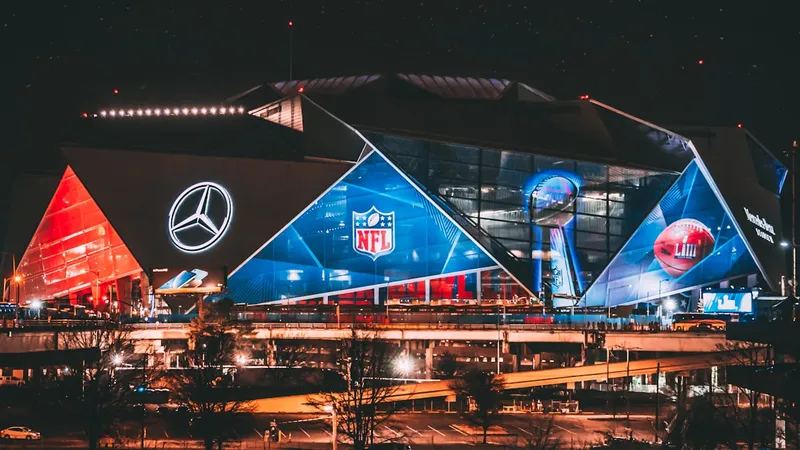
The biggest sporting event on earth is coming to American football stadiums. And that sentence alone should make you pause.
FIFA’s pitch requirements and NFL field dimensions aren’t just different — they’re built around fundamentally different sports with different geometries, different sight lines, and different crowd behaviors. So when three NFL venues were selected to host World Cup 2026 matches, the question wasn’t whether they could convert. It’s whether the experience would actually be any good.
Here’s the short answer: it’ll work. But the details matter a lot, and some stadiums are going to deliver a far better World Cup experience than others.
The Field Problem: NFL vs FIFA Dimensions
Let’s start with the numbers, because they tell the story immediately.
An NFL field is 100 yards long (plus two 10-yard end zones) and 53 1/3 yards wide. That’s roughly 109.7 meters by 48.8 meters.
A FIFA World Cup pitch must be 105 meters long and 68 meters wide. No exceptions, no flexibility — FIFA mandates these exact dimensions for the tournament.
See the issue? The soccer pitch is nearly 20 meters wider than an NFL field. That’s almost 65 feet of extra width that needs to exist inside a stadium bowl designed around a narrower playing surface. The length is comparable — you lose the end zones and gain a few meters — but it’s the width that creates headaches.
105m × 68m vs 100yd × 53⅓yd — FIFA’s required pitch dimensions are nearly 20 meters wider than an NFL field, forcing converted venues to remove lower-bowl sideline seating and reconfigure barriers to fit the wider playing surface.
NFL stadiums are built with sideline seating optimized for a 48.8-meter-wide field. When you widen the pitch by 40%, the front rows on the sidelines are suddenly too close. In some cases, they’re literally on the pitch. That means removing lower-bowl seating, reconfiguring barriers, and sometimes installing temporary platforms to raise the first rows higher.
It’s not a dealbreaker. But it does change the stadium’s capacity and, more importantly, the viewing experience for fans who thought they were getting premium sideline seats.
MetLife Stadium: The Final Venue
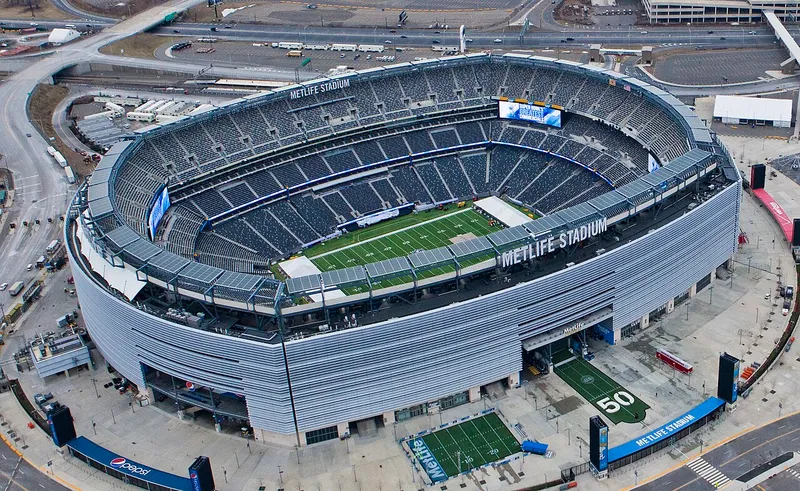
MetLife Stadium in East Rutherford, New Jersey, is hosting the World Cup Final. That’s the single biggest match assignment FIFA can give a venue, and MetLife earned it partly because of one thing the other NFL stadiums don’t have: a genuine plan for natural grass.
MetLife’s capacity sits at 82,500 for NFL games. For the World Cup, that’ll drop somewhat after the lower-bowl reconfiguration to accommodate the wider pitch. The stadium is open-air, which FIFA prefers for its showcase matches. No roof means natural light, natural atmosphere, and no questions about whether the playing surface is getting enough sun.
Here’s the thing about MetLife that people overlook. It’s not a glamorous stadium. Giants and Jets fans will tell you that themselves. It was built in 2010 for $1.6 billion with private money, and the design prioritized function over flash. There’s no signature architectural element, no record-breaking video board, no “wow” factor when you walk through the gates.
But for soccer? That straightforward design is actually an advantage.
The bowl is steep and close to the field. Sight lines from the upper deck are better than most NFL venues because the architects didn’t waste vertical space on luxury suites stacked between the lower and upper bowls. The open-air configuration means acoustics will bounce noise back toward the pitch instead of absorbing it into a cavernous roof structure. For a World Cup Final with 80,000+ fans singing and chanting, MetLife could genuinely be electric.
The grass conversion is the other big factor. MetLife currently uses natural grass for NFL games — one of the few NFL venues that does. For the World Cup, FIFA will install tournament-grade natural turf, but the stadium already has the drainage, irrigation, and sun exposure infrastructure to support it. That’s a meaningful head start over venues that normally play on synthetic turf.
Eight matches total, including the Final. MetLife’s first World Cup match is June 14, 2026. It won’t be the prettiest venue at the tournament. It might be the loudest.
AT&T Stadium: Jerry’s World Goes Global
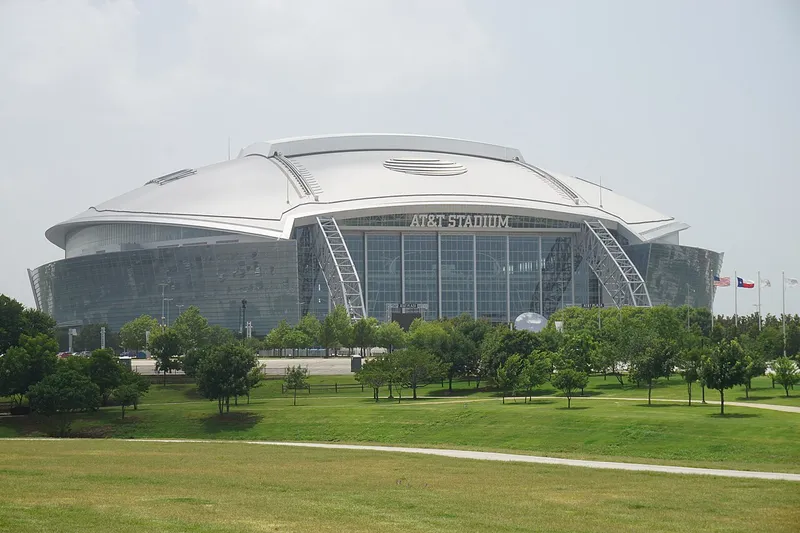
AT&T Stadium in Arlington, Texas, is the biggest venue in the tournament at 94,000 capacity. It’s also the most visually overwhelming.
That center-hung video board — the one that weighs 1.2 million pounds and required custom structural engineering — will be impossible to ignore during matches. It’s both AT&T Stadium’s greatest asset and its most obvious tension point with soccer purists who want the pitch, not a screen, to be the focal point.
The retractable roof is a genuine advantage for summer matches in Texas. June and July temperatures in Arlington regularly hit 100+ degrees Fahrenheit. FIFA will almost certainly keep the roof closed for daytime matches, which means climate control for fans but an indoor atmosphere. For evening kickoffs, opening that roof and letting the Texas twilight flood in could create something special. The 120-foot glass end zone doors can open too, which gives the stadium a semi-outdoor feel that’s unique among World Cup venues.
AT&T Stadium is hosting semi-final matches, which means the stakes will be enormous by the time the tournament reaches Arlington. Eight matches total, starting June 15.
But here’s where I’ll be honest: AT&T Stadium worries me for soccer.
The bowl is wide and spread out. NFL stadiums in general are designed to give every seat a view of a field that’s 53 yards across. When that field becomes 68 meters wide, the sideline seats get better — you’re closer to the touchline — but the end-line seats get worse. Way worse. You’re watching from behind the goal, looking down a pitch that’s 105 meters long, with action happening at the far end. At 94,000 capacity, a lot of fans will be in those positions.
The atmosphere is the other concern. NFL crowds in Dallas are famously… comfortable. The Cowboys’ fan base shows up, but AT&T Stadium was built for an experience — the art collection, the video board, the premium clubs. It’s a place where you go to be entertained. Soccer crowds, especially at a World Cup, generate their own entertainment through chanting, singing, flags, and coordinated displays. Those two cultures don’t always mesh.
That said, 94,000 people watching a World Cup semi-final is 94,000 people watching a World Cup semi-final. The sheer mass of humanity will create something, even if the stadium’s bones were designed for a different kind of event.
SoFi Stadium: The $5.5 Billion Hollywood Venue
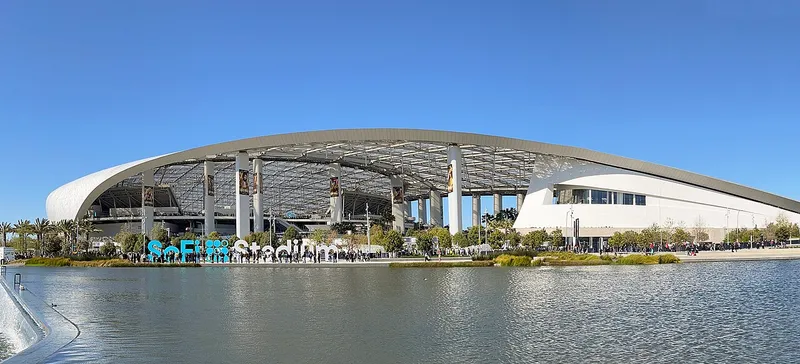
SoFi Stadium in Inglewood, California, cost $5.5 billion to build. That’s more than twice the cost of any other stadium on the planet. It opened in 2020, making it the newest NFL venue and the most technologically advanced stadium at the World Cup.
SoFi’s capacity is 70,240 — the smallest of the three NFL World Cup stadiums. It’s hosting quarterfinal matches, six total, with its first on June 13.
$5.5 billion for 70,240 seats — SoFi Stadium cost more than twice any other stadium on earth, yet holds the fewest fans of the three NFL World Cup venues. AT&T Stadium seats 94,000 and MetLife 82,500 by comparison.
The stadium sits 100 feet below street level. The entire thing was dug into the ground to comply with FAA height restrictions from nearby LAX. That sunken design creates an unusual approach: you walk down into the stadium rather than up into it. For a World Cup match, that descent builds anticipation in a way that’s hard to replicate.
SoFi’s ETFE canopy roof doesn’t fully enclose the stadium. It’s more of a massive translucent umbrella that lets in natural light and air while keeping out rain (not that rain is a concern in LA in June). The Infinity Screen — a 70,000-square-foot double-sided video board — hangs from the canopy and is visible from both inside and outside the bowl.
For soccer sight lines, SoFi has a problem and an advantage.
The problem: it’s an NFL stadium that shares with two teams (Rams and Chargers), so it was designed to maximize premium seating. There are a lot of luxury suites and club sections between the lower and upper bowls, which pushes the upper deck farther from the pitch. If you’re in the 300 level, you’re watching soccer from a distance.
The advantage: the lower bowl is intimate. SoFi’s design wraps the lower sections close to the field, and the pitch conversion will bring the touchline even closer to those front rows. For fans in the first 30 rows on the sideline, SoFi might offer the best World Cup viewing experience of any NFL venue.
And then there’s the LA factor. Southern California has one of the largest soccer fan bases in the United States. The city’s Mexican-American, Central American, and Korean-American communities bring genuine World Cup culture — the kind of atmosphere that can’t be manufactured. SoFi’s quarterfinal matches could feel more like a tournament in Mexico City or Seoul than a typical American sporting event.
The Wembley Precedent: What NFL London Tells Us
Here’s where things get interesting. While American football fans are wondering how soccer will work in NFL stadiums, Wembley Stadium in London has spent over a decade answering the reverse question: how does NFL work in a soccer stadium?
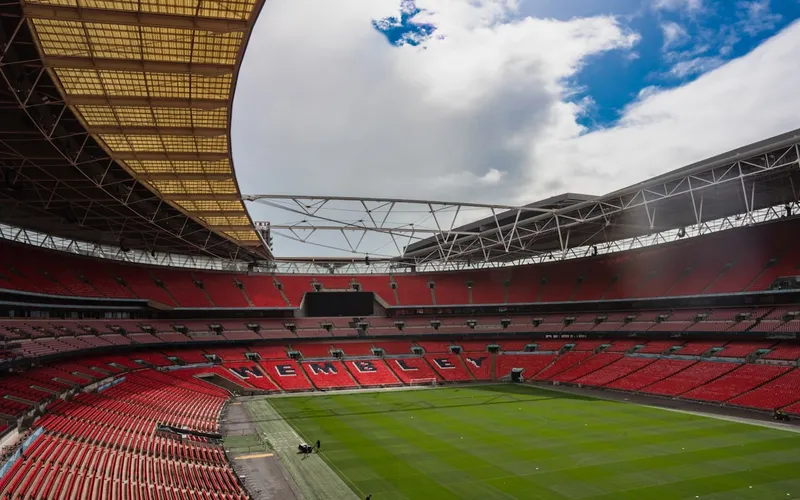
Since 2007, Wembley has hosted regular-season NFL games as part of the NFL International Series. The 90,000-seat venue was purpose-built for soccer and rugby, with a pitch designed to FIFA specifications. Converting it for American football means narrowing the playing surface, adding end zones, and reconfiguring the markings.
And the results have been mixed.
On the positive side, Wembley proved that stadium conversions are viable. NFL games at Wembley regularly sell out, the atmosphere is genuine, and the sight lines work well enough. Fans in the lower tiers get an excellent view of the action. The stadium’s steep bowl design means even upper-deck seats feel reasonably close to the field.
90,000 seats, sold out since 2007 — Wembley’s NFL International Series has consistently filled its soccer-configured bowl for American football, proving that cross-sport stadium conversions can deliver for fans on both sides of the Atlantic.
But the challenges are instructive. The pitch surface takes a beating during NFL games — the concentrated wear from the line of scrimmage area chews up the turf in ways that soccer doesn’t. Wembley has had to relay its pitch multiple times in seasons when NFL games fall close to FA Cup matches or England internationals.
For the World Cup conversion going the other direction, the lesson is about surface management. MetLife, AT&T Stadium, and SoFi will all need pristine natural grass pitches installed and maintained across multiple matches over several weeks. Any stadium that hosts an early group-stage match and then a later knockout round needs the pitch to hold up through repeated use, potentially in extreme heat.
Wembley’s other lesson is about atmosphere. NFL fans in London bring an energy that’s different from the home crowd — they’re enthusiastic but unfamiliar with the rhythms of the sport. Some NFL London games have had oddly quiet moments during plays that should generate roaring reactions, because the crowd doesn’t instinctively know when to react.
Flip that for the World Cup. American audiences at soccer matches sometimes miss the build-up play that European and South American fans react to. The slow passing sequences that build tension, the defensive shape that signals a counterattack — these are moments that generate crowd noise in soccer countries but can fall flat in an NFL venue.
The saving grace for the US World Cup: the crowds won’t be mostly American. FIFA allocates tickets globally, and traveling fans from Mexico, Brazil, Argentina, Germany, England, and dozens of other countries will fill these stadiums. They’ll bring the atmosphere with them.
Sight Lines: The Honest Assessment
NFL stadiums are optimized for a sport where the most important action happens in a relatively small area. The line of scrimmage, the pocket, the receiving routes — all of this unfolds within a 30-40 yard window for most plays. Stadium designers tilt the bowl toward midfield and angle the seats to face the center of the field.
Soccer uses the entire pitch, all the time. A goalkeeper distribution can launch a counter-attack that covers 100 meters in seconds. Wing play happens on the touchlines, 68 meters apart. A fan sitting on the east sideline needs to track action happening on the west touchline, behind the far goal, and everywhere in between.
This means the ideal soccer stadium has a different geometry than the ideal NFL stadium. Soccer stadiums tend to be more oval or rectangular, wrapping evenly around the pitch. NFL stadiums tend to be horseshoe-shaped or asymmetric, with the best seats concentrated along the sidelines and the end zones treated as secondary viewing areas.
For World Cup matches in NFL venues, here’s what that means in practice:
Sideline lower-bowl seats will be excellent. Possibly better than many purpose-built soccer stadiums, because the NFL premium sideline sections are typically well-angled and close.
End-zone seats will struggle. You’re behind the goal looking down the longest axis of the pitch, and the action at the far end will be 105 meters away. Bring binoculars or rely on the video boards.
Upper-deck seats are the wildcard. In MetLife, where the bowl is steep and compact, upper-deck seats are workable. In AT&T Stadium and SoFi, where the upper decks are farther from the field, you’re watching a soccer match from a considerable distance.
Temporary Seating and Capacity Adjustments
All three NFL stadiums will undergo seating reconfigurations for the World Cup. The wider pitch means removing lower-bowl seats along the sidelines, particularly in the first few rows. Some venues will add temporary seating behind the goals to fill out the view in those areas.
MetLife’s open-air design makes this relatively straightforward — there’s physical space to work with, and the stadium’s existing infrastructure supports temporary structures.
AT&T Stadium’s challenge is the end-zone glass doors. These massive openings are part of the stadium’s signature design, but for soccer, the space behind the goals needs to be reconfigured. Whether the doors remain open or closed during matches will affect both the atmosphere and the temporary seating options.
SoFi’s sunken design creates logistical complexity for any temporary construction, but the stadium is new enough that its architects likely planned for multi-sport configurations from the start. The Rams and Chargers already share the venue, so the operations team knows how to turn a stadium around quickly.
Which NFL Stadium Will Be Best for the World Cup?
I’ve got an opinion, and I’ll share it.
MetLife Stadium will be the best overall World Cup experience of the three NFL venues.
It’s not the biggest, not the newest, and not the most expensive. But it has the best combination of factors that actually matter for soccer.
The open-air design creates a genuine outdoor atmosphere. The steep bowl keeps fans close to the pitch. The natural grass infrastructure means the playing surface will be excellent from Day 1. The New York/New Jersey metro area guarantees a diverse, knowledgeable soccer crowd. And hosting the Final means the biggest matches will happen in the best-suited venue.
AT&T Stadium will be the most spectacular. The sheer size, the video board, the retractable roof — it’ll look incredible on television. But for fans in the stadium, particularly those in the upper deck or behind the goals, the experience could feel distant. Semi-final matches deserve better sight lines than AT&T Stadium can offer in its worst seats.
SoFi Stadium will be the most fun. LA’s soccer culture, the Hollywood energy, the incredible technology of the venue itself — quarterfinal matches in Inglewood will have an atmosphere that’s unique in World Cup history. The lower-bowl experience will be outstanding. But the upper deck and the 70,240 capacity (smallest of the three) limit its ceiling.
None of these venues were built for soccer. But the World Cup 2026 is about bringing the tournament to new audiences in new places, and these three NFL stadiums represent that ambition at its boldest. The conversions will work. The atmosphere will come from the fans, not the architecture. And when the Final whistle blows at MetLife Stadium on July 19, nobody in that crowd will be thinking about NFL field dimensions.
They’ll be thinking about the goal that just changed everything.