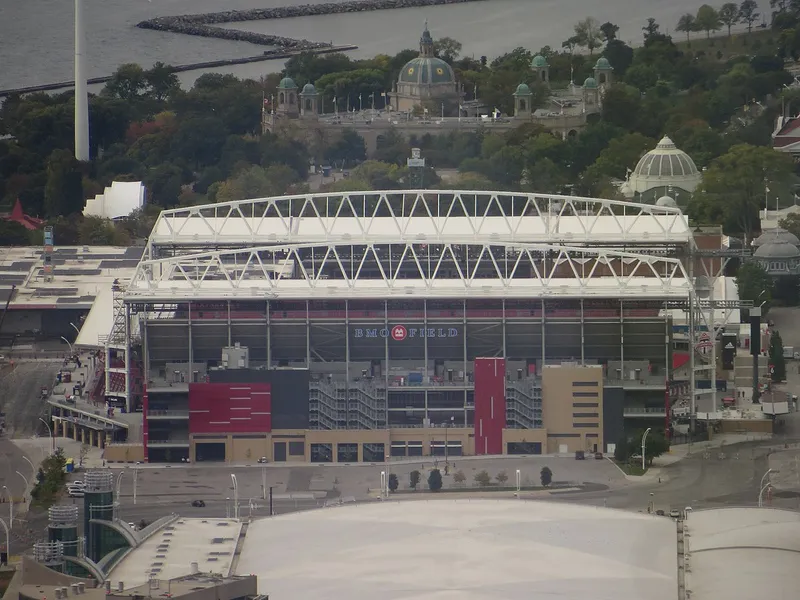
About BMO Field
BMO Field stands on the Lake Ontario waterfront at Exhibition Place, on grounds that have hosted sporting venues for over a century — the fifth stadium built on this exact site. When it opened on April 28, 2007, it was Canada’s first soccer-specific stadium and the home of Toronto FC, the country’s first Major League Soccer franchise. What started as a 20,000-seat venue built for $62.9 million has since been expanded, renovated, roofed, and is now undergoing a $146-million transformation that will push capacity to 45,736 for the 2026 FIFA World Cup — the first men’s World Cup matches ever played on Canadian soil.
The stadium is owned by the City of Toronto and managed by Maple Leaf Sports & Entertainment, which owns both Toronto FC and the Toronto Argonauts of the Canadian Football League. The Argonauts moved to BMO Field in 2016 after a $120-million expansion added an upper deck to the east grandstand, extended the field to CFL dimensions, and installed a sweeping canopy roof over three sides of the stadium. That expansion brought capacity from roughly 21,000 to 30,000 and transformed BMO Field from a modest soccer ground into a legitimate multi-sport venue.
The playing surface is a SISGrass hybrid system — 95% natural grass reinforced by artificial fibers stitched 7.5 inches into the profile, a technology that holds the surface together and reduces recovery time between events. A state-of-the-art heating system installed in 2010 allows the grass to grow through Toronto’s cold spring and fall months. The original FieldTurf artificial surface was replaced with natural grass before the 2010 season after persistent criticism from players and supporters alike.
For the 2026 World Cup, BMO Field hosts 6 matches — five group stage games and a Round of 32 knockout match — including Canada’s opening game on June 12 against a UEFA playoff winner. Germany vs Ivory Coast (June 20) is the marquee neutral match. The stadium will be referred to as “Toronto Stadium” during the tournament under FIFA’s naming conventions.
Getting to BMO Field
Public Transit
BMO Field has strong public transit connections — this is downtown Toronto, not a suburban parking lot — and for World Cup matches, transit is essentially mandatory.
GO Train (Exhibition Station): This is the fastest option. Exhibition Station is one stop west of Union Station on the Lakeshore East-West lines — a 7-minute ride. Trains run every 20 minutes, with fares at $3-5 one-way. The station is just outside the Exhibition Place grounds, a short walk to the stadium gates. For World Cup matches and TFC games, GO Transit runs special event service with increased train frequency.
TTC Streetcar: The 509 Harbourfront streetcar from Union Station and the 511 Bathurst streetcar from Bathurst Station on the Bloor-Danforth Line both terminate at Exhibition Loop, adjacent to BMO Field. The 509 is the most scenic route — it runs along Queens Quay through the Harbourfront before turning west to the stadium. Fare is $3.35 with PRESTO.
TTC Bus: The #29 Dufferin bus runs from Dufferin Station on the Bloor-Danforth subway line south to Exhibition Place, with service running every few minutes on event days. It’s the quickest connection from the west end of the subway system.
Future Ontario Line: The under-construction Ontario Line subway will have Exhibition Place as its southwestern terminus, providing a direct rapid transit connection through the heart of downtown. The line is targeted for a 2030 opening — after the World Cup, but a transformative addition for the stadium’s long-term transit access.
Pro tip: For World Cup matches, arrive at least 3 hours before kickoff. Gates typically open 2 hours early, but security screening can take 45+ minutes during major FIFA events. Take the GO Train — it’s fast, frequent, and drops you right at the door.
Driving + Parking
Driving is possible but not recommended for World Cup matches. GPS: “170 Princes’ Boulevard, Toronto, ON M6K 3C3.”
→ From the East (via Gardiner Expressway): Take the Gardiner Expressway westbound to the Spadina Avenue/Lake Shore Boulevard exit. Turn left onto Lake Shore Boulevard West, then left onto Ontario Drive to reach Exhibition Place and BMO Field.
→ From the West (via Gardiner Expressway): Take the Gardiner Expressway eastbound. Take the Lake Shore Boulevard West exit. Turn left onto Ontario Drive into Exhibition Place.
→ From the North (via Highway 427): Take the 427 southbound, merge onto the Gardiner Expressway East. Follow the Lake Shore Boulevard West exit to Ontario Drive.
Over 5,000 parking spots are available at Exhibition Place adjacent to BMO Field. Toronto FC game day parking runs $30, with Lot 856 (west of the stadium along British Columbia Road) offering a reduced rate. Lot 852 south of the stadium accepts payment through the Green P Parking App only — no cash or credit cards. Parking is not guaranteed during large events and can be severely limited when other Exhibition Place events coincide with matches. For the World Cup, driving is strongly discouraged.
From the Airport
→ Toronto Pearson International Airport (YYZ): Canada’s busiest airport, 24 km northwest of BMO Field. Take the UP Express train from Pearson Station to Union Station — it runs every 15 minutes, takes 28 minutes, and costs $12.35 ($9.25 with a PRESTO card). From Union Station, transfer to the GO Train (7 minutes to Exhibition Station) or TTC streetcar 509 to Exhibition Loop. Total travel time: approximately 45-55 minutes. Pearson is a major international hub with direct flights from across Europe, Asia, and the Americas — this is where the vast majority of World Cup visitors will arrive.
→ Billy Bishop Toronto City Airport (YTZ): A small regional airport on the Toronto Islands, just 2 km east of BMO Field. It handles Porter Airlines domestic and short-haul U.S. flights. A free shuttle ferry crosses the short channel to the city side, and from there it’s a quick taxi or rideshare to the stadium. Convenient for visitors flying from Montreal, Ottawa, New York, or other eastern cities.
Walking from Downtown
BMO Field is walkable from downtown Toronto. From the Entertainment District (King Street West and John Street area, near the CN Tower), the walk is approximately 25-30 minutes heading west along the waterfront or through the Liberty Village neighborhood. The route along Queens Quay and the Martin Goodman Trail is flat, scenic, and runs along the Lake Ontario shoreline. On warm June evenings, this is one of the great pre-match walks in world soccer.
FIFA World Cup 2026 at BMO Field
BMO Field will host 6 matches during the 2026 FIFA World Cup — five group stage games and one Round of 32 knockout match. Toronto is one of two Canadian host cities alongside Vancouver, and the June 12 opener at BMO Field will be a historic occasion: the first men’s FIFA World Cup match ever played on Canadian soil, featuring the Canadian men’s national team.
The complete schedule:
- June 12, 3:00 PM ET — Canada vs UEFA Playoff Winner A (Group A) — The match that will stop the country. Canada opens its home World Cup campaign in front of 45,736 fans, with the opponent determined by the March 2026 UEFA playoffs (Wales, Bosnia and Herzegovina, Italy, or Northern Ireland).
- June 17, 7:00 PM ET — Ghana vs Panama (Group E)
- June 20, 4:00 PM ET — Germany vs Ivory Coast (Group F) — The marquee neutral fixture at BMO Field. A four-time World Cup champion under the lights in Toronto.
- June 23, 7:00 PM ET — Panama vs Croatia (Group E)
- June 26, 3:00 PM ET — Senegal vs FIFA Playoff Winner 2 (Group L)
- July 2, 7:00 PM ET — Round of 32: 2nd Place Group K vs 2nd Place Group L
The expansion: BMO Field’s standard 30,000 capacity falls well below FIFA’s requirements, so a $146-million renovation is transforming the venue. The City of Toronto is investing $123 million and MLSE is contributing $23 million. Construction is being completed in two phases: Phase 1 (completed August 2025) installed four new LED videoboards at each corner, modernized lighting, sound, broadcast, and Wi-Fi systems, built a new rooftop terrace and VIP boxes for 1,000 fans on the north side, and added a premium club lounge on the west side. Phase 2 (December 2025 to March 2026) adds 17,756 temporary seats via grandstands at the north end (10,000 seats) and south end (7,000+ seats), replaces the playing surface with a new FIFA-standard pitch, installs new team dugouts, and expands player and locker room facilities to international standards. The temporary seating brings total World Cup capacity to 45,736.
The atmosphere: Toronto is the most multicultural city in North America — over half of its 2.9 million residents were born outside Canada, representing virtually every nation competing in the World Cup. When Ghana plays Panama, expect genuine Ghanaian and Panamanian communities filling the stands in authentic supporter fashion. When Germany takes the pitch, Toronto’s large German community will be there. This isn’t manufactured diversity for marketing purposes — it’s the actual fabric of the city. BMO Field during the World Cup will feel like a miniature version of the tournament itself.
History of BMO Field
The story of BMO Field is inseparable from the story of Toronto FC — Canada’s first Major League Soccer franchise and the team that ignited professional soccer culture in a country that had long treated the sport as an afterthought.
The founding (2006-2007): On May 11, 2006, during the buildup to the 2006 FIFA World Cup in Germany, MLS announced that Toronto would receive its 13th franchise. The timing was deliberate — World Cup fever was sweeping through Toronto’s incredibly diverse population, and MLSE (which already owned the Maple Leafs, Raptors, and Argonauts) saw an opportunity. Construction on BMO Field began at Exhibition Place, on the site of the demolished Exhibition Stadium, funded through a unique partnership between three levels of government and MLSE at a cost of $62.9 million. The stadium opened on April 28, 2007, and Toronto FC played its first match to a packed house. On May 12, 2007 — the official grand opening — Danny Dichio scored the first goal in club history in the 24th minute against the Chicago Fire, and 20,000 fans hurled their promotional seat cushions onto the pitch in delirious celebration. A tradition was born.
The U-20 World Cup summer (2007): That same summer, BMO Field served as the primary venue for the 2007 FIFA U-20 World Cup, hosting 12 matches including the final — won by Argentina with a squad featuring future stars Sergio Aguero, Angel Di Maria, and Maxi Moralez. Over 260,000 fans passed through the gates during 12 games, immediately establishing the stadium as an international-caliber soccer venue. It was temporarily renamed “National Soccer Stadium” for the tournament.
The early years and growing pains (2007-2013): Toronto FC’s early seasons on the pitch were dismal — the club missed the playoffs in each of its first seven seasons. But something remarkable happened in the stands. An obsessive supporter culture took root from day one, modeled on European ultra traditions rather than the reserved atmosphere typical of North American sports. The South End of BMO Field became the domain of supporter groups like the Red Patch Boys (who claim Section 112, known as “The Bunker”), the Inebriatti, U-Sector, and others who brought drums, smoke, coordinated chants, and unbridled passion to every match. Toronto FC fans didn’t just attend games — they created an atmosphere that rivaled anything in MLS and set a new standard for supporter culture in the league. All of this happened while the team was terrible, which only deepened the authenticity: these weren’t frontrunners. They were believers.
The expansion era (2014-2016): In 2014, MLSE broke ground on a massive $120-million expansion. Phase 1, completed in May 2015, added 8,400 seats through a new upper deck on the east grandstand, along with new clubs and suites. Phase 2 installed a sweeping canopy roof over the east, west, and south stands — a 377-by-68-foot structure lifted into place by two massive cranes and supported by four steel super-columns anchored into bedrock. The expansion brought capacity to 30,000 and transformed BMO Field from a charming but undersized soccer ground into a genuine multi-sport facility. The Toronto Argonauts moved in for the 2016 CFL season, and that November, BMO Field hosted the 104th Grey Cup.
The “Bloody Big Deal” and the treble (2014-2017): In 2014, Toronto FC signed U.S. national team captain Michael Bradley and English striker Jermain Defoe in a dual transfer that the club marketed as “It’s a Bloody Big Deal” — a moment that signaled TFC’s ambitions to become an elite MLS franchise. A year later, Italian star Sebastian Giovinco and American forward Jozy Altidore arrived. The transformation was staggering. Toronto FC went from perennial basement dwellers to the most dominant team in MLS history. The 2017 season was the masterpiece: TFC won the Supporters’ Shield (best regular season record), the Canadian Championship, and then, on December 9, 2017, defeated the Seattle Sounders 2-0 at BMO Field to win the MLS Cup. Jozy Altidore’s 67th-minute goal — a left-footed finish after a devastating counterattack — sent 30,584 frozen, ecstatic fans into delirium. Victor Vazquez sealed it in stoppage time. Toronto FC became the first Canadian team to win the MLS Cup and the first MLS club to complete a domestic treble.
Canada’s fortress (2011-present): Since 2011, the Canadian men’s national team has played all of its home matches at BMO Field, and the stadium has become a genuine fortress. Canada’s remarkable resurgence — from CONCACAF afterthought to World Cup qualifier — played out on this pitch. The team went 14-1-4 across three rounds of 2022 World Cup qualifying, with BMO Field providing a raucous, freezing home-field advantage that visiting Caribbean and Central American teams despised. The cold weather factor was real and deliberate — Canada scheduled qualifying matches in late fall and early spring to maximize the temperature differential. On March 27, 2022, Canada defeated Jamaica 4-0 at BMO Field to clinch qualification for the 2022 FIFA World Cup in Qatar, ending a 36-year absence from the tournament. The celebration that night was one of the great moments in Canadian sports history. BMO Field has also hosted CONCACAF Gold Cup matches (2015, 2023), the 2014 FIFA U-20 Women’s World Cup, and the 2016 MLS Cup Final.
The World Cup transformation (2024-2026): When Toronto was selected as a host city for the 2026 FIFA World Cup, BMO Field needed a significant upgrade to meet FIFA’s 40,000-seat minimum requirement. The $146-million renovation — $123 million from the City of Toronto, $23 million from MLSE — represents the most ambitious transformation in the stadium’s history. The architectural firm Gensler was awarded the redesign contract. Beyond the temporary seating expansion to 45,736, the renovation includes permanent upgrades that will benefit the stadium long after the World Cup: new LED videoboards, modernized broadcast infrastructure, expanded hospitality areas, and a complete overhaul of the playing surface and player facilities. BMO Field in June 2026 will be a very different venue from the modest 20,000-seat ground that opened in 2007 — but the passionate supporter culture that filled those original seats will be the same.
Cultural Significance of BMO Field
Toronto is Canada’s largest city, with a metropolitan population exceeding 6 million, and it is one of the most multicultural cities on Earth. Over half of Toronto’s residents were born outside Canada, with significant communities from virtually every nation that will compete in the 2026 World Cup — Ghanaian, Panamanian, Croatian, German, Senegalese, Ivorian, and dozens more. This isn’t a footnote; it’s the defining feature of what will make BMO Field during the World Cup unlike any other venue in the tournament. Every group stage match at BMO Field will feel like it has a genuine home crowd for both teams, because both teams will actually have one.
The Canadian men’s national team renaissance has been one of international soccer’s great recent stories. Led by Alphonso Davies — the Bayern Munich star whose family fled the Second Liberian Civil War, settling in Edmonton, Alberta — and Jonathan David, the prolific Lille striker born in Brooklyn to Haitian parents and raised in Ottawa, Canada has gone from a nation that hadn’t qualified for a World Cup since 1986 to a team that legitimately belongs on the global stage. Davies scored Canada’s first-ever men’s World Cup goal at the 2022 tournament in Qatar. The growth of the Canadian program mirrors the growth of soccer culture in the country itself — fueled by immigration, youth development, and a generation of young Canadians who grew up watching the Premier League, La Liga, and the Champions League and saw soccer not as a foreign sport but as their sport.
BMO Field sits at the intersection of all of this. It’s where Toronto FC built one of the most passionate supporter cultures in North America from scratch. It’s where Canada qualified for its first World Cup in 36 years. And on June 12, 2026, it will be where Canada takes the pitch in a home World Cup for the first time in history — in a city that looks and sounds like the entire world packed into one place. That’s not just a stadium story. That’s a country’s story.
Photo Gallery
Fun Facts
BMO Field is the fifth stadium built on its exact site at Exhibition Place. The previous tenant was Exhibition Stadium, which hosted the Toronto Blue Jays and Argonauts before the opening of SkyDome (now Rogers Centre) in 1989. Exhibition Stadium was demolished in 1999, and the grounds sat empty until BMO Field rose in 2007.
Danny Dichio scored the first goal in Toronto FC history on May 12, 2007, in the 24th minute against the Chicago Fire. Fans celebrated by hurling their promotional seat cushions onto the pitch. To this day, TFC supporters sing Dichio's name in the 24th minute of every home match — a tradition that has outlasted nearly every player who has worn the jersey.
In its inaugural summer of 2007, BMO Field hosted 12 matches of the FIFA U-20 World Cup, drawing over 260,000 fans — including the final, won by Argentina with a squad featuring Sergio Aguero and Angel Di Maria. The stadium was temporarily renamed 'National Soccer Stadium' because FIFA prohibits non-sponsor branding.
On December 9, 2017, Toronto FC defeated Seattle Sounders 2-0 at BMO Field to win the MLS Cup, becoming the first Canadian team to lift the trophy. TFC completed an unprecedented domestic treble that season — the Supporters' Shield, Canadian Championship, and MLS Cup — in front of 30,584 fans on a frigid Toronto evening.
Canada clinched qualification for the 2022 FIFA World Cup with a 4-0 demolition of Jamaica at BMO Field on March 27, 2022 — the country's first World Cup berth since 1986. Cyle Larin, Tajon Buchanan, and Junior Hoilett scored before a sellout crowd of 29,122, ending a 36-year drought that had defined Canadian soccer's frustration.
Stadium Location
Frequently Asked Questions
- What is the seating capacity of BMO Field?
- BMO Field's standard capacity is 30,000 for Toronto FC matches, expandable to approximately 36,000 with temporary seating. For the 2026 FIFA World Cup, 17,756 temporary seats are being added via grandstands at the north and south ends, bringing World Cup capacity to 45,736. The $146-million renovation also includes new LED videoboards, modernized locker rooms, upgraded lighting, sound, broadcast systems, Wi-Fi, a new rooftop terrace, VIP boxes for 1,000 fans on the north side, and a new club lounge on the west side.
- Where is BMO Field located?
- BMO Field is located at 170 Princes' Boulevard, Toronto, Ontario, M6K 3C3, on the Exhibition Place grounds along the Lake Ontario waterfront. It sits just west of downtown Toronto, approximately 1.5 miles from the CN Tower and within walking distance of the Entertainment District. The stadium was built on the former site of Exhibition Stadium.
- How many FIFA World Cup 2026 matches will BMO Field host?
- BMO Field will host 6 FIFA World Cup 2026 matches — 5 group stage games and 1 Round of 32 knockout match. The schedule: Canada vs UEFA Playoff Winner (June 12, 3 PM), Ghana vs Panama (June 17, 7 PM), Germany vs Ivory Coast (June 20, 4 PM), Panama vs Croatia (June 23, 7 PM), Senegal vs FIFA Playoff Winner (June 26, 3 PM), and a Round of 32 match (July 2, 7 PM). All times Eastern. The June 12 match will be the first-ever men's FIFA World Cup match played on Canadian soil.
- How do I get to BMO Field by public transit?
- BMO Field has multiple excellent transit options. The GO Train from Union Station to Exhibition Station takes just 7 minutes (trains every 20 minutes, $3-5 fare). TTC streetcar routes 509 Harbourfront and 511 Bathurst stop at Exhibition Loop, adjacent to the stadium. The #29 Dufferin bus runs from Dufferin Station on the Bloor subway line directly to Exhibition Place. For World Cup matches, public transit is strongly recommended — arrive at least 3 hours before kickoff as security screening can take 45+ minutes for major international events.
- How do I get from Pearson Airport to BMO Field?
- Take the UP Express train from Pearson Airport to Union Station — it runs every 15 minutes, takes 28 minutes, and costs $12.35 ($9.25 with PRESTO card). From Union Station, transfer to the GO Train (one stop to Exhibition Station, 7 minutes) or take TTC streetcar 509 westbound to Exhibition Loop. Total travel time is approximately 45-55 minutes. Billy Bishop Toronto City Airport, on the Toronto Islands, is even closer — just 2 km east of the stadium.
- Is there parking at BMO Field?
- There are over 5,000 parking spots at Exhibition Place adjacent to BMO Field. Toronto FC game day parking is $30, Argonauts game day parking is $25. Key lots include Lot 852 (south of BMO Field, Green P Parking App only) and Lot 856 (west of BMO Field along British Columbia Road, reduced rate). However, parking is not guaranteed during major events and can be extremely limited. For World Cup matches, driving is strongly discouraged — take transit.
- Does BMO Field have a roof?
- BMO Field has a partial canopy roof that covers the east, west, and south stands, installed during the major 2014-2016 expansion. The north end remains open. The canopy is supported by four steel super-columns with foundations drilled 7 meters into bedrock. The 377-by-68-foot canopy was lifted by two massive cranes during construction. For the 2026 World Cup, temporary grandstands at the north and south ends will be open-air, meaning roughly half the expanded seating will be uncovered.
- What will the stadium be called during the World Cup?
- During the 2026 FIFA World Cup, BMO Field will be referred to as 'Toronto Stadium.' FIFA does not permit non-sponsor branding on venue names during its tournaments — the same convention that will see MetLife Stadium become 'New York/New Jersey Stadium' and Lumen Field become 'Seattle Stadium.' The naming rights are held by BMO (Bank of Montreal), which extended its sponsorship in 2016 for an additional ten years.
Last updated: 2026-02-18