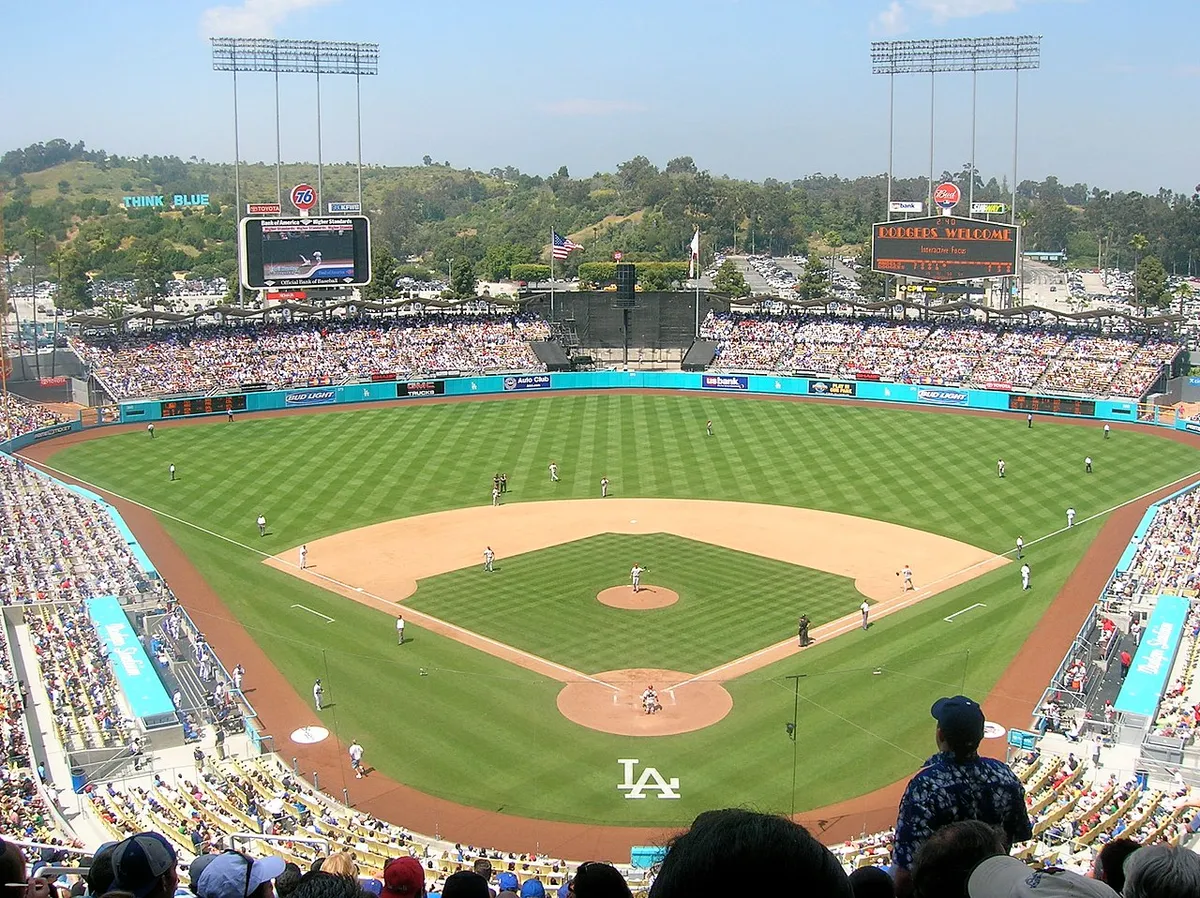
About Dodger Stadium
Dodger Stadium sits on a hilltop in Chavez Ravine, two miles north of downtown Los Angeles, with the San Gabriel Mountains framing the outfield and the city skyline visible beyond the left-field pavilion. At 56,000 seats, it’s the largest ballpark in Major League Baseball — and on a clear evening with the sun setting over the Pacific, there’s no better seat in sports.
Home to the Los Angeles Dodgers since 1962, the stadium is the third-oldest active MLB park behind Fenway Park and Wrigley Field. Unlike those intimate pre-war venues, Dodger Stadium was purpose-built for the automobile age — carved into a hillside with layered parking lots that let fans walk directly to their seating level without climbing stairs. That design was revolutionary in 1962 and still works today.
Walter O’Malley privately financed the $23 million construction, making it the first owner-funded major league ballpark since Yankee Stadium in 1923. Architect Emil Praeger, with Los Angeles-based Edward Fickett handling the regional character, created a modernist bowl with clean sight lines and a cantilevered roof that shades the upper deck. The stadium underwent a $100 million renovation in 2019-2020 that added the two-acre center-field plaza, new dining options, and improved accessibility.
Dodger Stadium has hosted 12 World Series, two MLB All-Star Games (1980, 2022), two papal visits, Olympic baseball in 1984 (and again in 2028), and concerts from the Rolling Stones to Elton John. The Dodgers won their most recent title here in 2024, their eighth championship overall.
Getting to Dodger Stadium
Public Transit
The Dodger Stadium Express is a free bus service operated by LA Metro that runs on all game days. It’s by far the best way to avoid the infamous stadium traffic.
→ From Union Station: Board at the West Portal on Alameda Street (facing downtown). Service begins 2.5 hours before first pitch and runs through the second inning. Return buses run until 45 minutes after the final out. Union Station parking is $8.
→ From the South Bay: The Express stops at Slauson, Manchester, Harbor Freeway, Rosecrans, and Harbor Gateway Transit Center (Bay 9). Free parking is available at these stations on a first-come, first-served basis.
You need a valid game ticket to board the Dodger Stadium Express. The ride from Union Station takes about 10-15 minutes depending on traffic.
Driving + Parking
Dodger Stadium is accessible from multiple freeways, but post-game traffic on the narrow exit roads is legendary. GPS users should enter “1000 Vin Scully Avenue, Los Angeles, CA 90012.”
→ From the 110 Freeway (north or south): Exit at Stadium Way / Dodger Stadium. Follow signs to Gate A or B.
→ From the 5 Freeway (north): Exit at Stadium Way. Follow signs to the stadium.
→ From the 101 Freeway: Exit at Alvarado Street or Echo Park Avenue, then follow signs north to the stadium.
General parking is $27 in advance ($30 at the gate). Preferred lots closer to entrances run $50-60. Budget exterior lots 13 and 14 are just $5 but limited. Arrive early — the parking lots are tiered into the hillside, and getting settled before the crowds makes a real difference.
Rideshare
Uber and Lyft have a designated pickup and drop-off area near Lot 1, entering through Gate B. After the game, expect 20-40 minute waits and surge pricing during the immediate post-game rush.
Pro tip: Grab a Dodger Dog at the center-field plaza after the final out, let the initial wave clear, then order your ride. You’ll save money and time.
From the Airport
→ Hollywood Burbank Airport (BUR): 12 miles north, 18-30 minutes by car. The closest and most convenient airport for Dodger Stadium. No direct transit — rideshare or car rental is your best bet.
→ Los Angeles International (LAX): 20 miles southwest, 30-50 minutes by car depending on traffic. By transit, take the LAX FlyAway bus to Union Station, then the Dodger Stadium Express on game days.
Dodger Stadium Beyond Baseball
Dodger Stadium has always been more than a ballpark. Its hilltop perch and massive capacity have made it one of the most versatile venues in Los Angeles for over six decades.
The stadium hosted Olympic baseball during the 1984 Summer Games and will do so again for the 2028 Los Angeles Olympics, making it one of the few venues in the world to host two Olympic competitions. In 1987 and 2015, Pope John Paul II and Pope Francis held masses here — drawing over 100,000 worshippers across the two events.
The concert history reads like a Rock & Roll Hall of Fame ballot: the Rolling Stones, Elton John, the Beatles (1966), and more recently Bad Bunny, who sold out three consecutive nights in 2023. The center-field plaza added during the 2020 renovation has made the stadium a year-round destination, not just a game-day venue.
History of Dodger Stadium
When Walter O’Malley moved the Brooklyn Dodgers to Los Angeles in 1957, he needed a stadium. The city offered 300 acres of hilly land in Chavez Ravine, and O’Malley hired architect Emil Praeger to design a modernist ballpark carved into the terrain. Construction began on September 17, 1959, requiring workers to move eight million cubic yards of earth and rock to reshape the Stone Quarry Hills.
- Opening Day (April 10, 1962): The Dodgers played their first game before 52,564 fans. The stadium cost $23 million — entirely privately financed.
- World Series Titles (1963, 1965, 1981, 1988): Sandy Koufax dominated in the ’60s, and Kirk Gibson’s walk-off home run in Game 1 of the 1988 Series became one of baseball’s most replayed moments.
- All-Star Games (1980, 2022): The 2022 Midsummer Classic brought renovated Dodger Stadium back to the national spotlight.
- Seat Replacement and Color Restoration (2006): All seats were replaced, restoring the original 1962 multicolor scheme — yellow, light orange, turquoise, and sky blue by level.
- $100 Million Renovation (2019-2020): Added the two-acre center-field plaza with new concessions, a Dodgers museum, improved accessibility, and gathering spaces that opened the stadium up beyond the seating bowl.
- 2024 World Series Championship: The Dodgers defeated the Yankees in five games for their eighth title, the first full-season championship at Dodger Stadium since 1988.
- 2028 Olympics (upcoming): Dodger Stadium will host baseball and softball competitions at the Los Angeles Summer Games.
Photo Gallery
Fun Facts
Dodger Stadium is the third-oldest MLB ballpark (after Fenway Park and Wrigley Field) and the largest by seating capacity at 56,000.
The stadium was the first privately financed major league ballpark since Yankee Stadium in 1923, costing $23 million to build in 1962.
Dodger Stadium has hosted more World Series games than any other active ballpark — 12 Fall Classics and counting, including 2024 when the Dodgers won their eighth title.
Stadium Location
Frequently Asked Questions
- What is the seating capacity of Dodger Stadium?
- Dodger Stadium seats 56,000, making it the largest ballpark in Major League Baseball by seating capacity. With standing room, capacity can exceed 57,000 for special events.
- Where is Dodger Stadium located?
- Dodger Stadium is at 1000 Vin Scully Avenue in the Chavez Ravine area of Los Angeles, about 2 miles north of downtown LA. It sits on a hilltop in Elysian Park with views of the San Gabriel Mountains and the downtown skyline.
- How do I get to Dodger Stadium by public transit?
- The free Dodger Stadium Express bus runs from Union Station (West Portal on Alameda Street) and from several South Bay Metro stations directly to the stadium on game days. Service starts 2.5 hours before first pitch and runs through the end of the second inning. Return buses run until 45 minutes after the final out.
- Is there parking at Dodger Stadium?
- Yes. Dodger Stadium has extensive parking lots surrounding the venue. General parking is $27 in advance ($30 at the gate). Preferred parking in Lots F, H, and K is $50 in advance ($60 on game day). Budget-friendly exterior lots (13 and 14) are $5 but limited. Pre-purchase online to avoid gate-day markups.
- When was Dodger Stadium built?
- Dodger Stadium opened on April 10, 1962, after nearly three years of construction that involved moving eight million cubic yards of earth in the Chavez Ravine hills. It was designed by architect Emil Praeger and cost $23 million — privately financed by Dodgers owner Walter O'Malley.
- Will Dodger Stadium host the 2028 Olympics?
- Yes. Dodger Stadium is confirmed as the baseball and softball venue for the 2028 Los Angeles Summer Olympics. It also hosted baseball during the 1984 Olympics.
- Can I visit Dodger Stadium without attending a game?
- Yes. The Dodgers offer behind-the-scenes stadium tours that include the Dodger dugout, the press box, the field, and exclusive club areas. Tours are available on non-game days year-round. Check mlb.com/dodgers for schedules and tickets.
Last updated: 2026-02-23