About Estadio Azteca
There is no stadium on earth with a resume like Estadio Azteca. Built in 1966 and perched 7,200 feet above sea level in the heart of Mexico City, it is the only venue in history to host three FIFA World Cups — and in 2026, it earns the honor of staging the Opening Match.
This is where Pelé lifted his third World Cup trophy in 1970. Where Maradona scored both the “Hand of God” and the “Goal of the Century” against England in 1986. Where the Mexican national team has built a fortress that visiting teams genuinely fear. The altitude alone is a weapon — at 2,200 meters, the thin air saps stamina from opponents who aren’t acclimatized.
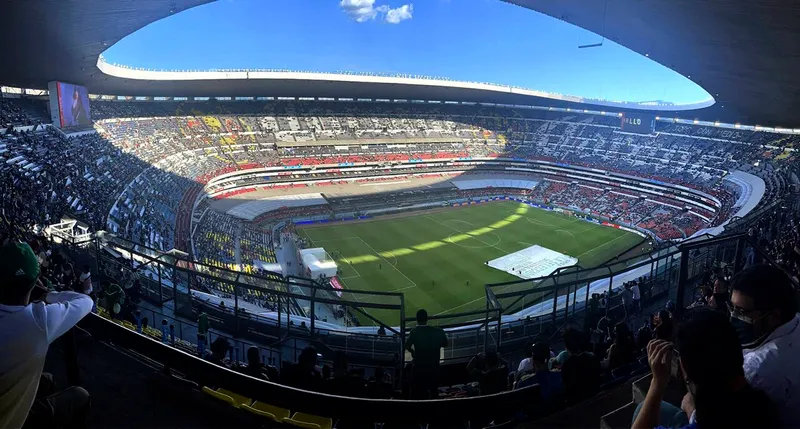
Estadio Azteca holds 87,523 spectators, making it the largest stadium in Mexico and one of the biggest in the Americas. It’s the permanent home of Club América, Mexico’s most successful club, and the de facto home of El Tri, the Mexican national team. On match days, the atmosphere is overwhelming — 87,000 fans creating a wall of sound in the Mexico City basin.
The stadium underwent significant renovations beginning in 2022 to prepare for the World Cup, including new seating, improved accessibility, upgraded facilities, and modernized broadcast infrastructure. FIFA required these updates to bring the 58-year-old venue up to current tournament standards.
Getting to Estadio Azteca
Public Transit
Mexico City has one of the most extensive and affordable metro systems in the world, and it goes directly to the stadium.
Metro: Take Line 2 (Blue Line) to the Estadio Azteca station. The station exit puts you within a 10-minute walk of the gates. From the city center (Zócalo), the journey takes approximately 30 minutes and costs 5 pesos (~$0.30 USD).
Metrobús: Line 1 runs along Insurgentes Avenue with a stop at Doctor Gálvez, about a 15-minute walk from the stadium. The Metrobús costs 6 pesos per ride.
Important for World Cup visitors: The metro gets extremely crowded on match days. Arrive at least 2 hours before kickoff. After the match, expect significant congestion at the metro station — consider walking to an adjacent station or waiting 30-45 minutes for crowds to thin.
Driving + Parking
Estadio Azteca is accessible via the Periférico (ring road) and Calzada de Tlalpan, but driving in Mexico City on match days is not recommended. Traffic around the stadium becomes gridlocked hours before kickoff.
If you must drive, parking is available in the stadium lots and surrounding streets. Official lot parking costs vary by event. Street parking in the surrounding neighborhood carries theft risk — use official lots only.
Rideshare
Uber and Didi both operate in Mexico City. A ride from the city center to the stadium costs approximately 100-200 pesos ($6-12 USD) under normal conditions. Surge pricing on match days can push this to 300-500 pesos.
Pro tip: Have your driver drop you 2-3 blocks from the stadium to avoid the worst traffic congestion near the gates.
From the Airport
→ Mexico City International Airport (MEX): 14 miles from the stadium, 30-60 minutes by car depending on the notorious Mexico City traffic. The metro connects the airport (Terminal Aérea station, Line 5) to the stadium with one transfer, taking about 45 minutes.
→ Felipe Ángeles International Airport (NLU): The newer airport is 30 miles north. Budget 60-90 minutes by car or use the Mexibús to connect to the metro system.
FIFA World Cup 2026 at Estadio Azteca
On June 11, 2026, Estadio Azteca will write another chapter in its unmatched World Cup history when it hosts the Opening Match of FIFA World Cup 2026. No other venue could carry this honor with the same weight.
Expected matches: 7 total — the Opening Match plus group stage games and potential Round of 16 matches.
Historic significance: This is the third World Cup for Estadio Azteca. In 1970, Brazil beat Italy 4-1 in the Final here, with Pelé scoring the opening goal. In 1986, Argentina defeated West Germany 3-2 in another iconic Final, with Maradona commanding the tournament. The 2026 Opening Match continues a legacy no other building on the planet can claim.
Altitude factor: At 7,200 feet, the thin air at Estadio Azteca is a genuine competitive factor. Players who haven’t acclimatized will fatigue faster, and the ball behaves differently — it flies farther and swerves less. Teams scheduled for Mexico City matches would be wise to arrive early for altitude training.
Renovations: Significant upgrades have been completed for 2026, including new premium seating areas, improved concourses, modernized media facilities, enhanced accessibility throughout the venue, and upgraded playing surface drainage.
Fan zones: FIFA Fan Festivals will be established in iconic Mexico City locations, likely including the Zócalo (main square) and Chapultepec Park areas. Mexico City’s vibrant culture, food scene, and nightlife will make it one of the most memorable host city experiences of any World Cup in history.
History of Estadio Azteca
Estadio Azteca opened on May 29, 1966, designed by architects Pedro Ramírez Vázquez and Rafael Mijares Alcérreca. The name “Azteca” honors the Aztec civilization that built Tenochtitlán, the ancient city upon which Mexico City stands. From its first day, the stadium was conceived as a monument to Mexican ambition — the largest and most modern venue in Latin America.
1970 FIFA World Cup: Estadio Azteca hosted 10 matches including the Final, where Brazil’s legendary squad — featuring Pelé, Jairzinho, Tostão, and Carlos Alberto — dismantled Italy 4-1 in what many consider the greatest World Cup Final ever played. Pelé’s header and Carlos Alberto’s thunderous goal remain two of the most replayed moments in soccer history.
1986 FIFA World Cup: Sixteen years later, the stadium hosted another iconic tournament. Diego Maradona’s Argentina faced England in the quarterfinals here on June 22, 1986 — a match that produced both the infamous “Hand of God” goal and the “Goal of the Century,” where Maradona dribbled past half the England team in a 60-meter solo run. Argentina went on to beat West Germany 3-2 in the Final, also at Azteca.
Beyond the World Cup: Estadio Azteca has hosted NFL regular-season games (the “Mexico City Series”), major concerts (U2, Paul McCartney, The Rolling Stones), and countless Liga MX matches. It is the spiritual home of Club América and remains the most important sporting venue in Mexico.
The stadium has survived two significant earthquakes — the devastating 1985 Mexico City earthquake (8.0 magnitude) and the 2017 earthquake (7.1 magnitude) — with only minor structural damage both times, a testament to its robust engineering.
At 58 years old in 2026, Estadio Azteca is the oldest World Cup venue by decades. But age is part of its power. The ghosts of Pelé and Maradona haunt this place in the best possible way. When the Opening Match kicks off on June 11, 2026, nearly 90,000 fans will be connected to 60 years of the most important moments in football history.
Photo Gallery
Fun Facts
Estadio Azteca is the only stadium in the world to host three FIFA World Cups (1970, 1986, 2026) and witnessed both Pelé's final World Cup triumph and Maradona's 'Goal of the Century.'
At 7,200 feet above sea level, it's one of the highest-altitude major stadiums in the world — visiting teams often struggle with the thin air, which has earned the venue the nickname 'The Fortress.'
The stadium was built in just 4 years (1962-1966) by architect Pedro Ramírez Vázquez, who also designed the National Museum of Anthropology — both are considered masterworks of modern Mexican architecture.
Stadium Location
Frequently Asked Questions
- What is the seating capacity of Estadio Azteca?
- Estadio Azteca has a capacity of 87,523, making it the largest stadium in Mexico and one of the largest in the world. For FIFA World Cup 2026, the capacity may be slightly adjusted to meet modern FIFA standards.
- Where is Estadio Azteca located?
- Estadio Azteca is located in the Coyoacán borough of Mexico City, at Calzada de Tlalpan 3465. It sits at an elevation of 7,200 feet (2,200 meters) above sea level, which is a significant factor for player performance.
- How many World Cups has Estadio Azteca hosted?
- Estadio Azteca is the only stadium in the world to host three FIFA World Cups: 1970, 1986, and 2026. It hosted both the 1970 and 1986 World Cup Finals, witnessing Pelé's last World Cup triumph and Maradona's famous 'Hand of God' and 'Goal of the Century.'
- What World Cup 2026 matches will be played at Estadio Azteca?
- Estadio Azteca will host the FIFA World Cup 2026 Opening Match on June 11, 2026, along with group stage matches. It is expected to host 7 matches total.
- How do I get to Estadio Azteca by public transit?
- Take Mexico City Metro Line 2 to Estadio Azteca station (formerly Tasqueña direction). The station is a short walk from the stadium. The Metrobús Line 1 also stops nearby at Doctor Gálvez. Mexico City's transit system is affordable — a metro ride costs 5 pesos (about $0.30 USD).
- What is the altitude at Estadio Azteca?
- Estadio Azteca sits at 7,200 feet (2,200 meters) above sea level. This high altitude affects player stamina and ball flight. Visiting teams historically struggle with the thin air, and FIFA has acknowledged altitude as a competitive factor.
Last updated: 2026-02-06