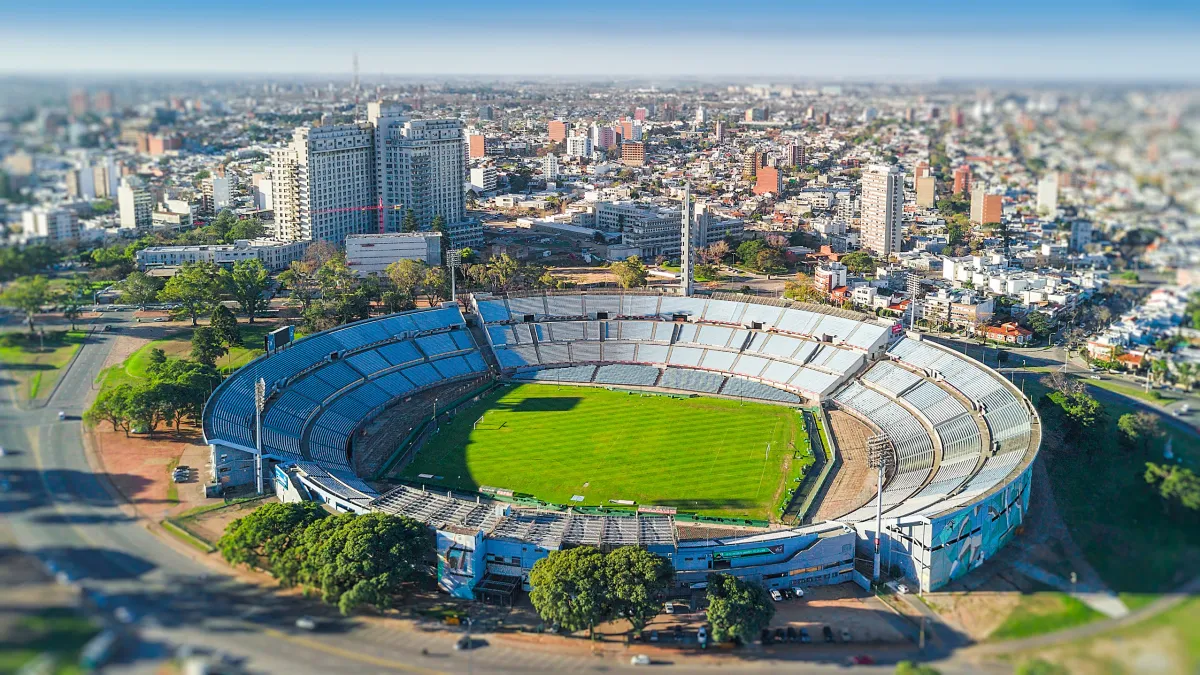
About Estadio Centenario
Unusually for a great football ground, this one belongs to the city rather than a club. It sits inside Parque Batlle, a wooded park a few kilometres east of central Montevideo, owned by the Montevideo departmental government and run by a body called CAFO. It is an open bowl of grass and concrete, with a natural-grass pitch of the standard 105 by 68 metres and no roof, at least not yet.
Its primary tenant is the Uruguay national team, La Celeste, which has played here since the day the stadium opened. For decades it was also home to Peñarol, from 1933 until the club moved to its own ground in 2016, and it still hosts the biggest club occasions, above all the Clásico against Nacional, when 60,000 seats are needed. From 2026 the club Boston River will play some fixtures here too.
The four grandstands are a history lesson in themselves. Colombes and Ámsterdam are named for Uruguay’s Olympic football golds of 1924 and 1928, Olímpica for those gold-medal years, and América for the country’s Copa América titles. Beneath two of the stands, in a quirk that surprises visitors, sit a working primary school and a police station.
The stadium is showing its age, which is part of why a major renovation is planned for the 2030 World Cup, a tournament that returns to Uruguay for the competition’s centenary. That work would roof most of the ground, lower the pitch and reconfigure it to around 63,000 seats. For now, the Centenario you visit is close to the one that made history in 1930.
Getting to Estadio Centenario
The stadium is a short trip from central Montevideo, reachable by bus, taxi or a walk through the park.
Public Transit
Montevideo relies on an extensive city bus network, and several lines run to the edge of Parque Batlle.
→ Via city bus: Lines including the 115 and 143 stop near the stadium, connecting it to the center and the Tres Cruces terminal area.
→ On foot from the park: However you arrive, the last stretch is a walk through Parque Batlle itself, a pleasant green approach to the ground.
Driving + Parking
Montevideo is an easy city to drive in for a capital city, and the stadium is clearly marked within the park.
→ From downtown: Roughly 15 to 20 minutes east along the main avenues to Parque Batlle in normal traffic.
→ Parking: There is parking on site, but it fills quickly on match days, so arrive early or plan to leave the car further out and walk in.
Rideshare
Ride-hailing apps and taxis are widely used in Montevideo, and a car from the center to the stadium is quick and inexpensive, usually 15 to 20 minutes. For visitors it is the simplest option, especially heading back after a match when buses are crowded.
From the Airport
→ Carrasco International (MVD): Montevideo’s main airport is about 20 kilometres east of the stadium. A taxi takes around 20 minutes, and airport bus line 701 runs into the city in roughly 45 minutes.
→ Into the city: Carrasco is a small, modern airport, and transfers into central Montevideo and on to Parque Batlle are straightforward.
Matchday and the Museum at Estadio Centenario
A visit to the Centenario works two ways, and both are worth your time. On a match day, the ground comes alive for the Uruguay national team or, best of all, for the Clásico between Peñarol and Nacional, a derby locals say stops the country. Regulars advise arriving around half an hour before kickoff, when the stadium is already filling and beginning to sing. Peñarol’s support traditionally fills the Ámsterdam stand, and visitors are struck by how even a modest midweek crowd makes the huge bowl feel loud.
Where you sit depends on what you want. The Tribuna Olímpica on the east side is the focal stand, three tiers with the best views of the pitch and the tower and museum right behind it. Be warned that the seating in much of the ground is old-style concrete, and the athletics track around the field leaves the lower rows some distance from the action, one of the reasons the 2030 renovation plans to lower the pitch. This is a stadium you go to for atmosphere and history, not modern comfort.
The food follows the Uruguayan football tradition rather than anything invented for the venue. Inside, the concessions are basic, with panchos, popcorn and beer. The better eating is at the street carts around the ground, where choripán is the staple, and if you want the national dish, track down a chivito, Uruguay’s loaded steak sandwich. A beer at a cart before kickoff, mingling with the crowd walking in through the park, is the pre-match ritual.
On any other day, the reason to come is the Museo del Fútbol. Set under the Olímpica stand, it traces Uruguayan football through its greatest era, with memorabilia from the 1924 and 1928 Olympic golds and the 1930 and 1950 World Cups. Pay the small amount extra to ride the Torre de los Homenajes up to its mirador, and you get a panoramic sweep across Montevideo. Between the museum, the tower and a guided tour of the pitch and stands, the Centenario is one of the few stadiums that is a genuine attraction even when nothing is being played.
Construction & Design
Speed defined the whole project. The Uruguayan architect Juan Antonio Scasso drew the plans, the cornerstone was laid on July 21, 1929, and despite heavy rain that delayed the concrete pour, the stadium was built in roughly nine months, opening on July 18, 1930. About 1,100 laborers worked three shifts a day, excavating 160,000 cubic metres of earth and pouring 14,000 cubic metres of reinforced concrete, at a cost of around one million US dollars of the era, an enormous sum for a nation of barely two million people.
The defining feature is the Torre de los Homenajes, the Tower of Tributes. It is a 100-metre Art Deco shaft of reinforced concrete rising from the Olímpica stand, with nine balconies representing the nine stripes of the Uruguayan flag and a form meant to suggest the prow of a ship, a tribute to the immigrants who arrived by sea to build the young country. It is the image most associated with the stadium, and a panoramic elevator now carries visitors up it.
The ground opened just after the first World Cup had already begun, on July 18, 1930, the exact centenary of Uruguay’s first constitution, with Uruguay beating Peru 1-0. Its stature only grew from there. On July 18, 1983, its fifty-third anniversary, FIFA declared it a Historical Monument of World Football, the first and still the only building to receive the honor, and Montevideo lists it as part of the city’s historical heritage.
History of Estadio Centenario
The Centenario exists because Uruguay won the right to host the first World Cup, and it was built to be the tournament’s showpiece. It hosted ten matches in 1930, including both semifinals and the final, though rain meant it opened days after the competition had started elsewhere in Montevideo.
The decisive day was July 30, 1930. Uruguay came from 2-1 down to beat Argentina 4-2 in front of 68,346 spectators and become the first world champions. Three days earlier the stadium had recorded its all-time attendance mark of 79,867, for a semifinal between Uruguay and Yugoslavia. Those two figures, the final and the record, tell the story of a ground that was the beating heart of the first World Cup.
It stayed at the center of the South American game for decades. Uruguay won all four Copa América finals it hosted here, in 1942, 1956, 1967 and 1995, and the stadium staged the 1980 Mundialito, a tournament of former world champions that Uruguay also won. Peñarol made it home from 1933 to 2016, including their 1960 Intercontinental Cup meeting with Real Madrid, and more recently the ground hosted the 2021 Copa Libertadores and Copa Sudamericana finals.
Now the story is coming full circle. The 2030 World Cup, marking a century since 1930, returns to Uruguay, and the Centenary tournament will bring matches back to the stadium built for the very first one. A renovation is planned to ready it for that return. For a ground that began as a monument to one anniversary, hosting the World Cup on the anniversary of the World Cup itself is a fitting next chapter.
Sources & Further Reading
- Wikipedia, Estadio Centenario: en.wikipedia.org. Capacity, dates, architect, stands, ownership and event history.
- FIFA, Estadio Centenario turns 90: inside.fifa.com. The construction story, the tower and the 1930 final.
- Estadio Centenario official site: estadiocentenario.com.uy. The build, the stands, the museum and construction figures.
- Inside World Football, the 2030 upgrade: insideworldfootball.com. The planned renovation, roof and reconfiguration for the World Cup.
- Outside Write, iconic stadiums, Estadio Centenario: outsidewrite.substack.com. Visitor experience, the museum and the tower climb.
Quick Facts
Everything you need at a glance.
Stadium specs
- Capacity
- 60,235
- Opened
- 1930
- Cost
- Approximately US$1 million (1930)
- Roof
- Open
- Surface
- Natural Grass
- Tenants
- Uruguay national team
Construction & location
- Groundbreaking
- 1929
- Architects
- Juan Antonio Scasso
- Engineering
- Not separately recorded
- General contractor
- Not separately recorded
- Address
- Avenida Dr. Américo Ricaldoni, Parque Batlle, Montevideo, Uruguay
- GPS
- 34.8947°S, 56.1528°W
Photo Gallery
Fun Facts
A working primary school and a police station operate in the space beneath two of the grandstands.
The 100-metre Torre de los Homenajes has nine balconies, one for each of the nine stripes on the Uruguayan flag, and was shaped to evoke a ship's prow honoring the immigrants who built the country.
The stadium was built in roughly nine months by about 1,100 laborers working three shifts a day, who excavated 160,000 cubic metres of earth and poured 14,000 cubic metres of reinforced concrete.
Stadium Location
Frequently Asked Questions
- Why is Estadio Centenario historically important?
- It was built as the centerpiece of the very first FIFA World Cup and hosted that 1930 tournament's final, when Uruguay beat Argentina 4-2 to become the first world champions. In 1983 FIFA declared it a Historical Monument of World Football, the only stadium in the world to hold that designation, honoring its place at the birth of the World Cup.
- Can you visit the football museum and tower at Estadio Centenario?
- Yes, and it is the top recommendation for visitors. The Museo del Fútbol under the Olímpica stand displays memorabilia from Uruguay's 1924 and 1928 Olympic titles and the 1930 and 1950 World Cups. For a little extra you can ride up the Torre de los Homenajes, the stadium's Art Deco tower, for panoramic views across Montevideo. Guided tours, some in English, are also available.
- What is the best stand to sit in at Estadio Centenario?
- The Tribuna Olímpica on the east side is the focal stand, with around 21,648 seats over three tiers and the best views of the pitch, plus the tower and museum entrance. The other three stands are named for Uruguayan triumphs: Colombes and Ámsterdam for the 1924 and 1928 Olympic golds, and América for the Copa América wins, which houses the official box.
- What food is there at a match at Estadio Centenario?
- Inside, the concessions are basic, with hot dogs known as panchos, popcorn, sodas and beer. The better food is on the street carts around the ground, where choripán, a grilled chorizo in a roll, is a staple of Uruguayan football. If you want the local signature dish, seek out a chivito, Uruguay's loaded steak sandwich, before or after the game.
- What is the atmosphere like at Estadio Centenario?
- National-team days and derbies are intense and passionate, especially Uruguay against Argentina. The biggest occasion is the Clásico between Peñarol and Nacional, a rivalry said to stop the country, with Peñarol's support traditionally packing the Ámsterdam stand. Visitors note that even a sparse midweek crowd fills the huge bowl with noise.
- How do you get to Estadio Centenario?
- The stadium sits in Parque Batlle, about 4 kilometres from central Montevideo. City bus lines such as the 115 and 143 stop nearby, and a taxi or rideshare from downtown takes 15 to 20 minutes. From Carrasco International Airport, allow about 20 minutes by taxi or 45 minutes on bus line 701. Walking from the center is impractical, but the final approach through the park is pleasant.
- What is the capacity of Estadio Centenario?
- About 60,235. Its record attendance was 79,867, set at a 1930 World Cup semifinal between Uruguay and Yugoslavia, in the days before all-seater safety limits. A renovation planned for the 2030 World Cup would add a roof over most of the stadium and reconfigure it to around 63,000 seats.
- Why is it called the Centenario?
- The name marks the 100-year anniversary of the ratification of Uruguay's first constitution in 1830. The stadium was deliberately inaugurated on the exact centenary date, July 18, 1930, as a monument to that anniversary as much as a venue for the first World Cup.
- Is Estadio Centenario still used today?
- Yes. It remains the home of the Uruguay national team and hosts major club matches, including the Peñarol against Nacional Clásico when a large capacity is needed. Peñarol played there until 2016 before moving to their own ground, and the stadium has also staged recent Copa Libertadores and Copa Sudamericana finals.
Last updated: 2026-07-17