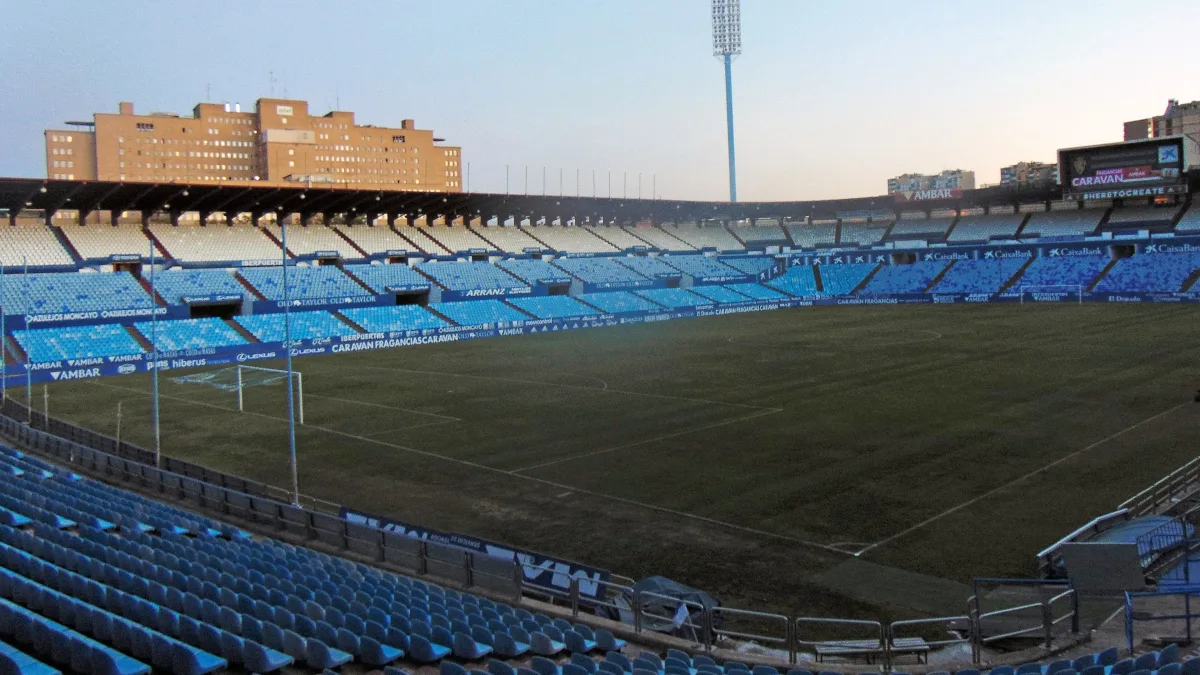
About Nueva Romareda
On the same patch of central Zaragoza where Real Zaragoza have played since 1957, the old La Romareda is gone and a new one is climbing out of the ground in its place. Nueva Romareda sits on Paseo Isabel la Católica, beside the leafy Parque Grande, a city-center location that most modern stadiums have long since traded for a ring road. The address has not moved. Only the building has.
The headline number is about 43,000 seats, published so far as 43,110 or 43,184 while the design is signed off. That is close to what the old ground held at its 1970s peak, but this time fully covered, all-seater, and wrapped in a shell shaped like nothing Zaragoza has seen. The single tenant is Real Zaragoza, the Aragonese club founded in 1932, a former Spanish cup winner and European trophy holder now working its way back through the second tier. The new home is a bet on where they are headed, not where they sit in the table.
There is a bigger reason for the scale and the hurry. Spain co-hosts the 2030 World Cup with Portugal and Morocco, and Zaragoza’s stadium was chosen as one of the Spanish venues, tentatively down to host matches through the round of 16. A World Cup deadline concentrates minds and budgets. The stadium itself is costed at about €148.6 million, most of it public money led by the city council, with the wider operation nearer €168.8 million once the temporary ground is counted in.
For now, it is a building site rather than a stadium. Partial demolition began in 2024, the last match was played in May 2025, and the new bowl is going up in phases with completion targeted for August 31, 2027. Everything below is the plan on paper and the work in progress, not a stadium you can yet walk into.
Getting to Nueva Romareda
The site is one of the easier stadium locations to reach in Spain, sitting inside the city rather than out beyond it. The catch is timing: until the new ground opens, the team is playing elsewhere, so a visitor heading to a Real Zaragoza match right now wants the Expo, not the Paseo.
Public Transit
Zaragoza runs a single tram line, Line 1, straight down the spine of the city, and it passes within a short walk of the Romareda site.
→ By tram: Line 1 runs along the Gran Vía and Fernando el Católico, a few minutes on foot east of the ground. It links the site to the center and the university in one ride.
→ By bus: Several city bus lines stop on Paseo Isabel la Católica right by the stadium, including services along the Gran Vía corridor. Fares are cheap and the routes are frequent.
Driving + Parking
The stadium sits in a dense residential grid, so driving in has always been the hard part, and the rebuild adds an underground element to the plan.
→ From the ring road: The Z-30 and Z-40 orbital roads feed into the central avenues, from which the Paseo Isabel la Católica is signposted. Reckon on slow going near kickoff.
→ Parking: The old ground had little parking of its own, and the tight streets around it fill fast. The new design includes two basement levels; how much of that goes to public parking is not yet public. For now, park further out and walk in.
Rideshare
Ride-hailing coverage in Zaragoza is thinner than the local taxi fleet, which is plentiful and metered. From the center, a taxi to the Romareda area is a short, cheap hop. Heading back after a full house, expect the usual wait while the crowd clears, and know that the drop-off will be a block or two from the gates given the narrow streets.
From the Airport
→ Zaragoza Airport (ZAZ): About 10 kilometres west of the center, roughly 20 minutes by road. A city bus and taxis link it to town, though flight options are limited outside peak season.
→ By high-speed train: Zaragoza-Delicias station sits on the Madrid-Barcelona AVE line, putting both cities a little over an hour away. For many visitors the train, not the plane, is the real gateway to the city.
Nights at the Old Romareda
Before the cranes, there was a ground people were fond of, and it is worth knowing what the new stadium has to live up to. The old La Romareda opened in 1957 and never pretended to be pretty. A plain concrete bowl on a city block, its charm was the way the crowd sat close and the way the Cierzo, the cold wind that scours Zaragoza off the mountains, could turn a mild evening raw and make life miserable for visiting teams. Aragonese fans wear that wind almost as a badge. It is no accident that the new roof is named for it.
The stadium had its share of big occasions. During the 1982 World Cup it hosted three group matches, a run of tight, low-scoring games featuring Yugoslavia, Northern Ireland and Honduras. Ten years later it staged seven matches of the 1992 Olympic football tournament, a quarterfinal among them. Three Copa del Rey finals were played here, in 1983, 1987 and 1996. And in the spring of 1995 came the night older locals still talk about, when Real Zaragoza beat Chelsea 3-0 on this pitch in the first leg of a European Cup Winners’ Cup semifinal, on the way to the trophy they sealed in Paris with Nayim’s absurd lob from near the halfway line.
What a matchday will feel like in the new bowl, nobody can honestly say yet. There are no seats to sit in, no concourses worn smooth, no new chants echoing off a fresh roof, because the stands do not exist. That is the gap between a plan and a place. The genuine article, the thing worth describing, is still the memory of the old ground and the promise of the drawings. Real Zaragoza have until 2027 to turn one into the other, and until 2030 to prove it can hold a World Cup.
Construction & Design
The design belongs to IDOM, the Spanish engineering and architecture firm, with César Azcárate leading a technical team drawn from across the company. Their concept starts with the weather. The defining feature is a roof and outer envelope shaped by the Cierzo, drawn as an aerodynamic shell that pulls tight over the stands, shelters all of the seats, and cantilevers out to form a continuous 360-degree promenade with views of both the pitch and the Zaragoza skyline. It is a stadium designed around the one thing everyone in the city complains about.
The numbers underneath are substantial. The structure rises across five floors above ground and two basement levels, over 31 metres tall, with a total built area of 76,653 square metres, of which roughly 52,090 are the stadium proper and the rest given over to ancillary and commercial uses. Capacity lands at about 43,000, published as 43,110 or 43,184 depending on the source, split into general seating, hospitality and a small block of media positions. The project carries a BREEAM Excellent sustainability rating, unusual for a football ground and a deliberate part of the pitch to the World Cup.
The build is the hard part, and it is being done the difficult way, in place. Rather than move to a fresh site, Real Zaragoza chose to knock down and rebuild on the exact footprint of the old ground, phase by phase. Partial demolition of the south end began in 2024 while the team kept playing at reduced capacity, the final match came in May 2025, and full demolition and construction followed across five phases. The stadium itself is budgeted near €148.6 million, with the main construction contract awarded in December 2024 at about €124.5 million, and completion targeted for August 31, 2027. That date is the one that matters, because it leaves only a slim margin before the 2030 tournament the whole project is racing toward.
History of Nueva Romareda
The story starts with a club that outgrew its field. Real Zaragoza, founded in 1932, opened La Romareda on September 8, 1957 with a 4-3 win over Osasuna, the first goal scored by Ramón Vila. The architect was Francisco Riestra, and the original ground held a little over 32,000. A 1977 expansion pushed it above 43,000, before later renovations for all-seater rules settled it back down. For 68 years it was simply home.
The modern chapter is about a tournament and a decision. When Spain, Portugal and Morocco won the right to stage the 2030 World Cup, Zaragoza wanted in, and the aging Romareda was not up to the standard. The city and club chose the boldest option: demolish the historic ground and raise a new one on the same land rather than build fresh on the edge of town. Partial demolition began in 2024, and on May 25, 2025 the old stadium hosted its last match, a 1-0 win over Deportivo de La Coruña, before the fans spilled onto the pitch to say goodbye.
The temporary home (2025): With the Romareda coming down, Real Zaragoza needed somewhere to play. The answer was the Ibercaja Estadio, a modular stadium assembled at the Expo fairgrounds in about 26 weeks and opened in July 2025, holding 20,071 and billed as the first of its kind in Spain. It is meant to serve two seasons, through 2026-27.
The naming rights (2025): In July 2025 the club announced a decade-long agreement under which the new stadium will carry the name Ibercaja Romareda, tying the local savings bank to the ground much as it has to the temporary one.
The chapters that count are still unwritten. No seat has been fixed in the new stands, no crowd counted, no goal celebrated under the Cierzo-shaped roof. If the schedule holds to August 2027, Real Zaragoza will have a couple of seasons to settle in before the world arrives in 2030. A ground rebuilt for a tournament it has yet to host, its biggest nights are still ahead, and everything until then is construction on the spot where the old Romareda stood.
Sources & Further Reading
- Wikipedia entry on La Romareda: en.wikipedia.org/wiki/La_Romareda. The 1957 opening, capacity history, the 1982 World Cup and 1992 Olympic matches, and the rebuild plan.
- Spanish Wikipedia on the Estadio de La Romareda: es.wikipedia.org. Detailed capacity evolution, the last match, demolition dates, cost breakdown and the Ibercaja Romareda naming deal.
- Real Zaragoza official stadium project page: realzaragoza.com. The club’s own account of the IDOM design and the Cierzo concept.
- Zaragoza city council announcement: zaragoza.es. The 43,184-seat figure, the five-floor structure, built area, budget and construction phasing.
- Spanish Wikipedia on the Ibercaja Estadio: es.wikipedia.org. The temporary modular ground, its 20,071 capacity, cost and construction timeline.
Quick Facts
Everything you need at a glance.
Stadium specs
- Capacity
- 43,184
- Opened
- 2027
- Cost
- About €148.6 million for the stadium (roughly €168.8 million total, including the temporary ground)
- Roof
- Canopy
- Surface
- Grass
- Tenants
- Real Zaragoza
Construction & location
- Groundbreaking
- 2024 (partial demolition); main construction from July 2025
- Architects
- IDOM
- Engineering
- Not separately recorded
- General contractor
- Not separately recorded
- Address
- Paseo Isabel la Católica, 50009 Zaragoza, Aragón, Spain
- GPS
- 41.6367°N, 0.9019°W
Photo Gallery
Fun Facts
The old La Romareda opened on September 8, 1957 with a 4-3 win over Osasuna, and stood for 68 years before its last match in May 2025.
The new roof is shaped by the Cierzo, Zaragoza's cold north-westerly wind. It is designed as an aerodynamic shell that covers 100 percent of the roughly 43,000 seats while leaving the pitch open, wrapped by a 360-degree public walkway with views over the city.
While the new stadium rises, Real Zaragoza play at the Ibercaja Estadio, the first modular stadium built in Spain, assembled at the Expo grounds in about 26 weeks and holding 20,071.
Stadium Location
Frequently Asked Questions
- Is Nueva Romareda finished?
- No. As of 2026 it is under construction. Partial demolition of the old La Romareda began in 2024, the last match was played in May 2025, and the main build runs across five phases from July 2025, with the stadium due to be fully operational by August 31, 2027 for the 2027-28 season. The roughly 43,000-seat figure and the design described here are the published plans, not a finished, measured building.
- Where does Real Zaragoza play during construction?
- At the Ibercaja Estadio, a temporary modular ground built at Zaragoza's Expo fairgrounds, northwest of the center. It holds 20,071 and opened in July 2025. It is billed as the first modular stadium in Spanish football, and Real Zaragoza are due to use it through the 2025-26 and 2026-27 seasons until the new La Romareda is ready.
- Where is Nueva Romareda located?
- On Paseo Isabel la Católica in central Zaragoza, beside the Parque Grande, on the exact site of the old La Romareda. It is about as central as a stadium gets, a short distance from the Gran Vía and about 3 kilometres south of the Basílica del Pilar and the Ebro riverfront.
- How big will Nueva Romareda be?
- The plan is for about 43,000 seats, published variously as 43,110 or 43,184 as the design is finalized, with room to expand for concerts. That is close to the old ground's peak size, but fully covered and all-seater to modern standards. Expect the exact figure to settle only once the stadium is complete.
- Will Nueva Romareda host the 2030 World Cup?
- That is a central reason for the rebuild. Spain co-hosts the 2030 tournament with Portugal and Morocco, and Zaragoza's new stadium is an official host venue, tentatively lined up to stage matches through the round of 16. FIFA confirms exact fixtures closer to the event.
- Who designed Nueva Romareda?
- The Spanish engineering and architecture firm IDOM, with César Azcárate as lead architect. The signature idea is a roof and envelope shaped by the Cierzo, the wind that defines Zaragoza's climate, drawn as an aerodynamic shell that shelters every seat while leaving the pitch open to the sky.
- How much is Nueva Romareda costing?
- The stadium itself is budgeted at about €148.6 million, and the total operation, including the temporary Ibercaja Estadio and associated works, is put at roughly €168.8 million. The bulk of the funding is public, led by Zaragoza city council. The main construction contract was awarded in December 2024 at about €124.5 million.
- What happened to the old La Romareda?
- It served Real Zaragoza from 1957 to 2025. Partial demolition of the south end began in 2024 while the team kept playing at reduced capacity, the final match was a 1-0 win over Deportivo de La Coruña on May 25, 2025, and full demolition followed. The new stadium is being built on the same footprint, so the address does not change, only the building.
- How do I get to the Nueva Romareda site?
- The site sits on Paseo Isabel la Católica in central Zaragoza. Tram Line 1 runs a short walk away along the Gran Vía and Fernando el Católico axis, and several city bus lines stop on the Paseo itself. It is walkable from much of the center. Remember, though, that match traffic currently heads to the temporary Ibercaja Estadio at Expo, not here.
- When will Nueva Romareda open?
- The target is for the stadium to be fully operational by August 31, 2027, letting Real Zaragoza move in for the 2027-28 season, a couple of years before the 2030 World Cup it is built to help host. As with any phased build, the date is a target rather than a certainty.
Last updated: 2026-07-27