About Estádio da Luz
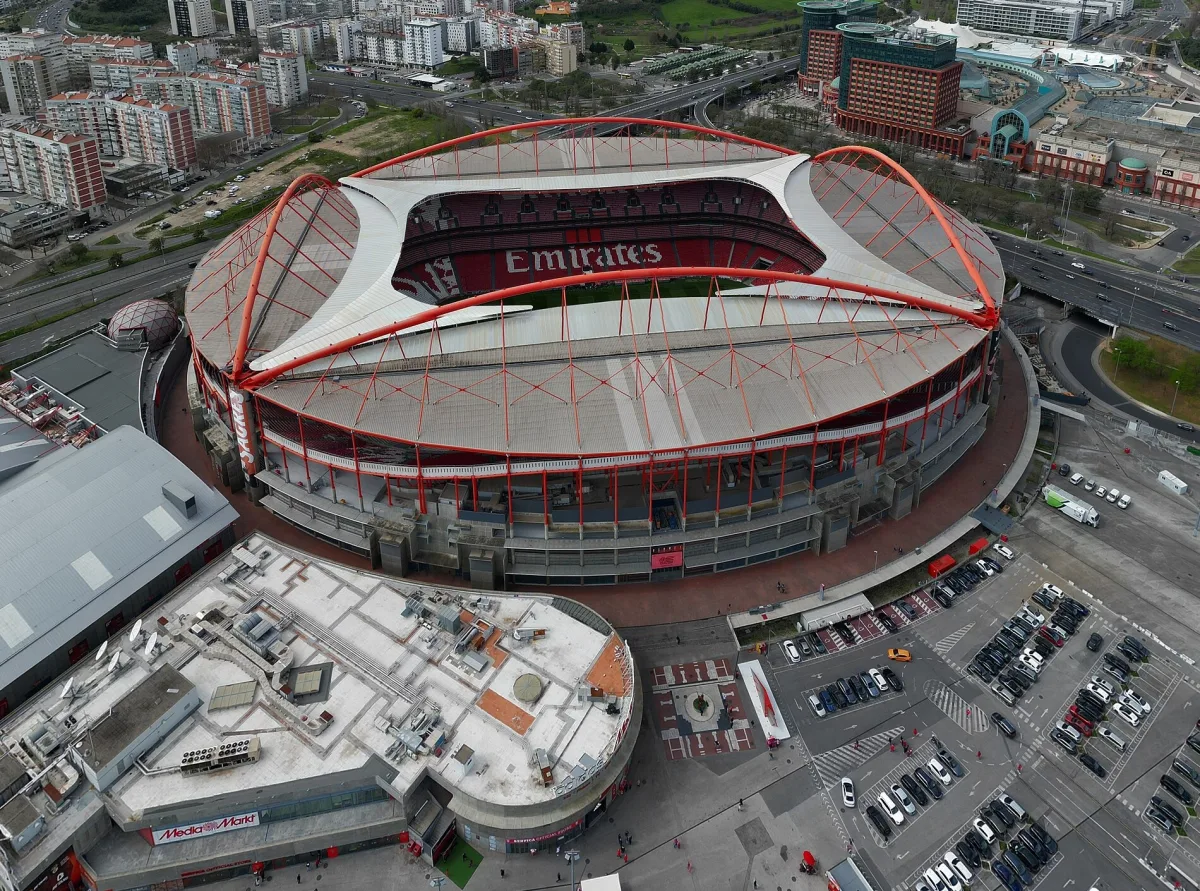
Four red arches lift off the skyline of northern Lisbon, and under them sits the home of Portugal’s most successful club. Estádio da Luz, officially the Estádio do Sport Lisboa e Benfica, holds 68,100 after Benfica’s 2025 renovation, which makes it the largest stadium in Portugal and one of the biggest in Europe by capacity. It is Benfica’s fortress, their museum, and their theater all at once.
The name is older than the building. Luz is the neighborhood, tucked on the border of the Benfica and Carnide parishes, and it takes its name from a nearby church, Nossa Senhora da Luz, Our Lady of Light. English speakers turned that into the Stadium of Light, which sounds grander than the plain Portuguese. Locals just say a Luz.
Benfica own the ground outright, a rarity among Europe’s giants, and they built it to replace the vast old Estádio da Luz that had stood on the same spot since the 1950s. The pitch is natural grass, kept alive partly by a roof that lets the sun through. Above it all float the four steel arches that give the stadium its shape and its nickname among architects: the cathedral of light.
Since it opened in 2003, da Luz has hosted a European Championship final and two Champions League finals, and it is one of the venues Portugal has put forward for the 2030 World Cup. Not bad for a stadium that reviewers keep calling the prettiest on the continent.
Getting to Estádio da Luz
Lisbon’s metro drops you almost at the turnstiles, so most fans skip the car entirely. Here is how to reach da Luz however you are travelling.
Public Transit
The Metro Blue Line is the easy answer. Two stations, Colégio Militar/Luz and Alto dos Moinhos, sit within a few minutes’ walk of opposite ends of the stadium, so you can pick whichever exit is closer to your seat. From the city center at Marquês de Pombal it is a direct ride with no change, around fifteen minutes. Carris buses run along the Segunda Circular and Avenida Lusíada too, past the Colombo mall next door, with extra service laid on for big matches.
Driving + Parking
The stadium shares a wall with Centro Colombo, one of the largest malls in Iberia, and its underground garage is the obvious place to park. It fills fast on match days, so arrive early or use one of the smaller lots off Avenida Lusíada. Access comes off the Segunda Circular, the ring road that loops northern Lisbon, with the A5 and CRIL feeding into it. Driving is doable, but on a European night the metro will beat you home.
Rideshare
Uber and Bolt both operate across Lisbon and are cheap by Western European standards. Drivers can drop you around Avenida Eusébio da Silva Ferreira, the road named after Benfica’s greatest player, though expect surge pricing and a slow crawl out of the area after the final whistle. Walking a few blocks toward the mall before ordering a car usually saves time and money.
From the Airport
Lisbon’s Humberto Delgado Airport sits about seven kilometres east of the stadium, close enough that the transfer is painless. The cleanest route by public transport is the Metro Red Line from the airport to São Sebastião, then a change to the Blue Line out to Colégio Militar/Luz, roughly thirty minutes on a single ticket. A taxi or Bolt covers it in fifteen to twenty minutes outside rush hour, usually for well under twenty euros.
Construction & Design
Ask a Lisbon taxi driver about da Luz and you will hear the word catedral before long. The nickname is not just romance. The architect Damon Lavelle, working for HOK Sport before the firm became Populous, designed the whole building around daylight and openness, so the concrete stays pale, the concourses stay bright, and the roof itself is translucent.
That roof is the trick. Instead of blocking the sky it filters it, clear polycarbonate panels letting enough sun through to keep the grass growing without baking the crowd. Four steel arches, each 43 metres tall, carry the load and let the canopy seem to hover over the three tiers rather than press down on them. From across the Segunda Circular the arches read almost like a crown.
The build came in at around 160 million euros, of which the Portuguese state chipped in roughly 22.6 million as part of the country’s investment in Euro 2004 venues. Benfica funded the rest and kept the freehold, which is why the club could later carve its own museum, the Cosme Damião, into the base of the stands rather than rent space from a city or a stadium company.
Inside, the bowl is steep and continuous, wrapping the pitch so the noise has nowhere to escape. Benfica’s support fills it in red, and on a Champions League night the sound is physical. The stadium replaced a giant, and it was built to feel intimate by comparison while still seating most of a small city. Architect Damon Lavelle has floated the idea of pushing capacity toward 80,000 one day, though the realistic path runs through selling standing places, which Portuguese law does not yet allow.
History of Estádio da Luz
The story starts with a demolition. The original Estádio da Luz, opened in the 1950s and expanded until it could swallow something like 120,000 people, was one of the largest stadiums Europe had ever built. But it was ageing, all standing terraces and open ends, and Portugal wanted modern all-seater grounds for Euro 2004. So Benfica knocked it down and built beside its own history.
October 25, 2003: the new da Luz opened with an exhibition match against Nacional of Uruguay, the club whose colors a young Benfica side had once borrowed. Less than a year later it hosted matches at Euro 2004, including the final on 4 July 2004, where Greece stunned the host nation with a single header.
The European finals kept coming. On 24 May 2014 Real Madrid won their tenth Champions League here, beating Atlético 4-1 after extra time in one of the competition’s cruellest late twists. Then on 23 August 2020, at the end of the pandemic-hit “Final 8,” Bayern Munich beat Paris Saint-Germain 1-0 in a silent, empty da Luz, one of the strangest showpieces the game has staged.
Through all of it runs one older tradition. Before every home game an eagle named Vitória, the club’s living symbol, is released to circle the pitch and settle on the crest at midfield, a piece of theater that predates the new building and survived the move intact. The stadium has also grown beyond football: in May 2024 Taylor Swift brought the Eras Tour here for two nights, filling da Luz the way a Lisbon derby does.
By its fifteenth birthday the stadium had welcomed more than 17 million spectators, and in 2014 a poll by the French paper L’Équipe voted it the most beautiful stadium in Europe. Benfica kept improving it, adding accessible seating in 2024 and finishing a renovation in July 2025 that pushed capacity to 68,100. The cathedral, it turns out, is still being built.
Sources & Further Reading
- SL Benfica official site: slbenfica.pt. The club’s own pages on the stadium, capacity, and the July 2025 renovation.
- Wikipedia entry on Estádio da Luz: en.wikipedia.org/wiki/Estádio_da_Luz. Construction history, the capacity timeline, and hosted finals with sourcing.
- Populous project page: populous.com. The design firm (formerly HOK Sport) behind the arches-and-daylight concept.
- UEFA venue records: uefa.com. Category rating, hosted finals, and match records for the venue.
Quick Facts
Everything you need at a glance.
Stadium specs
- Capacity
- 68,100
- Opened
- 2003
- Cost
- €160 million
- Roof
- Roof over stands (open pitch)
- Surface
- Natural grass
- Tenants
- SL Benfica (Primeira Liga)
Construction & location
- Groundbreaking
- 2002
- Architects
- HOK Sport (now Populous), Damon Lavelle
- Engineering
- Not separately recorded
- General contractor
- Sacyr Somague
- Address
- Av. Eusébio da Silva Ferreira, 1500-313 Lisboa, Portugal
- GPS
- 38.7527°N, 9.1847°W
Photo Gallery
Fun Facts
The polycarbonate roof is see-through on purpose: it lets daylight reach the pitch so the natural grass grows, while four steel arches 43 metres high carry the whole canopy.
Before every home game a real eagle named Vitória is released from the top tier, circles the pitch, and lands on the club crest at midfield, the oldest living symbol in Portuguese football.
The old Estádio da Luz that stood here from the 1950s once held roughly 120,000 people, one of the largest crowds any stadium in Europe could take before this all-seater replaced it in 2003.
Stadium Location
Frequently Asked Questions
- What is the capacity of Estádio da Luz?
- The stadium seats 68,100 after a renovation Benfica completed in July 2025. For most of its life it held 64,642, so older guides still cite that figure.
- Who plays at Estádio da Luz?
- It is the home of SL Benfica, who own the stadium and play their Primeira Liga and European matches here. Benfica also share the ground with the Portugal national team for some fixtures.
- Why is it called the Stadium of Light?
- Da Luz means 'of the Light,' the name of the Lisbon neighborhood the stadium sits in, which traces back to a local church, Nossa Senhora da Luz. English commentators translate it as the Stadium of Light.
- When did Estádio da Luz open?
- It opened on 25 October 2003 with an exhibition match against Nacional of Uruguay, replacing the original 1950s Estádio da Luz on the same site.
- What major finals has Estádio da Luz hosted?
- It hosted the UEFA Euro 2004 final, the 2014 Champions League final, and the 2020 Champions League final, the last played behind closed doors during the pandemic.
- How do I get to Estádio da Luz by metro?
- Take the Blue Line to Colégio Militar/Luz or Alto dos Moinhos. Both stations are a short walk from the stadium, and the ride from central Lisbon takes about 15 minutes.
- Is the pitch covered by a roof?
- No. The roof covers the stands but leaves the pitch open to the sky, and its clear polycarbonate panels let sunlight through to keep the natural grass healthy.
- Will Estádio da Luz host 2030 World Cup matches?
- It is one of Portugal's proposed venues for the 2030 World Cup, which Portugal will co-host with Spain and Morocco. The final list of stadiums is still being confirmed.
Last updated: 2026-07-12