About Estadio Olímpico Universitario
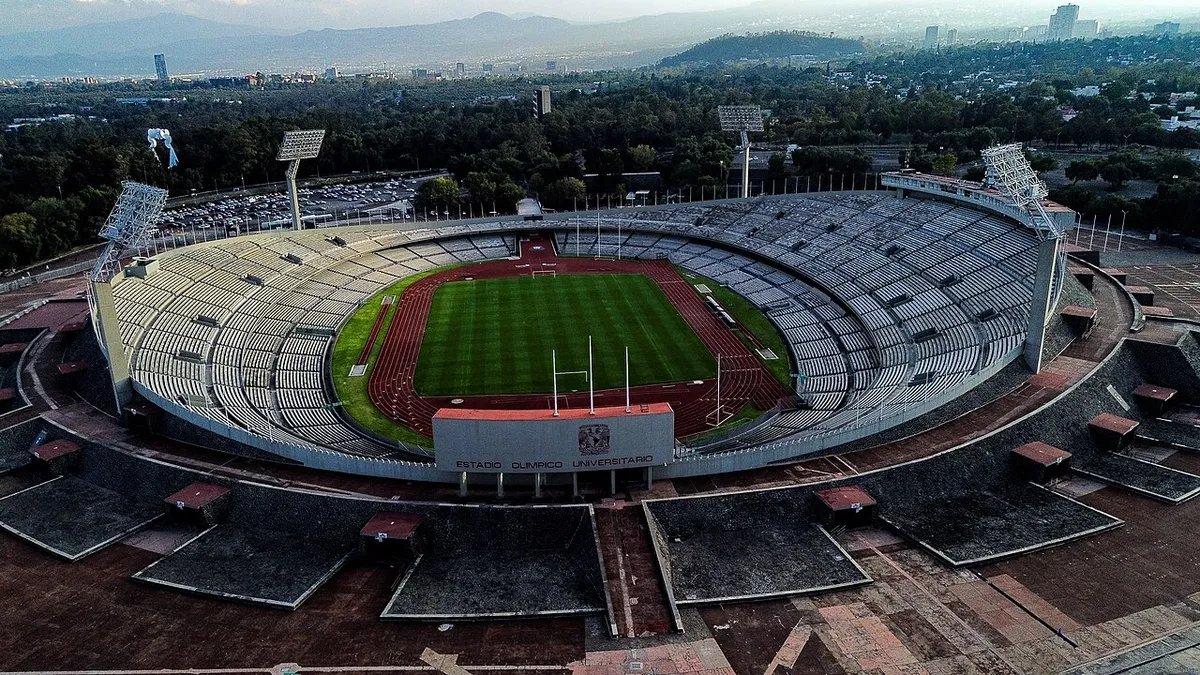
Estadio Olímpico Universitario sits within the Ciudad Universitaria campus of UNAM — the National Autonomous University of Mexico — in the southern reaches of Mexico City. With a capacity of 72,000, it is one of the largest and most historically significant stadiums in Latin America. It has hosted an Olympic Games, a World Cup, Pan American Games, and more than seven decades of Pumas UNAM football.
The stadium is home to Pumas UNAM of Liga MX, one of Mexico’s most passionately supported clubs. What makes this venue extraordinary isn’t just its size — it’s the setting. The bowl was literally carved from the Pedregal de San Ángel lava fields, with over 100,000 cubic meters of volcanic rock excavated to form the natural depression. At 2,240 meters (7,350 feet) above sea level, the thin air is a factor in every match.
Designed by architects Augusto Pérez Palacios, Jorge Bravo Jiménez, and Raúl Salinas Moro, the stadium opened on November 20, 1952. Diego Rivera created a stone relief mural on the east facade depicting the university, the Mexican family, peace, and sport — using natural colored stones that will never fade. He planned to cover the entire exterior but completed only one section before his death in 1957.
The UNAM campus was designated a UNESCO World Heritage Site in 2007 — making this the only Olympic stadium in the world located within a World Heritage Site. Over 60 architects, engineers, and artists built the campus between 1949 and 1952, and the stadium remains its most prominent landmark.
Getting to Estadio Olímpico Universitario
Public Transit
Mexico City’s transit network makes the stadium accessible from across the city.
→ From Centro Histórico / Zócalo: Take Metro Line 3 southbound to Copilco station. Walk 20-25 minutes through the UNAM campus to the stadium. The walk itself is worth it — you’ll pass some of Mexico’s most important modern architecture.
→ Via Metrobús: Take Line 1 (Insurgentes) to the Dr. Gálvez stop. Walk 10 minutes west to the stadium — this is the shorter walk.
PumaBus campus shuttles (routes 6, 7, and 8) run from the Metrobús CU station and Copilco Metro directly to the stadium area. On match days, expect heavier foot traffic through campus.
Driving + Parking
The stadium is within the UNAM campus on Avenida de los Insurgentes Sur, in the Coyoacán borough of southern Mexico City.
→ From Zócalo / Centro Histórico (~14 km): South via Avenida Insurgentes Sur. About 30-45 minutes depending on traffic.
→ From Coyoacán Centro (~3.5 km): West via Avenida Universidad or Insurgentes. About 10-15 minutes.
→ From Polanco (~15 km): South via Insurgentes Sur or Periférico. About 25-40 minutes.
Estacionamiento 6 is the main parking lot adjacent to the stadium — MXN 80 (~$4 USD) on match days. Campus parking is ample compared to downtown venues but access to lots is restricted during events. Metro or Metrobús is strongly recommended — Mexico City traffic around Insurgentes is notorious.
Rideshare
Uber and DiDi both operate widely in Mexico City. A ride from Centro Histórico to the stadium costs approximately MXN 80-150 (~$4-8 USD). DiDi is often slightly cheaper. Both accept credit cards in-app and cash payments.
Pro tip: Allow extra time on match days — traffic along Insurgentes Sur becomes congested. Post-match, walk toward Copilco Metro before requesting a ride.
From the Airport
→ Mexico City International Airport (MEX): 16 km (10 miles) east, about 25-45 minutes by car depending on traffic. A taxi from the airport costs approximately MXN 500-600 (~$26-32 USD). Metro is possible but requires transfers and is not practical with luggage.
→ Felipe Ángeles International Airport (NLU): 63 km (39 miles) north, about 50-90 minutes. Much farther and primarily serves budget and domestic carriers.
Legacy of Estadio Olímpico Universitario
Few stadiums on earth carry the historical weight of Estadio Olímpico Universitario. The 1968 Summer Olympics transformed this venue into a stage for moments that transcended sport. On October 18, 1968, Bob Beamon launched himself 8.90 meters in the long jump — a record that stood for 23 years — aided by the thin air at 2,240 meters. Two days earlier, Tommie Smith and John Carlos raised their fists on the medal podium during the 200-meter ceremony in one of the most iconic acts of protest in Olympic history.
The altitude played a role in 16 world records set in athletics at these Games. The stadium also hosted the opening and closing ceremonies, with events broadcast worldwide to an audience of hundreds of millions. Before the Olympics, it served as the centerpiece of the 1955 Pan American Games. After them, it hosted four matches of the 1986 FIFA World Cup.
As part of the UNAM campus — a UNESCO World Heritage Site since 2007 — the stadium exists within one of the most important architectural ensembles of the 20th century. Diego Rivera’s unfinished mural, the volcanic landscape, and the modernist campus buildings create a setting that is as much cultural pilgrimage as sporting venue.
History of Estadio Olímpico Universitario
Construction began on August 7, 1950, as part of the massive Ciudad Universitaria campus project. Over 10,000 laborers worked round-the-clock shifts to carve the bowl from volcanic lava fields. The stadium cost 28 million Mexican pesos (~$3.2 million USD at 1952 rates) and opened on November 20, 1952, inaugurated by President Miguel Alemán during the National Youth Games.
- Grand Opening (November 20, 1952): Inaugurated by President Miguel Alemán with a capacity of approximately 72,000. The stadium immediately becomes the crown jewel of the new UNAM campus.
- Pan American Games (March 1955): Hosts opening ceremony and athletics events. Reported crowds of 100,000 for the opening.
- 1968 Summer Olympics (October 12-27, 1968): Opening and closing ceremonies, all athletics events. Bob Beamon’s 8.90m long jump and the Smith-Carlos Black Power salute happen here. Sixteen world records set.
- 1986 FIFA World Cup (June 1986): Hosts four matches — group stage and Round of 16 games with attendances up to 70,000.
- Pumas UNAM Championship (May 29, 2011): Pumas defeat Morelia 2-1 in the Clausura 2011 Final second leg to win their seventh and most recent league title.
- UNESCO Designation (June 28, 2007): The UNAM campus is inscribed as a World Heritage Site, recognizing the stadium as part of an outstanding example of 20th-century modernism integrated with Mexican artistic traditions.
Photo Gallery
Fun Facts
The stadium was carved from the Pedregal de San Ángel lava fields — over 100,000 cubic meters of volcanic rock were excavated to form the bowl, at 2,240 meters (7,350 feet) above sea level.
Diego Rivera's unfinished stone relief mural on the east facade uses natural colored stones that will never fade. He planned to cover the entire stadium but died in 1957 with only one section complete.
It is the only Olympic stadium in the world located within a UNESCO World Heritage Site — the UNAM campus was designated in 2007 for its integration of modernist architecture and Mexican art.
Stadium Location
Frequently Asked Questions
- How do I get to Estadio Olímpico Universitario by public transit?
- Take Metro Line 3 to Copilco station and walk 20-25 minutes through the UNAM campus. Alternatively, take Metrobús Line 1 to Dr. Gálvez and walk 10 minutes west. PumaBus campus shuttles (routes 6, 7, 8) also run to the stadium.
- Is Estadio Olímpico Universitario a UNESCO World Heritage Site?
- The stadium is part of the UNAM Ciudad Universitaria campus, designated a UNESCO World Heritage Site on June 28, 2007, for its outstanding integration of modernist architecture, Mexican art, and urban planning.
- Who designed Estadio Olímpico Universitario?
- Architects Augusto Pérez Palacios, Jorge Bravo Jiménez, and Raúl Salinas Moro designed the stadium. The famous stone relief mural on the exterior is by Diego Rivera.
- What happened at the 1968 Olympics at this stadium?
- The stadium hosted opening and closing ceremonies and all athletics events. Bob Beamon set his legendary 8.90-meter long jump world record here, and Tommie Smith and John Carlos performed their historic Black Power salute during the 200m medal ceremony.
- Is there parking at Estadio Olímpico Universitario?
- Yes, Estacionamiento 6 is adjacent to the stadium. Match day parking costs approximately MXN 80 (~$4 USD). UNAM students and staff with valid credentials get free parking in designated lots.
- What is the Diego Rivera mural at the stadium?
- A stone relief titled 'The University, the Mexican Family, Peace and Youth Sports' adorns the east facade. Made of natural colored stones, it features the UNAM shield, athletes lighting Olympic torches, and Quetzalcóatl. Rivera planned to cover the entire stadium but never finished.
- How much do Pumas UNAM tickets cost?
- Tickets are very affordable. General admission behind the goal starts around MXN 140 (~$7 USD), mid-tier sideline seats are ~MXN 230, and premium sections reach ~MXN 290 (~$15 USD).
- Can I visit the stadium on non-match days?
- The UNAM campus is open to the public, so you can visit the exterior, see the Diego Rivera mural, and explore surrounding campus landmarks freely. Stadium interior access may be limited on non-event days.
Last updated: 2026-02-26