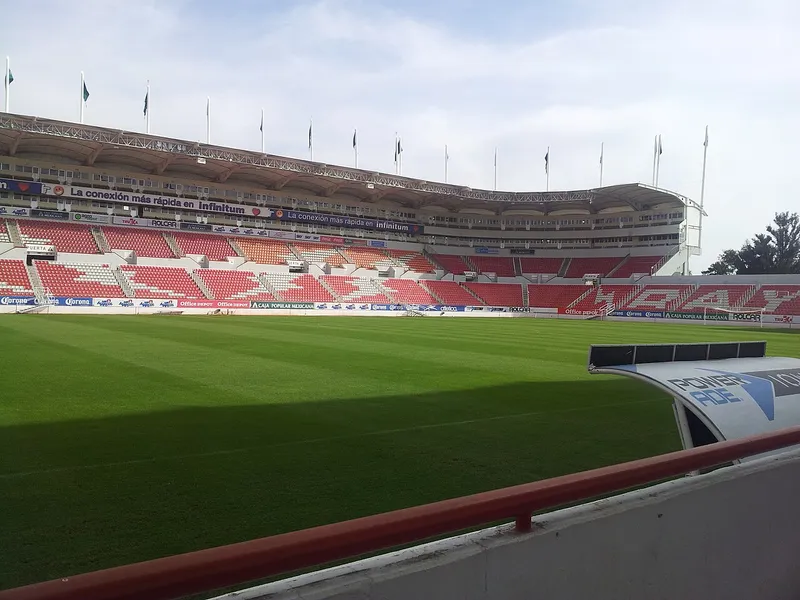
About Estadio Victoria
Estadio Victoria sits in the Colonia Héroes neighborhood of Aguascalientes, a mid-sized city in central Mexico known for its colonial architecture and the annual Feria Nacional de San Marcos — the country’s largest state fair. With 25,500 seats, it’s the home of Club Necaxa, one of Mexican football’s most storied franchises, who relocated here from Mexico City in 2003.
Necaxa — nicknamed Los Rayos (The Lightning Bolts) — are the sole tenants. The club won the Copa MX in 2018 with a dramatic 1-0 final victory over Toluca at this ground, their first trophy since arriving in Aguascalientes. The Mexico national team has also played World Cup qualifiers here, including an 8-0 rout of Dominica in 2004.
The stadium’s most distinctive feature is invisible to visitors who haven’t seen Necaxa score: a permanent aquatic multimedia fountain behind the south stand, claimed to be the world’s first integrated into a football stadium. When Necaxa find the net, the fountain erupts with choreographed water jets, lights, and music — a celebration that’s become part of the match-day experience.
Three of the four stands feature upper tiers and roof cover, while the south stand — where the fountain sits — remains open and single-tiered. The 25-year naming-rights deal with Grupo Modelo for the Victoria beer brand (2003-2028) gives the stadium its name, connecting it to one of Mexico’s oldest beer labels, brewed since 1865.
Aguascalientes sits at 1,888 meters above sea level on the central Mexican plateau, giving visiting teams from lower elevations a noticeable disadvantage. The city’s climate is dry and temperate, with summer daytime temperatures around 30°C (86°F) dropping to pleasant evenings — ideal for the Liga MX’s typical 7 PM and 9 PM kickoff times. On clear days, the distinctive silhouette of Cerro del Muerto — a mountain whose ridgeline resembles a reclining human figure — is visible from the upper tiers of the east stand.
Getting to Estadio Victoria
Public Transit
Aguascalientes has no metro or rail system. City buses are the primary public transit option.
→ From the city center: Over a dozen CMOV bus routes serve the stadium area, including Ruta 16, 19, 23, 24, 25, 27, 43, 47, and 48. The nearest stop is “Catrina,” a 4-minute walk. Flat fare approximately MXN $13.50.
→ From Central Camionera (bus terminal): Intercity buses connect Aguascalientes to Guadalajara, León, Zacatecas, and Mexico City via ETN, Primera Plus, and Omnibus de México.
Last bus service near the stadium (Ruta 43) departs around 10:24 PM — plan accordingly for evening matches.
Driving + Parking
GPS address: Colonia Héroes, Aguascalientes, Ags., Mexico.
→ From Guadalajara (220 km): North on Autopista 70D/45D. About 2 hours 30 minutes.
→ From León, Guanajuato (130 km): Northwest on Autopista 45D. About 1 hour 25 minutes.
→ From Zacatecas (121 km): South on Autopista 45D. About 1 hour 40 minutes.
Parking is limited. Small lots around the stadium fill quickly on match days at roughly MXN $50-100. Street parking in Colonia Héroes is the main overflow option. Rideshare is recommended over driving due to congestion and limited spaces.
Rideshare
Uber and DiDi both operate in Aguascalientes. A ride from the city center costs MXN $50-80 (about 5-10 minutes). From the airport, expect MXN $145-200. Post-match congestion is significant — walk a block or two from the stadium for quicker pickups.
From the Airport
→ Aguascalientes International Airport (AGU): 22 km south, about 25-30 minutes by car. Fixed-zone taxi fare approximately MXN $300. Uber is available but can be difficult to hail at the airport due to local taxi restrictions. Domestic flights connect to Mexico City, Tijuana, Monterrey, and select US cities including Houston, Dallas, and Los Angeles.
History of Estadio Victoria
Club Necaxa’s move to Aguascalientes in 2003 was one of the most significant franchise relocations in Liga MX history. The club — founded in 1923 in Mexico City — had a passionate following in the capital, but ownership decided that a purpose-built stadium in a mid-sized city offered a better path forward than competing for attention in Mexico City’s crowded market.
The municipality of Aguascalientes donated the site, which held an outdated 8,000-seat municipal stadium. That structure was demolished, and construction began in May 2002. In a remarkable 14-month build, the new 25,500-seat venue was ready for inauguration on July 26, 2003, with a friendly against Guadalajara.
Key moments in the stadium’s history:
- July 26, 2003: Inaugural match — Necaxa vs. Guadalajara (friendly), Guadalajara wins 1-0.
- July 29, 2003: Second friendly — Necaxa vs. AS Roma, 1-1 draw. Goalkeeper Rubén Ruiz Díaz saves a Francesco Totti penalty.
- June 27, 2004: Mexico 8-0 Dominica — first senior international match at the venue, a 2006 World Cup CONCACAF qualifier.
- December 1, 2016: Liga MX Apertura 2016 semifinal first leg — Necaxa 1-1 Club América, the club’s deepest playoff run in years.
- April 11, 2018: Copa MX Final — Necaxa 1-0 Toluca, the club’s first trophy in Aguascalientes.
Necaxa’s transition from Mexico City powerhouse to Aguascalientes institution wasn’t immediate. Early seasons saw sparse attendance as the city warmed to a franchise with no local roots. The 2018 Copa MX triumph — Ángel Sepúlveda’s lone goal against Toluca in a packed Estadio Victoria — was the moment the city fully embraced the club. Season ticket sales jumped 40% the following year, and the Barra Rayada supporters’ group, founded locally rather than transplanted from the capital, now fills the north end with drums, songs, and red-and-white flags every match day.
The Feria Nacional de San Marcos, held annually in April and May, brings over 8 million visitors to Aguascalientes — and when Liga MX fixtures overlap with the fair, the stadium fills to capacity with a mix of locals and visitors who make match attendance part of their feria experience.
The fountain, the beer-branded name, the lightning bolt crests in the stands — Estadio Victoria has developed its own identity that’s distinct from Necaxa’s Mexico City roots. After more than two decades in Aguascalientes, the club has grown into the city’s sporting soul, and the stadium reflects that bond between community and club.
Photo Gallery
Fun Facts
Estadio Victoria was built in just 14 months (May 2002 to July 2003), replacing an 8,000-seat municipal stadium on donated public land — one of the fastest-built Liga MX venues of its era.
The stadium's name comes from a 25-year naming-rights deal (2003-2028) with Grupo Modelo for its Victoria beer brand, one of Mexico's oldest beer labels brewed since 1865.
Estadio Victoria houses the world's first permanent aquatic multimedia fountain integrated into a football stadium — a dancing fountain behind the south stand that activates with water, light, and music every time Necaxa scores.
Stadium Location
Frequently Asked Questions
- What is the capacity of Estadio Victoria?
- Approximately 25,500 spectators. Three of its four stands feature upper tiers and roof cover; the south stand remains single-tiered and open.
- Who plays at Estadio Victoria?
- Club Necaxa ('Los Rayos') of Liga MX has been the stadium's primary tenant since its 2003 opening.
- How do I get to Estadio Victoria from the airport?
- Aguascalientes International Airport (AGU) is about 22 km south of the stadium, roughly 25-30 minutes by car. A taxi costs around MXN $300.
- Is there parking at Estadio Victoria?
- Parking is limited. Small lots surround the stadium but fill quickly. Street parking in Colonia Héroes is the main alternative. Taking Uber or DiDi is recommended.
- What is the fountain show at Estadio Victoria?
- The stadium features the world's first permanent aquatic multimedia show built into a football venue. A choreographed fountain behind the south stand activates with water, light, and music when Necaxa scores.
- Why is it called Estadio Victoria?
- The name comes from a 25-year naming-rights deal with Grupo Modelo for its Victoria beer brand. The agreement runs from 2003 to approximately 2028.
Last updated: 2026-03-12