About Grand Stade Hassan II
Out in the cork-oak woods northeast of Casablanca, on a stretch of red earth near the coast, Morocco is building what it intends to be the biggest football stadium in the world. Grand Stade Hassan II sits on a 100-hectare site in El Mansouria, in Benslimane Province, about 38 kilometres from the center of Casablanca and a short hop from the beach town of Mohammedia. It is not in the city that gives it its name. It is out in the forest, deliberately.
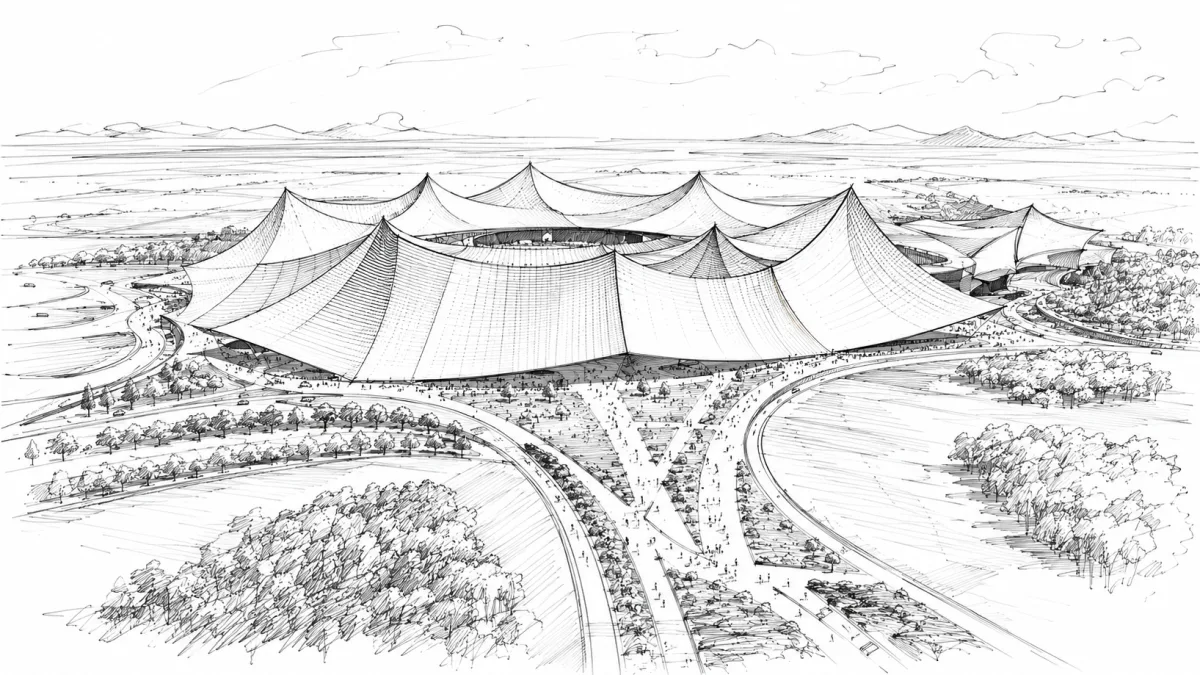
The headline number is 115,000. If the plan holds, that edges past North Korea’s May Day Stadium to make this the largest football ground on the planet, a title Morocco is chasing on purpose. The stadium is planned as the home of the national team and as the new base for Casablanca’s two great rivals, Raja CA and Wydad AC, who now share the aging Stade Mohammed V across town. A grass pitch, steep tiers packed behind the goals, and a translucent canopy shaped like a Moroccan tent: the ambition is written into every line of the design.
There is one reason above all others for the scale. The stadium was conceived to host the final of the 2030 World Cup, the tournament Morocco co-hosts with Spain and Portugal. Building a 115,000-seat arena from scratch in a forest is an enormous bet, and it is a bet placed entirely on that one night.
For now, it is a construction site. Earthworks began in August 2024, and the finished building is planned for late 2028. Everything below is the plan on paper and the work in progress, not a stadium you can yet walk into.
Getting to Grand Stade Hassan II
The site sits between Casablanca and Rabat, off the coast road near Mohammedia, and getting there today is a very different proposition from what it will be for the World Cup. Much of the access is still to be built.
Public Transit
There is no station at the stadium itself, at least not yet. New transport links are part of the 2030 program.
→ Nearest rail: Mohammedia sits on the busy Casablanca-Rabat train line, one of the best rail corridors in Africa, and it is the closest useful station. From there a taxi finishes the trip to the site.
→ Coming for 2030: Dedicated access roads and public-transport connections are planned as part of the World Cup infrastructure, so expect the routes here to change substantially before the stadium opens.
Driving + Parking
Road is the practical way in, and the site was chosen partly for its position on the main artery north.
→ From Casablanca: The A3 Casablanca-Rabat motorway runs close to El Mansouria, roughly 40 minutes from the center outside of match traffic.
→ Parking: A venue built for 115,000 will need parking to match, and it forms part of the wider complex being planned around the bowl. The specifics are not public yet.
Rideshare
Taxis are the everyday way to move around greater Casablanca, and a metered or agreed-fare grand taxi will be the surest bet out to a site this far from the city. App-based rideshare coverage in Morocco is thinner than the local petit and grand taxis, so do not count on hailing a car for the return leg from a forest at the edge of the metro area.
From the Airport
→ Casablanca Mohammed V (CMN): Morocco’s busiest airport is the main gateway, south of Casablanca and roughly an hour from the site by road.
→ Rabat-Salé (RBA): The capital’s airport lies a similar distance to the north, a reasonable alternative given the stadium’s position between the two cities.
The Ambition Behind Grand Stade Hassan II
Most stadiums are designed around a sport. This one is designed around a statement. The brief was not simply to seat a crowd but to announce, in concrete and aluminum, that Morocco belongs among the hosts of the world’s biggest tournament, and every decision follows from that.
Start with the size. At 115,000 the stadium is meant to be the largest football ground anywhere, a record Morocco is reaching for rather than stumbling into. Then the setting. Instead of dropping the bowl into the dense city, the designers placed it in the Beni Amer forest and pulled the landscape up into the building, with botanical gardens at ground level and more gardens on raised platforms about 28 metres up. The architect Tarik Oualalou has described the guiding idea in a single Arabic word, “Marhaba,” welcome. The moussem, the seasonal festival tent where Moroccan communities gather, is the reference the whole thing is built on.
The result, on paper, is less a fortress than a great tented pavilion in a wood. A ring of 32 stairways wraps the exterior as monumental gateways, and a translucent lattice canopy filters the sun over the stands while leaving the pitch open to the sky. The seating stacks steeply behind the goals to trap noise, and the flanks hold the hospitality levels and a Royal Box.
What it will actually feel like on a matchday, nobody can honestly say yet. There are no fans, no chants, no worn concourses to describe, because the stands do not exist. That is the gap between an ambition and a stadium, and it is the gap Morocco has until 2030 to close. The prize, if it closes, is a World Cup final in the biggest football arena ever built.
Construction & Design
The design team was settled in early 2024, when Morocco chose the global sports-architecture firm Populous, the practice behind Tottenham Hotspur Stadium, together with the Paris-based Moroccan office Oualalou + Choi. Their concept, the moussem tent set in a forest, won a competitive process and gave the project its identity: a translucent aluminum lattice stretched over the stands, wrapping a bowl for 115,000 inside a landscaped 100-hectare site.
The engineering follows the metaphor. A structural ring of 32 stairways carries much of the load, doubling as the grand gateways that thread visitors up through gardens set on platforms roughly 28 metres above the ground. The stands rise in steep tiers behind the goals, the configuration that keeps a crowd close and loud, while the sides carry several hospitality levels and the Royal Box. The whole scheme is being pursued to a high environmental-quality standard, the greenery a genuine part of the structure rather than decoration around it.
The build has moved in phases. Earthworks on the forest site began in August 2024, an early contract led by the Moroccan firm SGTM, and the far larger main construction package was put out to tender in 2025 with a build window of around 30 months. The money is substantial: an overall investment of about 5 billion dirhams, roughly US$500 million, backed by the Moroccan state and the Caisse de Dépôt et de Gestion, with the main construction phase alone tendered near 3.2 billion dirhams. Completion is planned for late 2028. That is the number that matters most, because it leaves barely a margin before the 2030 World Cup the entire stadium exists to serve.
History of Grand Stade Hassan II
The stadium is too new to have a history in the usual sense. Its story so far is a sequence of decisions, each one raising the stakes. The idea took firm shape as Morocco pushed to co-host the 2030 World Cup with Spain and Portugal, a bid that needed a venue worthy of a final, and a funding agreement for the project was signed in October 2023.
The design competition followed, and in early 2024 the Populous and Oualalou + Choi team was selected, fixing the tented, forest-set vision that now defines the plan. In August 2024 the machines arrived and earthworks began on the Beni Amer site, the first physical sign that the drawings were becoming real. A year on, in 2025, the main construction contract was tendered, opening the largest and most expensive phase of the work.
Naming ties it to the recent past. King Hassan II ruled Morocco from 1961 to 1999, and his name already sits on landmarks across the country, the great Casablanca mosque among them. Calling this the Grand Stade, the grand stadium, marks it out as the largest of them all.
The chapters that count have not been written. No match has been played, no crowd counted, no record set. If the plan holds to late 2028, the building will have roughly two years to settle before the tournament it was made for. A stadium conceived for a single night in 2030, its greatest day is still years away, and everything until then is preparation.
Sources & Further Reading
- Wikipedia entry on Hassan II Stadium: en.wikipedia.org/wiki/Hassan_II_Stadium. Capacity, architects, cost, ownership and the 2028 completion plan.
- Populous project showcase: populous.com. The design team’s own account of the moussem concept, the canopy and the El Mansouria setting.
- Parametric Architecture on the stadium: parametric-architecture.com. The 32-stairway ring, the seating layout, the budget and the construction timeline.
- Morocco World News on the construction launch: moroccoworldnews.com. The 2025 tender, the phased budget and the completion targets.
- The Plan on the architecture: theplan.it. The tent metaphor, the gardens and the design intent for 2030.
Quick Facts
Everything you need at a glance.
Stadium specs
- Capacity
- 115,000
- Opened
- 2028
- Cost
- About 5 billion dirhams (roughly US$500 million)
- Roof
- Canopy
- Surface
- Grass
- Tenants
- Morocco national team, Raja CA, Wydad AC
Construction & location
- Groundbreaking
- 2024
- Architects
- Populous, Oualalou + Choi
- Engineering
- Not separately recorded
- General contractor
- SGTM
- Address
- El Mansouria, Benslimane Province, Casablanca-Settat, Morocco
- GPS
- 33.6771°N, 7.2750°W
Fun Facts
At a planned 115,000 seats, Grand Stade Hassan II is designed to be the largest football stadium on earth, edging past North Korea's May Day Stadium and its roughly 114,000.
The stadium sits on a 100-hectare site in the Beni Amer forest, wrapped by a ring of 32 stairways that form monumental gateways, with landscaped gardens perched on platforms about 28 metres above the ground.
The roughly 5 billion dirham design takes its shape from the moussem, the traditional Moroccan festival tent, rendered as a translucent aluminum lattice canopy pulled over the stands.
Stadium Location
Frequently Asked Questions
- Is Grand Stade Hassan II finished?
- No. As of 2026 it is under construction. Earthworks on the site began in August 2024, the main construction contract was tendered in 2025, and completion is planned for late 2028, ahead of the 2030 World Cup. The 115,000-seat figure and the design details described here are the published plans, not a finished, measured building.
- Where is Grand Stade Hassan II located?
- In El Mansouria, in Benslimane Province, about 38 kilometres northeast of central Casablanca and close to the coastal town of Mohammedia. Despite carrying Casablanca's name, it is not in the city itself but on a 100-hectare site in the wooded Beni Amer area between Casablanca and Rabat.
- Will Grand Stade Hassan II host the 2030 World Cup final?
- That is its stated purpose. Morocco co-hosts the 2030 tournament with Spain and Portugal, and the stadium was conceived specifically to stage the final. FIFA assigns the exact fixtures closer to the event, but the whole project is built around hosting the final and the tournament's other marquee matches.
- How big is Grand Stade Hassan II?
- The plan is 115,000 seats, which would make it the largest football stadium in the world. For comparison, that is roughly 25,000 more than Wembley in London. The seating is arranged in steep tiers behind the goals for atmosphere, with hospitality levels and a Royal Box along the sides.
- Who will play at Grand Stade Hassan II?
- It is planned as a home of the Morocco national team and as the new home of Casablanca's two biggest clubs, Raja CA and Wydad AC, who currently share the Stade Mohammed V in the city. It is set to become Morocco's flagship national stadium.
- How much is Grand Stade Hassan II costing?
- The overall investment is put at around 5 billion dirhams, roughly US$500 million, funded by the Moroccan state and the Caisse de Dépôt et de Gestion. The main construction phase alone was tendered at about 3.2 billion dirhams in 2025, on top of the earlier earthworks.
- Who designed Grand Stade Hassan II?
- The global sports-architecture firm Populous together with the Paris-based Moroccan practice Oualalou + Choi, chosen in early 2024. Their design draws on the moussem, the traditional Moroccan festival tent, expressed as a translucent aluminum lattice canopy over the stands, set within landscaped gardens.
- How do you get to Grand Stade Hassan II?
- For now the site is reached by road off the A3 Casablanca-Rabat motorway, or by taking the train to Mohammedia and finishing by taxi. New access roads and transport links are part of the 2030 preparations, so the arrival routes will look very different by the time the stadium opens.
- Why is it called the Grand Stade Hassan II?
- It is named after King Hassan II, who ruled Morocco from 1961 to 1999. Several Moroccan venues carry his name, including a mosque in Casablanca, so this one is usually called the Grand Stade, the grand stadium, to set it apart as the country's largest.
Last updated: 2026-07-23