About Soldier Field
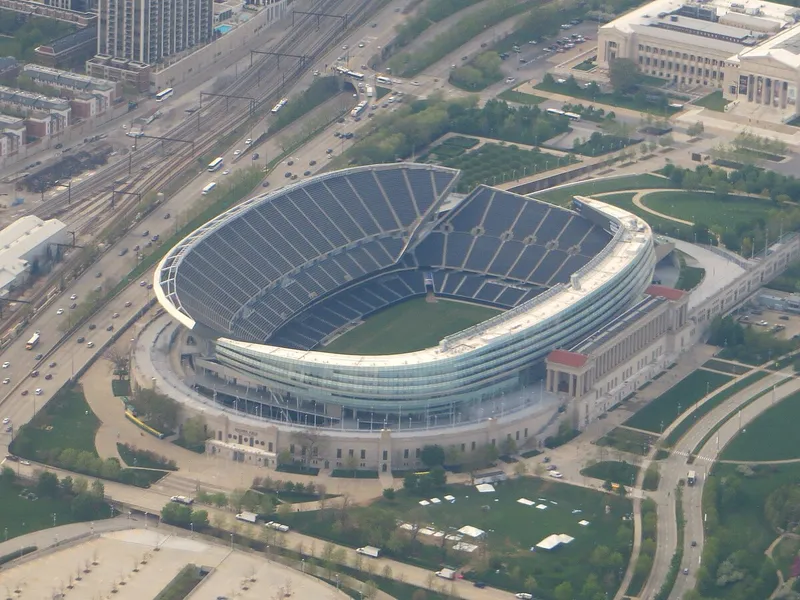
Soldier Field sits on Chicago’s lakefront like two buildings forced into a marriage — because that’s essentially what happened. The original 1924 Doric colonnades still frame the exterior, while a modern 61,500-seat bowl drops into the center like a spaceship that landed between ancient ruins. It’s the NFL’s smallest stadium and its oldest, and nothing else in professional sports looks remotely like it.
Located on the Museum Campus alongside the Field Museum, Shedd Aquarium, and Adler Planetarium, Soldier Field occupies some of the most valuable real estate in American sports. Lake Michigan stretches out behind the east stands, and the Chicago skyline rises to the north. On a clear autumn Sunday, there’s no better setting in football.
The stadium was designed by Holabird & Roche and opened on October 9, 1924, at a cost of $13 million. For decades it held crowds of 100,000-plus — including 104,943 for the legendary 1927 Dempsey-Tunney “Long Count” fight. The $690 million renovation in 2003, designed by Ben Wood and Carlos Zapata, gave the Bears a modern home but slashed capacity and triggered one of the most heated architectural debates in Chicago history.
Soldier Field has hosted far more than football: Copa America 2016 semifinals, NHL Winter Classic 2014, the Grateful Dead’s farewell concerts in 2015 (212,000 fans over three nights), and the very first Special Olympics in 1968. It is Chicago’s living room — battered by lake wind, scarred by controversy, and beloved all the same.
Getting to Soldier Field
Public Transit
The CTA L gets you closest. Take the Red, Orange, or Green Line to Roosevelt station and walk east along the Museum Campus — about 15 minutes to the gates.
→ From the Loop: CTA #146 Inner Drive/Michigan Express bus drops you near the stadium entrance. On game days, the #128 Soldier Field Express runs nonstop from Ogilvie and Union stations.
→ From the North Side: Red Line south to Roosevelt, then walk east. Or take the #130 Museum Campus bus (seasonal).
Metra also serves the area — the 18th Street station on the Rock Island line is a short walk from the south end of the stadium. On game days, transit frequency increases significantly.
Driving + Parking
The stadium address is 1410 Museum Campus Drive, Chicago, IL 60605. Lake Shore Drive runs directly past the stadium — exit at 18th Street or Museum Campus Drive.
→ From the North (Evanston, 15 mi): Lake Shore Drive south, exit at Museum Campus Drive. Follow signs to parking.
→ From the West (Suburbs via I-290): I-290 East to I-90/94, exit at 18th Street, head east to Museum Campus.
→ From the South (Indiana, 30 mi): I-90/94 North, exit at 18th Street eastbound.
Parking requires pre-paid passes for all events. Museum Campus surface lots run $85 per game, premium spots $165. Budget alternatives include the McCormick Place 31st Street lot ($16 with shuttle) and Millennium Park garages ($13 with free shuttle). Tailgating is allowed on surface lots — gates open 4 hours before kickoff.
Rideshare
Uber and Lyft drop-offs are at 18th Street, west of Soldier Field and Lake Shore Drive. After events, the designated pickup zone is at the corner of Balbo and Columbus — about a 10-minute walk north from the stadium.
From downtown hotels, expect $10–$18 and a 10-minute ride. Surge pricing after games is common; walking north to Michigan Avenue before requesting a ride can save you money and time.
From the Airport
→ Chicago Midway (MDW): 8 miles southwest, about 20 minutes by car. CTA Orange Line to Roosevelt, then walk east — about 40 minutes total. Taxi runs $25–$35.
→ Chicago O’Hare (ORD): 20 miles northwest, about 30–45 minutes by car depending on traffic. CTA Blue Line to Jackson, transfer to Red Line south to Roosevelt — about 60 minutes total. Taxi runs $45–$60.
The Controversial Renovation
When Chicago committed to a $690 million renovation in 2002, the goal was simple: give the Bears a modern NFL home without demolishing a beloved landmark. What they got was one of the most polarizing architectural projects in American history.
Architects Ben Wood and Carlos Zapata designed a 61,500-seat bowl that drops inside the original 1924 colonnades. Critics called it a “spaceship landed on a Greek temple.” The steel-and-glass interior towers above the historic facade, creating a visual clash that earned comparisons to everything from a toilet seat to a UFO. On February 17, 2006, the National Park Service officially revoked Soldier Field’s National Historic Landmark status — the only building ever delisted for that reason.
Love it or hate it, the renovation works as a football venue. Sightlines are excellent, the lakefront setting is unmatched, and the colonnades still give Soldier Field a gravitas that no other NFL stadium can claim.
History of Soldier Field
Soldier Field was designed by Holabird & Roche and opened on October 9, 1924, as Grant Park Municipal Stadium. It was renamed Soldier Field in 1925 at the request of the Chicago Gold Star Mothers as a memorial to American servicemen.
Dempsey-Tunney “Long Count” Fight (1927): Over 104,000 spectators packed in to watch one of boxing’s most controversial moments — Gene Tunney survived a delayed count in the seventh round to defeat Jack Dempsey.
First Special Olympics (1968): Eunice Kennedy Shriver founded the Special Olympics at Soldier Field, launching a global movement that now serves over 6 million athletes worldwide.
Chicago Bears Arrive (1971): The Bears left Wrigley Field for Soldier Field, beginning a tenancy that continues over 50 years later.
Copa America Centenario (2016): Soldier Field hosted four matches, including the semifinal between Chile and Colombia, bringing South American football to Chicago’s lakefront.
Grateful Dead Farewell (2015): Three sold-out nights drew 212,000 fans for the band’s final performances, shattering the stadium’s attendance record and turning Museum Campus into a city-sized celebration.
NHL Winter Classic (2014): The Blackhawks hosted the Penguins outdoors on a frozen rink laid across the Soldier Field turf — a surreal blend of hockey and football architecture.
Through a century of wars, weather, and one deeply controversial renovation, Soldier Field endures. It is Chicago’s oldest gathering place and its most defiant — a stadium that refuses to be anything other than itself.
Photo Gallery
Fun Facts
Soldier Field is the smallest stadium in the NFL at 61,500 seats — and also the oldest, having opened in 1924.
The 2003 renovation was so controversial that the stadium became the only building in U.S. history to lose its National Historic Landmark status.
The first Special Olympic Games were held at Soldier Field in 1968, founded by Eunice Kennedy Shriver.
Stadium Location
Frequently Asked Questions
- What is the seating capacity of Soldier Field?
- Soldier Field seats 61,500 for NFL games, making it the smallest stadium in the league. The original pre-renovation capacity exceeded 100,000.
- Where is Soldier Field located?
- Soldier Field is at 1410 Museum Campus Drive, Chicago, IL 60605. It sits on the lakefront in the Museum Campus area, about 1.5 miles south of the Loop.
- How do I get to Soldier Field by public transit?
- Take the CTA L to Roosevelt station (Red, Orange, or Green Line) and walk 15 minutes east. On game days, the #128 Soldier Field Express runs nonstop from Ogilvie and Union stations directly to the stadium.
- Is there parking at Soldier Field?
- Yes, but parking requires pre-paid passes for events. Surface lots on Museum Campus cost $85 per game, premium spots $165. Budget options include the 31st Street McCormick Place lot ($16 with shuttle) and Millennium Park garages ($13 with free shuttle).
- Why did Soldier Field lose its National Historic Landmark status?
- The 2003 renovation inserted a modern 61,500-seat bowl inside the original 1924 colonnades. A federal advisory committee found the changes so extensive that the stadium no longer met landmark criteria. It was delisted on February 17, 2006.
- Is Soldier Field an open-air stadium?
- Yes, Soldier Field is fully open-air with no roof. Chicago weather is part of the experience — from brutal winter games to summer concerts on the lakefront.
- When did the Chicago Bears start playing at Soldier Field?
- The Bears moved from Wrigley Field to Soldier Field in 1971. After the $690 million renovation, they played their first game in the rebuilt stadium on September 29, 2003, beating the Pittsburgh Steelers 17-15.
- Can I tailgate at Soldier Field?
- Yes, tailgating is allowed on Museum Campus surface lots, the upper level of Waldron Deck, and the McCormick Place 31st Street lots. Lots open 4 hours before kickoff. Tailgating during or after night games is prohibited on Museum Campus lots.
Last updated: 2026-02-20