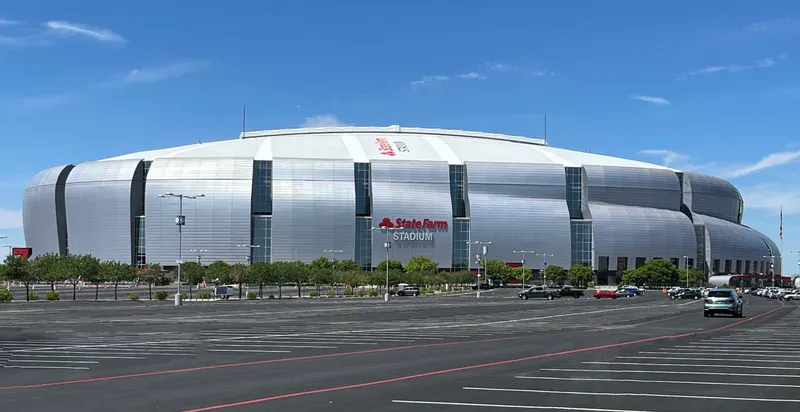
About State Farm Stadium
State Farm Stadium sits in Glendale’s sports district — a 63,400-seat marvel that is the only NFL stadium in the country with both a retractable natural grass field and a retractable roof. On game day, the 19-million-pound grass tray rolls 500 feet from its outdoor sunning spot into the building while the roof overhead can open or close in 12 minutes. Nothing else in professional sports works quite like this.
Located about 14 miles west of downtown Phoenix off Loop 101, the stadium anchors a sports and entertainment district that includes Desert Diamond Arena, Westgate, and the Dodgers’ spring training complex at Camelback Ranch. The area was empty desert a generation ago — now it’s the center of Arizona’s professional sports scene.
The $455 million stadium was designed by Peter Eisenman (his first completed stadium) with Populous, drawing inspiration from the Sonoran Desert — the coil of a rattlesnake and the ribbed form of a saguaro cactus. It opened on August 1, 2006. Four massive concrete super-columns support the 700-foot Brunel trusses that carry the retractable roof, giving the interior an open, column-free feel rare in domed stadiums.
In fewer than 20 years, State Farm Stadium has hosted three Super Bowls, a BCS and CFP National Championship, an NCAA Final Four, WrestleMania XXVI, Copa America 2024 matches, and the opening nights of Taylor Swift’s Eras Tour. The stadium that the City of Glendale briefly renamed “Swift City” has earned every name it’s been given.
Getting to State Farm Stadium
Public Transit
Valley Metro Route 70 bus runs along Glendale Avenue and stops near 95th Avenue, adjacent to the Westgate Entertainment District — a 5-minute walk to the stadium. Fare is $2.
→ From Downtown Phoenix: Take the Valley Metro Light Rail to Desert Sky Transit Center (79th Ave/McDowell Road), then board the game-day shuttle to the stadium. About 45 minutes total.
→ From Scottsdale: No direct transit. Drive or rideshare is the practical option — about 40 minutes.
The light rail does not extend to Glendale. The Desert Sky Transit Center shuttle only operates on Cardinals home game days. For non-football events, Route 70 bus or driving are your options.
Driving + Parking
The stadium address is 1 Cardinals Drive, Glendale, AZ 85305. Loop 101 is the primary approach — exit at Cardinals Way or Glendale Avenue.
→ From Phoenix (14 mi): I-10 West to Loop 101 North, exit Cardinals Way. About 25 minutes without traffic.
→ From Scottsdale (23 mi): Loop 101 West to Loop 101 South toward Glendale, exit Cardinals Way. About 40 minutes.
→ From Tucson (133 mi): I-10 North through Phoenix to Loop 101 North, exit Cardinals Way. About 2 hours.
General parking lots range from $10–$30, premium reserved up to $75. Tailgating is allowed — lots open 4 hours before kickoff, and all tailgating must end when the game starts. Pre-purchasing online is recommended.
Rideshare
Uber and Lyft use the Black Lot on the south side of the stadium off Cardinals Way for both pickup and drop-off. From downtown Phoenix, expect $25–$40 and about 25 minutes outside of game-day traffic.
Post-game surge pricing can spike dramatically — during Super Bowl LVII, Uber added a $20 event surcharge for pickups. Request your ride early or walk to Westgate and wait 20–30 minutes for prices to settle.
From the Airport
→ Phoenix Sky Harbor (PHX): 20 miles east of the stadium, about 30 minutes by car. Rideshare runs $35–$55. Transit is possible — Sky Train to light rail, light rail to Desert Sky, shuttle to stadium — but takes nearly 2 hours and only works on game days.
Two Engineering Marvels
State Farm Stadium is the only NFL venue with both a retractable natural grass field and a retractable roof — two systems that solve the fundamental problem of growing real grass in the Arizona desert while keeping fans comfortable in 110°F heat.
The playing surface sits on a steel-and-concrete tray measuring 234 by 403 feet, supporting 2.2 acres of Tifway 419 Bermuda grass. The tray weighs approximately 19 million pounds and normally lives outside the stadium’s south end, soaking up desert sunlight. On game day, 76 one-horsepower electric motors drive 542 wheel assemblies along 13 steel rails, pulling the field 500 feet into the building in about one hour.
Above, two translucent PTFE fabric panels — each weighing over 1.1 million pounds — form the retractable roof. They bi-part from midfield and slide along steel tracks mounted at the stadium’s upper perimeter, opening or closing in 12 minutes. The system rides on 700-foot Brunel trusses supported by four massive concrete super-columns — the first retractable roof ever built on an incline.
The result: natural grass that grows in real sunlight, a climate-controlled interior when you need it, and an open-air experience when Arizona’s winter weather cooperates.
History of State Farm Stadium
State Farm Stadium was designed by Peter Eisenman and Populous with structural engineering by Buro Happold and Walter P Moore. Groundbreaking was April 12, 2003, and the $455 million project opened on August 1, 2006.
Fiesta Bowl — Boise State vs. Oklahoma (January 2007): Boise State’s 43–42 overtime victory featured a Statue of Liberty play and a post-game proposal on the field — widely considered one of the greatest bowl games ever played.
Super Bowl XLII (February 2008): The New York Giants upset the undefeated New England Patriots 17–14, anchored by David Tyree’s helmet catch — one of the most iconic plays in NFL history.
Super Bowl XLIX (February 2015): Malcolm Butler’s goal-line interception with 26 seconds left sealed New England’s 28–24 victory over Seattle, denying the Seahawks back-to-back titles.
CFP National Championship (January 2016): Alabama defeated Clemson 45–40 in a game where Deshaun Watson set the championship record with 478 total yards.
Super Bowl LVII (February 2023): Patrick Mahomes and the Kansas City Chiefs beat the Philadelphia Eagles 38–35 in a back-and-forth game that cemented Mahomes as the defining quarterback of his generation.
Three Super Bowls, three of the most memorable finishes in NFL history. Peter Eisenman designed a building inspired by desert rattlesnakes, and the drama inside has matched the architecture.
Photo Gallery
Fun Facts
The natural grass field weighs approximately 19 million pounds and rolls 500 feet into the stadium on 542 wheels powered by 76 electric motors — a one-hour commute on game day.
The two retractable roof panels weigh over 1.1 million pounds each and open or close in approximately 12 minutes — the first retractable roof ever built on an incline.
When Taylor Swift's Eras Tour opened here in March 2023, the City of Glendale officially renamed itself 'Swift City' for the weekend.
Stadium Location
Frequently Asked Questions
- What is the seating capacity of State Farm Stadium?
- State Farm Stadium seats 63,400 for NFL games. Temporary seating expands capacity to approximately 72,800 for Super Bowls and championships. The all-time attendance record is 78,603, set during the 2011 BCS National Championship.
- Where is State Farm Stadium located?
- State Farm Stadium is at 1 Cardinals Drive, Glendale, AZ 85305. It sits in Glendale's sports and entertainment district, about 14 miles west of downtown Phoenix off Loop 101.
- Does State Farm Stadium have a retractable roof?
- Yes, the stadium has a two-panel retractable PTFE fabric roof that opens or closes in about 12 minutes. It was the first retractable roof ever built on an incline, supported by 700-foot Brunel trusses.
- Is the playing surface real grass?
- Yes, the field is natural Tifway 419 Bermuda grass grown in a retractable tray that slides outside the stadium between events for sunlight. The tray weighs approximately 19 million pounds and rolls on 542 wheels along 13 steel rails.
- How many Super Bowls has State Farm Stadium hosted?
- Three: Super Bowl XLII (2008, Giants 17–Patriots 14), Super Bowl XLIX (2015, Patriots 28–Seahawks 24), and Super Bowl LVII (2023, Chiefs 38–Eagles 35).
- How do I get to State Farm Stadium by public transit?
- Take Valley Metro Route 70 bus along Glendale Avenue to the stop near 95th Avenue, adjacent to Westgate. Or take the light rail to Desert Sky Transit Center (79th Ave/McDowell) and catch the game-day shuttle. Bus fare is $2.
- Is there parking at State Farm Stadium?
- Yes, general lots range from $10–$30, premium reserved lots up to $75. Tailgating is permitted — lots open 4 hours before kickoff. All tailgating must end at kickoff. Pre-purchase parking online for best rates.
- What was the stadium called before State Farm Stadium?
- The stadium opened as Cardinals Stadium in 2006, became University of Phoenix Stadium months later under a $154.5 million naming deal, and was renamed State Farm Stadium in September 2018 under an 18-year contract through 2036.
Last updated: 2026-02-20