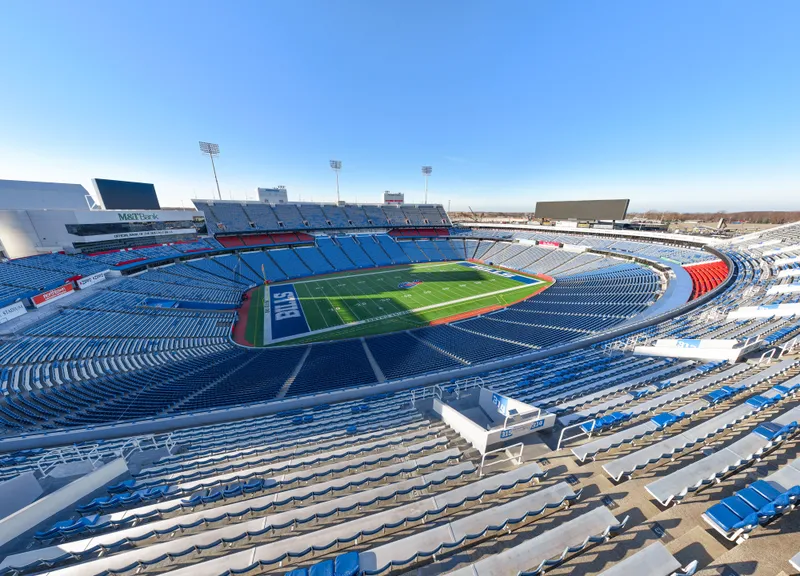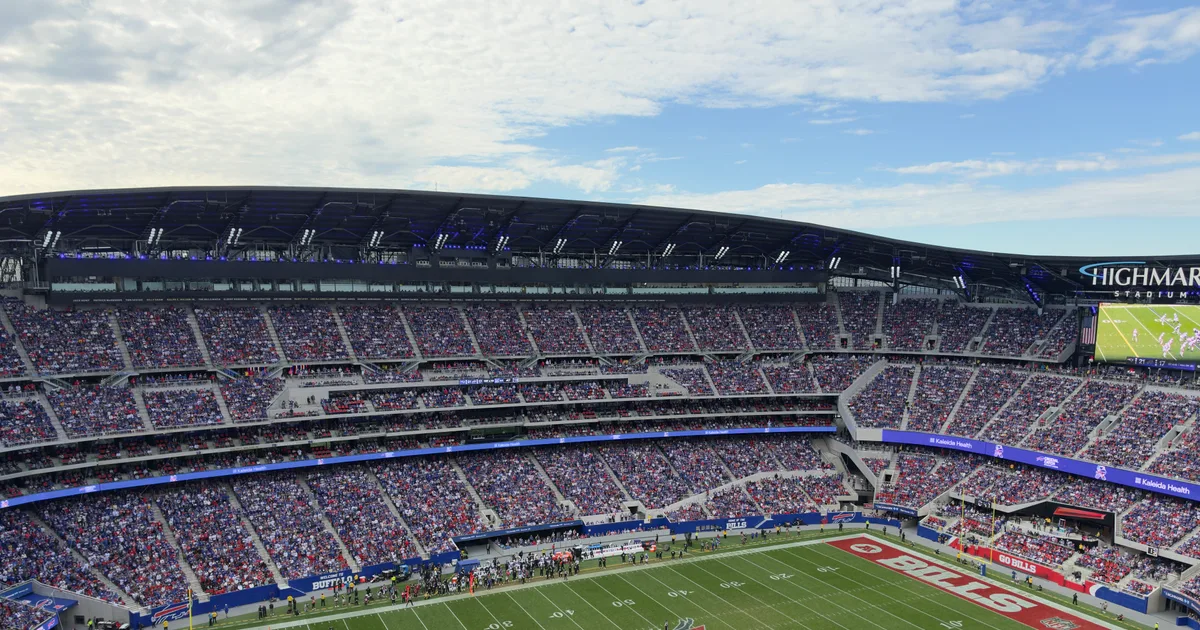
A bill in the New York Assembly would cap food and soft-drink prices at publicly subsidized venues at 20 percent above the average price at comparable businesses within 10 miles. At a hearing on Tuesday, the example put in front of lawmakers was the $11.63 hot dog at Highmark Stadium, the Buffalo Bills’ new home.
What the Fair Concession Pricing Act would do
Assembly Bill A8921, titled the Fair Concession Pricing Act, is sponsored by Assemblymember Nily Rozic, who also chairs the Assembly’s Consumer Affairs and Protection Committee. It doesn’t set a price for anything. Under the bill’s text, food and non-alcoholic drinks sold during public events could cost no more than 20 percent above the average retail price of similar items at similar non-venue businesses within a 10-mile radius. The bill calls this the “street pricing model.”
20% The most a covered venue could charge above the average local price for food and soft drinks under Assembly Bill A8921.
It doesn’t reach every venue. The bill covers arenas, stadiums, amphitheaters and similar venues in New York with 2,500 or more seats, used mainly for entertainment or professional sports, that have received what it calls a “public financial benefit.” That means taxpayer money for construction, renovation or operation, or a full or partial exemption from property, sales or other taxes.
It doesn’t reach every item either. Alcoholic drinks are excluded by the bill’s own text. The cap would apply to the hot dog and the soda, not the beer.
Covered venues would file annual compliance reports with the Department of State. The Secretary of State could run random audits, and the Attorney General could seek an injunction. The civil penalty runs up to $10,000 for each event at which a violation happens, and repeat violations could lead to suspension of tax exemptions or repayment of public funds.
Rozic chaired the committee’s hearing on concession pricing on Tuesday morning, November 10, which was covered by City & State New York and WKBW 7 News in Buffalo. The chair said venue owners and operators were invited to testify and declined. The Bills did not respond to WKBW’s request for comment.
The witness who brought up Buffalo was Brian Hess, executive director of the Sports Fans Coalition, a nonprofit. Hess testified that Highmark Stadium sells the most expensive hot dog in the NFL, at $11.63, even though taxpayers put $850 million toward the building.
What an $11.63 hot dog would have to clear
Because the bill never names a price, the number that matters is the one outside the gates. Under a 20 percent cap, a stadium price stays legal only if the outside average is at least that price divided by 1.2.
| Figure | |
|---|---|
| Highmark hot dog, as cited by Hess | $11.63 |
| Outside average it would need to match, by our calculation ($11.63 / 1.2) | $9.69 |
| Cap if the 10-mile average were $5, by our calculation | $6.00 |
So for Hess’s $11.63 hot dog to survive, comparable hot dogs at shops and restaurants within 10 miles would need to average $9.69 or more, by our calculation. We haven’t measured whether they do. The $5 row is hypothetical, there only to show how the formula works: a $5 street average would mean a $6 ceiling inside.
$9.69 The 10-mile average that comparable hot dogs would need to reach for Highmark’s $11.63 price to stay under the cap, by our calculation.
Highmark makes a natural test case because of how it was paid for. The stadium opened in 2026, with the ribbon cut on June 23, and seats 60,108. The New York governor’s office gives the finished project as $2.1 billion. Of that, $600 million came from New York State and $250 million from Erie County, which is the $850 million Hess cited. That’s about 40 percent of the cost, by our calculation, and the bill applies only to venues with a public financial benefit. We’ve covered who owns NFL stadiums and what they cost the public in more detail.
The comparison raised at the hearing was Mercedes-Benz Stadium, home of the Atlanta Falcons, as the example of a venue that cut prices voluntarily. It launched “Fan First” pricing when it opened in 2017, with $2 hot dogs. Hess’s Highmark figure is $9.63 more than that, nearly six times the price, by our calculation, though Atlanta’s number comes from its 2017 opening menu.
What happens next
A8921 is not law. It was referred to the Consumer Affairs and Protection Committee on January 7, 2026, and it’s still there. The earliest the proposal can be taken up is when the new legislative session begins in January. A companion bill, S8479, sits in the Senate. If the act did pass, it would take effect 180 days after becoming law.
The cap isn’t the only charge in play. Surcharges came up at the hearing too, and Highmark carries one: a 6 percent Erie County surcharge on stadium sales, including tickets, parking, merchandise and concessions, paid into a capital improvement fund. It’s also not the only live argument over what fans pay at a stadium: Inglewood has its own dispute over a ticket-tax cap at SoFi Stadium.
For now, nothing changes at the concession stands at Highmark Stadium.