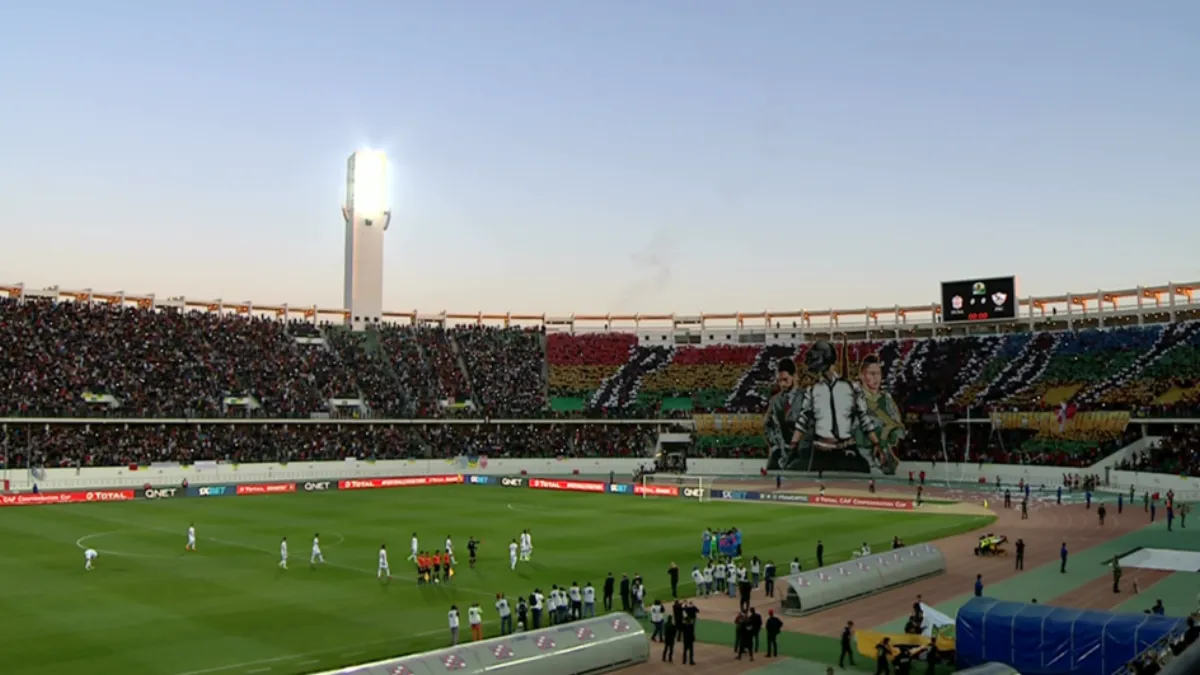
About Adrar Stadium
Agadir is a city that lives by the sea, rebuilt from scratch after a 1960 earthquake, and its biggest ground carries the name of the mountains behind it. Adrar means mountain in Tamazight, the Amazigh language of southern Morocco, and the stadium was designed to look the part, its facade climbing in stone-like steps meant to suggest a peak. The home club is Hassania Agadir, and the Morocco national team plays here too.
The stadium sits on the airport road, on the southeastern edge of the city, about 15 minutes from the center. It opened on October 11, 2013 with about 45,480 seats, a multi-purpose bowl wrapped around an athletics track, and it was thrown into the deep end almost at once. Within weeks it was hosting the 2013 FIFA Club World Cup, and it has been one of Morocco’s reliable big-match venues ever since.
What stands today is a freshened version of that building. A round of work before the 2025 Africa Cup of Nations reworked the exterior, the security systems, the pitch and the training facilities, and the ground was listed at a reduced 41,144 for the tournament, an operational figure below its standard capacity, where it hosted matches through to a quarterfinal in January 2026. A bigger job is still to come.
For 2030, when Morocco co-hosts the World Cup with Spain and Portugal, Agadir is one of six host cities. The plan is to lift gross capacity to 46,000 and crown the ground with a 360-degree panoramic roof, turning a decade-old multi-sport arena into a modern World Cup venue. The mountain the stadium is named for is not going anywhere; the building beneath it keeps changing.
Getting to Adrar Stadium
The ground sits out on the edge of the city near the airport, so unlike a downtown stadium this is a trip you plan, by taxi, bus or car.
Public Transit
Agadir has no tram or metro, so getting to the stadium on public transport means a city bus.
→ Via city bus: Agadir’s ALSA network runs the airport road, with routes passing the stadium side of town toward Inezgane and Aït Melloul. Fares are cheap, a couple of dirhams, but services can be busy on a match day, so allow extra time each way.
→ From the center: There is no direct rail or rapid-transit link, so many fans coming from the beachfront or Talborjt pair a short taxi with the bus, or simply take a taxi the whole way.
Driving + Parking
Its out-of-town setting makes driving a genuine option here, more so than at a cramped city-center ground.
→ Parking: The 2025 works pushed on-site parking from 2,600 spaces to about 4,100, spread across the 32-hectare complex. It still fills for a big fixture, so arrive early.
→ From the center: A drive of roughly 15 minutes southeast from central Agadir outside match traffic, out along the airport road.
Rideshare
Agadir runs on its taxis. Petits taxis handle short city hops and grands taxis take the longer runs, so a taxi is the simplest way to the stadium for most visitors. Agree the fare or insist on the meter before setting off, especially heading back into the city after the final whistle, when demand spikes. App-based rideshare is thin on the ground here compared with the licensed taxis, so do not count on it after a match.
From the Airport
→ Agadir-Al Massira (AGA): The city’s international airport is about 22 kilometres from the stadium, a taxi ride of roughly 25 to 30 minutes depending on traffic, and both sit on the same road out of town.
→ Into the city: Al Massira is around 25 kilometres from the seafront, so most visitors base themselves in central Agadir and travel out to the ground from there.
Watching a Match at Adrar Stadium
The engine of a Hassania Agadir home game is its ultras. The Imazighen, formed in 2006 and named for the region’s Amazigh identity, and the Red Rebels, who arrived in 2011, hold the home end with drums, banners and standing song, and on the right night the low bowl catches and holds the noise. HUSA are not one of Morocco’s giants, and league crowds tend to be loyal rather than vast, but the club’s history gives the place its edge: founded in 1946 by locals pushing back against colonial rule, nicknamed the Souss gazelle, it is a proper southern institution.
The bigger occasions belong to the tournaments. The 2013 Club World Cup, weeks after the ground opened, put Bayern Munich and Raja Casablanca on this pitch, and the 2025 Africa Cup of Nations filled it again through to a quarterfinal. Those are the nights the stadium is built for, and the ones worth timing a trip around.
A word of honesty about the visitor detail. Because Agadir is a resort city rather than a football-first town, the fine-grained matchday lore, the best stands, the stall to find, is not written down the way it is for a century-old European ground. What is clear is the shape of the day. No alcohol is sold inside, in line with Moroccan grounds generally, and the eating happens beforehand, in the city.
The other thing to plan for is the location. The stadium sits out on the airport road, away from the center, so getting in and out is a transport exercise, not a stroll. Give yourself time before kickoff, eat first down at the marina or by the beach, and after a big match expect the taxis and buses to be busy. Patience at the exit goes a long way.
Construction & Design
Adrar Stadium was a long time coming. Construction was launched in June 2004, but the project stalled repeatedly and the ground did not open until October 11, 2013, close to nine years later, with a friendly between Hassania Agadir and JS Kabylie of Algeria. The design came from the Italian firm Gregotti Associati International, working with the Moroccan architect Saâd Benkirane, the same partnership behind the Grand Stade de Marrakech, and the reported cost was around 860 million dirhams, roughly €80 million at the time.
The building they produced is unusual to look at. Rather than a smooth outer skin, the facade is built up in broad stone-clad steps, a form meant to read as a mountain or a stepped pyramid, tying the architecture to the name and to the Atlas range behind the city. Inside, the brief was multi-purpose: a rectangular pitch of 105 by 84 metres wrapped by a Tartan athletics track, which let Agadir stage track meets but, as at Morocco’s other track stadiums, pushed the stands back from the touchline. The seats were a deep Hassania green, the bowl low and wide, the two floodlight pylons its most visible landmark from the road at night.
The first modern overhaul arrived for the 2025 Africa Cup of Nations, at a reported €34 million, about 39.5 million dollars. Most of the money went where television does not always look. Parking grew from 2,600 spaces to roughly 4,100, three full training pitches and a mini stadium went in alongside the main bowl, the perimeter fence was reinforced, new ticketing points were built, facial-recognition security was installed, and the pitch and the training surfaces were relaid. The dressing rooms were rebuilt, and the whole 32-hectare site was tidied for a continental tournament.
The larger job is still ahead. For the 2030 World Cup the plan is to lift gross capacity to 46,000, raise the VIP tiers to FIFA’s standard, and add a 360-degree panoramic roof over the stands, the piece that will change the skyline of the ground most. A stadium built to do several things is being sharpened, step by step, into a World Cup venue.
History of Adrar Stadium
For a venue that took so long to arrive, Adrar Stadium wasted no time proving its worth. It opened in October 2013, and before the year was out it was hosting the FIFA Club World Cup, staging the play-off, quarterfinals and a semifinal in Agadir while Marrakesh held the final. Raja Casablanca beat Auckland City here on December 11, then edged Monterrey after extra time, and the tournament’s most famous Agadir night came on December 17, when Bayern Munich brushed Guangzhou Evergrande aside 3-0 in a semifinal.
The big events kept coming. In 2018 the ground hosted matches at the African Nations Championship, the tournament reserved for home-based players, cementing its role as one of Morocco’s regular neutral venues. Through the 2010s and into the 2020s it did the quieter work too, as Hassania Agadir’s Botola home, backed by the Imazighen and the Red Rebels in the stands.
The busiest stretch came at the end of that era. Freshened by its 2024 to 2025 works, the stadium was a full host for the 2025 Africa Cup of Nations, staging six group games, a round-of-16 tie and a quarterfinal from December 2025 into January 2026, before attention turned to the next project. Agadir had held its own among the tournament’s biggest cities.
Its next assignment is the largest yet. As one of the Moroccan venues for the 2030 World Cup, co-hosted with Spain and Portugal, the ground that opened as a wide multi-sport bowl is being remade into a roofed, expanded football arena. From a stadium that took nine years to build, Agadir’s has become one of the venues on which Morocco’s World Cup will turn.
Sources & Further Reading
- Wikipedia entry on Adrar Stadium: en.wikipedia.org/wiki/Adrar_Stadium. Capacity, opening, architect, cost, design and events.
- CAF on the AFCON 2025 venue: cafonline.com. Capacity for the tournament, location and role.
- Morocco World News on the renovation: moroccoworldnews.com. The AFCON 2025 works, cost, parking and the 2030 plan.
- Wikipedia entry on the 2013 FIFA Club World Cup: en.wikipedia.org/wiki/2013_FIFA_Club_World_Cup. The matches Agadir hosted and their results.
- Wikipedia entry on Hassania Agadir: en.wikipedia.org/wiki/Hassania_Agadir. The club, its founding and its ultras.
Quick Facts
Everything you need at a glance.
Stadium specs
- Capacity
- 45,480
- Opened
- 2013
- Cost
- About 860 million dirhams (roughly €80 million, 2013)
- Roof
- Open
- Surface
- Natural Grass
- Tenants
- Hassania Agadir, Morocco national team
Construction & location
- Groundbreaking
- June 2004
- Architects
- Gregotti Associati International, Saâd Benkirane
- Engineering
- Not separately recorded
- General contractor
- Not separately recorded
- Address
- Route de l'Aéroport (P1714), Agadir, Souss-Massa, Morocco
- GPS
- 30.4272°N, 9.5403°W
Photo Gallery
Fun Facts
Adrar means mountain in Tamazight, the Amazigh language of the region, and the stadium's stone-stepped facade was designed to echo a mountain, a nod to the Atlas peaks that rise behind Agadir.
The ground took roughly nine years to build, launched in June 2004 and not opened until October 11, 2013, only weeks before it hosted quarterfinals of the 2013 FIFA Club World Cup.
The 2025 upgrade before the Africa Cup of Nations pushed on-site parking from 2,600 to 4,100 spaces across a 32-hectare complex, and added three training pitches and a mini stadium.
Stadium Location
Frequently Asked Questions
- Is Adrar Stadium open, or being rebuilt right now?
- It is open and in use. The ground was refreshed for the 2025 Africa Cup of Nations and hosted matches into January 2026, up to a quarterfinal. A second phase of work, lifting capacity and adding a roof, is planned before the 2030 World Cup, but this is an upgrade to a working stadium rather than a full closure like some of Morocco's other grounds.
- How do you get to Adrar Stadium from central Agadir?
- The stadium is on the airport road on the southeastern edge of the city, about 15 minutes out, so plan on a taxi or bus rather than a walk. Agadir has no tram or metro. A petit taxi from the center is the simplest option, ALSA city buses run the airport road toward Inezgane, and there is large on-site parking after the 2025 expansion to about 4,100 spaces.
- Who plays at Adrar Stadium?
- The home club is Hassania Agadir, known as HUSA or the Souss gazelle, a Botola Pro side founded in 1946 that won back-to-back Moroccan league titles in 2002 and 2003. The Morocco national team uses the ground for selected matches, the local club Olympique Dcheira has also played there since 2025, and it regularly hosts major one-off tournaments.
- What does the name Adrar mean?
- Adrar means mountain in Tamazight, the Amazigh (Berber) language of southern Morocco, a fitting name for a city backed by the Atlas Mountains. The stadium leans into it: its facade is built up in stone-like steps meant to evoke a mountain or a stepped pyramid, which makes the name more than a label.
- What is the atmosphere like at Adrar Stadium?
- Hassania Agadir's support is driven by two ultras groups, the Imazighen, formed in 2006 and named for the region's Amazigh identity, and the Red Rebels, from 2011, who bring the drums, banners and standing singing to the home end. League crowds are loyal rather than enormous, but a national-team night or a tournament match fills the bowl and lifts it, as the 2013 Club World Cup and the 2025 Africa Cup of Nations both showed.
- What food and drink is there at the stadium?
- There is no famous signature dish at the ground, and, as at Moroccan stadiums generally, no alcohol is sold inside. Because the stadium sits away from the center, the better plan is to eat first in Agadir, where the marina, the beachfront and Souk El Had are full of grilled fish, tagine and cafés, then head out for the match.
- What is Adrar Stadium's role in the 2030 World Cup?
- Agadir is one of six Moroccan host cities for the 2030 World Cup, co-hosted with Spain and Portugal. Adrar Stadium is being upgraded specifically for it, with plans to raise gross capacity to 46,000 and add a 360-degree panoramic roof and elevated VIP areas to meet FIFA standards.
- What major matches has Adrar Stadium hosted?
- Plenty for a club ground. It staged quarterfinals and a semifinal of the 2013 FIFA Club World Cup in the weeks after it opened, matches at the 2018 African Nations Championship, and a full slate at the 2025 Africa Cup of Nations, six group games, a round-of-16 tie and a quarterfinal.
- Is the capacity changing for the World Cup?
- Its standard capacity is about 45,480, the figure most club and stadium references have carried since it opened in 2013. For the 2025 Africa Cup of Nations it was listed at a reduced 41,144, an operational net figure for the tournament. The 2030 plan lifts gross capacity to 46,000, with a net around 42,800 once broadcast and hospitality fittings are counted, so the headline number will move again before the tournament.
Last updated: 2026-07-23