About Estadio de La Cartuja
Estadio de La Cartuja is Spanish football’s great neutral ground. It sits on the Isla de la Cartuja, an island in the Guadalquivir on the edge of Seville, and it belongs to no club. Instead it is the southern home of the Spain national team and the fixed stage for the Copa del Rey final, the role that keeps it busy and gives it its identity as the country’s national final stadium.
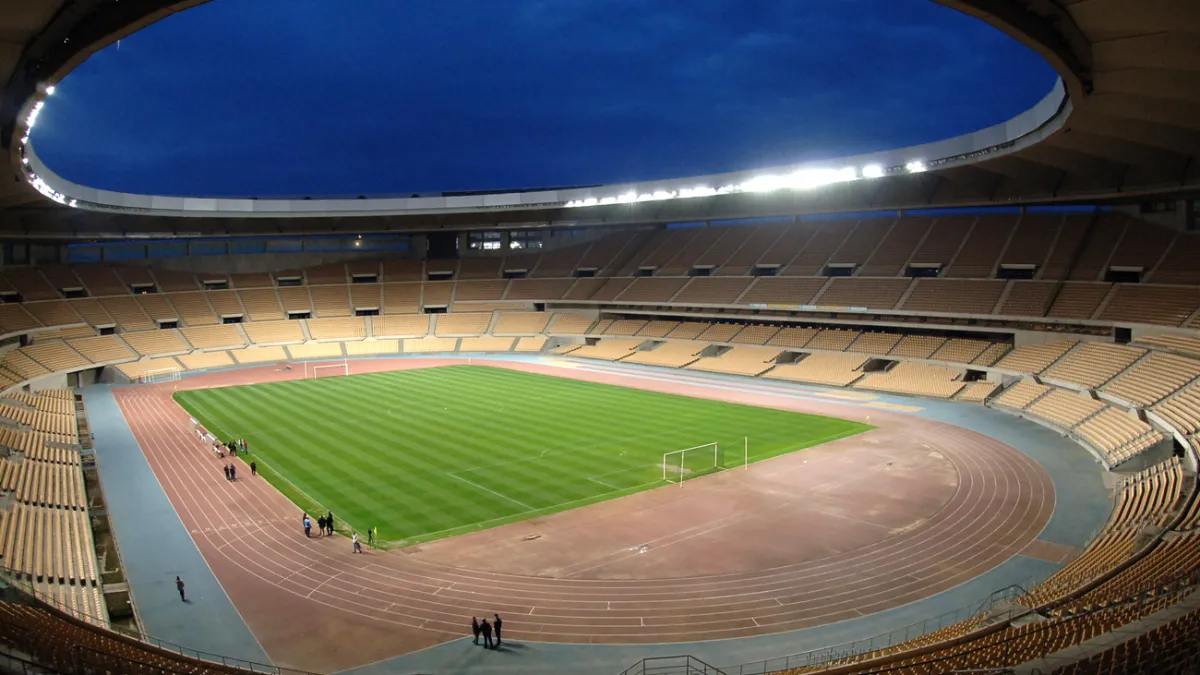
It was not meant to end up this way. The ground opened in 1999 as an Olympic-style athletics stadium, built for Seville’s ambitions to host the Summer Games. Those bids failed, and for two decades La Cartuja was a big, handsome, underused bowl with a running track that pushed spectators far from the pitch. Its rebirth came with the award of the 2030 World Cup, for which Spain is a co-host, and a renovation that has finally turned it into a proper football stadium.
That work has changed the numbers. The 2025 phase of the remodel removed the athletics track, lowered the pitch and built new lower stands, raising capacity to about 70,000, up from 57,600 in the track era. A second phase, planned for around 2028, will add a glass roof over the seats and lift the final figure to 71,374, which will make La Cartuja the third-largest stadium in Spain, behind only Camp Nou and the Bernabeu.
For now it is a publicly owned venue, run by a consortium led by the government of Andalusia, on a natural-grass pitch of 105 by 68 metres. It is a stadium built for the biggest nights, and after twenty-five years it is finally being fitted to hold them.
Getting to Estadio de La Cartuja
The stadium’s island setting is its defining logistical fact: it is cut off from the central bar scene and reached by shuttle, bus, bridge or a long walk.
Public Transit
No metro line reaches the island directly, so the routine is a metro-plus-shuttle hop, or one of the circular buses.
→ Via metro and shuttle: Take Metro Line 1 to Blas Infante, then the frequent Lanzadera shuttle bus that runs to the stadium every few minutes on match days.
→ Via bus: The C1 and C2 circular lines link the center, Santa Justa station and the island.
→ Via train: Cercanías line C-2 runs from Santa Justa to the Estadio Olímpico stop in about 15 minutes.
Driving + Parking
Driving to a match is actively discouraged, and for good reason.
→ Access closes early: Police shut the island to private cars roughly 90 minutes before kickoff, and the single-island road network chokes badly afterward.
→ Park and walk: The common workaround is to park at Torre Sevilla or another mainland spot and walk across the Barqueta bridge, or to pre-register for one of the official lots.
Rideshare
Taxis and ride-hailing work well for reaching the island before a match, dropping you near the bridges or the approved access points. Getting out is the hard part: the same bottleneck that snarls private cars slows pickups after the final whistle, so a common tactic is to walk back across the bridge into the city and find a ride there.
From the Airport
→ Seville Airport (SVQ): About 13 minutes by taxi from the airport, the quickest option. There is no direct bus, so a public-transport trip means the airport EA bus into the city and then a C2 bus toward the stadium, closer to an hour in total.
Matchday at La Cartuja
The first rule of a match at La Cartuja is to eat before you cross the river. The island is thin on bars and restaurants, so regulars fuel up in central Seville, around the Alameda de Hércules, before making the trip over the Barqueta bridge. On the mainland side near the bridge there are a few terraces to gather at, and on match days an official fan zone with food trucks sets up near the Gol Sur end, with Parque del Alamillo alongside for a pre-match picnic in the sun.
Inside, the offering is basic and tightly controlled. Concessions run to bocadillos, hot dogs and pipas, the sunflower seeds Spanish crowds chew through a game, and only non-alcoholic beer is sold. Water bottles are limited to 500ml, with the caps taken at security. This is a stadium you come to for the occasion, not the catering.
Where you sit matters more here than at most grounds, because of the building’s Olympic bones. The new Grada Baja, the lower tier laid over the old running track in 2025, is now the closest to the pitch and the best seat in the house. The long sides, Este and Oeste, give the best all-round view. What groundhoppers warn against is the upper Segundo Anfiteatro, a long way back, and the corners, where the old oval geometry leaves you watching across an awkward diagonal. The vocal ends are the Gol Sur and Gol Norte behind the goals.
Then there is the atmosphere debate, the thing every regular will tell you about. For a routine fixture the vast bowl can feel flat, the noise dispersing in a way it never does in a tight club ground. But the big nights are a different animal. A Copa del Rey final, a Spain international, a European tie, and the place fills and roars. La Cartuja is the national game’s neutral cathedral, built for showpiece finals rather than a weekly home, and the ongoing test, with Betis playing here during their own rebuild, is whether the new closer stands can finally lend it a club soul.
Construction & Design
La Cartuja was built for an Olympics that Seville never got. The city bid to host the 2004 and then the 2008 Summer Games, and the stadium was conceived as the flagship of those ambitions, an Olympic-grade athletics-and-football arena on the island that had staged the 1992 World’s Fair. The Seville firm Cruz y Ortiz Arquitectos, led by Antonio Cruz and Antonio Ortiz, drew the design, and the ground was built between 1997 and 1999 at a cost of around 120 million euros, over 20 billion pesetas in the money of the day, well beyond its original budget.
It opened on May 5, 1999, inaugurated by the King with a Spain win over Croatia, and hosted the World Athletics Championships that August. Then the Olympic bids failed, one after the other, and the stadium settled into a long second life as a big neutral bowl for national-team games and cup finals, its running track a constant reminder of the athletics venue it had been designed to be.
The reinvention came with the 2030 World Cup. Cruz y Ortiz, the original architects, returned to lead a two-phase remodel. Phase one, from 2024 to 2025, tore out the athletics track, dropped the pitch and built new lower stands over the old oval, taking capacity to about 70,000 and reopening in time for the April 2025 Copa del Rey final. Phase two, planned for around 2028, will wrap the ground in a new facade and a glass roof over the seating, lifting the final figure to 71,374 and readying it to FIFA standard. Reported costs for the work vary, with the first phase cited anywhere from roughly 9.5 to 15 million euros and the second phase estimated near 100 million.
History of Estadio de La Cartuja
For a stadium without a club, La Cartuja has hosted a remarkable amount of history. It arrived in 1999 with the World Athletics Championships, then quickly became a venue for the biggest one-off occasions Spanish football could send its way.
The early landmarks were European and international. In 2003 it staged the UEFA Cup final, Porto beating Celtic 3-2 after extra time in José Mourinho’s first major European triumph. Spain won two Davis Cup finals on temporary indoor courts installed on the pitch, in 2004 and 2011. And when the pandemic forced Bilbao to drop out as a Euro 2020 host, Seville stepped in, and La Cartuja staged four matches in June 2021, including all three of Spain’s group games.
Its defining modern role, though, is the Copa del Rey final. Since 2020 the Spanish federation has made La Cartuja the fixed home of its showpiece, a deal that runs through at least 2028, turning the ground into the country’s national final stadium, its equivalent of Wembley for the FA Cup. The 2025 final, Barcelona beating Real Madrid 3-2 after extra time, was the first played on the renovated pitch. The stadium has also hosted the 2024 Women’s Nations League final, where Spain beat France, and a long run of stadium concerts, from a sold-out U2 in 2010 to Manuel Carrasco’s Spanish record crowd of 74,345 in 2022.
Now it faces its biggest assignment yet. As a confirmed host for the 2030 World Cup, La Cartuja is being rebuilt to hold the tournament that Spain, Portugal and Morocco will share. A stadium constructed for a Games that never came is, at last, being finished for a World Cup that will.
Sources & Further Reading
- Wikipedia entry on Estadio de La Cartuja: en.wikipedia.org/wiki/Estadio_de_La_Cartuja. Capacity, ownership, architect, events and the renovation.
- Cruz y Ortiz Arquitectos on the La Cartuja remodel: cruzyortiz.com. The design firm’s account of the phases and the 71,374 figure.
- El Español on La Cartuja’s history and cost: elespanol.com. The 1999 build, the Olympic bids and the RFEF role.
- Coliseum on the renovation works: coliseum-online.com. The phased remodel, track removal and Betis tenancy.
- Seville Traveller matchday guide: seville-traveller.com. Transit, seating, and the visitor experience.
Quick Facts
Everything you need at a glance.
Stadium specs
- Capacity
- 70,000
- Opened
- 1999
- Cost
- Approximately €120 million (1999)
- Roof
- Open
- Surface
- Natural Grass
- Tenants
- Spain national team
Construction & location
- Groundbreaking
- 1997
- Architects
- Cruz y Ortiz Arquitectos
- Engineering
- Not separately recorded
- General contractor
- Not separately recorded
- Address
- Isla de la Cartuja, Seville, Andalusia, Spain
- GPS
- 37.4172°N, 6.0046°W
Photo Gallery
Fun Facts
La Cartuja was built as the flagship for Seville's Olympic dreams, but the city's bids for the 2004 and 2008 Summer Games both failed, leaving a stadium built for a Games that never came.
The renovation is taking capacity from about 57,600 in its athletics-track days to around 70,000 now, on the way to a planned 71,374 for the 2030 World Cup, which will make it the third-largest stadium in Spain, behind only Camp Nou and the Bernabeu.
Manuel Carrasco drew 74,345 fans here on June 11, 2022, cited as a Spanish single-day concert attendance record, while U2 sold the ground out at 76,159 back in 2010.
Stadium Location
Frequently Asked Questions
- What is Estadio de La Cartuja used for if it has no club?
- It is primarily the home of the Spain national team in the south and the fixed host of the Copa del Rey final, a role it holds through at least 2028. It has no permanent club tenant, though Real Betis is playing there temporarily from 2025 while their own Benito Villamarin ground is rebuilt. That neutral-venue status makes it Spain's de facto national final stadium.
- What happened to the athletics track at La Cartuja?
- It was removed in the 2024 to 2025 renovation. La Cartuja was built as an Olympic-style athletics stadium for the 1999 World Championships, and the track long kept spectators far from the pitch. Phase one of the World Cup remodel buried the track, lowered the pitch and built new lower stands, reopening for the April 2025 Copa del Rey final with fans much closer to the action.
- How big is La Cartuja, and how big will it be for 2030?
- After the 2025 works it holds about 70,000, up from 57,600 in its athletics-track days. A second phase planned for around 2028 will add a glass roof over the seating and take the final capacity to 71,374 for the 2030 World Cup, which would make it the third-largest stadium in Spain.
- Where are the best seats at Estadio de La Cartuja?
- The new Grada Baja, the lower tier built over the old track in 2025, is now the closest to the pitch and the best value. The long sides, Este and Oeste, give the best overall views. Groundhoppers advise avoiding the upper Segundo Anfiteatro, which sits a long way back, and the corners, where the old oval shape leaves awkward diagonal sightlines.
- What is the atmosphere like at La Cartuja?
- It divides opinion. For an ordinary fixture the huge bowl can feel flat, as the sound disperses more than in a tight club ground. But big occasions transform it: Copa del Rey finals, Spain internationals and European nights fill it and lift the energy. Fans tend to sum it up as a stadium that is made for showpiece finals rather than everyday football.
- How do you get to La Cartuja in Seville?
- The stadium is on an island in the river, so take Metro Line 1 to Blas Infante and the Lanzadera shuttle, the C1 or C2 buses, or the Cercanias C-2 train from Santa Justa to the Estadio Olimpico stop. Walking from the center takes around 45 minutes over the Barqueta bridge. Do not drive, as the island is closed to private cars before matches and bottlenecks afterward.
- Who designed and paid for La Cartuja?
- It was designed by the Seville firm Cruz y Ortiz Arquitectos and built between 1997 and 1999 for around 120 million euros, a peseta-era figure of over 20 billion pesetas. It is publicly owned by a consortium led by the regional government of Andalusia, with the Spanish state, the city, the provincial council and the two Seville clubs holding smaller shares.
- Did La Cartuja host Euro 2020?
- Yes. Seville was added as a Euro 2020 host after Bilbao dropped out over COVID restrictions, and La Cartuja staged four matches in June 2021, including all three of Spain's group games and a round-of-16 tie between Belgium and Portugal.
- When was Estadio de La Cartuja built?
- It opened on May 5, 1999, inaugurated by the King of Spain with a friendly in which Spain beat Croatia 3-1, and hosted the World Athletics Championships that summer. It was conceived as the centerpiece of Seville's Olympic bids, and only found a lasting purpose as a national-team and cup-final venue years later.
Last updated: 2026-07-18