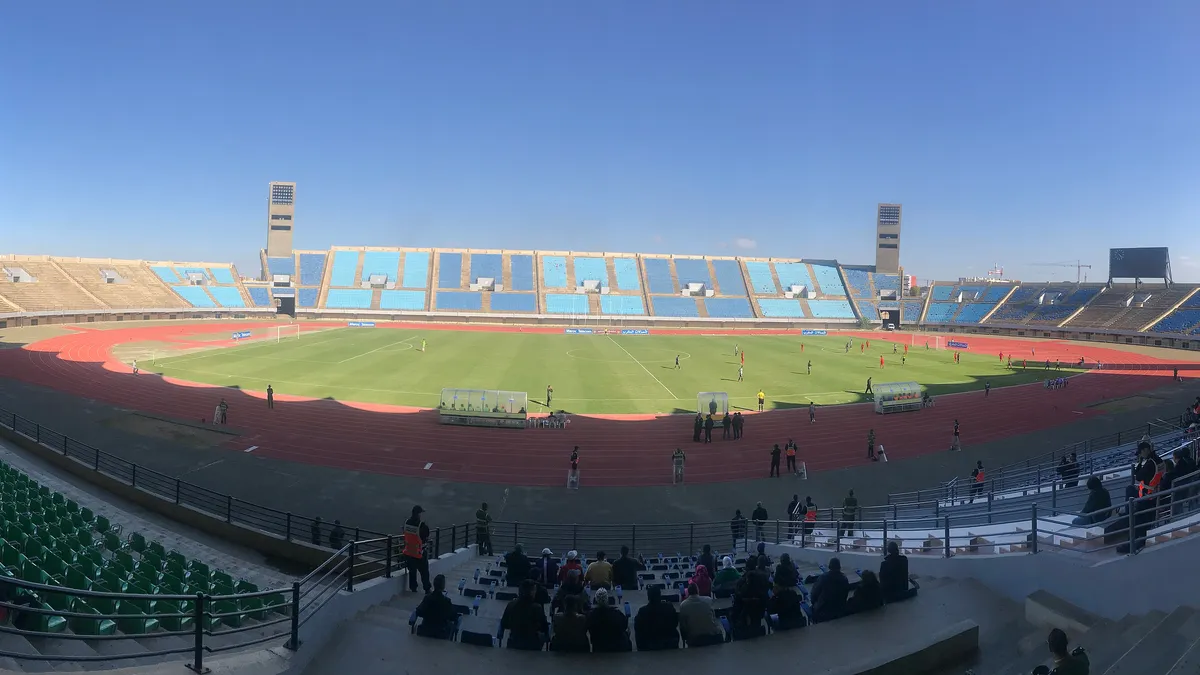
About Fez Stadium
Fez is one of the oldest cities on Earth still going about its business, a medieval capital wrapped around the largest car-free old town anywhere, and its biggest sports arena sits a few kilometres south of all that history, out on the road toward Sefrou. That gap between the ancient city and the modern bowl is the first thing to know about Fez Stadium. It is not a ground you happen upon wandering the medina; it is a trip you make on purpose. The home club is Maghreb de Fès, and the Morocco national team plays here too.
Officially the Complexe Sportif de Fès, the stadium was a long time coming. Ground was broken in 1994, the build was meant to finish in 1997, and technical delays dragged it out until 2003. Even then it sat largely unused until an official inauguration on November 25, 2007. The design was pitched as a blend of traditional Moroccan style and modern facilities, with a glass façade fronting a multi-purpose bowl that wrapped an athletics track. Capacity is most often given as 45,000.
What stands today is a freshened version of that building. A rapid overhaul before the 2025 Africa Cup of Nations tore out the running track, pulled the stands closer to the pitch, rebuilt the dressing rooms and press areas, and wired the place with more than 500 smart cameras. The ground reopened on June 6, 2025 with a friendly between Morocco’s Atlas Lions and Tunisia, then went straight into hosting the continental tournament. A bigger job is still to come.
For 2030, when Morocco co-hosts the World Cup with Spain and Portugal, Fez is one of the host cities. The plan is to expand the stadium toward 55,800 seats to meet FIFA’s requirements, turning a two-decade-old provincial arena into a World Cup venue. The city it serves needs no such reinvention. Fez has been drawing visitors for more than a thousand years, and the stadium is simply the newest reason to come.
Getting to Fez Stadium
The ground sits out on the southern edge of the city, away from the old town, so unlike a medina-side stadium this is a journey you plan, by taxi, bus or car.
Public Transit
Fez has no tram or metro, so getting to the stadium on public transport means a city bus.
→ Via city bus: Fez’s bus network runs out toward the southern edge of the city where the complex stands. Fares are cheap, a few dirhams, but services can be crowded on a match day, so allow extra time in each direction.
→ By train, then bus or taxi: Intercity ONCF trains link Fez with Meknès, Rabat and Casablanca, arriving at Fès railway station north of the center. From there it is a taxi or bus down to the ground.
Driving + Parking
Its out-of-town setting makes driving a genuine option here, more so than at a cramped city-center ground.
→ Parking: The complex has room for around 7,500 cars and 350 coaches, one of the larger stadium car parks in the country. It still fills for a big fixture, so arrive early.
→ From the center: A drive south from central Fez, toward the Sefrou road, of roughly 15 to 20 minutes outside match traffic.
Rideshare
Fez runs on its taxis. The small red petits taxis handle short city hops, and grands taxis take the longer runs, so a taxi is the simplest way to the stadium for most visitors. Insist on the meter or agree the fare before setting off, especially heading back into the city after the final whistle, when demand spikes and drivers know it. App-based rideshare is thinner on the ground here than the licensed taxis, so do not count on it after a match.
From the Airport
→ Fès-Saïss (FEZ): The city’s airport sits on the southern side of Fez, roughly 15 kilometres out, a taxi ride of around 20 to 25 minutes and on the same side of town as the stadium.
→ Into the city: Most visitors base themselves near the medina and travel out to the ground from there, so factor the airport transfer and the stadium trip as two separate legs.
Watching a Match at Fez Stadium
Start with the club, because at Fez the club is the story. Maghreb de Fès, MAS to everyone, was founded in 1946 and is one of the founding institutions of Moroccan football, a name bound up with the city’s identity and its role in the country’s independence era. Nicknamed the Yellow Tigers, MAS carries five Botola titles and a 2011 CAF Confederation Cup, and its support runs deep. The ultras group, the Fatal Tigers, formed in 2006, hold the home end with drums, banners and standing song.
The nights this ground remembers are the big ones. In December 2011 MAS won the second leg of the CAF Confederation Cup final here and lifted the club’s first continental trophy, the high-water mark of its modern history. And in July 2026, MAS were crowned champions of Morocco for the first time since 1985, a 41-year wait ended, sending the club back into the African Champions League. A provincial stadium does not get many weeks like that.
A word of honesty about the visitor detail. Fez is a football city with a proud club, but the fine-grained matchday lore, the exact best stand, the stall to find, is not written down in English the way it is for a century-old European ground, and the stadium itself only reopened in mid-2025. What is clear is the shape of the day. No alcohol is sold inside, in line with Moroccan grounds generally, and the eating happens beforehand, in the city.
And what a city to eat in. Fez is one of the great food towns of Morocco, its medina packed with bakeries, street stalls and cafés serving bissara, brochettes and the famous sweet-savoury pastilla. The smart plan mirrors the geography: spend the day in Fes el-Bali, the largest car-free old city on the planet, eat well, then head south to the ground for kickoff. Give yourself time at both ends, because getting a crowd in and out of a site on the edge of the city takes patience, and the real reason to come to Fez is waiting back inside the walls.
Construction & Design
Few stadiums have had a slower birth than this one. Planning began in the early 1990s, ground was broken in 1994, and the build was scheduled to finish in 1997. Technical problems saw to that timetable. The stadium was not completed until 2003, and then sat largely idle until it was formally inaugurated on November 25, 2007, close to a decade and a half after the first plans. The original construction budget is not separately recorded in the available sources, and no architect or engineering firm is publicly credited, an unusual blank for a national venue.
What the design brief did produce is well documented. The stadium was conceived to marry traditional Moroccan architecture with modern facilities, fronted by a glass façade, and built as a multi-purpose bowl wrapped around a full athletics track. That track let Fez stage more than football, but, as at Morocco’s other track stadiums, it held the stands back from the touchline. Around the bowl came the full apparatus of a national ground: a media center, first-aid and infirmary rooms, an anti-doping control room, and parking for some 7,500 cars and 350 coaches.
The building that matters now is the one that came out of the 2025 renovation. With the Africa Cup of Nations and the 2030 World Cup on the horizon, the ground was gutted and remade at a reported cost of around 600 million dirhams, roughly 56 million euros. The athletics track came out, the stands were reconfigured to bring fans closer to the pitch and improve sightlines, and the dressing rooms and press areas were rebuilt from scratch. Water, electricity, drainage, air-conditioning and ventilation were all overhauled.
The most modern touch is the one you do not see from your seat. More than 500 smart cameras were installed, with facial-recognition and license-plate-reading systems feeding an intelligent access-control setup, part of the security standard Morocco has rolled out across its tournament grounds. The whole revamp was pushed through fast, reported at around 13 weeks of works, to be ready for a June 2025 reopening. The bigger job, the expansion toward 55,800 seats for the World Cup, is still ahead.
History of Fez Stadium
For a stadium that took so long to arrive, Fez wasted little time once it opened. Its first official match, on November 25, 2007, was the 2006-07 Throne Cup final between FAR Rabat and Rachad Bernoussi, played in front of a reported 40,000 spectators, with Atik Chihab of FAR scoring the ground’s first goal. A national final for a christening set the tone for a venue meant to be more than a club home.
The defining night came four years later. On December 4, 2011, Maghreb de Fès hosted the second leg of the CAF Confederation Cup final against Club Africain of Tunisia, and went on to win the tie and lift the club’s first continental trophy. MAS followed it with the CAF Super Cup in 2012. For a club and a city, those two seasons remain the modern high point, and the stadium was their stage.
Then came the reinvention. Closed for its rapid overhaul, the ground reopened on June 6, 2025 with Morocco’s national team facing Tunisia in a friendly, and was thrown straight into the 2025 Africa Cup of Nations. Fez staged four tournament matches from December 2025 into January 2026, three group games, including Nigeria against Tunisia, and a round-of-16 tie, proving the revamped venue on continental duty.
Its next assignment is the largest yet. As one of the Moroccan venues for the 2030 World Cup, co-hosted with Spain and Portugal, the ground that opened as a wide multi-sport bowl is set to be expanded again for the biggest stage in the game. The timing feels apt: with that 2026 title fresh, the old city has a champion again just as its stadium prepares for the world.
Sources & Further Reading
- Wikipedia entry on Fez Stadium: en.wikipedia.org/wiki/Fez_Stadium. Capacity, dates, inauguration, facilities and events.
- CAF on the AFCON 2025 venue: cafonline.com. Capacity, location and the tournament matches hosted.
- The North Africa Post on the renovation: northafricapost.com. The revamp cost, track removal, cameras and June 2025 reopening.
- Wikipedia entry on Maghreb de Fès: en.wikipedia.org/wiki/Maghreb_de_F%C3%A8s. The club, its honors, the Fatal Tigers and the 2011 continental title.
- Yabiladi on the 2025-26 title: yabiladi.com. MAS Fez winning the Botola and returning to the Champions League.
Quick Facts
Everything you need at a glance.
Stadium specs
- Capacity
- 45,000
- Opened
- 2003
- Cost
- Not separately recorded
- Roof
- Open
- Surface
- Natural Grass
- Tenants
- Maghreb de Fès (MAS), Morocco national team
Location
- Groundbreaking
- 1994
- Address
- Route de Sefrou, Fez, Fès-Meknès, Morocco
- GPS
- 34.0028°N, 4.9689°W
Photo Gallery
Fun Facts
The complex parks around 7,500 cars and 350 coaches, one of the larger stadium car parks in Morocco, on a site out on the road between Fès and Sefrou.
The ground took roughly nine years to build, from groundbreaking in 1994 to completion in 2003, and was not officially inaugurated until November 25, 2007.
Home club Maghreb de Fès won the 2025-26 Botola, its first Moroccan league title in 41 years, sealed in July 2026 as the countdown to the 2030 World Cup began.
Stadium Location
Frequently Asked Questions
- Was Fez Stadium renovated for AFCON 2025?
- Yes. The ground was completely revamped before the 2025 Africa Cup of Nations, reopening on June 6, 2025 for a friendly between Morocco and Tunisia. The reported roughly 600 million dirham job stripped out the old athletics track, reshaped the stands for better sightlines, rebuilt the locker rooms and press areas, and fitted more than 500 smart cameras. It is a heavily upgraded version of the stadium completed in 2003, not a new build.
- How big is Fez Stadium, and is the capacity changing for the World Cup?
- It is generally listed at 45,000, the figure the Confederation of African Football and most club records carry, and the number used at the 2025 Africa Cup of Nations. Some references, including Wikipedia, cite a lower post-renovation seated figure of about 35,468 after the stands were reconfigured, so the exact current total is reported inconsistently. For the 2030 World Cup the plan is to expand the ground toward 55,800 seats to meet FIFA standards.
- Who plays at Fez Stadium?
- The home club is Maghreb de Fès, known as MAS or the Yellow Tigers, founded in 1946 and one of the oldest clubs in Moroccan football. The Morocco national team also uses the ground for selected matches, and it hosts major one-off tournaments. MAS won the 2025-26 Botola, its first league title since 1985.
- What is the atmosphere like at a MAS Fez match?
- Passionate. MAS is a founding institution of Moroccan football with deep roots in the city, and its ultras group, the Fatal Tigers, formed in 2006, drives the singing, drums and banners from the home end. League crowds are loyal rather than vast, but a derby, a national-team night or a continental tie fills the bowl and lifts it, as the club's 2011 CAF Confederation Cup triumph on this pitch showed.
- How do you get to Fez Stadium?
- The ground is on the southern edge of the city, on the road toward Sefrou, so plan on a taxi or bus rather than a walk from the medina. Fez has no tram or metro. A red petit taxi is the simplest option, city buses run the route, and there is large on-site parking for around 7,500 cars. Fès-Saïss Airport sits south of the city, a short drive away.
- What food and drink is there at the stadium?
- There is no famous signature item at the ground, and, as at Moroccan stadiums generally, no alcohol is sold inside. The far better plan is to eat beforehand in Fez, one of the great food cities of Morocco, where the medina is full of street stalls, bakeries and cafés serving everything from bissara and grilled brochettes to pastilla.
- What is Fez Stadium's role in the 2030 World Cup?
- Fez is one of the Moroccan host cities for the 2030 World Cup, which Morocco co-hosts with Spain and Portugal. The stadium's AFCON 2025 overhaul was the first step, and a further expansion toward 55,800 seats is planned to bring it up to the tournament's standard.
- What major matches has Fez Stadium hosted?
- Plenty for a club ground. It opened with the 2006-07 Throne Cup final in November 2007, hosted the second leg of MAS Fès's 2011 CAF Confederation Cup final win, staged Morocco's reopening friendly against Tunisia in June 2025, and held four matches at the 2025 Africa Cup of Nations, three group games and a round-of-16 tie.
Last updated: 2026-07-27