About Yankee Stadium
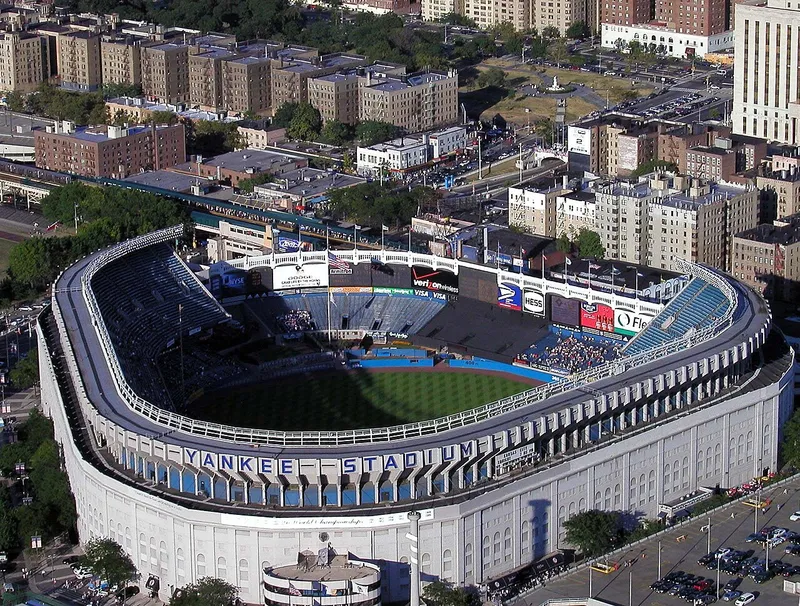
One block north of where “The House That Ruth Built” stood for 85 years, the current Yankee Stadium anchors the South Bronx. With 46,537 seats, it’s smaller than the original, but everything else is bigger. The $2.3 billion complex is one of the most expensive sports venues ever built, wrapped in 11,000 pieces of Indiana limestone that echo the iconic frieze of the 1923 original.
The stadium is home to the New York Yankees, the most decorated franchise in American sports with 27 World Series championships. It also serves as the home ground for New York City FC of Major League Soccer, who will play here through the 2027 transition season before moving to their new Etihad Park in Queens.
Architect Populous designed the park to blend modern luxury with old-world grandeur. The Kentucky Bluegrass playing surface is grown at a sod farm in Bridgeton, New Jersey, and the field dimensions mirror the final layout of the original stadium, 318 feet down the left-field line, 408 to dead center, 314 to right. Monument Park, relocated from the old stadium, sits in center field with plaques and retired numbers honoring the greatest players in baseball history.
The new stadium has already staged its share of defining moments. The Yankees won the 2009 World Series in its inaugural season. The 2013 All-Star Game saw Mariano Rivera take his final All-Star bow. And the 2024 World Series brought the Fall Classic back to the Bronx for the first time in 15 years, with the Dodgers clinching in five games.
Getting to Yankee Stadium
Public Transit
Yankee Stadium is one of the most accessible ballparks in America by public transit. Three subway lines stop at 161st Street-Yankee Stadium station, directly adjacent to the park.
→ From Midtown Manhattan: Take the 4 train from Grand Central or the D train from Midtown. Both reach the stadium in about 25 minutes. The B train also stops here on weekdays.
→ Via Metro-North: The Yankees-East 153rd Street station on the Hudson Line is a 15-minute ride from Grand Central Terminal. Special Yankee Clipper service runs on game days.
Service is frequent before games and continues for about 90 minutes after the final out. The 4 train is the most popular option and gets packed, arriving early or waiting 20 minutes after the game helps.
Driving + Parking
The stadium is accessible via the Major Deegan Expressway (I-87). GPS users should enter “1 East 161st Street, Bronx, NY 10451.”
→ From Manhattan (East Side): FDR Drive North to the Willis Avenue Bridge, then follow signs to I-87 North, Exit 4 or 5.
→ From New Jersey: George Washington Bridge to the Cross Bronx Expressway (I-95) to the Major Deegan Expressway (I-87) South, Exit 6.
Over 9,000 parking spaces surround the stadium across garages and lots operated by City Parking. Expect to pay around $49 at official lots, though third-party options along Jerome Avenue run $7.50 to $35. Pre-book online, showing up without a pass on game day is not advisable.
Rideshare
Uber and Lyft have a designated drop-off along Jerome Avenue near Gate 8. Post-game pickup is at Jerome Avenue and Anderson Avenue. A ride from Midtown Manhattan costs $25-45 depending on demand. Expect surge pricing after games, walking a few blocks before requesting a ride can reduce both wait times and cost.
From the Airport
→ LaGuardia Airport (LGA): 8 miles, 20-40 minutes by car. The closest and most convenient airport for Yankee Stadium.
→ JFK Airport: 19 miles, 45-75 minutes by car. AirTrain to subway is an option but adds time.
→ Newark Liberty (EWR): 24 miles, 40-60 minutes by car. NJ Transit to Penn Station, then subway, is the transit route.
Construction & Design
The current Yankee Stadium is a copy that cost a fortune. When the 1923 original, the House That Ruth Built, finally aged out, the Yankees did not renovate it. They built a new one across 161st Street and made it look like the old one. Populous, then trading as HOK Sport, drew the plans, Thornton Tomasetti engineered it, and Turner Construction built it between the 2006 groundbreaking and the 2009 opening. The bill came to about $2.3 billion, ranking it among the most expensive sports venues ever built.
A good chunk of that, roughly $1.2 billion, came from public subsidies, mostly tax-exempt bonds plus city and state infrastructure spending. That made the project a lightning rod. Critics asked why one of the richest franchises in sports needed public money for a ballpark, and the answer, then as now, was that this is simply how big-league stadiums get built in America.
What the money bought was nostalgia with modern plumbing. The exterior is clad in 11,000 pieces of Indiana limestone, the same stone on the Empire State Building, and the white frieze ringing the upper deck deliberately echoes the 1923 park. Inside, Monument Park was carried over from the old stadium and set beyond center field, and the Great Hall, billed as the largest open-air entryway at any sports venue in the world, runs along the bowl.
Then there are the dimensions. The right-field porch sits just 314 feet down the line, and in the early seasons balls flew out of here at a rate that raised eyebrows. The popular theory was a wind tunnel. The engineers who studied it concluded the culprit was the shape and height of the right-field wall, not the breeze. Either way, the new park earned a reputation as a hitter’s haven almost immediately.
The seat count has drifted down over time, from about 50,287 at the opening to 46,537 today, as the team traded bleacher rows for premium clubs and suites. The grass, a Kentucky bluegrass grown on a New Jersey sod farm, is one of the few things about the place that has stayed exactly the same.
History of Yankee Stadium
The story begins across the street. The original Yankee Stadium opened on April 18, 1923, “The House That Ruth Built,” where Babe Ruth, Lou Gehrig, Joe DiMaggio, Mickey Mantle, and Derek Jeter made history for 85 years. It hosted more World Series than any ballpark in history, the stage for most of the Yankees’ 27 championships.
By the mid-2000s, the old stadium had outlived its infrastructure. The Yankees and New York City agreed on a new $2.3 billion venue one block north. Populous designed the replacement to honor the original while delivering modern amenities, wider concourses, premium clubs, and 68 luxury suites. Construction began in 2006 on the former site of Macombs Dam Park.
Notable events at Yankee Stadium:
- Opening Day (April 16, 2009): The Cleveland Indians spoiled the party with a 10-2 win, but the Yankees would have the last word that season.
- 2009 World Series (November 4, 2009): The Yankees defeated the Philadelphia Phillies in Game 6 to clinch their 27th championship, the first title at the new stadium.
- 2013 All-Star Game (July 9, 2013): Mariano Rivera earned MVP honors in his final All-Star appearance, entering to a standing ovation at his home park.
- NYCFC Debut (March 8, 2015): New York City FC played their first MLS home match, converting the baseball diamond into a soccer pitch.
- 2024 World Series (October 30, 2024): The Dodgers defeated the Yankees in Game 5, becoming the first visiting team to clinch a championship at the new stadium.
The old stadium’s footprint is now Heritage Field, a public park where Bronx kids play on the same ground where Ruth pointed to center field and Jeter hit his 3,000th. The new stadium carries the same name, the same expectations, and, 27 banners hanging from the rafters, the same weight.
Sources & Further Reading
- Wikipedia entry on Yankee Stadium: en.wikipedia.org/wiki/Yankee_Stadium. Construction, the design, the frieze, financing, and events.
- Populous, Yankee Stadium project: populous.com. The architect’s account of the 2009 stadium.
- Ballparks of Baseball, Yankee Stadium: ballparksofbaseball.com. A detailed ballpark reference and timeline.
- New York Yankees official ballpark page: mlb.com/yankees/ballpark. Events, tickets, and visitor information.
Quick Facts
Everything you need at a glance.
Stadium specs
- Capacity
- 46,537
- Opened
- 2009
- Cost
- approximately $2.3 billion (including about $1.2 billion in public subsidies)
- Roof
- Open
- Surface
- Natural Grass (Kentucky Bluegrass)
- Tenants
- New York Yankees (MLB), New York City FC (MLS)
Construction & location
- Groundbreaking
- August 16, 2006
- Architects
- Populous (lead design architect)
- Engineering
- Thornton Tomasetti
- General contractor
- Turner Construction
- Address
- Yankee Stadium, 1 East 161st Street, Bronx, NY 10451
- GPS
- 40.8297°N, 73.9262°W
Photo Gallery
Fun Facts
The new Yankee Stadium cost $2.3 billion total, roughly 958 times more than the $2.4 million original 1923 stadium it replaced.
The exterior features 11,000 pieces of Indiana limestone, the same stone used to build the Empire State Building.
On July 9, 2011, Derek Jeter became the only player to collect all 3,000 career hits as a Yankee, reaching the milestone with a home run, going 5-for-5 that day.
Stadium Location
Frequently Asked Questions
- What is the seating capacity of Yankee Stadium?
- Yankee Stadium seats 46,537 for baseball games. Maximum capacity with standing room reaches 52,325. The stadium also has 68 luxury suites and 4,300 club seats.
- How do I get to Yankee Stadium by subway?
- Take the 4, B, or D train to 161st Street-Yankee Stadium station, located directly adjacent to the stadium. The 4 train from Grand Central takes about 25 minutes.
- Is there a Monument Park at Yankee Stadium?
- Yes. Monument Park in center field contains plaques, monuments, and retired numbers honoring Yankees legends. It is open to ticketed fans when gates open and closes 45 minutes before first pitch.
- How much does parking cost at Yankee Stadium?
- Official lots charge approximately $49 on game days. Third-party lots along Jerome Avenue range from $7.50 to $35. Pre-booking through SpotHero or ParkMobile can save money.
- Can you bring food into Yankee Stadium?
- Yes. Outside food for individual consumption is permitted in a clear plastic grocery-style bag. Factory-sealed plastic water bottles (1 liter or smaller) are also allowed.
- Does Yankee Stadium have a roof?
- No, Yankee Stadium is an open-air ballpark with no roof or retractable cover. Games may be delayed or postponed due to weather.
- When was the current Yankee Stadium built?
- The current Yankee Stadium opened on April 16, 2009, replacing the original 1923 stadium. It was built one block north of the old site, which is now Heritage Field, a public park.
- Is tailgating allowed at Yankee Stadium?
- Tailgating is permitted at City Parking-operated lots before games only. Open flames and charcoal grills are prohibited. Tailgating is not allowed during or after events.
- Who designed and built Yankee Stadium, and what did it cost?
- The current Yankee Stadium was designed by Populous, engineered by Thornton Tomasetti, and built by Turner Construction between 2006 and 2009. It cost about $2.3 billion, including roughly $1.2 billion in public subsidies, one of the most expensive stadiums ever built.
- What is the frieze at Yankee Stadium?
- The frieze is the white scalloped cornice that rings the top of the stadium, a deliberate echo of the original 1923 Yankee Stadium. The exterior is clad in 11,000 pieces of Indiana limestone, the same stone used on the Empire State Building, designed to recall the grandeur of the old park across the street.
- Why is Yankee Stadium known for home runs?
- The current stadium drew a reputation as home-run-friendly in its early seasons, especially to right field, where the porch is just 314 feet down the line. It was first blamed on a wind-tunnel effect, but engineers concluded the surge had more to do with the shape and height of the right-field wall than the wind.
Last updated: 2026-07-03