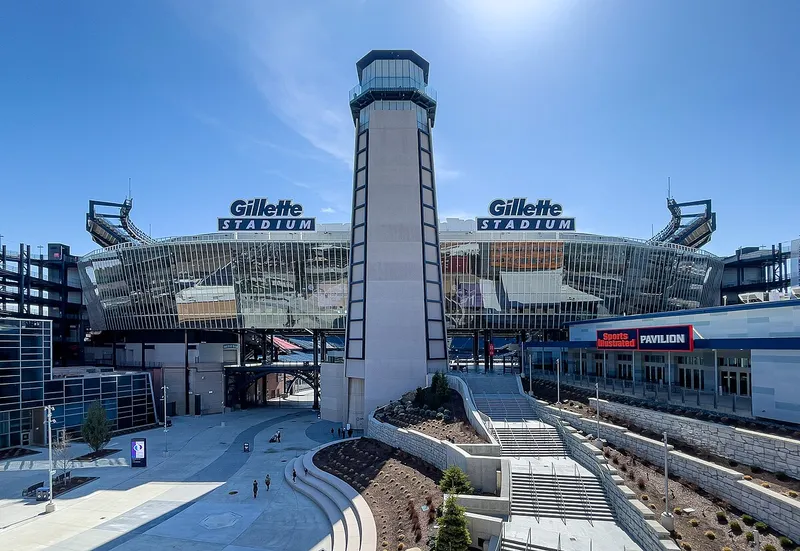
About Gillette Stadium
Gillette Stadium sits in the small town of Foxborough, Massachusetts, roughly equidistant between Boston and Providence — a location that seems odd until you understand the history. The Patriots played at the old Foxboro Stadium next door from 1971, and when Robert Kraft built the replacement in 2002, he kept the team where it was. The result is one of the NFL’s premier venues planted in a town of 18,000 people, surrounded by highway exits and pine trees instead of a city skyline.
The stadium holds 64,628 fans and serves as home to both the New England Patriots (NFL) and the New England Revolution (MLS). For the 2026 FIFA World Cup, Gillette Stadium is one of the tournament’s most important American venues, hosting 7 matches — including group stage games, a Round of 32 knockout match, and a quarterfinal on July 9. FIFA will market it as “Boston Stadium,” which is technically a 29-mile stretch but close enough for international branding.
The $325 million construction cost was paid entirely out of Robert Kraft’s pocket, making Gillette one of the rare major American sports venues built without public funding. That’s worth pausing on: in an era where NFL owners routinely extract hundreds of millions in taxpayer subsidies, Kraft wrote the check himself. The motivation was partly principle and partly leverage — Kraft had a deal to move the team to Hartford, Connecticut, and used that threat to secure the infrastructure improvements around Foxborough that made the private build viable.
Architecturally, Gillette Stadium is recognizable for two features: a distinctive curved facade clad in silver and blue, and a 218-foot lighthouse tower above the north end zone that tips its hat to New England’s maritime heritage. The lighthouse doubles as an observation deck and fires up a working beacon after Patriots touchdowns. It’s a surprisingly effective piece of stadium theater that gives Gillette a visual identity most NFL venues lack.
Getting to Gillette Stadium
Public Transit
Foxborough isn’t a transit hub, but the MBTA Commuter Rail gets the job done on event days — and for the 2026 World Cup, service is being significantly expanded.
MBTA Commuter Rail (Franklin/Foxboro Line): Special event trains run from Boston’s South Station directly to Foxboro Station, which is about a quarter mile from the stadium gates — close enough to walk without a shuttle. The ride takes 50-60 minutes. Round-trip event tickets cost $20 ($8.75 one-way on regular service). Trains run 2-3 hours before kickoff and for about 90 minutes after the final whistle. For the 2026 World Cup, the MBTA is expanding commuter rail service for all 7 matches with increased frequency and capacity.
From Providence: MBTA commuter rail service also connects from Providence, though service is less frequent. Many fans coming from the south drive to Foxborough directly rather than routing through Boston.
Pro tip: Board early. The event trains out of South Station fill up fast, and standing room is the norm on later departures. After games, the wait for return trains can run 30-45 minutes as 65,000 people funnel toward one station. Consider lingering at Patriot Place for a meal to let the initial rush pass.
Driving + Parking
Most fans drive to Gillette Stadium — it’s a suburban venue built for car access. GPS: “One Patriot Place, Foxborough, MA 02035.”
→ From downtown Boston: Take I-93 South to I-95 South (also signed as Route 128), then follow Route 1 South directly to the stadium. Approximately 29 miles, 40-60 minutes depending on traffic. On game days, expect heavy congestion on Route 1 in the final 3-4 miles.
→ From Providence, RI: Take I-95 North to Route 1 North toward Foxborough. Approximately 25 miles, 30-45 minutes. Traffic is generally lighter from this direction.
→ From Hartford, CT: Take I-84 East to the Massachusetts Turnpike (I-90 East), then I-95 South to Route 1 South. Approximately 100 miles, 1.5-2 hours.
Gillette Stadium has massive parking operations spread across lots on both sides of Route 1. General parking in lots across Route 1 is free for most events — a rarity at NFL venues. Premium stadium-side lots cost $50 (prepaid required). Tailgating is a Patriots institution: grills fire up 4-5 hours before kickoff, and the Route 1 lots become one of the NFL’s most spirited pre-game scenes. For World Cup matches, expect modified tailgating rules but the same festive energy.
Rideshare
Uber and Lyft operate at Gillette Stadium with a designated pickup and drop-off zone in Lot 15. Drop-off before events works smoothly, but post-event pickups are a test of patience — with 65,000 fans all requesting rides at once, waits of 30-45 minutes are typical. A ride from downtown Boston runs $50-80 depending on surge pricing; from Providence, $35-55. If you’re using rideshare after a match, walk to Patriot Place first — it’s easier to get picked up away from the main stadium exits.
From the Airport
→ Boston Logan International Airport (BOS): The primary airport for Gillette Stadium, 29 miles to the northeast. Allow 35-60 minutes by car — heavily traffic-dependent, especially through the I-93/I-95 interchange. Rideshare from Logan runs $50-80. Logan is a major international hub with direct flights from Europe, making it the default choice for World Cup visitors. There’s no direct rail link from Logan to Foxborough; you’d need to take the Blue Line to South Station, then the Commuter Rail to Foxboro.
→ T.F. Green Airport (PVD): Located in Warwick, Rhode Island, about 25 miles south of Gillette Stadium. A smaller, less congested alternative to Logan with lower fares on some routes. The drive to Foxborough takes 30-45 minutes via I-95 North. Worth considering if you’re flying from the mid-Atlantic region or can find cheaper flights — you’ll save time even if you don’t save money.
FIFA World Cup 2026 at Gillette Stadium
Gillette Stadium will host 7 matches during the 2026 FIFA World Cup, making it one of the busier American venues in the tournament. The assignment includes group stage matches, a Round of 32 knockout game, and a quarterfinal on July 9 — a significant draw that reflects FIFA’s confidence in the Boston market and the venue’s capacity for high-stakes matches.
The schedule: Gillette’s World Cup begins June 13 with Haiti vs Scotland, followed by a playoff winner vs Norway (June 16), Scotland vs Morocco (June 19), England vs Ghana (June 23), Norway vs France (June 26), a Round of 32 match (June 29), and the quarterfinal (July 9). The England vs Ghana and Norway vs France matches will be the biggest group stage draws, and the July 9 quarterfinal will bring the most intense atmosphere of the tournament to Foxborough.
The “Boston” branding: FIFA will market the venue as “Boston Stadium” during the tournament, even though the stadium is 29 miles from downtown Boston in the small town of Foxborough. This is standard FIFA practice — MetLife Stadium becomes “New York/New Jersey Stadium” despite being in East Rutherford, and Levi’s Stadium becomes “San Francisco Bay Area Stadium” despite being in Santa Clara. For visitors, the important thing to know is that getting from Boston to the stadium requires planning — it’s not a quick subway ride.
Pitch conversion: Like most NFL venues in the tournament, Gillette Stadium will swap its FieldTurf synthetic surface for natural grass installed on modular trays. The open-air environment is actually favorable for grass health compared to domed venues, and New England’s summer climate provides good growing conditions. The stadium has hosted international soccer before — it was a venue for the 2003 FIFA Women’s World Cup and hosted Copa America 2016 matches.
Weather: New England in June and July is pleasant by American standards — average highs of 75-85°F with moderate humidity. Rain is possible (June averages 3.5 inches), but the climate is far more comfortable than the extreme heat that enclosed venues like NRG Stadium in Houston need to combat. An open-air stadium works fine here.
Soccer culture: Boston’s soccer culture has grown steadily, driven by the New England Revolution (MLS since 1996) and a large international community — particularly Brazilian, Portuguese, Irish, and Latin American populations. The 2003 Women’s World Cup and Copa America 2016 drew enthusiastic crowds to Foxborough. When England plays Ghana here, expect a strong English contingent — Boston has deep historical ties to the UK, and the city’s Irish and English communities will turn out in force.
History of Gillette Stadium
Gillette Stadium opened on September 9, 2002, replacing the old Foxboro Stadium that had stood next door since 1971. The first sporting event was actually an MLS match on May 11, 2002, when the New England Revolution hosted the Dallas Burn — a soft opening that let the stadium work out operational kinks before the Patriots’ NFL season kicked off.
The backstory is one of the NFL’s great leverage plays. Robert Kraft bought the Patriots in 1994 and immediately began pushing for a new stadium, arguing that the old Foxboro Stadium — a bare-bones facility with aluminum benches and no luxury suites — couldn’t compete in the modern NFL. When Massachusetts proved reluctant with public funding, Kraft negotiated a deal to move the team to Hartford, Connecticut, with a state-funded stadium downtown. The Hartford deal eventually fell apart over financing issues, and Kraft pivoted back to Foxborough — this time building the stadium himself for $325 million. No public money, no taxpayer subsidy. HOK Sport (now Populous) designed the venue, which broke ground in March 2000 and opened just over two years later.
The dynasty years: Gillette Stadium became the home stage for one of the greatest dynasties in professional sports history. Between 2001 and 2018, the Tom Brady–Bill Belichick Patriots won six Super Bowls, appeared in nine, and went 137-27 in regular season home games. Gillette earned a reputation as one of the toughest places to play in the NFL — the cold New England weather, the hostile crowd noise, and the sheer competence of the home team made visiting teams miserable. The “Do Your Job” culture Belichick built permeated the entire stadium experience.
The name: Originally named CMGI Field after an internet company (peak dot-com era naming), the stadium was quickly renamed Gillette Stadium in 2002 after the razor company — a Procter & Gamble brand headquartered in nearby Boston — signed a long-term naming rights deal. The name has stuck, and unlike many corporate-named venues, “Gillette Stadium” rolls off the tongue naturally enough that even casual fans use it without irony.
Major events beyond the Patriots: Gillette Stadium has punched well above its small-town location for major events. It hosted the 2003 FIFA Women’s World Cup, Copa America 2016 matches, the 2016 NHL Winter Classic (Bruins vs Canadiens on an outdoor ice rink), NCAA lacrosse championships, and massive concert tours from Taylor Swift’s Eras Tour to Ed Sheeran (who set the attendance record at 71,723 in 2023). The Revolution have called it home since opening day, and the adjacent Patriot Place development — a shopping, dining, and entertainment complex built by Kraft — has made the stadium area a year-round destination rather than a place that only comes alive 10 Sundays a year.
The Tom Brady statue: In June 2024, a 12-foot bronze statue of Tom Brady was unveiled outside Gillette Stadium, depicting the quarterback in his iconic throwing stance. It joined the Patriots Hall of Fame museum as a pilgrimage site for fans of the greatest quarterback in NFL history — and a reminder that while the dynasty may be over, its legacy is literally set in stone.
Photo Gallery
Fun Facts
Gillette Stadium was built entirely with private money — Robert Kraft's $325 million investment made it one of only a handful of major U.S. sports venues funded without a single dollar of public subsidy. Kraft had threatened to move the Patriots to Hartford, Connecticut before ultimately committing to Foxborough.
The stadium features a working lighthouse — a 218-foot-tall structure modeled after a New England coastal lighthouse that sits above the north end zone. Fans can pay $5 to ride an elevator to the observation deck for panoramic views of the surrounding area.
The record attendance at Gillette Stadium isn't a Patriots game or a World Cup qualifier — it's Ed Sheeran, who packed 71,723 fans into the venue for a concert in July 2023, well above the stadium's official football capacity of 64,628.
Stadium Location
Frequently Asked Questions
- What is the seating capacity of Gillette Stadium?
- Gillette Stadium has a seating capacity of 64,628 for standard NFL configuration. The stadium underwent a major renovation reducing capacity from its original 68,756 to create more premium seating areas. For concerts and special events, capacity can exceed 70,000 with floor seating — Ed Sheeran set the all-time record at 71,723 in 2023.
- Where is Gillette Stadium located?
- Gillette Stadium is located at One Patriot Place, Foxborough, Massachusetts 02035, approximately 29 miles southwest of downtown Boston and 25 miles northeast of Providence, Rhode Island. Despite being marketed as 'Boston' for FIFA World Cup 2026, the stadium is actually in the small town of Foxborough.
- How many FIFA World Cup 2026 matches will Gillette Stadium host?
- Gillette Stadium will host 7 FIFA World Cup 2026 matches, including group stage games and a quarterfinal on July 9. The venue will be known as 'Boston Stadium' during the tournament. Notable matches include England vs Ghana (June 23), Norway vs France (June 26), and a Round of 32 knockout game (June 29).
- How do I get to Gillette Stadium by public transit?
- Take the MBTA Commuter Rail on the Franklin/Foxboro Line to Foxboro Station, which is about a quarter mile from the stadium gates. On event days, special trains run from Boston's South Station with round-trip tickets at $20. The ride takes approximately 50-60 minutes. For the 2026 World Cup, the MBTA is expanding commuter rail service for all 7 matches.
- Is there parking at Gillette Stadium?
- Yes, Gillette Stadium has extensive parking across multiple lots along Route 1 in Foxborough. General parking across Route 1 is free for most events, while premium stadium-side parking costs $50 and must be prepaid. Lots typically open several hours before events for tailgating, which is a major part of the Patriots game-day culture.
- Does Gillette Stadium have a roof?
- No, Gillette Stadium is an open-air venue. While this is fine for fall and winter NFL games (Patriots fans embrace the cold), it does mean World Cup matches in June will be subject to New England summer weather. Temperatures typically range from 70-85°F in June, which is far more comfortable than indoor-required venues in Houston or Texas.
- What is the Tom Brady statue at Gillette Stadium?
- A 12-foot-tall bronze statue of Tom Brady was unveiled outside Gillette Stadium in June 2024, honoring the quarterback who led the Patriots to six Super Bowl victories during his 20 seasons in New England (2000-2019). The statue depicts Brady in his iconic throwing stance and has become a popular photo spot for visiting fans.
- How far is Gillette Stadium from the airport?
- Boston Logan International Airport (BOS) is approximately 29 miles northeast of Gillette Stadium, about 35-60 minutes by car depending on traffic. T.F. Green Airport (PVD) in Warwick, Rhode Island, is about 25 miles to the south and can be a less congested alternative, especially for fans coming from the New York area.
Last updated: 2026-02-17