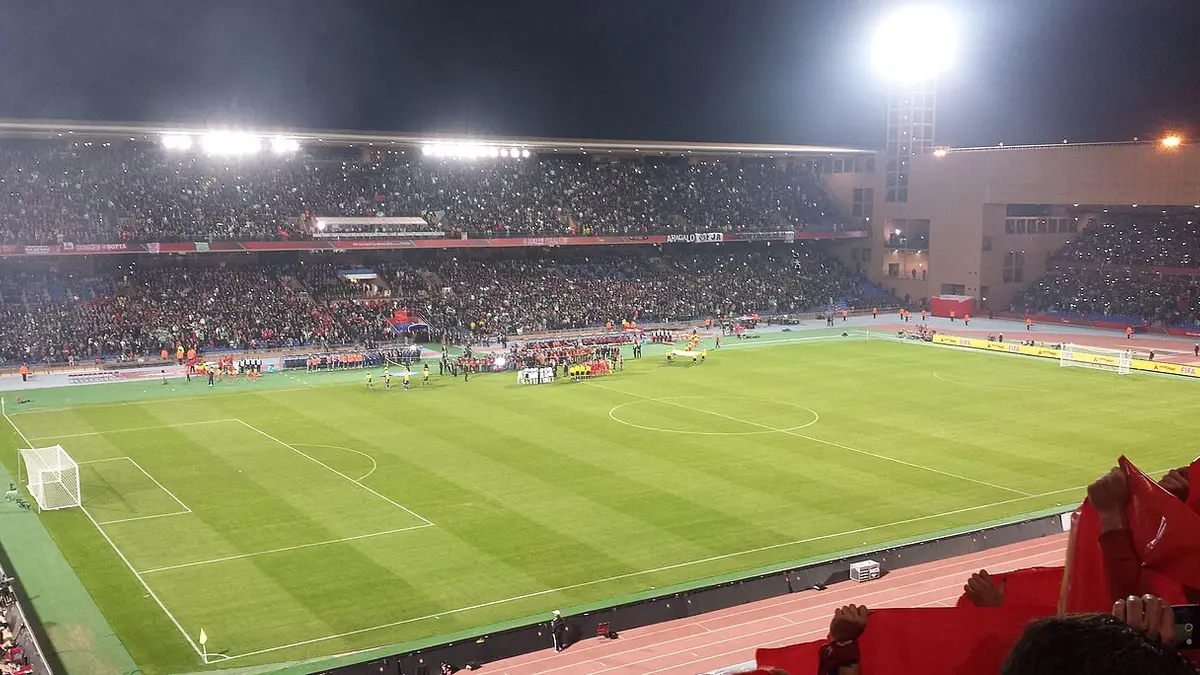
About Grand Stade de Marrakech
Marrakesh is a city people cross the world to see, and its biggest stadium sits about 11 kilometres from all of it, out on the open plain north of town toward the Casablanca road. That distance is the first thing to know about the Grand Stade de Marrakech. It is not a stadium you stumble on wandering the medina; it is a trip you make on purpose. The home club is Kawkab Marrakech, and the Morocco national team plays there too.
The ground opened on January 5, 2011 as a multi-purpose arena, a rectangular bowl wrapped around an athletics track, seating 45,240. For its first decade that track defined the place, both its ambition and its main flaw. It let Marrakesh host world-class athletics, but it also pushed the stands back from the pitch, and the viewing distance drew steady criticism from the day it opened.
What stands today is a building in the middle of being reinvented. A first wave of work in 2024 and 2025 refreshed the ground for the Africa Cup of Nations. Then, in early 2026, the stadium closed for a deeper rebuild aimed squarely at the 2030 World Cup, tearing out the athletics track, lowering the pitch and reshaping the bowl to pull the crowd in close. Capacity is set to land near 46,000 as a football-only arena.
For 2030, when Morocco co-hosts with Spain and Portugal, Marrakesh is one of six host cities. The venue that reopens will be a very different one from the wide multi-sport bowl that hosted two Club World Cup finals, and that is precisely the point.
Getting to Grand Stade de Marrakech
The ground sits well out of town, so unlike a downtown stadium this is a journey you plan, by taxi, bus or car.
Public Transit
Marrakesh has no tram or metro, so getting to the stadium on public transport means a city bus.
→ Via city bus: Marrakesh’s Alsa bus network runs out toward the northern edge of the city where the stadium stands. Services are cheap but can be crowded on a match day, so allow extra time in each direction.
→ From the medina: There is no direct rail or rapid-transit link to the ground, so most fans coming from the old city pair a short walk or taxi with the bus, or simply take a taxi the whole way.
Driving + Parking
Its out-of-town setting makes driving a genuine option here, more so than at a cramped city-center ground.
→ Parking: The complex has room for roughly 7,500 vehicles across its lots, one of the larger stadium car parks in the country. It still fills for a big fixture, so arrive early.
→ From the center: A drive of about 20 to 25 minutes north from central Marrakesh outside match traffic, heading toward the Casablanca road.
Rideshare
Marrakesh runs on its taxis. Beige petits taxis handle short city hops, and grands taxis take longer runs, so a taxi is the simplest way to the stadium for most visitors. Insist on the meter or agree the fare before setting off, especially heading back into the city after the final whistle, when demand spikes and drivers know it. App-based rideshare is thinner on the ground here than the licensed taxis.
From the Airport
→ Marrakesh Menara (RAK): The city’s international airport is about 14 kilometres from the stadium, a taxi ride of roughly 20 to 25 minutes depending on traffic.
→ Into the city: Menara sits only around 4 to 5 kilometres from the medina, so most visitors base themselves in town and travel out to the ground from there.
Watching a Match at Grand Stade de Marrakech
Start with an honest caveat: as of now there is no match to watch here. The stadium has been shut since early 2026 for its 2030 rebuild, and what follows describes the ground as fans knew it and as it is set to return.
The home team is Kawkab Marrakech, one of Moroccan football’s old names. Founded in 1947 and nicknamed the Palm Knight, Al-Kawkab won league titles in 1958 and 1992 and lifted the CAF Cup in 1996, though recent seasons have been quieter, mid-table in the Botola. Their crowds are loyal rather than vast, and on a national-team night or a big continental occasion the place feels very different, closer to full and considerably louder.
The one thing every visitor used to notice was the distance. Because the old bowl wrapped an athletics track, the stands sat a long way back from the touchline, and the sense of being removed from the game was the ground’s most common complaint. That is the single biggest thing the rebuild is meant to cure: with the track gone, the pitch dropped and new lower tiers built in, the crowd should finally sit close.
The other constant is the setting. No alcohol is sold inside, in line with Moroccan grounds generally, and the ground’s isolation 11 kilometres from town means the pre-match ritual happens in the city, not at the stadium. The smart plan is to eat first in Marrakesh, where Jemaa el-Fnaa’s food stalls and the medina’s cafés are the whole point, then head out to the match. Give yourself time at both ends of the trip, because getting a crowd of tens of thousands in and out of a site on the edge of the plain takes patience.
Construction & Design
The Grand Stade de Marrakech took the better part of a decade to build. Ground was broken in September 2003, and construction ran more than seven years before the stadium opened in January 2011. The design came from the Italian firm Gregotti Associati International, working with the Moroccan practice of Saâd Benkirane, and the reported cost was around 890 million dirhams, roughly €84 million at the time.
Their brief produced an unusual building. Marrakesh was conceived as a rectangular stadium that still enclosed a full athletics track, and it was pitched as one of the first grounds designed to do both. That dual purpose paid off in the 2014 IAAF Continental Cup and the African Athletics Championships, but it came at a cost fans felt every week, with the running track holding the stands at a distance from the pitch. The original complex also came with the full apparatus of a national venue: a 5,000-seat auxiliary stadium, a media center, and parking for thousands.
The first modern overhaul arrived for the 2025 Africa Cup of Nations. Between 2024 and June 2025, at a reported 400 million dirhams, the ground was relaid and refitted: every seat replaced with a wider model, new locker rooms and media areas, a 180-seat panoramic restaurant, seven VIP lounges and fifteen sky boxes, and the turnstiles taken from 36 to 77 to move crowds faster.
Then came the bigger job. Closed since early 2026 for the 2030 World Cup, the stadium is being remade as a football-only arena. The athletics track is coming out, the pitch is being lowered, new lower stands are going in, and the plan is to roof the ground and reshape the bowl, lifting capacity toward 46,000. A stadium built to do two things is being rebuilt to do one of them well.
History of Grand Stade de Marrakech
For a venue that took so long to arrive, the Grand Stade de Marrakech wasted little time making itself useful. Within three years of opening in 2011 it was handed one of club football’s showpieces, the FIFA Club World Cup, hosting the 2013 final in which Bayern Munich beat Morocco’s own Raja Casablanca. The tournament came straight back in 2014, when Real Madrid beat San Lorenzo of Argentina in the final on the same pitch.
Athletics had its moment too. In 2014 Marrakesh staged the IAAF Continental Cup and the African Championships, the events that justified the running track, and in 2018 the ground hosted matches at the African Nations Championship, the tournament for locally based players. For a decade it worked as one of Morocco’s reliable big-match venues, a neutral host as often as a club home.
The busiest stretch came at the end of that first era. After its 2024 to 2025 refit, the stadium was a main stage for the 2025 Africa Cup of Nations, hosting eight matches from December 2025 into January 2026, group games through to a quarterfinal, before closing for its transformation. It went out at capacity and on a high.
Its next assignment is the largest yet. As one of the Moroccan venues for the 2030 World Cup, co-hosted with Spain and Portugal, the ground that opened as a wide multi-sport bowl will return as a modern football arena. From a stadium long defined by the track around its pitch, Marrakesh is being remade into one without it.
Sources & Further Reading
- Wikipedia entry on Marrakesh Stadium: en.wikipedia.org/wiki/Marrakesh_Stadium. Capacity, opening, architect, events and the design.
- CAF on the AFCON 2025 venue: cafonline.com. Capacity, location, facilities and tournament role.
- Morocco World News on the renovation: moroccoworldnews.com. The 2024 to 2025 works, costs and the 2030 plan.
- Niya Maghribia on the 2030 project: niya.maroc.ma. The government’s account of the World Cup makeover.
- Dezeen on the 2030 World Cup stadiums: dezeen.com. Marrakesh’s place among the tournament’s venues.
Quick Facts
Everything you need at a glance.
Stadium specs
- Capacity
- 45,240
- Opened
- 2011
- Cost
- Approximately 890 million dirhams (about €84 million, 2011)
- Roof
- Open
- Surface
- Natural Grass
- Tenants
- Kawkab Marrakech, Morocco national team
Construction & location
- Groundbreaking
- September 2003
- Architects
- Gregotti Associati International, Saâd Benkirane
- Engineering
- Not separately recorded
- General contractor
- Not separately recorded
- Address
- Route de Casablanca, Marrakesh, Morocco
- GPS
- 31.7067°N, 7.9806°W
Photo Gallery
Fun Facts
The stadium sits 11 kilometres north of Marrakesh, out in open country toward the Casablanca road, so getting there is a planned trip, not a stroll from the square.
Its 2024 to 2025 makeover before the Africa Cup of Nations more than doubled the turnstiles, from 36 to 77, and slotted in a 180-seat panoramic restaurant.
It was billed on opening as a stadium designed to be rectangular yet still wrap a running track, the very track now being torn out to bring the crowd closer to the pitch for 2030.
Stadium Location
Frequently Asked Questions
- Can you visit the Grand Stade de Marrakech right now?
- Not really. The stadium closed in early 2026 for a full 2030 World Cup rebuild, so there is no football being played there at the moment and access is limited to the works. It hosted matches at the 2025 Africa Cup of Nations through January 2026, then shut for the transformation. Check the status before planning a visit.
- How do you get to the Grand Stade de Marrakech?
- The ground is about 11 kilometres north of central Marrakesh, toward the Casablanca road, so plan on a taxi or bus rather than a walk. A beige petit taxi from the center takes 20 to 25 minutes, city buses run the route, and there is large on-site parking. Marrakesh Menara Airport sits about 14 kilometres away.
- Who plays at the Grand Stade de Marrakech?
- The home club is Kawkab Marrakech, known as KACM or Al-Kawkab, a Botola Pro side founded in 1947 and nicknamed the Palm Knight. The Morocco national team also uses the ground for selected matches, and it has hosted a long run of major one-off events over the years.
- Will the athletics track still be there after the renovation?
- No. The current 2030 rebuild removes the running track entirely, lowers the pitch and builds new lower stands, turning a multi-purpose bowl into a football-first arena. The track was long blamed for pushing the stands too far from the action, so its removal is meant to fix exactly that.
- What food and drink is there at the stadium?
- There is no famous signature item at the ground, and, as at Moroccan stadiums generally, no alcohol is sold inside. The 2024 to 2025 works did add a 180-seat panoramic restaurant, but for most visitors the better plan is to eat beforehand in Marrakesh, where Jemaa el-Fnaa and the medina are full of street food and cafés.
- How big is the Grand Stade de Marrakech, and is that changing?
- It seats 45,240, the figure carried by the tournament organizers and the stadium's own records. The 2030 rebuild is set to reshape the bowl and lift capacity toward roughly 46,000 as a football-only venue. Some earlier reports floated much larger numbers, but 45,240 is the reliable current figure.
- What major matches has the stadium hosted?
- A lot for a club ground. It staged the FIFA Club World Cup finals in 2013, when Bayern Munich beat Raja Casablanca, and 2014, when Real Madrid beat San Lorenzo, plus the 2018 African Nations Championship and eight matches at the 2025 Africa Cup of Nations, including a quarterfinal.
- What is the stadium's role in the 2030 World Cup?
- It is one of six Moroccan host cities for the 2030 World Cup, which Morocco co-hosts with Spain and Portugal. The current rebuild, removing the track and reshaping the bowl to FIFA standards, is being done specifically to ready the ground for the tournament.
Last updated: 2026-07-23