About Memorial Stadium
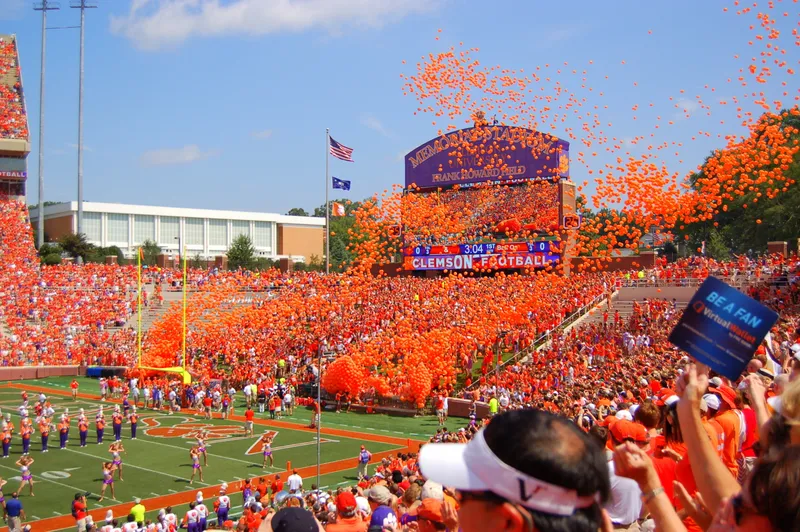
Memorial Stadium sits on the Clemson University campus overlooking Lake Hartwell — an 81,500-seat fortress known as Death Valley, where the Clemson Tigers play football, touch Howard’s Rock at the top of the Hill, and sprint onto the field in a pregame tradition that has been called the most exciting 25 seconds in college football. The nickname, the rock, and the Hill — these three things define this stadium as completely as any combination of traditions defines any stadium in America.
The stadium opened in 1942 with 20,000 seats, built for $125,000 and dedicated as a memorial to Clemson students who served in the military. Presbyterian College coach Lonnie McMillian gave it the Death Valley nickname in the 1940s because his teams never came back alive from playing there. Nearly 80 years of expansions have turned the original structure into one of the 25 largest stadiums in the world, with a home winning percentage above 78% that justifies the name.
Howard’s Rock — a piece of white flint from the actual Death Valley in California — was given to coach Frank Howard in 1966 by a friend who didn’t know what to do with it. Howard used it as a doorstop before mounting it on a pedestal at the top of the east end zone hill. Since then, every Tiger player touches the rock before running down the Hill and onto the field — a ritual performed before sellout crowds that generates one of the most explosive moments in college sports.
The Tigers’ recent dynasty under Dabo Swinney — two national championships in 2016 and 2018, four College Football Playoff appearances in five years — elevated Death Valley from one of the great college stadiums to one of the most intimidating venues in all of American sports. On a Saturday night in October, with 81,500 fans wearing orange and the Tigers coming down the Hill, Death Valley earns its name.
Getting to Memorial Stadium
Public Transit
Clemson has no public rail transit. The university operates shuttle buses from remote parking areas on game days.
→ Via CATbus Shuttles: Free shuttle buses run from remote parking lots along Perimeter Road and on the east side of campus to stadium-area drop-off points. Service begins 3 hours before kickoff and continues for 1 hour after the game.
→ Via Lake Hartwell: Many fans arrive by boat, docking at university-maintained piers on the lake shore below the stadium. It is one of the only college stadiums in America accessible by watercraft.
There is no practical public transit from Greenville, Atlanta, or Charlotte to Clemson. Everyone drives. On game days, the two-lane roads into Clemson create severe bottlenecks — arrive at least 3 hours before kickoff.
Driving + Parking
The stadium is on Avenue of Champions, Clemson, SC 29634. US-123 from I-85 is the primary approach.
→ From Greenville (~30 mi): SC-93 South or US-123 West from I-85. About 40–50 minutes without traffic, 1.5+ hours on game day.
→ From Atlanta (~140 mi): I-85 North to US-123 West to campus. About 2 hours.
→ From Charlotte (~150 mi): I-85 South to US-123 West. About 2 hours 15 minutes.
Campus lots cost $20–$40 and fill early. Remote lots with shuttle service are free along Perimeter Road. Private lots in the town of Clemson charge $20–$40. Lake Hartwell tailgating — by boat or on the shore — is a Clemson tradition. Arrive very early; the roads are the bottleneck.
Rideshare
Uber and Lyft operate in the Clemson area but availability is extremely limited on game days. Expect $10–$15 from downtown Clemson hotels. From Greenville, rideshare is not practical — drive. Post-game rides are nearly impossible; plan to wait or walk.
From the Airport
→ Greenville-Spartanburg International (GSP): 40 miles east, about 45 minutes by car. Regional airport with service from major carriers including Delta, American, United, and Southwest. Rental car required — no transit connection. Rideshare runs $40–$55.
→ Hartsfield-Jackson Atlanta International (ATL): 140 miles southwest, about 2 hours by car. The closest major hub for long-haul flights. Rental car is the only practical option.
History of Memorial Stadium
Memorial Stadium was built in 1942, dedicated as a tribute to Clemson students who served in the military. Designed by Carl Lee and H.E. Glenn, the original 20,000-seat structure cost $125,000 and was built on a hillside that would become the most famous architectural feature in college football — the Hill in the east end zone, where the Tigers make their entrance before every game.
Death Valley Nickname (1940s): Presbyterian College coach Lonnie McMillian coined the name because his teams never came back alive from playing in Clemson. Frank Howard, Clemson’s head coach from 1940 to 1969, embraced it, and Death Valley became the stadium’s permanent identity.
Howard’s Rock (1966): A friend brought Howard a piece of white flint from Death Valley, California. Howard kept it as a doorstop until 1966, when he mounted it on a pedestal at the top of the Hill. The tradition of touching the rock before running down the Hill was born — and The Most Exciting 25 Seconds in College Football became Clemson’s defining ritual.
2016 National Championship: Under Dabo Swinney, the Tigers defeated Alabama 35–31 in the national championship game on a last-second touchdown pass from Deshaun Watson to Hunter Renfrow. It was Clemson’s first national title since 1981 and the beginning of a dynasty that would define Death Valley for a generation.
2018 National Championship: The Tigers destroyed Alabama 44–16 in the championship game — the most dominant title-game performance in modern history. Trevor Lawrence, a true freshman, led the offence. Clemson had become the only program capable of consistently challenging Alabama’s dominance, and Death Valley was the foundation.
From Lonnie McMillian’s curse to Howard’s doorstop to Deshaun Watson’s final throw, Memorial Stadium is Death Valley — a place where the Hill, the rock, and 81,500 fans in orange create a pregame entrance and a home-field advantage that no visiting team has ever managed to neutralise.
Photo Gallery
Fun Facts
Memorial Stadium is known as Death Valley — a nickname given by Presbyterian College coach Lonnie McMillian in the 1940s because his teams never came back alive from playing there — and it has been one of the toughest road environments in college football ever since, with Clemson posting a .781 home winning percentage since 1942.
Howard's Rock — a piece of white flint from Death Valley, California, given to coach Frank Howard in 1966 — sits on a pedestal at the top of the east end zone hill, and every Clemson player touches it before running down the hill in a pregame tradition called 'The Most Exciting 25 Seconds in College Football.'
The Hill and the entrance through Howard's Rock have been called the most exciting pregame tradition in college football — the Tigers pour out of the locker room at the top of the hill, touch the rock, and sprint downhill onto the field while 81,500 fans in orange create a wall of noise that has been measured at over 130 decibels.
Stadium Location
Frequently Asked Questions
- What is the seating capacity of Memorial Stadium?
- Memorial Stadium seats 81,500 for Clemson Tigers football games, making it one of the 25 largest stadiums in the world. The record attendance is 86,092. The stadium has been expanded multiple times since its original 20,000-seat capacity in 1942.
- Where is Memorial Stadium located?
- Memorial Stadium is on Avenue of Champions on the Clemson University campus in Clemson, South Carolina 29634. It sits on the western side of campus overlooking Lake Hartwell, about 30 miles west of Greenville.
- Why is it called Death Valley?
- Presbyterian College coach Lonnie McMillian gave the stadium the nickname in the 1940s because his teams never came back alive from playing there. The name stuck because of Clemson's dominant home record — the Tigers have won over 78% of their games in Memorial Stadium since it opened.
- What is Howard's Rock?
- Howard's Rock is a piece of white flint from Death Valley, California, given to coach Frank Howard in 1966 by a friend. Howard initially used it as a doorstop before mounting it on a pedestal at the top of the Hill. Every Clemson player touches it before running down the Hill — a pregame ritual called The Most Exciting 25 Seconds in College Football.
- How do I get to Memorial Stadium?
- Most fans drive to Clemson via US-123 from I-85 or SC-93 from Greenville. There is no rail transit. Clemson University provides shuttle buses from remote parking lots on game days. The campus is about 30 miles from Greenville-Spartanburg International Airport.
- Is there parking at Memorial Stadium?
- Clemson campus lots cost $20–$40 on game days. Remote lots with free shuttle service are available along Perimeter Road. Many fans tailgate on the shores of Lake Hartwell and boat to campus docks. Private lots in the town of Clemson charge $20–$40. Arrive early — the roads into Clemson are two-lane and back up severely.
- How far is the airport from Memorial Stadium?
- Greenville-Spartanburg International Airport (GSP) is 40 miles east, about 45 minutes by car. Atlanta's Hartsfield-Jackson (ATL) is 140 miles southwest, about 2 hours. Charlotte Douglas (CLT) is 150 miles northeast, about 2 hours 15 minutes. GSP is the most convenient for game-day visitors.
Last updated: 2026-03-05