About Wembley Stadium
Wembley Stadium is the home of football. Not just English football — football, full stop. For over a century, this patch of north-west London has been the stage where the sport’s greatest moments have played out, where careers are defined by a single afternoon, and where the roar of 90,000 voices can be heard from miles away.
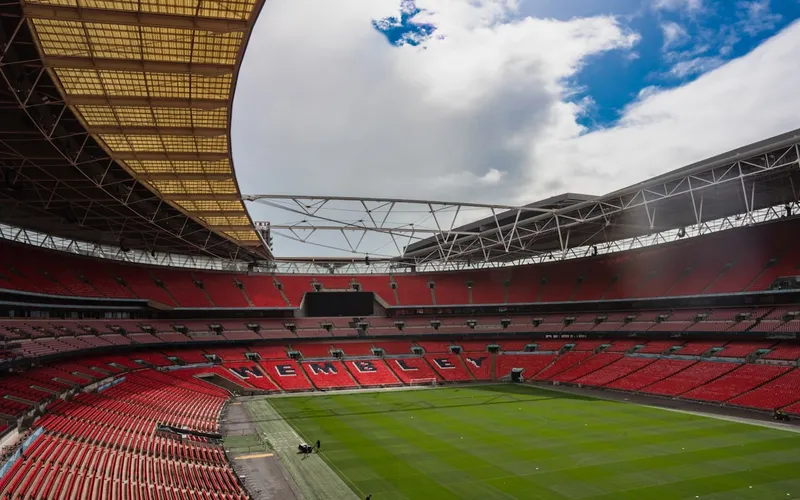
The current stadium, opened in 2007, replaced the legendary original that hosted everything from the 1966 World Cup Final to Live Aid. The new Wembley kept the soul of its predecessor while adding 21st-century ambition: 90,000 seats, a partially retractable roof, and the iconic 133-meter arch that has replaced the Twin Towers as London’s sporting landmark. It is the largest stadium in the UK and the second-largest in Europe.
Wembley hosts the FA Cup Final, the League Cup Final, the Community Shield, England international matches, the NFL London Series, and the biggest concerts in British music. It has also hosted Champions League Finals, Euro 2020/2021 knockout rounds and the Final, and boxing world title fights. No other stadium in the world hosts such a breadth of elite events across so many sports and entertainment categories.
The walk up Olympic Way — “Wembley Way” — from the Tube station to the stadium is one of sport’s great approaches. The arch grows larger with every step, the crowd thickens, the anticipation builds. By the time you reach the turnstiles, you’re ready for something special. Wembley rarely disappoints.
Getting to Wembley Stadium
Public Transit
London’s public transit to Wembley is excellent, and driving is actively discouraged.
Jubilee Line: To Wembley Park station, a 10-minute walk up Olympic Way. From Baker Street, 12 minutes. From Westminster, 25 minutes. This is the most popular route and the one that delivers the full Wembley Way experience.
Metropolitan Line: Also stops at Wembley Park. Useful from King’s Cross St Pancras, Euston Square, or Baker Street. Faster than the Jubilee Line from north London.
Chiltern Railways: To Wembley Stadium station from London Marylebone (8 minutes). This station is closer to the stadium than Wembley Park but runs limited event-day services — check schedules.
On event days: TfL runs extended services on the Jubilee and Metropolitan lines. The walk up Olympic Way is part of the experience — food vendors, street performers, and a sea of scarves and shirts. After the match, Wembley Park station gets extremely crowded. Walking to the nearby Wembley Central station (Bakerloo Line, 15 minutes) or waiting 30 minutes can avoid the worst crush.
Driving + Parking
Wembley operates a strict “public transport first” policy. There is no general public parking at the stadium. The surrounding area implements event-day parking restrictions, and local streets are controlled by Brent Council.
→ From central London: A406 (North Circular) to Wembley. Approximately 10 miles, 30-60 minutes depending on traffic. But there is nowhere to park when you arrive.
→ If you must drive: Pre-book parking at one of the commercial car parks within a 15-minute walk (Wembley Park area has several). Expect to pay £20-40. Or park at an outer Tube station and take the train in.
Seriously — take the Tube.
Rideshare
Uber is widely available in London. A ride from central London costs approximately £15-30, though surge pricing on event days can double this. Drop-off points are on the roads surrounding the stadium. Post-event pick-up is extremely slow — budget 30-45 minutes of waiting or walk to a quieter street nearby.
From the Airport
→ Heathrow Airport (LHR): 15 miles west. Piccadilly Line to Baker Street, then Metropolitan or Jubilee Line to Wembley Park. Total: approximately 60 minutes. The Heathrow Express to Paddington (15 minutes) plus a taxi is faster but more expensive (£40-60 total).
→ Gatwick Airport (LGW): 35 miles south. Gatwick Express to Victoria (30 minutes), then Victoria Line to Baker Street, then Jubilee to Wembley Park. Total: approximately 75 minutes.
→ London Luton Airport (LTN): 25 miles north. Thameslink train to St Pancras (25 minutes), then short walk to Baker Street, then Metropolitan Line to Wembley Park. Total: approximately 50 minutes — actually the quickest airport connection.
→ London Stansted Airport (STN): 40 miles northeast. Stansted Express to Liverpool Street (50 minutes), then Tube to Wembley Park. Total: approximately 80 minutes.
History of Wembley Stadium
The story of Wembley begins in 1923, when the Empire Stadium was built in just 300 days for the British Empire Exhibition. The very first event — the 1923 FA Cup Final between Bolton Wanderers and West Ham United — drew an estimated 200,000 spectators to a venue designed for 127,000. The resulting chaos, with fans spilling onto the pitch and a policeman on a white horse (named “Billy”) helping to clear the field, became known as the “White Horse Final” and is one of the foundational legends of English football.
1966 World Cup Final: On July 30, 1966, England defeated West Germany 4-2 after extra time in one of the most dramatic finals in World Cup history. Geoff Hurst’s hat-trick — including the controversial “crossbar goal” that may or may not have crossed the line — gave England their only World Cup title. Kenneth Wolstenholme’s commentary — “Some people are on the pitch… they think it’s all over… it is now!” — is the most famous line in British sports broadcasting.
Live Aid (1985): On July 13, 1985, Wembley hosted the London half of the Live Aid concert. Queen’s 20-minute set — featuring Freddie Mercury conducting the crowd through “Bohemian Rhapsody,” “Radio Ga Ga,” “We Will Rock You,” and “We Are the Champions” — is widely considered the greatest live music performance of all time.
The Twin Towers era: The original Wembley’s iconic Twin Towers flanked the main entrance and became the most recognizable symbol of English football. Their demolition in 2003 was emotionally charged — the last event at the old Wembley was an England vs. Germany friendly in 2000, which England lost 0-1 in a fitting, bittersweet farewell.
The new Wembley (2007): The new stadium opened in March 2007 after a troubled construction process that ran years behind schedule and billions over budget. The final cost was approximately £798 million (over £1 billion in today’s money). The 133-meter arch replaced the Twin Towers as the stadium’s signature feature, and the 90,000-seat bowl immediately became the UK’s premier venue.
Euro 2020/2021: Wembley hosted eight matches including both semi-finals and the Final of the delayed Euro 2020 tournament. England reached the Final — their first major tournament final since 1966 — but lost to Italy on penalties. The atmosphere during the semi-final victory over Denmark (2-1 after extra time) is considered one of the greatest nights in the stadium’s history.
Champions League Finals: The new Wembley has hosted the Champions League Final three times: 2011 (Barcelona 3-1 Manchester United), 2013 (Bayern Munich 2-1 Borussia Dortmund), and 2024 (Real Madrid 2-0 Borussia Dortmund). Each event has cemented Wembley’s status as European football’s grandest stage.
NFL London: Since 2007, Wembley has regularly hosted NFL regular-season games, attracting 80,000+ American football fans and establishing London as a viable market for the NFL’s global expansion.
Wembley is where legends are made. The walk up Olympic Way, the arch growing overhead, the collective intake of breath when 90,000 people stand for the national anthem — it adds up to something no other stadium can replicate. Whether it’s a rainy Tuesday night or a Champions League final under the lights, Wembley delivers.
Photo Gallery
Fun Facts
The Wembley Arch is 133 meters tall and spans 315 meters across the stadium — it is the longest single-span roof structure in the world and is visible across London, serving as a modern replacement for the old Twin Towers.
The original 1923 Wembley hosted the legendary 'White Horse Final' — the first FA Cup Final at the venue drew an estimated 200,000+ fans who spilled onto the pitch, with police on a white horse pushing crowds back to allow the match to proceed.
Wembley has 2,618 toilets — more than any other building in the world. The stadium was designed to allow all 90,000 fans to use facilities within a single 15-minute halftime break.
Stadium Location
Frequently Asked Questions
- What is the seating capacity of Wembley Stadium?
- Wembley Stadium has a seating capacity of 90,000, making it the largest stadium in the United Kingdom and the second-largest in Europe (after Camp Nou). For concerts, the capacity can exceed 90,000 with floor standing areas.
- Is the current Wembley the original stadium?
- No. The original Wembley Stadium (the 'Empire Stadium') opened in 1923 and was demolished in 2003. The current stadium was built on the same site and opened in 2007. The iconic Twin Towers were replaced by the Wembley Arch.
- How do I get to Wembley Stadium by public transit?
- The easiest options are the Metropolitan Line or Jubilee Line to Wembley Park station (10-minute walk via Olympic Way), or the Chiltern Railways service to Wembley Stadium station (5-minute walk). From central London, the journey takes 15-25 minutes depending on your starting point.
- Does Wembley Stadium host NFL games?
- Yes. Wembley has hosted NFL regular-season games as part of the NFL International Series since 2007. The Jacksonville Jaguars have been the most frequent team to play at Wembley. Games typically take place in October, drawing around 85,000 fans.
- Can I visit Wembley Stadium without attending an event?
- Yes. Wembley offers guided tours that take visitors through the Royal Box, players' tunnel, England changing room, press conference room, and pitch-side. Tours last approximately 75 minutes and are available most days when no event is scheduled.
- What is the Wembley Arch?
- The Wembley Arch is a 133-meter-tall steel lattice arch that spans 315 meters across the stadium roof. It supports the retractable roof and has become London's most recognizable modern landmark. The arch is illuminated in different colors for different events and occasions.
Last updated: 2026-02-11