About Energizer Park
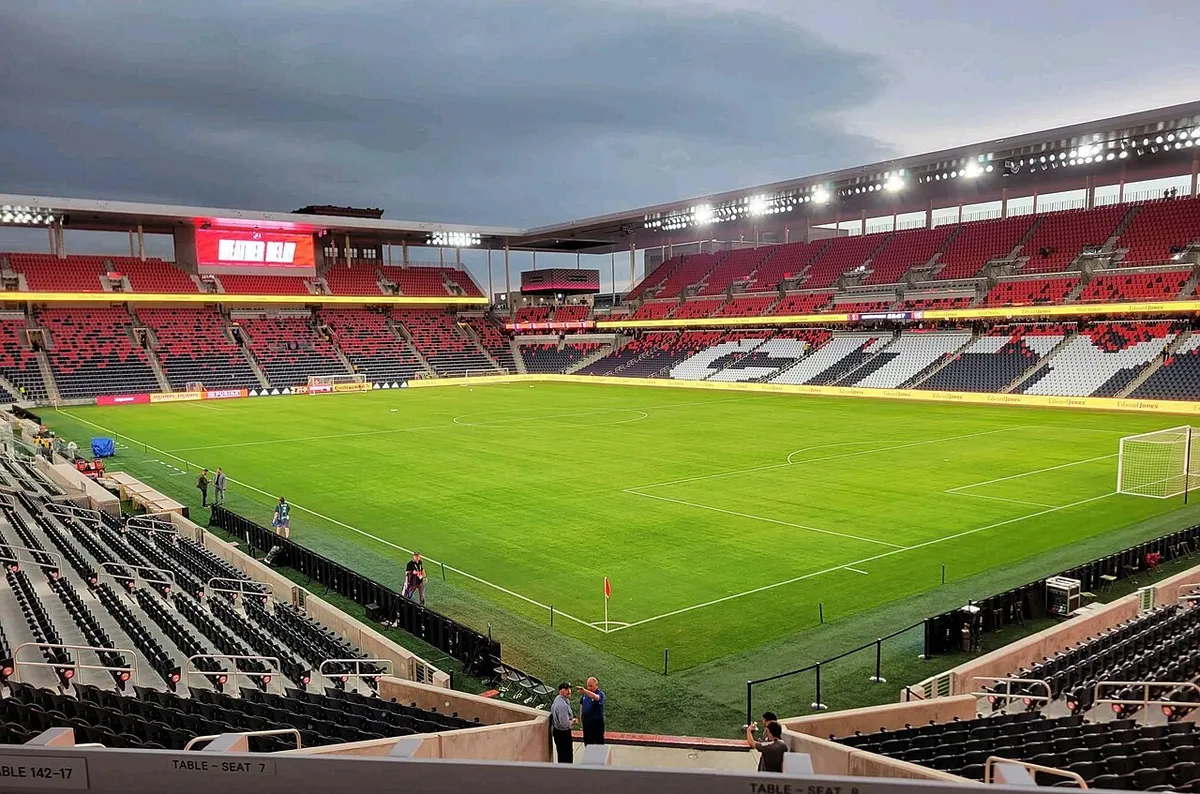
In the heart of downtown St. Louis, next to the historic Union Station in the Downtown West neighborhood, Energizer Park holds 22,423 fans around a pitch sunk 40 feet below street level, one of the most intimate and visually striking soccer venues in North America. Every seat is within 120 feet of the field, closer than any other stadium in MLS.
The stadium is home to St. Louis City SC, the MLS expansion franchise that began play in 2023 as the league’s 29th team. St. Louis City 2, the club’s developmental squad in MLS Next Pro, also calls this place home. The supporters’ section holds over 3,000 standing fans and features an integrated tifo rigging system stretching 257 feet, purpose-built for the atmosphere soccer demands.
Designed by HOK and Snow Kreilich Architects, the $457.8 million campus broke ground in February 2020 and opened in November 2022. The 32-acre stadium district is the largest urban professional sports campus in the United States, housing the stadium, team headquarters, practice facility, and team store in one downtown footprint. The stadium was built with recycled-content structural steel and designed by HOK as a zero-waste venue, and the club has since been awarded LEED Gold certification for Operations and Maintenance, which it says is a first for a St. Louis sporting venue.
Energizer Park has already hosted major international soccer. The USMNT played a 2023 CONCACAF Gold Cup group stage match here (a 6-0 rout of St. Kitts and Nevis), returned for a 2024 Nations League quarterfinal against Jamaica, and hosted a 2025 Gold Cup semifinal. This stadium has quickly established itself as a premier U.S. Soccer venue.
Getting to Energizer Park
Public Transit
MetroLink is the easiest way to reach Energizer Park. The Union Station stop on both the Red and Blue lines puts you a 10-minute walk from the stadium gates. MetroBus routes 4 and 94 drop you even closer, at Market Street and 22nd Street.
Buy a $5 Day Pass on the Transit app or at any MetroLink ticket vending machine, it covers unlimited rides on MetroLink and MetroBus all day. Trains run frequently on match days, and the club encourages fans to use public transit to reduce congestion around the stadium district.
Driving + Parking
Energizer Park is located at 2019 Market Street in downtown St. Louis, easily accessible from major interstates.
→ From Kansas City: Take I-70 East directly into downtown St. Louis (approximately 4 hours). Exit toward 22nd Street and follow signs to the stadium district.
→ From Springfield, MO: Take I-44 East to I-64 East into downtown (approximately 3.5 hours). Exit at Jefferson Avenue and head south to Market Street.
→ From Chicago: Take I-55 South to I-64 West into downtown St. Louis (approximately 4.5 hours). Exit at 22nd Street.
The CITY Parking Garage at 1950 Olive Street is the primary option, with entry on Olive east of N 20th Street. Union Station offers additional parking in its West and South lots on match days. Ballpark Village also runs a shuttle service to and from the stadium. Arrive 30-60 minutes before kickoff, downtown lots fill up fast.
Rideshare
Uber and Lyft serve Energizer Park with a designated pickup and drop-off zone at 20th Street and Olive Street. After matches, expect moderate surge pricing and 10-20 minute wait times. A ride to Lambert Airport typically runs $20-30 depending on demand.
Pro tip: Head straight to the rideshare zone when the final whistle blows, or wait 15-20 minutes for pricing to settle.
From the Airport
→ St. Louis Lambert International (STL): 14 miles northwest, 20-30 minutes by car. Take I-70 East to I-64 East into downtown. MetroLink also connects the airport directly to Union Station, roughly a 35-minute ride on the Red Line.
Watching a Match at Energizer Park
Everything here follows from one decision: the pitch was dug 40 feet down. Sinking it meant the bowl could fold in tight rather than spread out, and the result is that every seat in the ground sits within 120 feet of the field, the closest of any stadium in Major League Soccer. There is no distant seat to avoid, which is unusual enough to change how you buy a ticket. You are not choosing between good and bad views. You are choosing what kind of afternoon you want.
The north end is the supporters’ section, and the honest picture from season-ticket holders is more layered than the marketing. Its core is excellent: capos leading, a middle around section 119 that gets roped off for the marchers, and a tifo rigging system built into the structure, 257 feet of it, so the banners are part of the architecture rather than an improvisation. Toward the section’s outer reaches the mood thins out, and there is a recurring argument in the fanbase about whether buying a ticket there carries any obligation to sing. Season-ticket holders in the section put the share actually chanting at any given moment as low as one in five.
That argument is useful information for a visitor rather than a problem. If you want the noise without the commitment, the corner sections immediately outside the supporters’ end, 127 and 128, are where regulars say you hear everything without being expected to join in. One fan who sits in 127 describes it as the corner next to it all. You get the singing arriving sideways, the same short distance to the pitch as anywhere else in the ground, and nobody minding whether you stand.
On food, the club has made the rules more interesting than the menu. Energizer Park is 100 percent cashless with no ATMs anywhere in the building, and it uses no single-use plastic for food or drink: beer and soft drinks come in aluminum cups you are welcome to take home, though you cannot bring them back next time. Outside food is not allowed at all, and the only outside drink permitted through the gates is the club’s own refillable 25-ounce mug. Bags must be clear and no bigger than 14 by 14 by 6 inches, with no backpacks. No signature dish has emerged that fans reliably name, which for a St. Louis venue is a small missed opportunity.
One more thing that shapes the noise. The seating is covered by a translucent canopy that keeps rain off without shading the grass, and it holds sound in rather than letting it escape upward. A full house at 22,423 in a bowl this compact is loud in a way the seat count does not suggest.
Construction & Design
Energizer Park was designed to be dropped into downtown St. Louis rather than parked beside it. HOK led the design with the Minneapolis firm Snow Kreilich, and a joint venture of Mortenson, Alberici, and L. Keeley built it after a February 2020 groundbreaking, opening in November 2022. The roughly $458 million project was paid for by the ownership group, which asked the city for nothing toward the stadium itself. That is worth stating carefully rather than grandly: the group did take more than $60 million in St. Louis tax incentives, in amusement and real-estate breaks, and several MLS clubs had already built privately before them.
The design’s whole idea is compression. The pitch sits about forty feet below street level, so the two-tier bowl folds in tight around it, and every one of the 22,423 seats is within roughly 120 feet of the field, the closest of any stadium in the league. Behind one goal, a safe-standing supporters’ section holds more than 3,000 fans and carries a 257-foot rigging system built specifically for giant tifo displays. A clear canopy shelters the crowd while keeping the noise trapped inside.
The stadium opened as CityPark and was renamed Energizer Park under a naming-rights deal with the St. Louis-based Energizer Holdings, announced in late 2024 and in effect from the 2025 season. Woven into the Downtown West street grid beside Union Station, it has already collected design honors, including a Prix Versailles selection among the world’s most beautiful sports venues.
The Story of Energizer Park
Energizer Park represents the culmination of a decade-long fight to bring top-flight professional soccer to St. Louis. The stadium sits on land in the Mill Creek Valley, a once-thriving Black neighborhood displaced by urban renewal in the late 1950s. Outside the main entrance, the “Pillars of the Valley” monument by East St. Louis artist Damon Davis memorializes the community that once stood here.
The path to building this stadium was anything but smooth. A 2017 ballot measure seeking $60 million in public funding for an MLS stadium was defeated 53-47. The dream could have died there, but a new ownership group led by the Taylor family (founders of Enterprise Holdings) and Jim Kavanaugh of World Wide Technology revived the project in 2018, this time with fully private funding. MLS approved St. Louis as an expansion city in August 2019, making City SC the first majority-woman-owned team in league history.
Construction broke ground in February 2020, and the finished stadium opened on November 16, 2022, with a friendly between St. Louis City 2 and Bayer Leverkusen. The first MLS home match followed on March 4, 2023, when City SC beat Charlotte FC 3-1 in front of a sold-out crowd of 22,423. The naming rights story has its own chapters: Centene Corporation signed a 15-year deal in February 2022, backed out eight months later, and the venue operated as CityPark until Energizer, a St. Louis-based company, took over naming rights starting January 1, 2025.
History of Energizer Park
Energizer Park arrived as the newest purpose-built soccer stadium in MLS, carrying the weight of a city with deep soccer roots. St. Louis produced more U.S. national team players than any other city for decades, and this stadium finally gave the city a venue worthy of that legacy.
- Stadium Opens (November 16, 2022): St. Louis City 2 hosted Bayer 04 Leverkusen in a friendly to christen the new venue. Leverkusen won 3-0, but the 22,423 fans in attendance made the statement.
- First MLS Home Match (March 4, 2023): St. Louis City SC defeated Charlotte FC 3-1 in the inaugural MLS home game, with Eduard Lowen and Joao Klauss scoring in front of a sold-out crowd.
- USWNT Friendly (April 11, 2023): The U.S. Women’s National Team drew 22,294 for an international friendly, the first sign that the ground would fill for more than MLS.
- A Third Full House (April 25, 2023): City SC hosted Union Omaha in the U.S. Open Cup before another 22,423. That is the same figure as the opening friendly and the first MLS match, because a sell-out here is a sell-out: the ground has no standing overflow to push it higher.
- USMNT Gold Cup (June 28, 2023): The U.S. Men’s National Team played at the stadium for the first time, routing St. Kitts and Nevis 6-0 in CONCACAF Gold Cup group play.
- CONCACAF Nations League (November 18, 2024): The USMNT returned to beat Jamaica 4-2 in a Nations League quarterfinal, cementing the stadium’s status as a regular U.S. Soccer host.
- Energizer Naming Rights (January 1, 2025): CityPark officially became Energizer Park under a new naming rights partnership with the St. Louis-based battery company.
- Gold Cup Semifinal (July 2, 2025): The USMNT beat Guatemala 2-1 in a CONCACAF Gold Cup semifinal before another sell-out crowd.
- 2028 Olympics (upcoming): Energizer Park takes eight matches of the Olympic soccer tournament: group-stage games spread across July 10 to 17, then a men’s quarterfinal on July 20, 2028. It is one of six grounds outside Los Angeles, and the draw pushes west as the rounds go on, with the semifinals split between San Diego and Pasadena, both bronze medal matches in San Diego, and both gold medal games at the Rose Bowl. For the duration of the Games the venue will be called St. Louis Stadium, since the IOC does not permit sponsor names. For a ground that opened in 2022, an Olympic fixture list inside six years is quick work. Every venue is mapped in our Los Angeles 2028 Olympics guide.
Energizer Park has transformed downtown St. Louis. What was once vacant land from a never-built highway interchange is now the centerpiece of a 32-acre stadium district that has reenergized the city’s west side, proof that soccer can anchor urban revival in America.
Sources & Further Reading
- Wikipedia entry on Energizer Park: en.wikipedia.org/wiki/Energizer_Park. Construction, the sunken-bowl design, financing, and the name change.
- HOK, St. Louis City SC CityPark project: hok.com. The architect on the below-grade bowl and downtown campus.
- Mortenson, St. Louis MLS stadium: mortenson.com. The builder’s account of the project.
- St. Louis City SC official stadium page: stlcitysc.com/stadium. Events, tickets, and visitor information.
Quick Facts
Everything you need at a glance.
Stadium specs
- Capacity
- 22,423
- Opened
- 2022
- Cost
- Around $458 million (privately financed)
- Roof
- Open
- Surface
- Natural Grass
- Tenants
- St. Louis City SC (MLS)
Construction & location
- Groundbreaking
- February 2020 (opened November 16, 2022)
- Architects
- HOK, Snow Kreilich Architects
- Engineering
- Not separately recorded
- General contractor
- Mortenson / Alberici / L. Keeley (joint venture)
- Address
- Energizer Park, 2019 Market Street, St. Louis, MO 63103
- GPS
- 38.6314°N, 90.2103°W
Photo Gallery
Fun Facts
Energizer Park's pitch sits 40 feet below street level, and every seat is within 120 feet of the field, the closest in all of MLS.
The $457.8 million stadium campus is the largest urban professional sports campus in the United States, housing the stadium, team headquarters, practice facility, and team store across a 32-acre stadium district downtown.
HOK designed Energizer Park as a zero-waste venue, using 100 percent recycled structural steel, LED lighting throughout and low-flow water fixtures.
Stadium Location
Frequently Asked Questions
- What is the seating capacity of Energizer Park?
- 22,423, though you will often see it rounded to 22,500 and the club's own architect and builder both use the round number. It includes a supporters' section with standing room for over 3,000 fans, making it one of the loudest atmospheres in MLS.
- Where is Energizer Park located?
- Energizer Park is located at 2019 Market Street in the Downtown West neighborhood of St. Louis, Missouri 63103. It sits directly next to the historic St. Louis Union Station.
- How do I get to Energizer Park by public transit?
- Take the MetroLink Red or Blue line to Union Station, which is a 10-minute walk from the stadium. MetroBus routes 4 and 94 also stop near the venue at Market and 22nd Street. A $5 Day Pass covers unlimited MetroLink and MetroBus rides.
- Is there parking at Energizer Park?
- Yes. The CITY Parking Garage at 1950 Olive Street is the closest option. Union Station also offers parking in its West and South lots on matchdays. Street parking is available in the surrounding downtown area. Arrive 30-60 minutes early to secure a spot.
- Why was CityPark renamed to Energizer Park, and what was Centene Stadium?
- This ground has worn four names in four years, which is unusual for a stadium that only opened in 2022. It was St. Louis City Stadium through planning, then Centene Stadium from February to October 2022 under a deal with the St. Louis healthcare company, then CityPark from October 2022, which is the name it actually opened under a few weeks later, through the end of the 2024 season, and finally Energizer Park from January 1, 2025 under a partnership with Energizer, also headquartered in St. Louis. Photographs of the build are still filed under the Centene name.
- Where should I sit at Energizer Park?
- There is no bad seat, which makes this an unusual decision. Every seat is within 120 feet of the pitch because the field was sunk 40 feet down and the bowl folded in tight around it, so you are picking an atmosphere rather than a view. The north end is the supporters' section, and its middle, around section 119, is roped off for the marchers and is where the capos and the organized singing are. If you would rather hear it than join it, the corners just outside that end, sections 127 and 128, put you alongside the noise with nobody minding whether you stand.
- Is Energizer Park a good stadium for a first soccer match?
- Unusually good. The compactness does the work: a full house of 22,423 in a bowl this tight, under a translucent canopy that holds the sound in rather than letting it escape, is louder than the seat count suggests. Add a supporters' section with a 257-foot tifo rig built into the structure and you get the theater of a much bigger European ground at a fraction of the distance from the pitch.
- When did Energizer Park open?
- The stadium opened on November 16, 2022, with a friendly match between St. Louis City 2 and Bayer 04 Leverkusen. The first MLS home match was played on March 4, 2023, a 3-1 win over Charlotte FC in front of a sold-out crowd.
- Does Energizer Park have a roof?
- No, Energizer Park is an open-air stadium. However, a translucent canopy covers the seating areas to protect fans from rain while keeping the pitch open to natural light. The canopy also helps trap crowd noise, amplifying the atmosphere.
- Who designed Energizer Park?
- The stadium was designed by HOK and Snow Kreilich Architects, with Mortenson Construction leading the build. The total campus cost was $457.8 million, making it one of the most expensive soccer-specific developments in the world.
Last updated: 2026-08-18