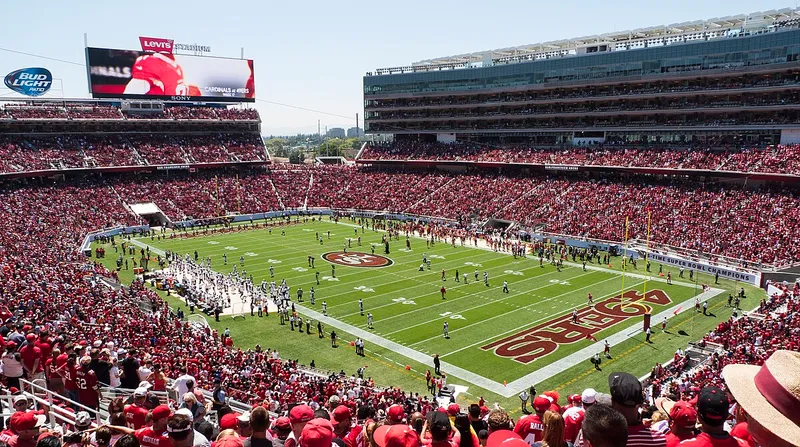
About Levi's Stadium
Levi’s Stadium sits in Santa Clara, California — right in the beating heart of Silicon Valley, about 40 miles south of the San Francisco city limits. If you’re picturing the Golden Gate Bridge and cable cars, adjust your expectations. This is suburban tech country: low-slung office parks, highways, and the headquarters of Apple, Google, and Intel within a short drive. The stadium’s address is closer to San Jose than San Francisco, and that geographic reality has been a source of debate among 49ers fans since the team packed up and left Candlestick Park in 2014.
With a capacity of 68,500 for NFL games (expandable to around 75,000 for major events), Levi’s Stadium will serve as a quarterfinal venue for the FIFA World Cup 2026, hosting 6 matches total. It’s one of two California venues selected for the tournament, alongside SoFi Stadium in the Los Angeles area. Where SoFi represents Hollywood excess at $5.5 billion, Levi’s Stadium is the practical Silicon Valley counterpart — built for $1.3 billion, delivered on time, and designed with sustainability as a core principle rather than an afterthought.
The San Francisco 49ers are the sole NFL tenant, and they’ve called this place home since its opening on July 17, 2014. The first event was a soccer match between the San Jose Earthquakes and the Seattle Sounders — a fitting baptism for a stadium that will now welcome the World Cup. The 49ers’ move from the wind-battered, fog-soaked Candlestick Park to this sun-drenched South Bay venue was a seismic shift for the franchise. They traded character for comfort, history for modernity, and San Francisco proper for Silicon Valley money.
One of Levi’s Stadium’s most notable achievements is its LEED Gold certification — the first NFL stadium to earn that distinction. The suite tower features a 27,000-square-foot green roof planted with native vegetation. The facility runs on 1,186 solar panels, uses recycled water for irrigation, and was built with local and recycled materials wherever possible. The environmental credentials are genuine, not just marketing. That said, the stadium hasn’t been without problems. The natural Bermuda grass surface has been a well-documented headache, with uneven sun exposure across the open bowl creating patchy, inconsistent turf that drew complaints from players and coaches for years. The grounds crew has made real improvements, but the grass remains a talking point.
Getting to Levi's Stadium
Public Transit
Public transit to Levi’s Stadium is workable but not seamless. Silicon Valley was built around the automobile, and it shows.
VTA Light Rail: The closest station is the Great Mall Transit Center on the VTA Green Line, roughly a 10-minute walk from the stadium’s main gates. On game days, free shuttles bridge the gap between the station and the venue. VTA Light Rail connects to downtown San Jose and other South Bay destinations.
Caltrain + VTA: Coming from San Francisco or the Peninsula? Take Caltrain south to the Santa Clara station (about 70 minutes from San Francisco’s 4th & King terminal). From there, transfer to VTA Light Rail or catch a game-day shuttle. It’s not fast, but it avoids the worst of the traffic. Caltrain runs express trains on weekdays that cut the trip to around 55 minutes.
BART + VTA: If you’re coming from the East Bay, take BART to the Milpitas station, then transfer to VTA Light Rail heading toward the stadium. The connection adds time, but it keeps you off I-880.
Game-day express shuttles: The 49ers typically operate shuttle services from multiple locations on game days, including downtown San Jose and select Caltrain stations. Check the team website for updated routes and schedules closer to World Cup match dates.
Driving + Parking
Levi’s Stadium is immediately accessible from US-101 and I-880, the two main freeways running through Silicon Valley. GPS: “4900 Marie P DeBartolo Way, Santa Clara, CA 95054.”
→ From San Francisco: Take US-101 South for approximately 40 miles to the Great America Parkway exit. Turn left and the stadium is immediately visible. Allow 50-90 minutes depending on traffic — the 101 corridor is one of the most congested stretches in the Bay Area.
→ From San Jose (downtown): Take US-101 North to Tasman Drive or Great America Parkway exit. About 8 miles, 15-30 minutes.
→ From the East Bay (Oakland/Fremont): Take I-880 South to US-101 South, exit at Great America Parkway. Approximately 25-40 miles, 35-70 minutes depending on your starting point.
→ From the Peninsula (Palo Alto/Mountain View): Take US-101 South, about 12-20 miles. 20-40 minutes outside of event traffic.
Parking is primarily in the Great America surface lots adjacent to the stadium, with additional parking at the nearby convention center and satellite lots. Standard parking runs $40-60 for NFL events. Pre-purchase parking through the 49ers app or Ticketmaster — lots fill up and walk-up availability isn’t guaranteed. Arriving 2 hours before kickoff is wise. Tailgating is permitted in designated lots and is a major part of the 49ers game-day culture.
Rideshare
Uber and Lyft have a designated pickup and drop-off zone on Tasman Drive, on the north side of the stadium. After events, expect 20-40 minute wait times as thousands of fans compete for rides. A trip from downtown San Jose costs roughly $15-25; from San Francisco, $50-80 depending on surge pricing. For World Cup matches, consider scheduling your ride in advance or walking to a less congested pickup spot a few blocks away.
From the Airport
→ San Jose International Airport (SJC): Just 5 miles south — by far the closest and most convenient option. A 10-15 minute drive without event traffic, 20-30 minutes on match days. VTA Light Rail also connects SJC to the stadium area. This is a midsize airport with direct flights from most major US cities and some international routes.
→ San Francisco International Airport (SFO): 32 miles north, a major international hub with flights from everywhere. Drive time is 35-60 minutes via US-101, but can exceed 90 minutes in heavy traffic. Caltrain connects SFO to the South Bay if you prefer rail.
→ Oakland International Airport (OAK): 28 miles north via I-880. Drive time 30-55 minutes. A good alternative if you’re finding cheaper flights, and BART connects OAK to the Milpitas VTA transfer point.
FIFA World Cup 2026 at Levi's Stadium
Levi’s Stadium brings something no other World Cup 2026 venue can claim: it’s already playing on natural grass. While stadiums like SoFi Stadium and MetLife Stadium will need to install temporary grass surfaces over their synthetic turf, Levi’s Stadium has the real thing growing year-round. The Bermuda grass has had its well-publicized struggles, but FIFA’s groundskeeping teams will be on-site months in advance to bring the pitch to tournament standard.
Expected matches: 6 total — group stage games building to a quarterfinal, one of the marquee rounds of the tournament.
Climate for soccer: Santa Clara’s summer weather is nearly ideal for outdoor sport. Expect warm, dry conditions with temperatures between 75-85°F (24-29°C) in June and July. Rain is essentially nonexistent during these months. The open stadium means afternoon matches will have direct sun exposure — great for the grass, demanding for the players. Evening kickoffs will be comfortable, cooling into the mid-60s as the Pacific influence rolls in.
The Silicon Valley factor: There’s a poetic quality to the tech capital of the world hosting the world’s most popular sport. The Bay Area has a deep soccer culture — the San Jose Earthquakes have played MLS soccer here since 1996, and the region’s massive immigrant communities from Mexico, Central America, and South Asia bring passionate, knowledgeable fanbases. World Cup matches here will sell out instantly.
Setting the stage: The stadium’s open design gives it a classic outdoor football feel that translates perfectly to soccer. The 68,500 capacity is intimate enough to generate real atmosphere while large enough to meet FIFA’s requirements. With Silicon Valley’s tech infrastructure, expect the broadcast production and fan connectivity to be among the best in the tournament.
History of Levi's Stadium
The story of Levi’s Stadium is really the story of the 49ers leaving San Francisco. For decades, the team played at Candlestick Park — a cold, windy, fog-drenched concrete bowl on the city’s southeastern edge that was beloved for its character but miserable for its comfort. By the 2000s, the franchise was pushing hard for a new stadium. When San Francisco politics, limited land, and funding battles made a city replacement impossible, the 49ers looked south.
Santa Clara offered what San Francisco couldn’t: a 17-acre parcel adjacent to California’s Great America theme park, a cooperative city government, and voters who approved a public financing deal in 2010. Groundbreaking happened on April 19, 2012. Construction took just over two years — remarkably fast for a project of this scale — and the $1.3 billion stadium opened for business on July 17, 2014. That opening event? A soccer match between the San Jose Earthquakes and the Seattle Sounders, attended by 48,765 fans. The first NFL game followed on August 17, a preseason matchup against the Denver Broncos.
Super Bowl 50 (February 2016): Less than two years after opening, Levi’s Stadium hosted the biggest game in American sports. The Denver Broncos defeated Cam Newton’s Carolina Panthers 24-10 in what turned out to be Peyton Manning’s final NFL game. The halftime show featured Coldplay, Beyonce, and Bruno Mars. The “50” branding (the NFL abandoned Roman numerals for that one year because “Super Bowl L” looked awkward) became iconic.
College football and beyond: The stadium has hosted the College Football Playoff National Championship (2019, Clemson vs. Alabama), the Pac-12 Championship Game multiple times, and the Redbox Bowl. International soccer has been a recurring visitor — the Copa America Centenario in 2016 brought matches here, and the stadium has hosted numerous Gold Cup and friendly matches featuring Mexico, the USMNT, and other national teams.
Concerts and cultural events: The venue has welcomed Taylor Swift (multiple Eras Tour dates), Beyonce, the Rolling Stones, Metallica, U2, and Ed Sheeran. WrestleMania 31 in 2015 drew over 76,000 fans. The stadium has proven it can handle events of any scale and type.
The location debate: Ten years on, the conversation about whether the 49ers belong in Santa Clara hasn’t fully gone away. Fans from San Francisco face a 40-mile drive south on one of the country’s most congested highway corridors. The stadium’s surroundings — parking lots, office parks, a theme park — lack the urban character of a city-center venue. But the counterargument is hard to dismiss: Silicon Valley’s corporate money has made the stadium a financial powerhouse, with naming rights, luxury suites, and sponsorship deals that would have been harder to secure in a more constrained San Francisco location. The 49ers traded urban authenticity for suburban viability, and the balance sheet says it worked.
Photo Gallery
Fun Facts
Levi's Stadium hosted Super Bowl 50 in February 2016, where the Denver Broncos defeated the Carolina Panthers 24-10 in Peyton Manning's final NFL game.
The stadium earned LEED Gold certification — the first NFL venue to do so. It has a 27,000-square-foot green roof on the suite tower, 1,186 solar panels, and uses recycled water for irrigation.
When the 49ers moved here in 2014, they relocated 40 miles south of their old Candlestick Park home. The stadium sits in Santa Clara, not San Francisco — a fact that still irritates some longtime fans.
Stadium Location
Frequently Asked Questions
- What is the seating capacity of Levi's Stadium?
- Levi's Stadium has a standard seating capacity of 68,500 for NFL games, expandable to approximately 75,000 for special events like concerts and the FIFA World Cup. The stadium features 174 luxury suites and over 9,000 club seats.
- Where is Levi's Stadium located?
- Levi's Stadium is located at 4900 Marie P DeBartolo Way, Santa Clara, California 95054. Despite being home to the 'San Francisco' 49ers, the stadium is about 40 miles south of San Francisco in the heart of Silicon Valley.
- How many FIFA World Cup 2026 matches will Levi's Stadium host?
- Levi's Stadium will host 6 FIFA World Cup 2026 matches, including group stage games and a quarterfinal. The first match is scheduled for June 13, 2026.
- How do I get to Levi's Stadium by public transit?
- Take VTA Light Rail to the Great Mall Transit Center station, which is about a 10-minute walk from the stadium. On event days, free shuttles connect the station to the venue. From San Francisco, take Caltrain to the Santa Clara station, then transfer to VTA Light Rail or use the event shuttle service.
- How much does parking cost at Levi's Stadium?
- Parking at Levi's Stadium typically costs $40-60 for NFL games, with premium lots closer to the stadium costing more. The main parking areas are the Great America lots adjacent to the stadium. Pre-purchasing parking through the 49ers app or Ticketmaster is strongly recommended — lots fill up quickly.
- Does Levi's Stadium have grass or turf issues?
- Levi's Stadium uses natural Bermuda grass, which has been a recurring challenge. The Bay Area's mild but foggy climate and the stadium's open bowl design create uneven sun exposure, leading to well-documented turf quality issues in past seasons. The grounds crew has made significant improvements since the early years, and FIFA will work with venue staff to ensure pitch quality meets World Cup standards.
- Why is Levi's Stadium in Santa Clara and not San Francisco?
- The 49ers chose Santa Clara because the franchise couldn't secure a suitable site and public funding in San Francisco. Santa Clara offered available land adjacent to Great America theme park, along with a voter-approved public financing deal. The move was controversial, but Silicon Valley's corporate wealth has made the stadium financially successful through naming rights and luxury suite sales.
- What is the weather like at Levi's Stadium during summer?
- Santa Clara enjoys warm, dry summers typical of the Bay Area's inland South Bay. June and July temperatures average 75-85°F (24-29°C) with very little rain. The open stadium means full sun exposure during afternoon matches, so sunscreen and hydration are essential. Evening games are comfortable, often cooling to the mid-60s.
Last updated: 2026-02-14