About Maracanã
There is no stadium on earth with more soul than Maracanã. Officially named Estádio Jornalista Mário Filho, it has been known simply as Maracanã since it opened in 1950 — a word that has become synonymous with football itself. This is where Pelé scored his 1,000th goal, where the “Maracanazo” shattered a nation’s heart, where the 2014 World Cup reached its conclusion, and where the 2016 Olympics opened under the night sky of Rio de Janeiro.
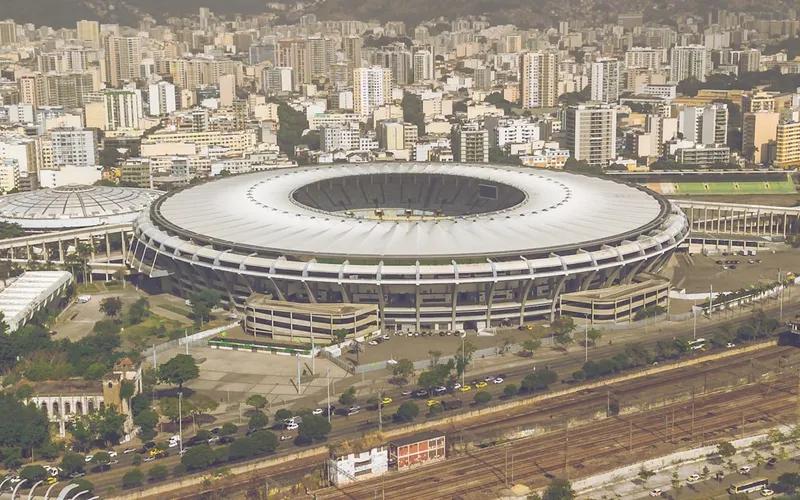
Maracanã sits in the Tijuca neighborhood of Rio’s North Zone, surrounded by the lush green of the world’s largest urban forest. The stadium holds 78,838 spectators in its modern configuration — a fraction of the nearly 200,000 who packed it for the 1950 World Cup Final — but the atmosphere it generates is unmatched. When Flamengo plays a Libertadores knockout match here, the noise, the passion, and the visual spectacle of 78,000 Brazilians in full voice is the most intense experience in world football.
The current structure is the result of a comprehensive 2014 renovation that essentially rebuilt the stadium within its original circular footprint. Modern seating, improved sightlines, a tensioned-membrane roof canopy, and upgraded facilities replaced the crumbling concrete terraces of the old venue. What survived the renovation was the location, the scale, and the overwhelming sense of history that permeates every seat.
Flamengo and Fluminense share the stadium as their primary home ground — two of Brazil’s biggest clubs, separated by a fierce rivalry known as the Fla-Flu derby, one of the most passionate in South American football.
Getting to Maracanã
Public Transit
Rio’s Metro runs directly to the stadium, making public transit the best option.
Metro Line 2 (Green): The Maracanã station is immediately adjacent to the stadium complex. From the city center (Central station), the journey takes just 5 minutes. From Botafogo, approximately 15 minutes with a transfer at Estácio.
From Copacabana/Ipanema: Take Line 1 (Orange) to Estácio, then transfer to Line 2 (Green) one stop to Maracanã. Total journey approximately 25-30 minutes.
SuperVia commuter trains: The Maracanã station on the SuperVia network is also adjacent to the stadium. Useful if coming from the western suburbs or connections from the Central do Brasil station.
On matchdays: Extra metro services run before and after matches. The station gets extremely crowded post-match — expect 20-40 minutes of waiting. Heading one station in either direction (São Cristóvão or Triagem) can reduce wait times significantly.
Driving + Parking
Driving to Maracanã is straightforward but parking is limited and the surrounding area gets congested on matchdays.
→ From Copacabana/South Zone: Take the Rebouças Tunnel north through to Tijuca, then follow signs to the stadium via Avenida Maracanã. Approximately 8 km, 20-40 minutes depending on traffic.
→ From the city center: Head north on Avenida Presidente Vargas, connecting to Avenida Presidente Castelo Branco. The stadium is visible from the highway. Approximately 5 km, 10-25 minutes.
Parking is available in the official lots surrounding the stadium and in nearby commercial garages. Expect to pay R$30-60 (approximately $6-12 USD). Arriving 2+ hours early secures the best spots. Do not park on informal or unmonitored streets — car break-ins are a risk in parts of the surrounding area.
Rideshare
Uber and 99 (a Brazilian rideshare app) are widely used in Rio. A ride from Copacabana to Maracanã costs approximately R$25-45 (roughly $5-9 USD) under normal conditions. Surge pricing on matchdays can push this to R$60-100. Ask to be dropped at the Metro station entrance for the easiest access — driving right up to the gates is often impossible due to road closures.
From the Airport
→ Galeão International Airport (GIG): 15 km north. By car or Uber, 20-40 minutes depending on traffic (via the Linha Vermelha expressway). There is no direct Metro connection to the airport, but the BRT (Bus Rapid Transit) connects to Metro Line 2. Budget extra time for BRT.
→ Santos Dumont Airport (SDU): 10 km south, in the city center. The domestic airport is much more convenient — a quick Uber (15-25 minutes) or Metro from Cinelândia station (Line 1 to Estácio, transfer to Line 2, total 20 minutes).
History of Maracanã
Maracanã was built for the 1950 FIFA World Cup — the first held after World War II — and Brazil was determined to announce its return to the world stage with a venue that would leave every other stadium in the dust. Designed by architects Rafael Galvão, Pedro Paulo Bastos, Orlando Azevedo, and Antônio Dias Carneiro, the stadium was constructed in just two years and opened on June 16, 1950.
The Maracanazo (1950 World Cup Final): On July 16, 1950, an estimated 199,854 spectators — the largest crowd in football history — filled Maracanã for the decisive match between Brazil and Uruguay. Brazil needed only a draw to win the World Cup and led 1-0 through Friaça’s goal. Then Uruguay equalized through Schiaffino and, in the 79th minute, Alcides Ghiggia scored the winner. The silence that fell over nearly 200,000 people is described as the most devastating moment in Brazilian sporting history. The defeat traumatized the nation — Brazil changed their jersey colors from white to yellow and blue as a result.
Pelé’s 1,000th goal (1969): On November 19, 1969, Pelé scored his milestone 1,000th career goal at Maracanã, converting a penalty for Santos against Vasco da Gama. The match was stopped as fans invaded the pitch, Pelé was lifted onto shoulders, and the moment was broadcast live nationwide. A plaque at the stadium commemorates the exact spot.
The golden age: Through the 1960s, 70s, and 80s, Maracanã regularly hosted crowds exceeding 150,000 for Fla-Flu derbies and Brazilian national team matches. The standing terraces (arquibancadas) created an atmosphere of almost frightening intensity. The stadium was the beating heart of Brazilian football culture — samba drums, massive banners, fireworks, and a collective passion that defined the sport’s image worldwide.
Decline and renovation: By the early 2000s, Maracanã’s aging infrastructure had become a safety concern. Capacity was progressively reduced, standing areas were converted to seating, and the stadium underwent a partial renovation for the 2007 Pan American Games. But the real transformation came for the 2014 World Cup — a R$1.2 billion rebuild that essentially constructed a new stadium within the original’s circular shell.
2014 FIFA World Cup Final: On July 13, 2014, Maracanã hosted Germany vs. Argentina in the World Cup Final. Mario Götze’s extra-time goal gave Germany a 1-0 victory and their fourth world title. Earlier in the tournament, Maracanã had witnessed Brazil’s semi-final — a 7-1 demolition by Germany that ranks as the most shocking result in World Cup history. That match, played at Estádio Mineirão in Belo Horizonte, was watched by a horrified nation, many of whom had gathered at Maracanã’s fan zone.
2016 Rio Olympics: Maracanã hosted the Opening and Closing Ceremonies of the 2016 Olympic Games. The Opening Ceremony — a celebration of Brazilian music, culture, and environmental consciousness — was widely praised as one of the best in Olympic history. The Closing Ceremony featured the iconic handover to Tokyo 2020.
Copa Libertadores finals: Maracanã has hosted multiple Copa Libertadores Finals, including Flamengo’s dramatic 2019 triumph over River Plate, when Gabriel Barbosa scored twice in the final minutes to win South America’s biggest club trophy. That night, Maracanã exploded with a joy that rivaled any World Cup celebration.
Maracanã is 75 years old and has been rebuilt twice, but its power is undiminished. In a city where Christ the Redeemer watches from above and the Atlantic Ocean meets the mountains, this stadium holds its own as Rio’s most emotionally charged landmark. It is not the biggest, the newest, or the most technologically advanced — but it is, by any reasonable measure, the most important stadium in the history of football.
Photo Gallery
Fun Facts
The original 1950 Maracanã held an estimated 199,854 spectators for the World Cup Final — the largest crowd ever recorded at a football match. Uruguay's shock victory over Brazil that day is known as the 'Maracanazo,' and the heartbreak still echoes in Brazilian culture.
Pelé scored his 1,000th career goal at Maracanã on November 19, 1969, converting a penalty for Santos against Vasco da Gama. The game was stopped, Pelé was carried on the shoulders of fans, and the moment was broadcast live across Brazil.
Maracanã has been rebuilt twice — first for the 2007 Pan American Games and then comprehensively for the 2014 World Cup — but its circular footprint and location in Rio's Tijuca neighborhood have remained constant since 1950.
Stadium Location
Frequently Asked Questions
- What is the seating capacity of Maracanã?
- Maracanã currently holds 78,838 spectators after its 2014 renovation. The original 1950 stadium held approximately 200,000 (standing and seated), making it the largest football venue in the world for over four decades.
- Where is Maracanã located?
- Maracanã is located in the Tijuca neighborhood of Rio de Janeiro's North Zone (Zona Norte), at Avenida Presidente Castelo Branco. It is approximately 8 km from Copacabana Beach and 5 km from the city center.
- How many World Cup Finals has Maracanã hosted?
- Maracanã has hosted two FIFA World Cup Finals: the 1950 Final (Uruguay 2-1 Brazil, the 'Maracanazo') and the 2014 Final (Germany 1-0 Argentina, after extra time). It is one of only three stadiums to host multiple World Cup Finals, along with Estadio Azteca and the original Stade de France design site.
- How do I get to Maracanã by public transit?
- Take Rio Metro Line 2 (Green) to Maracanã station, which is directly adjacent to the stadium. From Copacabana/Ipanema, take Line 1 (Orange) and transfer at Estácio. Total journey approximately 25-30 minutes. SuperVia commuter trains also stop at Maracanã station.
- Can I visit Maracanã without attending a match?
- Yes. Maracanã offers guided tours that include the pitch, locker rooms, press room, the Walk of Fame (with footprints of Brazilian legends), and panoramic views of the bowl. Tours run daily and last approximately 40 minutes.
- Is Maracanã safe to visit?
- The stadium area and Metro access are generally safe, especially on matchdays when police presence is heavy. Standard big-city precautions apply: don't flash expensive electronics, use official transport, and stick to well-lit areas at night. The neighborhood of Tijuca is considered one of Rio's safer areas.
Last updated: 2026-02-11