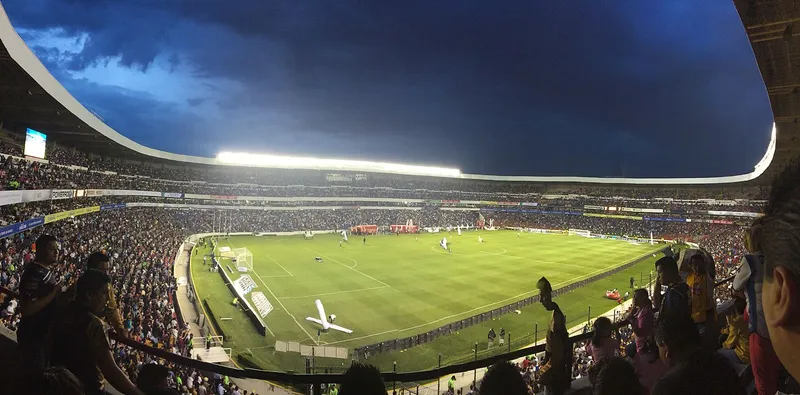
About Stade de France
Stade de France is the cathedral of French sport. Built for the 1998 FIFA World Cup in the northern Paris suburb of Saint-Denis, it is where Zinedine Zidane headed France to their first World Cup title, where the French rugby team defends its honor in the Six Nations, and where 81,338 voices merge into something that shakes the ground beneath your feet.
The stadium has no permanent club tenant — a rarity for a venue this size. Instead, it serves as France’s national stage for football, rugby, athletics, and concerts. This gives it a unique character: every event at Stade de France feels like an occasion, never routine. When the lights come on and the French national anthem echoes through the bowl, there is no mistaking where you are.
Architecturally, the stadium is defined by its elliptical floating roof — a 13,000-tonne steel and glass structure suspended 46 meters above the pitch on 18 massive pillars. The roof can be partially retracted, and its translucent panels flood the interior with natural light during day events. The design by architects Michel Macary, Aymeric Zublena, Michel Regembal, and Claude Constantini won the prestigious Équerre d’Argent award.
In 2024, Stade de France hosted the athletics program and rugby sevens for the Paris Olympics, cementing its status as one of the most versatile major venues in the world. From World Cup finals to Olympic gold medals to Beyoncé’s Renaissance Tour — if it matters in France, it happens here.
Getting to Stade de France
Public Transit
Paris has one of the best public transit systems in the world, and Stade de France is excellently served.
RER B and RER D: Both lines stop at Stade de France – Saint-Denis station, directly adjacent to the stadium. From central Paris (Gare du Nord or Châtelet – Les Halles), the journey takes just 10-15 minutes. This is the best option for most visitors.
Metro Line 13: Stop at Saint-Denis – Porte de Paris, approximately a 10-minute walk. From the city center, the Metro takes 20-25 minutes.
On event days: RATP runs additional trains on both RER lines before and after events. Follow the crowd from the station — the stadium is visible from the platform. Post-event, expect 20-30 minutes of congestion at the RER station as 80,000 fans funnel through the gates.
Driving + Parking
Driving to Stade de France is possible but not recommended on event days. The A1 and A86 motorways provide access, but traffic around Saint-Denis becomes heavily congested 2-3 hours before kickoff.
→ From central Paris: Take the A1 motorway north toward Lille, exit at Saint-Denis – Stade de France. Approximately 10 km, 15-40 minutes depending on traffic.
→ From Charles de Gaulle Airport: A1 south, exit Saint-Denis. Approximately 20 km, 25-45 minutes.
→ From Gare du Nord: Just 4 km north — but take the RER instead. Driving adds nothing and parking is expensive.
Limited parking is available in structures around the stadium (P1-P7), but spaces must typically be reserved in advance for major events. Street parking in Saint-Denis is restricted on event days. Seriously — take the train.
Rideshare
Uber operates in Paris and is a viable option, though surge pricing applies on event days. A ride from central Paris costs approximately €15-25 normally, rising to €30-50 during peak event times. Designated drop-off areas are near the north and south entrances.
From the Airport
→ Charles de Gaulle Airport (CDG): 20 km northeast. RER B runs directly from CDG Terminal 2 to Stade de France – Saint-Denis in approximately 25 minutes — no transfers needed. This is the best airport option. By car, 25-45 minutes via the A1.
→ Orly Airport (ORY): 25 km south. Take the Orlyval to Antony, then RER B north to Stade de France – Saint-Denis. Total transit time approximately 50 minutes. By car, 35-60 minutes via the A6 and A86.
→ Paris Beauvais Airport (BVA): 85 km north. Budget carrier airport with limited direct connections. Shuttle bus to Porte Maillot, then Metro/RER. Allow 2+ hours.
History of Stade de France
Stade de France was born from necessity. When France was awarded the 1998 FIFA World Cup, the country lacked a modern national stadium capable of hosting the Final. The government chose a site in Saint-Denis — a working-class commune north of Paris with excellent transport links — and broke ground in 1995.
1998 FIFA World Cup Final: On July 12, 1998, 80,000 fans packed Stade de France for France vs. Brazil. Zinedine Zidane scored two headers in the first half, and Emmanuel Petit sealed a 3-0 victory that gave France its first World Cup title. The Champs-Élysées erupted. An estimated 1.5 million people flooded central Paris. It remains the greatest night in French sporting history.
Euro 2000 and Champions League: Stade de France quickly became a premier European venue. It hosted the 2000 Champions League Final (Real Madrid 3-0 Valencia) and has since staged the 2006 Champions League Final (Barcelona 2-1 Arsenal) and the controversial 2022 Final (Real Madrid 1-0 Liverpool), marred by security failures outside the ground.
2007 Rugby World Cup: France hosted the Rugby World Cup, with Stade de France as the centerpiece. The stadium hosted the Opening Match, both semi-finals, and the Final (South Africa 15-6 England). It solidified the venue’s dual identity as both a football and rugby cathedral.
Euro 2016: France hosted the European Championship, and Stade de France staged the Opening Match (France 2-1 Romania) and served as a key venue throughout. The tournament was overshadowed by the 2015 Paris attacks, which included three bombings outside the stadium during a France-Germany friendly six months earlier — a night that tested the venue’s security protocols under the most extreme circumstances imaginable.
2024 Paris Olympics: Stade de France was the athletics venue for the 2024 Games, hosting track and field events and rugby sevens. The stadium received upgrades including a temporary athletics track, improved accessibility, and enhanced broadcast infrastructure. It delivered one of the most visually stunning athletics presentations in Olympic history.
Concert legacy: Every major touring artist plays Stade de France. The Rolling Stones, Beyoncé, Rihanna, Coldplay, U2, AC/DC, and Depeche Mode have all sold out the venue multiple times. Johnny Hallyday’s farewell concerts here in 2009 drew 240,000 fans across three nights — the most emotional musical event in French history.
Despite being over 25 years old, Stade de France remains France’s largest and most important stadium. Its lack of a permanent club tenant is occasionally debated — Paris Saint-Germain has explored moving from the Parc des Princes — but for now, the stadium thrives as a national venue. Every time France plays here, the history of 1998 is in the air. You can feel Zidane’s headers in the architecture.
Photo Gallery
Fun Facts
Stade de France was built specifically for the 1998 FIFA World Cup and had no designated tenant team — it remains one of the few national stadiums in the world without a permanent club occupant.
The roof weighs 13,000 tonnes and can be retracted to cover or expose the seating bowl. It rests on 18 steel pillars and spans 275 meters at its widest point — large enough to shelter the Arc de Triomphe underneath.
During the November 2015 Paris terrorist attacks, three suicide bombers detonated outside the stadium during a France vs. Germany friendly. The 80,000 fans inside were kept safe, and the match finished before a calm evacuation — an extraordinary act of crisis management.
Stadium Location
Frequently Asked Questions
- What is the seating capacity of Stade de France?
- Stade de France has a seating capacity of 81,338, making it the largest stadium in France. For athletics events, the capacity drops to approximately 75,000 due to the reconfigured track layout.
- Where is Stade de France located?
- Stade de France is located in Saint-Denis, a commune just north of Paris in the Île-de-France region. The address is 93216 Saint-Denis. It is approximately 7 km from central Paris and well-connected by RER and Metro.
- Does Stade de France have a permanent home team?
- No. Stade de France is unusual among major national stadiums in that it has no permanent club tenant. It hosts France's national football and rugby teams, the French Cup finals, and the Top 14 rugby final, but no club plays there week-to-week.
- How do I get to Stade de France by public transit?
- The easiest option is RER Line B or D to 'Stade de France – Saint-Denis' station, which is a 5-minute walk from the stadium. Alternatively, Metro Line 13 stops at 'Saint-Denis – Porte de Paris,' about a 10-minute walk. On event days, extra trains run on both lines.
- What major events has Stade de France hosted?
- Stade de France has hosted the 1998 FIFA World Cup Final (France 3-0 Brazil), Euro 2016 matches including the Final, the 2024 Paris Olympics athletics and rugby, two UEFA Champions League Finals (2000, 2022), Rugby World Cup 2007 Final, and numerous concerts by artists like Beyoncé, The Rolling Stones, and Rihanna.
- Can I visit Stade de France without attending an event?
- Yes. Stade de France offers guided tours year-round, taking visitors through the locker rooms, tunnel, pitch-side, and presidential suite. Tours last approximately 90 minutes and are available in French and English. Booking in advance is recommended.
Last updated: 2026-02-11