Saudi Arabia is about to attempt something no World Cup host has ever tried. It’s building or rebuilding all 15 tournament stadiums more or less at once, in a decade-long construction sprint, including one whose pitch is designed to float 350 metres in the air inside a city that does not exist yet. It’s the most ambitious stadium program in the tournament’s history, and also the most contested.
The 2034 World Cup is Saudi Arabia’s alone. No co-hosts, no shared continents, just one country and a checkbook tied to its Vision 2030 plan to remake itself. The stadiums are the centerpiece of that pitch, all glass and steel and desert-inspired curves. They are also the reason human-rights groups have spent the years since the award warning about who builds them and at what cost.
So here’s the full map: every 2034 stadium, the megaproject venues that grab the headlines, and the controversy FIFA can’t pour concrete over.
The 2034 World Cup, at a glance:
- One host, 15 stadiums, 5 cities (Riyadh, Jeddah, Al Khobar, Abha, NEOM); 10 are new builds, 5 renovations.
- King Salman International Stadium (Riyadh, planned ~92,000) hosts the opening match and the final.
- The NEOM Stadium is designed to sit ~350 metres up inside the megacity “The Line,” planned capacity ~46,000.
- Timing is officially undecided. Summer heat rules out June-July, so a cooler-season tournament is expected, with January 2035 widely reported but unconfirmed.
- The controversy: human-rights groups including Amnesty and Human Rights Watch condemned the award; supporters cite Vision 2030 reform.
15 stadiums, 10 of them brand new. Saudi Arabia is building more new World Cup stadiums for a single tournament than any host before it.
How the 2034 World Cup works
The 2034 World Cup was awarded to Saudi Arabia on December 11, 2024, at an Extraordinary FIFA Congress, by acclamation. There was no competitive vote because there was no competition. After FIFA opened the 2034 bid only to Asia and Oceania and set a tight timeline, Australia opted out, leaving Saudi Arabia as the sole bidder. It’s the same session that confirmed the 2030 World Cup for Spain, Portugal, and Morocco.
It will be the first 48-team World Cup held entirely inside one country. The bid lists 15 stadiums across five host cities: Riyadh, Jeddah, Al Khobar, Abha, and NEOM. Riyadh carries eight of them, Jeddah four, and Al Khobar, Abha, and NEOM one each. Ten are new builds and five are renovations, though the line between the two blurs when a “renovation” means demolishing most of a stadium and starting over.
One thing that isn’t settled: when it happens. FIFA lists the dates as still to be announced. A Saudi summer runs well past 40°C and touches 50°C in the desert, so the usual June-to-July slot is off the table, and the tournament is expected in the cooler months, exactly the heat logic that pushed Qatar 2022 to winter. Multiple outlets report a shift to January 2035, because the natural late-2034 window overlaps with Ramadan and the 2034 Asian Games in Riyadh. FIFA has not confirmed it.
Riyadh: eight stadiums, and the one built for the final
Riyadh is the heart of the tournament with eight venues, and the biggest of them is the one built for the biggest night. The King Salman International Stadium, a new build with a planned capacity near 92,000 that would rank it among the largest stadiums in the world, is designed to host the opening match and the final, and to become the Saudi national team’s home afterward. Designed by Populous, its form is meant to echo the Saudi desert, and construction was reported to begin in 2025 for a target completion around 2029.
~92,000. Planned capacity of King Salman International Stadium, the venue built to host both the opening match and the final.
The most striking Riyadh venue, though, sits outside the city on a cliff. The Prince Mohammed bin Salman Stadium in Qiddiya is planned as a three-sided bowl perched on the edge of a roughly 200-metre escarpment, with an open side framing the valley below and, reportedly, a retractable roof and pitch. The rest of Riyadh’s slate is a wave of new and rebuilt grounds in the 46,000 to 47,000 range: the crystalline Roshn Stadium, the acacia-roofed New Murabba Stadium, South Riyadh Stadium, the redeveloped Prince Faisal bin Fahd Stadium, and the upgraded King Saud University Stadium, current home of Al Nassr. The King Fahd International Stadium, Riyadh’s 1987 landmark with its tent-inspired roof, gets a renovation toward around 70,000.
Jeddah, Al Khobar, and Abha: the rest of the map
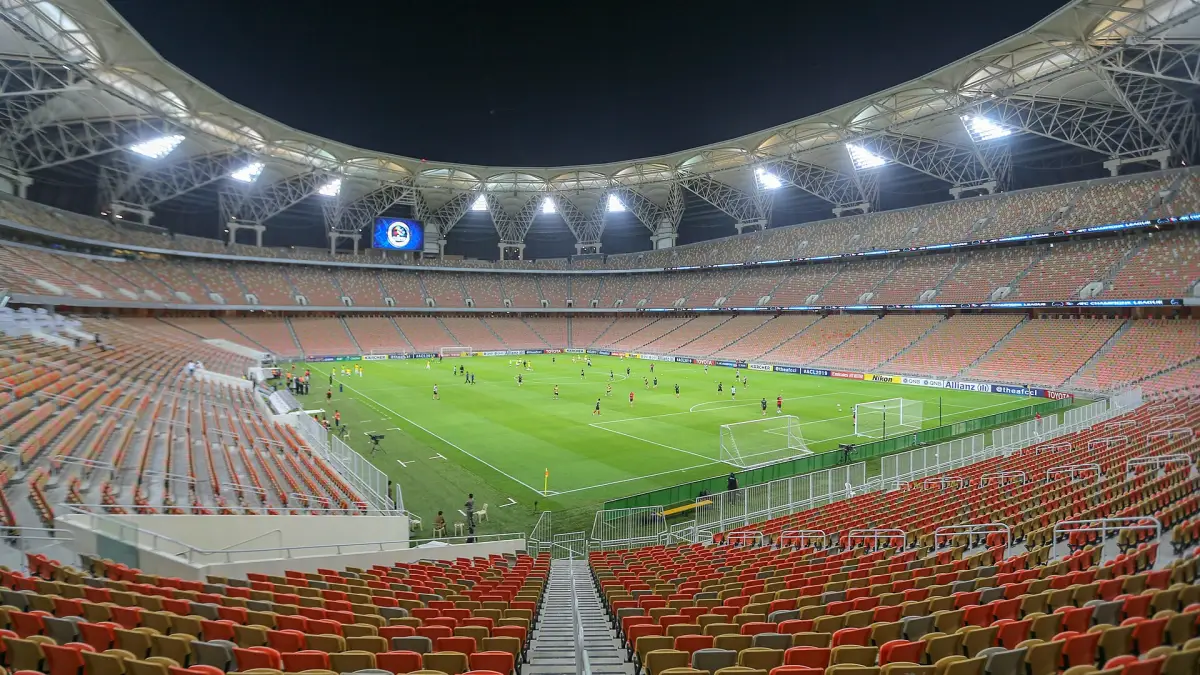
Jeddah supplies four venues on the Red Sea coast. The anchor is the existing King Abdullah Sports City Stadium, nicknamed “The Jewel,” which holds roughly 58,000 to 62,000 depending on the source and is being renovated, reportedly with a large solar array and seawater cooling. Around it come three new builds, all near 46,000: the deliberately colorful Qiddiya Coast Stadium, the Jeddah Central Development Stadium whose design nods to the historic Al-Balad district, and the King Abdullah Economic City Stadium north of the city.
The two outlying cities each bring one venue. In Al Khobar, on the Persian Gulf, the Aramco Stadium is the exception to the “still on paper” rule: it’s genuinely under construction, broke ground in 2024, and is designed by Populous with a coiled “whirlpool” form and built-in air conditioning, targeting completion around 2027. In Abha, up in the cooler Asir highlands, the King Khalid University Stadium gets a large expansion from roughly 12,000 toward 45,000. That jump, from a modest university ground to a World Cup venue, captures the scale of what Saudi Arabia is promising across the board.
NEOM: the sky stadium, and a reality check
The venue everyone talks about is the NEOM Stadium, marketed as the world’s first “sky stadium.” The design places the pitch around 350 metres above ground level, roughly the height of the Eiffel Tower, integrated into the upper levels of The Line, the planned linear megacity that is supposed to stretch 170 kilometres across the desert. On paper it’s the most futuristic stadium ever proposed, planned for about 46,000 fans and, per the bid, powered entirely by renewable energy.
350 metres. The height at which the NEOM Stadium’s pitch is designed to sit, inside the upper levels of the planned megacity The Line.
Here’s the reality check. A viral video suggested a stadium balanced on top of a single skyscraper, and ESPN specifically debunked that: the 350 metres refers to the venue sitting within the tiers of The Line’s megastructure, not perched on a tower. The renewable-power claim comes from bid and promotional material and hasn’t been independently verified. And The Line itself has been scaled back, with reports that Saudi Arabia is reassessing parts of its megaproject and stadium plans, which raises a fair question about whether NEOM’s venue will be ready, or built as pictured, by 2034. As of mid-2026, it is a design, not a building.
Every 2034 World Cup stadium at a glance
All 15 venues, with planned capacities. Read every figure as a target: most of these stadiums are pre-construction or early-construction, and capacities have shifted between announcements. Only the Aramco Stadium in Al Khobar is meaningfully under way.
| City | Stadium | Capacity (planned) | Type |
|---|---|---|---|
| Riyadh | King Salman International Stadium | ~92,000 | New (final + opener) |
| Riyadh | King Fahd Sports City Stadium | ~70,000 | Renovation |
| Riyadh | Prince Mohammed bin Salman Stadium (Qiddiya) | ~47,000 | New (cliff-edge) |
| Riyadh | South Riyadh Stadium | ~47,000 | New |
| Riyadh | Prince Faisal bin Fahd Stadium | ~47,000 | Redevelopment |
| Riyadh | Roshn Stadium | ~46,000 | New |
| Riyadh | New Murabba Stadium | ~46,000 | New |
| Riyadh | King Saud University Stadium | ~46,000 | Renovation |
| Jeddah | King Abdullah Sports City Stadium | ~58,000-62,000 | Renovation |
| Jeddah | Qiddiya Coast Stadium | ~46,000 | New |
| Jeddah | Jeddah Central Development Stadium | ~46,000 | New |
| Jeddah | King Abdullah Economic City Stadium | ~46,000 | New |
| Al Khobar | Aramco Stadium | ~47,000 | New (under construction) |
| Abha | King Khalid University Stadium | ~45,000 | Renovation |
| NEOM | NEOM Stadium | ~46,000 | New (planned, ~350m up) |
The controversy FIFA can’t build around
The stadiums are only half the 2034 story. The award drew some of the sharpest criticism in FIFA’s history, and it centers on who pays the human cost of all this construction. Amnesty International called FIFA’s evaluation of the bid “an astonishing whitewash of the country’s atrocious human rights record,” warning of “no meaningful commitments that will prevent workers from being exploited, residents from being evicted or activists from being arrested.” Amnesty flagged the lack of reform to the kafala labor system that ties migrant workers to their employers.
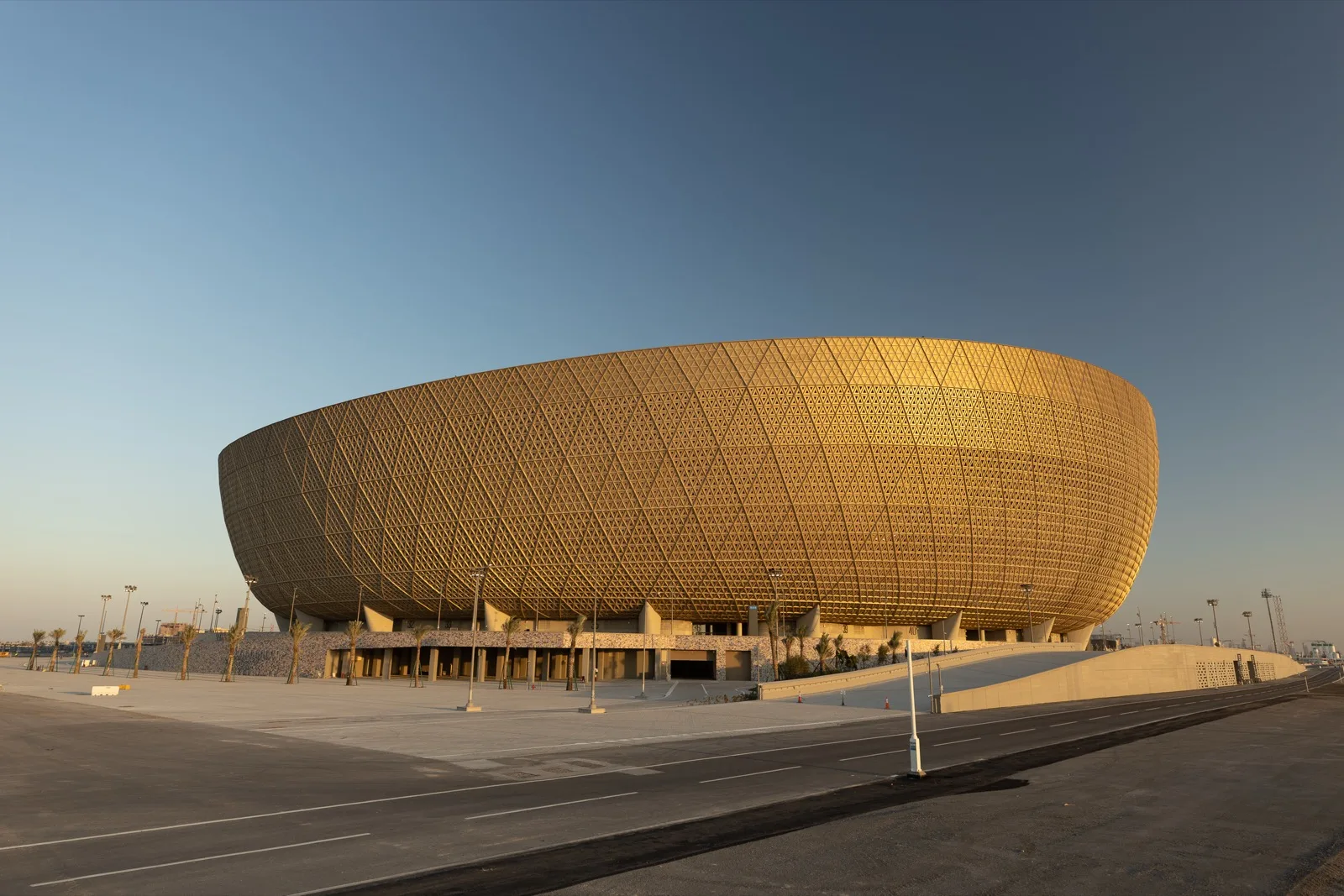
The concern is not abstract, given that the last Gulf World Cup, Qatar 2022 at venues like Lusail Stadium, was shadowed by questions over migrant-worker deaths. On the day of the 2034 award, Human Rights Watch and 20 other organizations issued a joint statement warning the tournament “will be tarnished by repression, discrimination and exploitation on a massive scale,” and arguing that “without competitive bidding, there was little prospect of bids being rejected.” FIFA had rated the Saudi bid only “medium” risk on human rights, a grade rights groups rejected.
“Medium” risk. FIFA’s own human-rights rating of the Saudi bid, which Amnesty and Human Rights Watch rejected as far too low. Same-sex relationships are criminalized in Saudi Arabia, and alcohol will be banned in stadiums, with officials saying fans can enjoy the tournament without it.
Saudi Arabia and its supporters frame all of this differently, as part of a Vision 2030 modernization opening the country to the world. Both things are being said at once, loudly, and the gap between them is the defining tension of this World Cup. In a comment widely recirculated in coverage of the bid, the Saudi crown prince Mohammed bin Salman brushed off the criticism: “If sportswashing is going to increase my GDP by 1%, then we’ll continue doing sportswashing.”
That’s the 2034 World Cup as it stands, roughly eight years out: an unprecedented building program, a genuinely new idea of what a stadium can be, and a human-rights debate that will follow every groundbreaking. Most of these venues are still renderings, the dates aren’t set, and even the megacity meant to hold the sky stadium is being redrawn. A lot can change before the first whistle. What won’t change is the scale of the bet Saudi Arabia is placing on football, and the size of the questions riding alongside it.
For the tournament happening right now, start with our World Cup 2026 hub. For the one in between, see the 2030 World Cup and its stadiums.
Sources
- FIFA’s 2034 tournament page and FIFA’s own Bid Evaluation Report. Host confirmation and the to-be-announced tournament details; and FIFA’s assessment of the bid, which states that “the Saudi Arabia bid proposes 15 stadiums across five proposed host cities, slightly above the minimum number of 14 stadiums required to host the competition”, names King Salman International Stadium as the venue proposed for the opening match and the final, and tabulates every venue with its host city, gross capacity, pitch type and build status.
- Al Jazeera: Saudi Arabia named 2034 World Cup host. The December 2024 award by acclamation and the 48-team, single-host format.
- ESPN: what you need to know about the 2034 tournament and on why Saudi Arabia is not building a stadium on top of a skyscraper. The bid process, the timing and heat question, cost context and the sportswashing quote; plus the reality check on the NEOM “sky stadium.”
- Olympics.com: 2034 World Cup stadiums. Venue-by-venue capacities and cities.
- Amnesty International: FIFA produces “whitewash” of Saudi bid. The human-rights evaluation criticism.
- Human Rights Watch: joint statement on the 2034 award. The 21-organization warning.
Stadium details were cross-referenced across the FIFA bid book, Saudi and international reporting, and the architects’ own pages. Every capacity is a planned figure for venues that are mostly pre-construction and is labeled as such; where sources disagreed, the number is given as a range. Human-rights claims and the sportswashing quote are attributed to the organizations and outlets that reported them.
Hero photo: King Abdullah Sports City Stadium by saudipics, CC BY-SA 4.0, cropped.