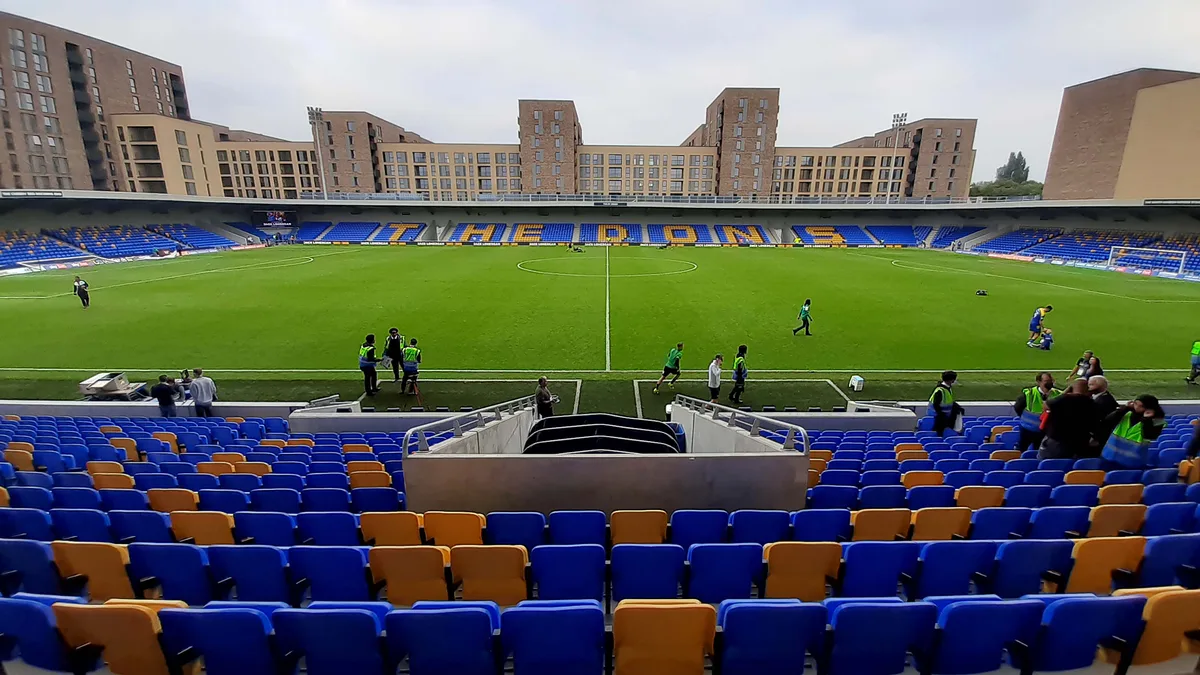
AFC Wimbledon’s stadium at Plough Lane cost £31,735,847.
That is the audited cost at 30 June 2021, the year end in which the stadium was moved out of assets under construction and into use, taken from the accounts of the company that owns it.
Divided by the ground’s capacity of around 9,200, it comes to about £3,450 a seat.
A housing developer paid £14m of it, and the accounts show exactly where that money went.
| Date | Cost | Basis | Per seat | |
|---|---|---|---|---|
| Build, at transfer into use | 30 June 2021 | £31,735,847 | AUDITED-FINAL | £3,450 |
| Cumulative | 30 June 2025 | £33,825,399 | CUMULATIVE, UNAUDITED | £3,677 |
What everyone else says
The published figures for Plough Lane are close to the filed one, which is unusual for this series.
Before the stadium was finished, Construction Enquirer reported in November 2019 that “costs have risen above the original £30m estimate for the 9,000 seat scheme”, and quoted the club: “Because of unforeseen planning delays and increased building costs, we will need to raise a further £11m”. When it opened, Last Word on Football put it at £32 million. The Wikipedia entry for the ground gives £34 million, with no source attached.
The audited build cost sits £1,735,847 above the original estimate and £264,153 below the £32m. Nobody has this badly wrong. None of these figures carries a basis, a date or a document, though, and the £34m sits nearer the later cumulative total than the build.
Where the real number is
The obvious place to look is the wrong one. AFCW Stadium Limited, company 04764828, owned Kingsmeadow, the club’s previous ground in Kingston, and has been dormant since its sale to Chelsea completed on 24 December 2018.
Plough Lane belongs to a different subsidiary. The Wider Interests of Football Limited, company number 10749941, was incorporated on 2 May 2017 and is registered at the stadium. Its accounts state its purpose in one line: “The principal activity of the company is the ownership of a football stadium.” Its directors’ report for 2021 says: “The new stadium built by AFC Wimbledon is held by this company.”
It is wholly owned by AFCW PLC, which is owned by the Dons Trust, the supporters’ trust behind the club. BDO LLP audited its accounts for every year to June 2018 through 2022. For 2023 and 2024 it took the audit exemption open to a subsidiary whose parent guarantees it, and for 2025 the small-company exemption. The build cost comes from an audited year. The latest balance does not.
To be precise about what exists: nobody filed a line reading “the stadium cost £31,735,847”. What was filed is the audited cost of a company’s tangible fixed assets, and that company’s only substantial asset is the stadium. Reading one as the other is an interpretation. It is a reasonable one, and it is ours.
The series
Cost of tangible fixed assets at each year end, in pounds, from the fixed asset note of each year’s accounts.
| Year end | Additions | Cost at year end | Where it sat |
|---|---|---|---|
| 30 June 2018 | 0 | ||
| 30 June 2019 | 4,243,794 | 4,243,794 | assets under construction |
| 30 June 2020 | 16,876,603 | 21,120,397 | assets under construction |
| 30 June 2021 | 10,615,450 | 31,735,847 | transferred to freehold |
| 30 June 2022 | 1,719,432 | 33,455,279 | |
| 30 June 2023 | 103,378 | 33,558,657 | |
| 30 June 2024 | 209,292 | 33,732,948 | disposals of 35,000 |
| 30 June 2025 | 224,526 | 33,825,399 | disposals of 132,075 |
Every year closes against the next year’s opening balance, to within a pound of rounding. The filings are scanned images with no text layer, so each figure was read rather than extracted, and the arithmetic is what confirms the reading.
The company started from nothing. It held no fixed assets at 30 June 2018, the land arrived on 24 December 2018, and work began in the first months of 2019. Merton Council records that the club moved in to play its fixtures in November 2020. The accounts for 2021 describe the stadium as “substantially completed in the year ended 30 June 2021”, which is the year the whole £31,735,847 left assets under construction and depreciation was charged for the first time, £104,859 of it.
Since then the line has grown by £2,089,552, most of it in the year to June 2022. In the accounts for 2024, £5,934,826 was reclassified from freehold property to plant and machinery, which changes how quickly it depreciates but not what it cost.
What the money bought, and what these filings will not say
The cost note splits the stadium two ways and no further: freehold property and, from 2024, plant and machinery. It never itemizes the stands, the roof or the groundworks. The directors’ reports name Buckingham Group Contracting as the builder, but no contract value appears.
What the policy note does say is what counts as cost: “purchase price, costs of site preparation, delivery, handling installation and any relevant professional and legal fees directly incurred”. Interest is not on that list. The stadium company paid interest on the money it borrowed during the build, £55,653 in the year to June 2020 and £366,056 the year after, and every pound went through the profit and loss account.
What these filings cannot settle is the land. The accounts record the transfer of “the land on which the stadium is now built” on 24 December 2018, give it no value, and keep land and buildings in one figure. Whether the site is inside the £31,735,847 is not answerable from these documents.
How it was paid for
The accounts list the sources in a single sentence. The stadium “was funded by a contribution from Merton Catalyst, with whom we made a joint planning application for the site, and the proceeds of the sale of Kingsmeadow, with the balance financed from a mixture of funds raised via equity (Seedrs crowdfunding campaign and 10% shareholding sold to Nick Robertson) and debt (bond raise and bridging loan with MSP Capital Limited).”
Merton Catalyst is the joint venture of Galliard Homes and Catalyst Housing, and its contribution was planning money. The stadium company booked it as income rather than deducting it from the asset: “Other income comprises a Section 106 payment of £13,000,000 (2019 - £1,000,000) received as a contribution towards the cost of building the stadium.” The two payments total £14,000,000, the figure the 2018 accounts had expected, and they amount to 44.1 percent of the build cost. Because they were booked as income, the £31,735,847 is the gross cost of the building, not what was left after the developer paid.
The sale of Kingsmeadow raised £7,600,000 for the group, according to the old stadium company’s accounts for 2019. The crowdfunding raised “nearly £2.5 million”, the same year’s report says. The amount Nick Robertson paid for his 10 percent is not stated.
The debt was the tightest part. On 10 July 2020 the stadium company took a £4,100,000 loan from MSP Capital, “secured against the freehold of the site of the new stadium” and due in April 2022. At the 2021 year end £3,486,845 was outstanding, and the auditor flagged a material uncertainty over going concern while the club sought the money to repay it. It was repaid during the following year, “via a mix of additional unsecured bonds, new equity and a loan note from a related party”, and the charges in favor of MSP were satisfied on 28 April 2022.
The bonds are what is left. The Plough Lane Bond “was launched by the Dons Trust in January 2020”, to help fund the new stadium, and its proceeds were lent on to the group. In the parent company’s 2025 accounts the Dons Trust and Plough Lane bonds stood at £7,946,633 including accumulated interest, repayable between July 2023 and June 2043 at fixed rates from 0 to 7 percent chosen by the holder. That year the club repaid £1.4m of maturing bonds and described the stadium as “free of secured debt”.
The stadium company itself owes £19,992,921 to the rest of the group, £18,374,077 of it to AFC Wimbledon Limited, which the accounts say “primarily relate to the costs incurred for building the new stadium”. The building is paid for. The money it was paid with is still being repaid, by supporters’ bonds that mature for another seventeen years.
What it means
Merton Council gives the ground “a total capacity of around 9,200 spectators”. Divided by that, the build cost comes to about £3,450 a seat and the cumulative total to about £3,677. The capacity is approximate and covers all spectators rather than counting seats, so these are comparisons, not measurements.
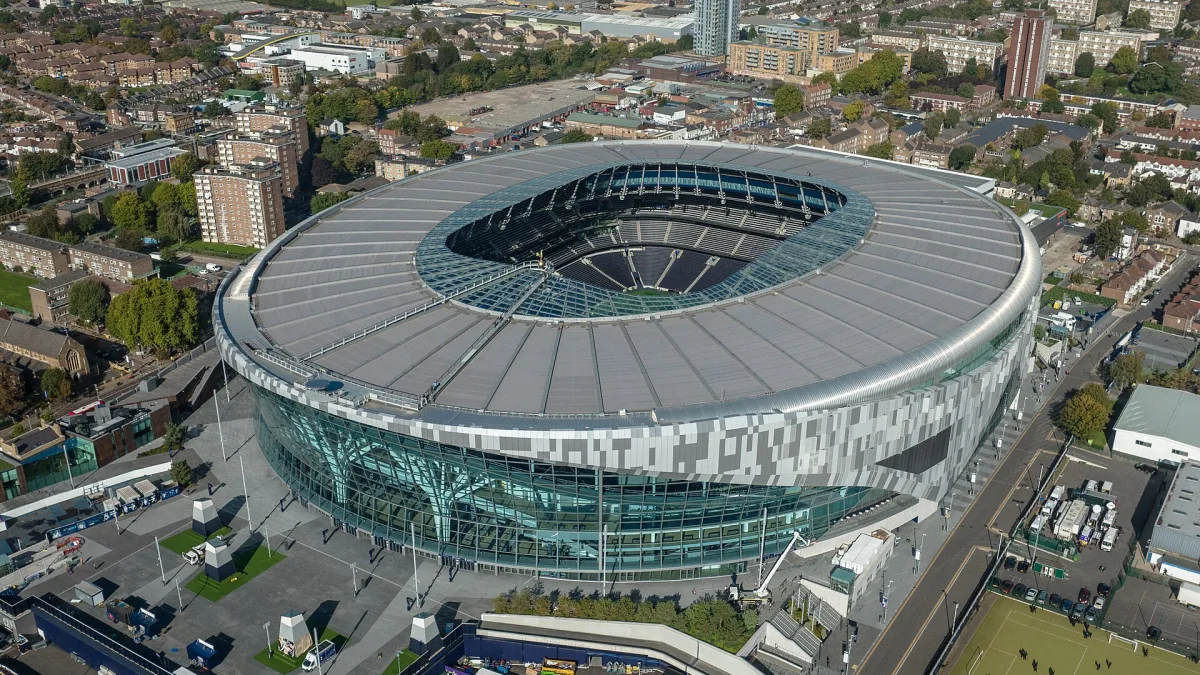
The comparison worth making is with Tottenham Hotspur Stadium, which cost £18,405 a seat on the same audited basis, as we set out in our reading of its accounts. Plough Lane cost less than a fifth as much per seat. One is a 62,850-capacity stadium with a retractable pitch. The other is the first phase of a ground with permission for 20,000. The accounts cannot say how much of the fivefold gap is ambition and how much is efficiency.
The more useful finding is the shape of the money. Almost half the building was paid for by a housing developer under a planning agreement, and the company records that as income rather than a discount. Miss that note and you either overstate what Wimbledon spent or understate what the stadium cost. Only one of those is the cost.
Sources
- The Wider Interests of Football Limited, company 10749941: the filing history, accounts for the years ended 30 June 2018 to 2025 (audited by BDO LLP for 2018 to 2022; unaudited from 2023 under the section 479A exemption, and for 2025 under section 477). The tangible fixed assets note carries the cost series; the directors’ reports carry the build history and the funding sources; other income carries the Section 106 payments; creditors and going concern carry the MSP loan and the intra-group balances. The charges register records the MSP charges and their satisfaction.
- AFCW Stadium Limited, company 04764828: the filing history, accounts for the years ended 30 June 2019 and 2021, for the sale of Kingsmeadow and its £7,600,000 proceeds.
- AFCW PLC, company 04764827: the filing history, consolidated accounts for the year ended 30 June 2025, also filed against its subsidiaries, for the bond balances, their terms and the 2025 repayments.
- Construction Enquirer: Grant Prior, 26 November 2019, for the original £30m estimate and the £11m shortfall. Last Word on Football: David Whitworth, 29 October 2020, for £32 million. These are the published figures the filings are tested against.
- Capacity: London Borough of Merton, Event Management and Safety Advisory Groups, 8 June 2023, which gives “a total capacity of around 9,200 spectators” and dates the move to November 2020.
Filings at Companies House are served as scanned PDFs with no text layer, so every figure here was read from the scanned page rather than extracted. Arithmetic was checked by confirming that opening balance plus additions, less disposals, equals the closing balance in each year. Every year closes.
Hero photo: The Ry Stand in Plough Lane Stadium by Steve Daniels, CC BY-SA 2.0, via Wikimedia Commons, cropped.
Figures from British statutory accounts are quoted as filed, British spellings included. The per seat figures are our own arithmetic, dividing a cost by an approximate total capacity. Where a published figure and a filed figure measure different things, this piece states both and names the document each came from.