Birmingham City sold St Andrew’s for £22,760,000 on 31 May 2019. The figure is in note 3 of the club’s accounts for the year to 30 June 2019, filed at Companies House, the UK’s public register of companies.
The buyer was a new stadium company, Birmingham City Stadium Ltd, incorporated on 20 May 2019. It and the club had the same ultimate parent, Birmingham Sports Holdings Limited, a Cayman Islands company listed in Hong Kong.
The same note records a profit on the sale of £17,188,766. The accounts are audited, meaning an independent firm checked them.
The cash flow statement, which tracks money arriving and leaving, shows the proceeds from selling property that year: nil. The price was booked as money owed to the club by another company in the group.
| Date | Figure | Basis | |
|---|---|---|---|
| Sale price, club to sister company | 31 May 2019 | £22,760,000 | price between two companies of one group |
| Club’s profit on the sale | year to 30 June 2019 | £17,188,766 | audited |
| Cash received from the sale that year | year to 30 June 2019 | nil | audited cash flow statement |
| Value of the ground, latest | 30 June 2025 | £19,610,000 | fair value, Knight Frank |
What everyone else says
BBC Sport reported on 7 January 2020 that the club “sold St Andrew’s to a company controlled by owner Paul Suen Cho Hung for £22.8m to bring pre-tax losses down to £8.4m last season.” It later says: “That sale brought the pre-tax loss down to £8.2m”. The club’s accounts give a loss before tax of £8,161,178, so £8.2m is the right one.
That article had the ground “leased back to the club for £1.25m per year for 25 years”. On 1 April 2021 the BBC reported “a 12-year deal backdated from May 2019 to run until May 2031”. Both are right. The lease of 31 May 2019 ran for 25 years and was cut to 12 from the same start date when the stadium company was sold in 2021.
The 2021 article ties a rent review in 2025 to “UK interest rates”. The parent’s Hong Kong announcement of the same deal ties it to the Retail Prices Index, a measure of inflation.
Sky Sports reported on 23 March 2019 that Birmingham were “handed an immediate nine-point deduction by the EFL”, the English Football League, for losing more than the £39m its rules permitted over three years.
Where the real number is
Both sides of the transaction filed accounts at Companies House.
Note 3 of the 2019 accounts of the seller, Birmingham City Football Club PLC, reads: “During the year the company disposed of freehold land & buildings to a wholly owned subsidiary of Birmingham Sports Holdings Limited. The directors received independent advice on the value of the asset at the date of disposal.”
| Note 3, profit on disposal | £ |
|---|---|
| Proceeds | 22,760,000 |
| Net book value | (7,037,591) |
| Release of deferred capital grant | 1,466,357 |
| Profit on disposal | 17,188,766 |
Net book value is what the ground was carried at in the club’s books: its cost, less depreciation. The deferred capital grant is grant money received in the past for the ground, held back in the accounts and released when the ground was sold.
The cash flow statement’s line for “Proceeds from sale of property, plant and equipment” reads nil (2018: £5,538). The receivables note, which lists money owed to the club, shows “Amounts owed by group undertakings” of £22,760,000 (2018: nil).
The stadium company’s accounts for 20 May to 30 June 2019 show investment property additions of £22,760,000, matched by “Amounts owed to fellow group undertakings” of £22,760,000. An investment property is a building held to earn rent. The two sets of accounts mirror each other to the pound.
Nobody filed a line saying St Andrew’s is worth £22,760,000. What was filed is the price one company in a group charged another for a building, settled by an amount owed between them, on advice the filings do not name. It is a price agreed inside a group. No open-market sale stands behind it.
A valuation report published by the Hong Kong-listed parent in November 2020 states, from Land Registry records, that “the registered owner of the property is Birmingham City Football Club PLC”. Searches published by the Blues Trust, the supporters’ trust, showed the same on 8 January 2020 and in April 2021. More than a year after the sale, the official register still named the club.
The series
The stadium company’s investment property note values the ground at each 30 June.
| Year end | Value in the accounts | Change | What it rests on |
|---|---|---|---|
| 2019 | £22,760,000 | price paid | independent advice at acquisition |
| 2020 | £20,600,000 | (£2,160,000) | JP Assets valuation at 28 February 2021 |
| 2021 | £20,600,000 | nil | same valuation |
| 2022 | £20,600,000 | nil | same valuation |
| 2023 | £20,600,000 | nil | same valuation |
| 2024 | £20,600,000 | nil | same valuation |
| 2025 | £19,610,000 | (£990,000) | Knight Frank LLP valuation at 30 June 2025 |
One valuation, dated 28 February 2021, carried the figure through five year ends.
The 2019 accounts held the property “at cost or valuation, net of depreciation and any impairment losses”. From 2020 the company used the fair value model, under which the building is carried at a valuation each year and is not depreciated. So the 2019 figure is a price and every later figure is a valuation.
The report by JP Assets Consultancy Limited in the parent’s November 2020 circular valued the stadium at £20,700,000 at 30 September 2020 on depreciated replacement cost: roughly, what it would cost to rebuild, less wear and age, plus the land. Knight Frank’s 2025 figure is stated as open market value under the valuation standards of the Royal Institution of Chartered Surveyors.
By our arithmetic, the 2025 value is £3,150,000 below the 2019 price, or 13.8% lower.
What the sale did to the club’s accounts
The club’s loss before tax for the year to 30 June 2019 was £8,161,178, from its cash flow statement. The year before, it was £37,461,303. By our arithmetic, without the £17,188,766 profit on the ground the 2019 loss would have been £25,349,944.
The nine-point deduction for breaching the EFL’s loss limit was handed down in March 2019. The stadium company was incorporated on 20 May 2019. The transfer was dated 31 May 2019. The club’s year ended on 30 June 2019.
We found no published EFL decision on the stadium sale.
Who owned the building next, and what they paid
According to the stadium company’s 2020 accounts, the Hong Kong-listed parent agreed on 9 October 2020 to sell 25% of the stadium company to Oriental Rainbow Investments Limited. On 31 March 2021 it agreed to sell the other 75%, with the loan the stadium company owed it, to Achiever Global Group Limited. Its announcement that day gives the price as about £0.02m for the shares and about £10.78m for the loan, paid in cash.
Under a loan reorganization deed that day, £14,374,800 of the stadium company’s debt to the club was reassigned. At 30 June 2021, its accounts show, it owed £10,781,100 to Achiever Global and £3,593,700 to Oriental Rainbow.
The change in ownership triggered a Stamp Duty Land Tax liability of £1,127,500, the tax on buying property in England (stadium company accounts, 2022 to 2024). The auditor reported a material uncertainty over the company’s ability to continue as a going concern, meaning to keep operating and pay what it owes, in four consecutive years, 2021 to 2024. The 2025 accounts carry no such warning.
On 13 July 2023 Shelby Companies Limited, owned by two Knighthead entities, bought 100% of the stadium company from Oriental Rainbow and Achiever Global. A share allotment return at Companies House shows 16,111,252 new £1 shares issued that day against loans owed to the sellers.
The parent’s circular of 27 June 2023 prices that agreement as a bundle: a stake in the club’s holding company, the entire share capital of the stadium company, and loans. It gives no separate price for the stadium company. It also says the lower Kop and the Tilton Road End had been closed for structural maintenance since December 2020.
Birmingham’s planned 62,000-seat stadium at Bordesley Green is targeted for 2030-31 and had no planning permission when we wrote about it.
The lease, the rent and the rebate
The parent’s announcement of 31 March 2021 records the varied lease: twelve years from 31 May 2019, £1.25m a year, with a rent review on 31 May 2025 by the March Retail Prices Index. The new rent must “equal or be greater than (A x 1.05) and must never be greater than (A x 1.22)”, A being the rent before the review: at least 5% more, at most 22% more.
The club also received “the right to set off the rent against any sum due and owing by BCSL”, the stadium company. It could pay its rent by cancelling money the stadium company owed it or its group.
The stadium company’s accounts show rental income of £1,250,000 in every year from 2020 to 2025. The 2025 accounts give future minimum rentals of £1,250,000 a year for each of the next five years, then £1,145,833. That is eleven months of rent, which ends the lease in May 2031.
So one document sets a review on 31 May 2025 with a floor of 5%. The other, accounts made up to 30 June 2025, still shows the rent at £1,250,000 for every remaining year and does not mention the review. A 5% rise would make it £1,312,500 a year. The accounts do not say what happened.
The same accounts record: “On 6 March 2024 a rental rebate of £1,642,447 was agreed to between BCSL and BCFC and has been included within exceptional administrative expenses”. BCFC is the club. The accounts give no reason.
What the figures are, and what they are not
£22,760,000 is a price inside a group. £20,700,000 is a depreciated-replacement-cost valuation, and £20,600,000 came from the same valuer five months later. £19,610,000 is an open-market valuation by another. None is what the ground cost to build, and none was tested by a sale to an outsider.
At the capacity of 29,409 given on the club’s own stadium page, the 2019 price works out at £774 a seat and the 2025 value at £667.
Those figures cannot be compared with the build costs we have read from filings. A build cost is money spent on construction. The St Andrew’s figures are a price between two companies of one group and two valuers’ estimates.
What these filings will not say
- Whether the club was ever paid the £22,760,000 in cash, and when. In 2019 both sides show it as owed. By 2021, £14,374,800 of the stadium company’s debt to the club had been reassigned to the new owners.
- What Knighthead paid for the stadium company in 2023.
- What happened at the 31 May 2025 rent review.
- Why the £1,642,447 rebate was agreed.
- What the structural works on the lower Kop and the Tilton Road End cost.
Sources
- Birmingham City Stadium Ltd, company 12004615: the filing history, accounts for the period to 30 June 2019 and the years ended 30 June 2020 to 2025, and the share allotment return of 13 July 2023. The investment property note carries the value series; the related party note carries the rent, the rebate and the balances owed to the club.
- Birmingham City Football Club PLC, company 00027318: the filing history, accounts for the year ended 30 June 2019, for the proceeds, the profit on disposal, the cash flow statement and the amount owed by the group.
- Birmingham Sports Holdings, Hong Kong filings: circular of 16 November 2020, with the original lease and JP Assets’ valuation report; announcement of 31 March 2021, with the 2021 sale and the varied lease; circular of 27 June 2023, with the Knighthead agreements and the stand closures.
- BBC Sport: 7 January 2020 and 1 April 2021. Sky Sports: 23 March 2019, for the nine-point deduction. These are the published reports the filings are tested against.
- Blues Trust: St Andrew’s ownership, January 2020 and the 2021 sale, April 2021, for the Land Registry searches.
- Capacity: Birmingham City FC, stadium information.
Filings at Companies House are served as scanned PDFs with no text layer, so every figure here was read from the scanned page rather than extracted, and checked by making each year’s opening and closing balances agree. The Hong Kong filings are text documents and are quoted as published.
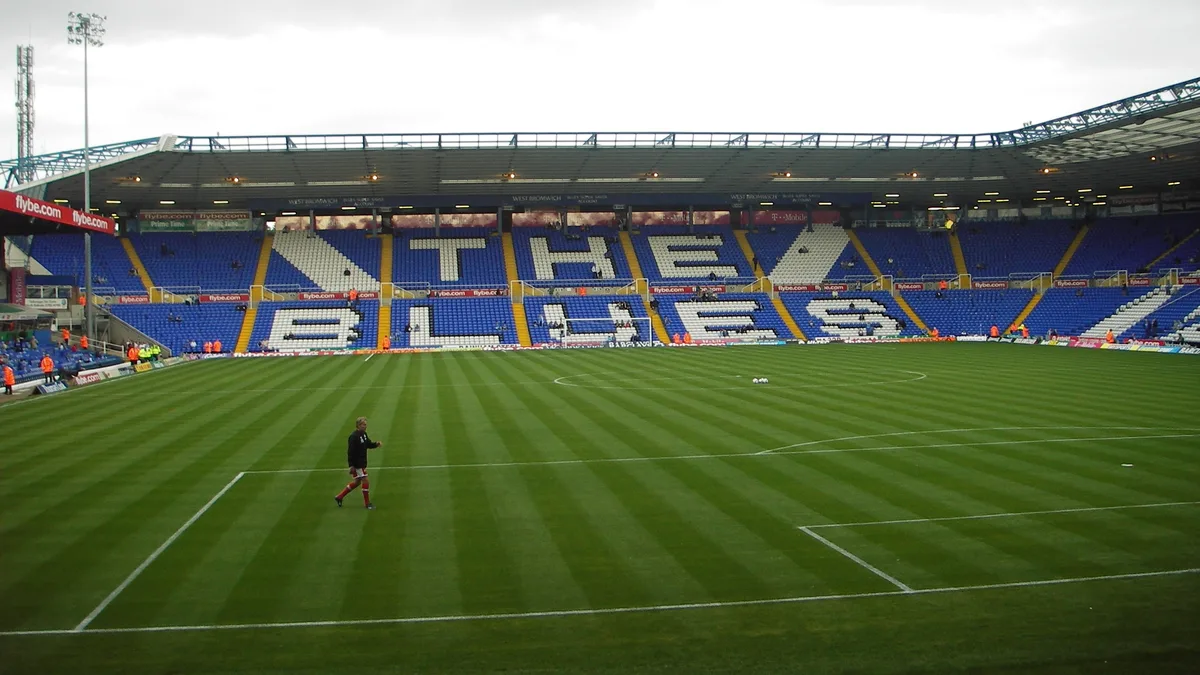
Hero photo: St Andrew’s by TuborgLight, CC BY-SA 3.0, via Wikimedia Commons, cropped.
Figures from British statutory accounts and Hong Kong filings are quoted as filed, British spellings included. The per-seat figures and the differences between figures are our own arithmetic. Where a published figure and a filed figure measure different things, this piece states both and names the document each came from.