About Old Trafford
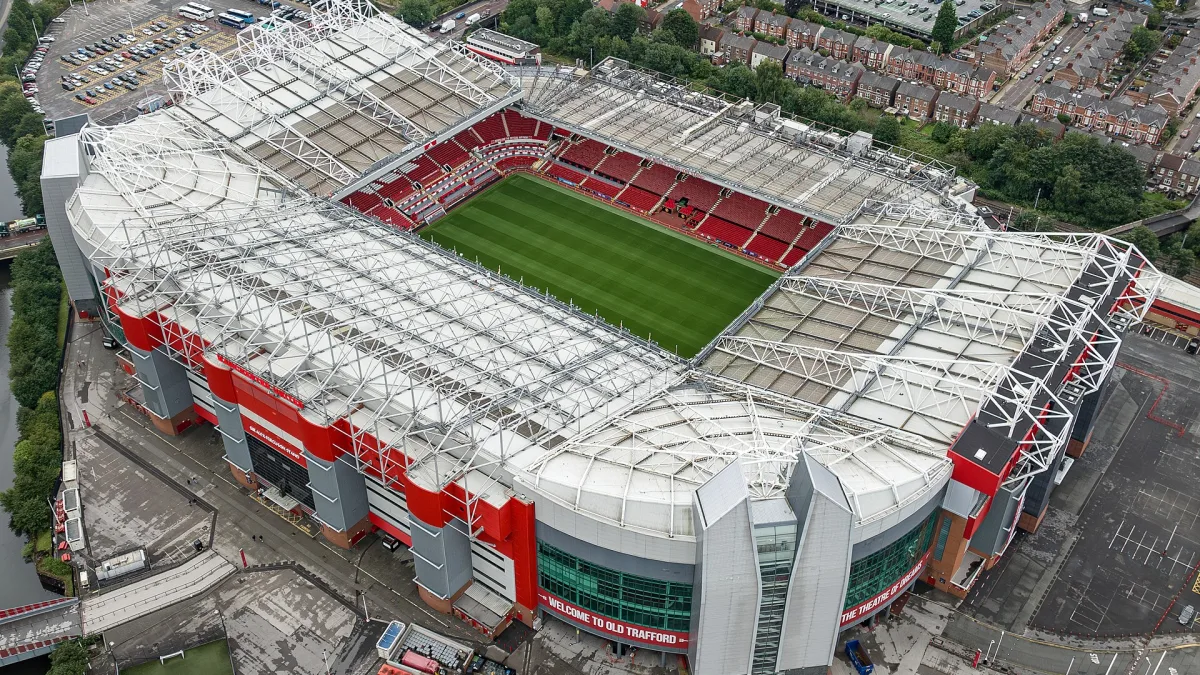
Walk up Sir Matt Busby Way on a match afternoon and the first thing you notice is the roof: a white steel canopy on the north side that reaches 58.5 metres (192 feet) from the back wall to its front edge, the largest cantilever in Europe when it went up in 1996. Under it is the largest club ground in Britain. Old Trafford holds 74,158, the Premier League’s figure for the start of the 2026-27 season, second in England only to Wembley, and Manchester United have played here since 19 February 1910, when a crowd of around 45,000 watched Liverpool win the opening match 4-3. A bad start. The club has lost fewer arguments since.
The nickname belongs to Sir Bobby Charlton. He called it the Theatre of Dreams, and the club put the phrase up in lights on the East Stand. Since the mid-1990s the ground has grown in three pushes (a three-tier North Stand in 1996, renamed for Sir Alex Ferguson in 2011, second tiers on the East and West stands in 2000, the two northern quadrants in 2006), each paid for by a team that kept winning, until the record crowd of 76,098 in March 2007 left just 114 seats empty. Then it stopped growing. Accessibility works have trimmed the number since, and the Sir Bobby Charlton Stand along the south side is still a single tier because a railway line runs directly behind it.
Archibald Leitch drew the original in 1909 for the brewer and chairman John Henry Davies, who wanted 100,000 places and settled for about 80,000 to keep the bill near £60,000 with the land included. The pitch measures 105 by 68 metres (115 by 74 yards), a Desso GrassMaster hybrid with 37 kilometres (23 miles) of heating pipe underneath, and every seat sits under a cantilevered roof, a program that began with the North Stand in 1965.
The guest list runs long: an FA Cup Final in 1915, three 1966 World Cup group games, a Euro 96 semi-final, the 2003 Champions League Final, nine matches of the 2012 Olympic tournament, the opening game of Women’s Euro 2022, and every Super League Grand Final since 1998 bar one. Plenty of grounds have had a big night. Few have had a century of them. What Old Trafford has not had is upkeep to match, and in May 2024 the roof leaked on live television. The club now plans a 100,000-seat replacement a few hundred metres away.
Getting to Old Trafford
Public Transit
Take the tram. Manchester’s Metrolink network puts three stops within ten minutes’ walk of the turnstiles, and on a matchday every alternative is worse.
→ Wharfside (Trafford Park line): The closest stop, across Trafford Wharf Road from the ground, about five minutes on foot.
→ Old Trafford (Altrincham line): Shared with the cricket ground, about half a mile away down Warwick Road and Sir Matt Busby Way. Direct from Piccadilly and St Peter’s Square. Matchday numbers here reach around 9,500 passengers against a normal 2,000, so turnstiles come out after the final whistle. Expect a queue.
→ Exchange Quay (Eccles line): On the Salford Quays side, under ten minutes’ walk to the ground, and often the calmest way home.
→ Trafford Bar: The interchange one stop short of Old Trafford, where the Altrincham and Airport lines meet. Not the nearest stop, but fans use it on matchdays because more lines call there and it is easier to reach than Old Trafford or Wharfside.
Buses 255, 256 and 263 run from Piccadilly Gardens to Chester Road and stop near Sir Matt Busby Way; the 250 stops on Wharfside Way outside the ground. The railway station wedged against the Sir Bobby Charlton Stand, Manchester United Football Ground, opened in 1935 for matchdays only and has not seen a train since 2018, at the club’s request, on safety grounds. Ignore it on the map.
Driving + Parking
Drive if you must, and only with a permit. The club’s own advice is blunt: roads around the ground, motorway network included, are “extremely busy” on matchdays, and Sir Matt Busby Way itself is usually closed to traffic. Use postcode M16 0RA on a matchday and M17 1FP at any other time.
→ From the M60: Leave at junction 7 and follow the A56 (Chester Road) toward Stretford for about 2 miles (3 kilometres) to the turn for Sir Matt Busby Way. From the west, the M56 feeds straight into the M60.
→ From the city center (about 2.5 miles / 4 kilometres): Chester Road (A56) southwest from Deansgate. Twenty minutes on a quiet day. Not on a match one.
Official matchday parking is in car parks E1 and E2, permit-only, entered from Wharfside Way; arrive via Chester Road and the stewards will send you around the traffic system, and the police may hold those cars back after the game. On non-matchdays visitors use E2 and the club’s lots are free. Locals rent out driveways on the residential streets around the ground through parking apps such as JustPark. Free cycle racks sit at car parks N2, E2 and W2. Bring your own lock.
Rideshare
Uber operates in Manchester and any black cab knows postcode M16 0RA. The club puts a taxi from Piccadilly station at about 15 minutes and £10, and from the airport at 20 to 30 minutes and around £35. After the match the roads lock solid; walk toward Chester Road or the Quays before you order, or ride the tram one stop and call a car from Trafford Bar.
From the Airport
→ Manchester Airport (MAN): About 9 miles (14.5 kilometres) south. Metrolink’s Airport line runs straight to Trafford Bar, around 45 minutes, from where it is one stop on the Altrincham line to Old Trafford, or a walk. The airport’s rail station also has frequent trains into Piccadilly, with a tram or a £10 taxi from there. A taxi door to door is 20 to 30 minutes and about £35 by the club’s estimate.
Watching a Match at Old Trafford
Start with the argument, because every visitor walks straight into it. José Mourinho spent the week of his first home league game in charge, in August 2016, saying that if a couple of thousand away supporters could be noisier than seventy-odd thousand at Old Trafford, “then we are in trouble.” Away fans have been saying it for years, less politely. One who completed the full set of Premier League grounds in 2025 ranked this one thirteenth of twenty and called it a tacky tourist trap, and the line that it feels more like the Tower of London than a football ground gets repeated because plenty of people half agree. So, in its way, does the club. It has consulted acoustic engineers, tried song sheets, and in 2019 turned about 1,200 seats in the first tier of the Stretford End into a dedicated atmosphere section after two seasons of fan-led trials.
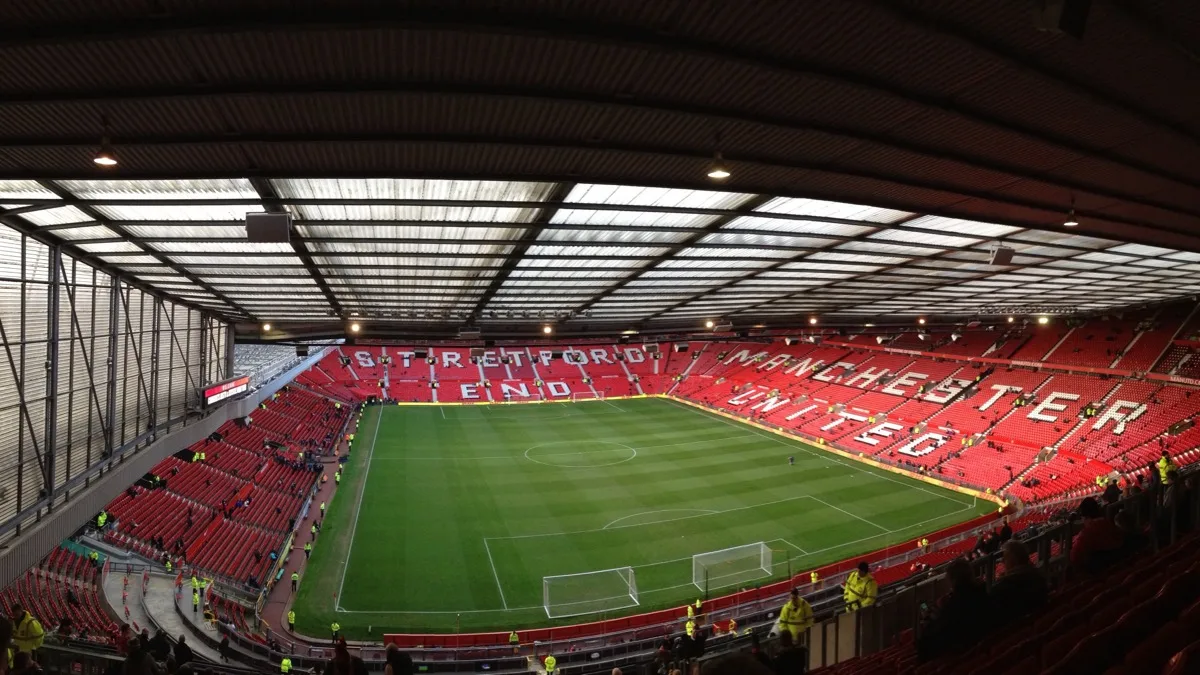
Then a derby or a European night arrives and the argument evaporates. The noise starts in the Stretford End at the west end and always has: the hard core sits there, the old K Stand crowd moved to its second tier when that opened in 2000 and hung their flags along the front rail, and the white seats spell the stand’s name across the red. Rail seating has arrived in stages: 1,500 seats in J Stand in the northeast quadrant in 2021, more beside the Stretford End in 2023, and from autumn 2025 around 6,000 in the Stretford End’s upper tier, doubling the ground’s safe-standing provision. Sing there. Watch from the Sir Alex Ferguson Stand along the north touchline: three tiers, the best sightlines in the ground, and a top tier high enough to read the whole game from. Away fans get the corner between the Sir Bobby Charlton Stand and the East Stand, about 3,000 of them at league games, under a low roof that makes a small crowd sound like a big one. They rate the view and the stewards and loathe the concourse. Cramped is the word every review uses.
The building’s age shows in the seats first. Every stand is cantilevered, so no pillar blocks the pitch, but the rows were laid out for a shorter era and anyone over about 190 centimetres (6 feet 3) will spend the afternoon with their knees in the seat in front. Then there is the roof. On 12 May 2024, in a downpour near the end of a home defeat to Arsenal, water came through it in sheets onto the Stretford End, and opposition fans have sung “Old Trafford is falling down” in every rain shower since. Sir Jim Ratcliffe’s version was gentler: the stadium had served the club brilliantly for 115 years and had fallen behind the best arenas in world sport.
Inside, the meat and potato pie is the item regulars vouch for. In 2025-26 a three-item meal deal cost £10.70, a 500 ml bottle of Carling £4.95 and a pint of Madri £5.75, both drinks up from £3.80 a season earlier (the club’s defense: still the ninth cheapest pint in the Premier League), and you drink it on the concourse, since alcohol cannot go to a seat with a view of the pitch at any English ground. The better ritual is outside. Lou Macari’s chip shop on Chester Road, owned by the man who played 329 league games in United’s midfield between 1973 and 1984, has a matchday queue that is part of the experience. The Bishop Blaize at 708 Chester Road is the nearest pub and the loudest: a Wetherspoons that is the home support’s singing pub, raises its prices on matchdays to pay for the door staff, and was named the chain’s best in the country in 2024. Away colors are not welcome; visiting fans drink at Salford Quays. Across the canal stands Hotel Football, the supporters’ hotel Gary Neville opened in 2015 with room for 1,500.
Arrive an hour early. Sir Matt Busby Way closes to traffic and fills with flag sellers, food trucks and buskers. The East Stand forecourt is a museum in its own right: Sir Matt Busby above the megastore, the United Trinity of Best, Law and Charlton across the road from him, and the Munich Clock at the corner of the East and South stands; round the corner on the north side, Sir Alex Ferguson stands in 2.7 metres (9 feet) of bronze outside the stand that carries his name. The harder part is getting in at all. Tickets go to members first and general sales for league games are rare, so buy an official membership (a little under £30 in 2026) and target the fixtures nobody fights over. A groundhopper who did exactly that in May 2026 paid €80 at face value for Brentford at home after being quoted more than €300 on the resale sites. The 2026-27 categories run from Category C, about £35-55 for the smallest league games, to Category A at £65-120 and up for the biggest, and pricing is its own talking point here: a £66 flat price for every remaining 2024-25 ticket, with concessions scrapped, brought protests, in a ground where protest has form. The pitch invasion against the Glazer ownership on 2 May 2021 forced a Liverpool match to be postponed.
Construction & Design
The ground exists because a brewer got tired of smoke. John Henry Davies had rescued Newton Heath from bankruptcy in 1902, renamed it Manchester United and put it in red, but its Bank Street pitch in Clayton sat under fumes from the factories next door. In 1909, with United league champions and about to win a first FA Cup, Davies bought a site beside the Bridgewater Canal off Warwick Road and hired Archibald Leitch, the Glasgow engineer behind Craven Cottage and White Hart Lane, with a one-line brief: create the finest stadium in the North. Davies wanted 100,000 places. Reaching that would have cost £30,000 over the estimate, so club secretary J. J. Bentley talked it down to about 80,000, and the whole job, land included, came in around £60,000 by the club’s own account (some later reckonings put it at £90,000). At a time when a transfer fee was about £1,000, the bill confirmed the nickname the club had carried since Davies took over. Moneybags United.
Leitch’s ground was one covered stand of 12,000 seats along the south side and room for 70,000 on open terraces that curved unbroken through the corners, with a gym, a plunge bath, billiards, massage and laundry rooms underneath, and attendants to steer the better-off customers between the tea rooms and their tip-up seats. Brameld and Smith of Manchester finished it in late 1909. Almost none of it survives. German raids on Trafford Park hit the ground twice, on 22 December 1940 and 11 March 1941, and the second flattened the main stand. United rented Maine Road from their rivals for eight seasons at £5,000 a year plus a share of the gate, and came home on 24 August 1949 to a stadium the War Damage Commission had helped rebuild with £17,478 for the stands and £4,800 for the rubble. Floodlights followed in 1957 for £40,000, with two sections of the main stand roof cut away so they would not throw shadows.
The 1966 World Cup modernized it. With three group games coming, the club replaced the United Road stand in 1965 with a 20,000-capacity structure by Mather and Nutter (now Atherden Fuller) whose roof hung from cantilevers at the back instead of pillars at the front, for £350,000, with the first private boxes at any British football ground. The East Stand followed in 1973, and the plan from then on was to bowl the whole ground in so the noise stayed inside. The Taylor Report interrupted: all-seater rules cut the capacity to about 44,000 in the early 1990s. Then success paid for the rebound. The club bought the 20-acre trading estate across United Road for £9.2 million in March 1995, demolished the North Stand and had a three-tier replacement up by May 1996 for Euro 96: Atherden Fuller design, Campbell Reith Hill engineering, Hilstone Laurie managing, £18.65 million, about 25,500 seats, and a cantilever roof reaching 58.5 metres (192 feet) from back wall to front edge, the largest in Europe. Second tiers on the East Stand and the Stretford End in 2000 took the ground to 68,217, and the two northern quadrants in 2005-06 added around 8,000 more for a peak of 76,212. The south side stayed single-tier because the railway runs a few metres behind it. Since then the number has only fallen: a reseat in 2009 took it to 75,957, an £11 million accessibility program from 2016 added 118 wheelchair positions and 158 amenity seats at a cost of around 3,000 places, and the Premier League’s figure for the start of 2026-27 is 74,158.
The pitch is 105 by 68 metres (115 by 74 yards), crowned about 23 centimetres (9 inches) higher in the middle than at the edges so the rain runs off, with 37 kilometres (23 miles) of plastic heating pipe buried 25 centimetres (10 inches) beneath it, and it is mowed three times a week from April to November. Out in car park E1 stands a 10-metre Hublot clock tower with four 2-metre faces, the largest the watchmaker has made.
The successor is already drawn. On 11 March 2025 the club confirmed a 100,000-seat stadium by Foster + Partners, to rise about 350 metres northwest of the current ground on a 25-acre site bought from Indurent in June 2026. Three masts, the tallest 200 metres (656 feet) and arranged as a trident after the club crest, will hold up an umbrella canopy over a plaza the architects describe as twice the size of Trafalgar Square; the parts would arrive prefabricated along the Manchester Ship Canal, the build is pitched at five years and the cost at around £2 billion, privately funded, with the 2030-31 season the target. What becomes of the old ground has not been said.
History of Old Trafford
The first goal here went to a United player and the first result went to Liverpool. Sandy Turnbull scored on 19 February 1910 in front of roughly 45,000, Liverpool won 4-3, and United then went almost a year without losing at home again on the way to the 1911 league title. A journalist that day called the place unrivaled anywhere in the world. That stuck, and so did the nickname Davies’s money had already earned the club.
- 1911 and 1915 FA Cup Finals: Before Wembley existed the final moved around, and Old Trafford staged the 1911 replay (Bradford City 1-0 Newcastle United, 58,000) and the 1915 final, Sheffield United 3-0 Chelsea before 49,557 spectators, so many of them in uniform that it became the Khaki Cup Final.
- Crowd of 13 (7 May 1921): A Second Division match between Stockport County and Leicester City, moved here from Edgeley Park, drew an official attendance of 13, with thousands of leftover spectators from the United game earlier that day watching for free.
- Record attendance (25 March 1939): 76,962 for the FA Cup semi-final between Wolverhampton Wanderers and Grimsby Town. Not a United match, and never beaten.
- Bombed and rebuilt (1940-49): Raids on 22 December 1940 and 11 March 1941 hit the ground, the second destroying the main stand. United rented Maine Road for eight seasons and returned on 24 August 1949, when 41,748 saw a 3-0 win over Bolton Wanderers.
- Munich (6 February 1958): The air disaster that struck the Busby Babes is marked by the Munich Clock, the plaque on the East Stand, and the original players’ tunnel, the only surviving piece of the 1910 ground, renamed the Munich Tunnel on the fiftieth anniversary in 2008.
- 1966 World Cup: Three Group 3 games: Portugal 3-1 Hungary (13 July, 29,886), Portugal 3-0 Bulgaria with a Eusébio goal (16 July, 25,438) and Hungary 3-1 Bulgaria (20 July, 24,129). Modest crowds for a tournament remembered as a national festival.
- 1970 FA Cup Final replay (29 April 1970): Chelsea 2-1 Leeds United before 62,078.
- Euro 96: Three group games, then the quarter-final in which Germany beat Croatia 2-1 (23 June, 43,412) and the semi-final in which France and the Czech Republic drew 0-0 before the Czechs won 6-5 on penalties (26 June, 43,877).
- Super League Grand Final (1998 onward): Rugby league’s showpiece has been played here every year since 1998 except 2020, following the Premiership Finals the ground had hosted since 1986-87.
- 2003 Champions League Final (28 May 2003): Milan and Juventus drew 0-0 through extra time and Milan won 3-2 on penalties, Andriy Shevchenko converting the decisive kick, before 62,315 in the first all-Italian final.
- Record all-seater crowd (31 March 2007): 76,098 saw United beat Blackburn Rovers 4-1, leaving 114 of the 76,212 seats empty.
- 2012 Olympics: Nine matches, including Great Britain’s 1-1 draw with Senegal before 72,176 and the women’s semi-final on 6 August in which the United States beat Canada 4-3 after extra time, Alex Morgan heading the winner in the 123rd minute.
- Rugby League World Cup finals (2000, 2013, 2022): Australia beat New Zealand 40-12 in 2000 (44,329) and 34-2 in 2013 before 74,468, a world record for a league international, then beat Samoa 30-10 in the delayed 2021 final in November 2022 (67,502).
- Women’s Euro 2022 opener (6 July 2022): England beat Austria in front of 68,871, then a record for a Women’s Euros match, until the Wembley final drew 87,192 on 31 July.
- England’s return (19 June 2023): The men’s team came back for the first time since 2007 and beat North Macedonia 7-0 before 70,708.
The odd thing about Old Trafford’s history is how much of it belongs to other people: a Wolves-Grimsby crowd holds the record, the FA Cup finals were neutral, rugby league fills it every autumn, and its biggest final was contested by two Italian clubs. The club moves about 350 metres northwest when the new ground opens. The building, 116 years and two bombing raids old, is nearer the end of its story than the beginning.
Sources & Further Reading
- Manchester United official site: manutd.com. The club’s account of the 1910 build and the 1930s, plus visitor, travel and new-stadium announcements.
- FIFA: inside.fifa.com. Archibald Leitch as architect, the first game against Liverpool on 19 February 1910, “two destructive bombing raids, the first on 22 December 1940, and the second on 11 March 1941, which destroyed most of the stadium, including the club’s prize asset; the main stand”, the 1949 reopening, “the first private boxes at a British football ground” in the 1965 North Stand, the drop “from 80,000 to 44,000” after the Taylor Report, 68,217 by the 2003 European final, and the Theatre of Dreams phrase “coined by Sir Bobby Charlton”.
- Wolverhampton Wanderers: wolves.co.uk. One of the two clubs that played it: the 76,962 who watched the FA Cup semi-final against Grimsby Town on 25 March 1939, which “remains a record Old Trafford gate”.
- UEFA: uefa.com. The Women’s EURO 2022 opener drew “a UEFA Women’s EURO record crowd of 68,871”.
- Premier League Handbook 2026/27: resources.premierleague.pulselive.com. The league’s club directory (PDF), including the 74,158 capacity at the start of the season and pitch dimensions.
- Architects’ Journal: architectsjournal.co.uk. The Foster + Partners masts, canopy and 100,000-seat replacement next door.
- The 1888 Letter, “The Opening of Old Trafford”: the1888letter.com. Contemporary press accounts of the 1910 opening, drawing on Simon Inglis.
- Fan accounts: reddit.com/r/PremierLeague. A supporter who has visited every Premier League ground, on Old Trafford now.
Sources are cross-referenced where they disagree; contested figures are noted in the text with the competing values.
Quick Facts
Everything you need at a glance.
Stadium specs
- Capacity
- 74,158
- Opened
- 1910
- Cost
- Around £60,000 (1909-10); £18.65 million (North Stand, 1995-96)
- Roof
- Cantilever (all four stands covered)
- Surface
- Desso GrassMaster hybrid grass
- Tenants
- Manchester United (Premier League)
Construction & location
- Groundbreaking
- 1909
- Architects
- Archibald Leitch (original ground, 1909-10), Atherden Fuller (Sir Alex Ferguson Stand, 1995-96)
- Engineering
- Campbell Reith Hill (Sir Alex Ferguson Stand, 1995-96); the 1910 ground's engineer is not separately recorded
- General contractor
- Brameld and Smith of Manchester (1909-10)
- Address
- Old Trafford, Sir Matt Busby Way, Old Trafford, Manchester M16 0RA, England, UK
- GPS
- 53.4631°N, 2.2914°W
Photo Gallery
Fun Facts
The all-time record crowd, 76,962 on 25 March 1939, was not for a Manchester United match. It was an FA Cup semi-final between Wolverhampton Wanderers and Grimsby Town, and the all-seater era has never come closer than 76,098.
Under the pitch run 37 kilometres (23 miles) of plastic heating pipe, buried about 25 centimetres (10 inches) down, and the surface is crowned roughly 23 centimetres (9 inches) higher in the middle than at the touchlines so the rain runs off.
On 7 May 1921 the official attendance for a Second Division match here between Stockport County and Leicester City was 13, although thousands who had stayed on from the United game earlier that afternoon watched for nothing.
Stadium Location
Frequently Asked Questions
- Where are the best seats at Old Trafford, and where do away fans sit?
- For the football, the Sir Alex Ferguson Stand on the north touchline. Its upper tier is high enough to show you the whole shape of a game. For noise, the Stretford End at the west end, where the hard core sits, the flags hang from the second tier, and most of the rail seating is. Away supporters get the corner between the Sir Bobby Charlton Stand and the East Stand, roughly 3,000 places at league games under a low roof that flatters the noise of a small crowd. Every stand is cantilevered, so there are no pillars anywhere, but the legroom is tight if you are tall.
- Is Old Trafford loud?
- Honestly, it depends on the fixture. José Mourinho complained in 2016 that a couple of thousand away fans could out-sing seventy-odd thousand home ones, visiting supporters still call it a tourist trap, and the club has tried acoustic engineers, song sheets and a dedicated atmosphere section in the Stretford End to fix it. Then a derby or a European night arrives and none of that applies. Big matches here are as loud as anywhere in England; a routine Saturday against a mid-table side can be quiet.
- How do I get Manchester United tickets as a visitor?
- Become an official member, then aim low. Tickets go to season-ticket holders and members before any general sale, and general sales for league games almost never happen. A membership cost a little under £30 in 2026, and with it a Brentford fixture sold at face value, about €80, on the club's site, against €300 and more on resale. For 2026-27 the club's categories are Category C at about £35-55, Category B at £45-75 and Category A at £65-120 and up.
- How do I get to Old Trafford by tram?
- Three Metrolink stops are within ten minutes' walk. Wharfside on the Trafford Park line is directly across the road from the ground. Old Trafford on the Altrincham line, shared with the cricket ground, is about half a mile away and runs direct from Piccadilly and St Peter's Square. Exchange Quay on the Eccles line is a quieter option afterward. The railway station beside the Sir Bobby Charlton Stand, Manchester United Football Ground, has not had a train since 2018, so ignore it on the map.
- Is there parking at Old Trafford?
- Only with a permit on matchdays. The club's official parking is in car parks E1 and E2, reached from Wharfside Way, and stewards will turn you around if you arrive via Chester Road; supporters parked there may also be held back after the game on police instructions. Use postcode M16 0RA on a matchday and M17 1FP otherwise. On non-matchdays visitors use E2, and the club's lots are free. Private driveways on the residential streets around the ground are listed on parking apps such as JustPark for matchdays.
- What should I eat and drink at Old Trafford?
- Inside, regulars swear by the meat and potato pie; a three-item meal deal was £10.70 in 2025-26, a 500 ml bottle of Carling £4.95 and a pint of Madri £5.75, and you drink on the concourse, since English grounds do not allow alcohol within view of the pitch. Outside is better. Lou Macari's chip shop on Chester Road, owned by the former United midfielder, has a matchday queue that is part of the ritual, and the Bishop Blaize at 708 Chester Road is the nearest pub and the singing pub for the home support. It is home fans only in practice, so visiting supporters drink at Salford Quays.
- Can I tour Old Trafford when there is no match on?
- Yes. The stadium tour takes you through the Sir Alex Ferguson Stand, the players' tunnel and dressing rooms, the dugouts and pitchside, then into the Manchester United Museum, which opened in 1986 as the first of its kind and moved to the North Stand in 1998, where Pelé opened it. Dates and prices are on the club's site; book after the fixture list settles, because home games move the schedule. Allow an extra hour for the museum.
- Is Manchester United leaving Old Trafford?
- The plan is to build next door rather than renovate. On 11 March 2025 the club confirmed a 100,000-seat stadium designed by Foster + Partners, three masts (the tallest 200 metres) holding up an umbrella canopy over a plaza the architects compare to two Trafalgar Squares, at a cost put around £2 billion and privately funded. In June 2026 it bought the 25-acre site about 350 metres northwest of the current ground, and the target is the 2030-31 season. What happens to the old stadium afterward has not been announced.
- Why is Old Trafford called the Theatre of Dreams?
- Sir Bobby Charlton coined it. The phrase has since gone up in lights on the East Stand and is used by the club everywhere, which is why away fans enjoy the 'Old Trafford is falling down' chant so much when it rains.
- Does the roof at Old Trafford really leak?
- It did, on television, on 12 May 2024, late in a home defeat to Arsenal: water poured through onto the Stretford End, the footage went around the world, and the leak became the shorthand for a ground that has had no major upgrade since the 2006 quadrants. Sir Jim Ratcliffe's own verdict, 115 years of brilliant service and a ground now behind the best arenas in world sport, is the argument for the new stadium.
- Is Old Trafford the biggest stadium in England?
- The biggest club ground, yes. At 74,158 for the start of 2026-27 it is second only to Wembley (90,000) among English football stadiums and the largest home ground of any British club. It peaked at 76,212 after the 2006 expansion; accessibility upgrades have trimmed it since.
- What is worth seeing outside the ground before kick-off?
- Give it an hour. Sir Matt Busby Way closes to traffic and fills with stalls, food trucks and flag sellers, and the East Stand forecourt is a small museum in itself: Sir Matt Busby's statue above the megastore, the United Trinity of Best, Law and Charlton across the road from him, the Munich Clock at the corner of the East and South stands, and the Munich plaque at the East Stand's south end. Sir Alex Ferguson's statue is round the corner on the north side, by the stand named after him. Hotel Football, Gary Neville's supporters' hotel, sits across the canal.
- Does anyone other than Manchester United play at Old Trafford?
- Rugby league, above all. The Super League Grand Final has been played here every year since 1998 bar 2020, and the ground staged the Rugby League World Cup finals of 2000, 2013 (a world-record 74,468 for a league international) and the 2021 tournament played in 2022. It also opened UEFA Women's Euro 2022 before 68,871, hosted 14 England home games while Wembley was being rebuilt, and staged the 2003 Champions League Final and nine matches of the 2012 Olympic football tournament.
Last updated: 2026-08-28