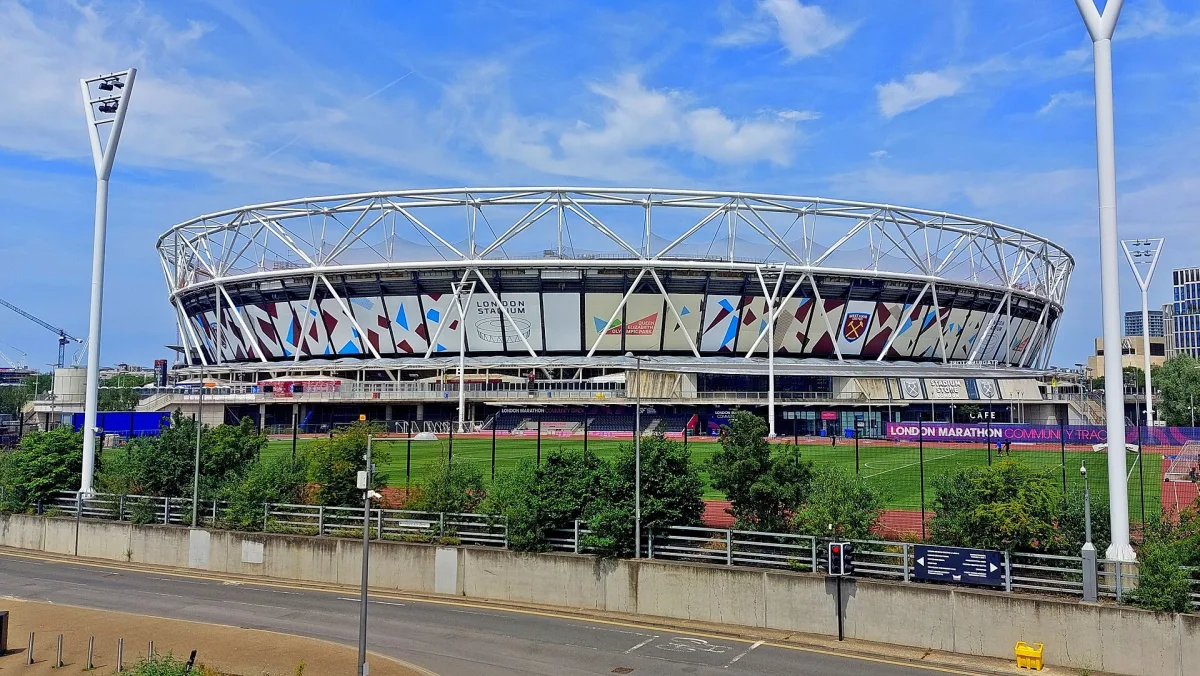
About London Stadium
Come out of Stratford station and the ground is still fifteen minutes away, over a bridge, past Westfield, and onto an island. That last part is not a figure of speech. The River Lea runs down one side of the site, the City Mill River and the Old Pudding Mill River close the loop, and St Thomas’ Creek sits 200 metres (660 feet) to the south, so every one of the 62,500 people at a full house crosses water to get in. London put its Olympic stadium on a scrap of former industrial land in the Lower Lea Valley, 10 kilometres (6 miles) east of the middle of the city, and the walk is still the first thing anyone mentions.
Three capacity figures circulate, and all three are correct. For football the regulated number is 62,500, set when West Ham reconfigured the West Stand lower tier for the 2022-23 season. The concession agreement that governs the tenancy uses a different one: a deed of variation signed in December 2021 defines Complete Capacity in football mode as 66,513 spectator seats, including at least 3,400 club seats, plus a minimum 1,500 more in the West Stand, for a total of at least 68,013. The gap between the two, around 5,500 seats, is the expansion the club keeps talking about. For concerts the stadium lists 80,000, which is what it held across the 2012 Olympic and Paralympic Games. Which number you meet depends on who is asking.
The venue opened on 5 May 2012, shut for rebuilding in 2013, and reopened in 2016 as something structurally different. West Ham United arrived that August on a 99-year lease at £2.5 million a year, and were relegated to the EFL Championship at the end of 2025-26 after fourteen seasons in the Premier League. UK Athletics holds a 50-year agreement of its own and takes the place over each summer for the London leg of the Diamond League. That dual tenancy is the source of everything good and everything difficult about the building. The track stays. The football pitch, 105 by 68 metres (115 by 74 yards) of Desso GrassMaster hybrid over under-soil heating, sits inside it.
Ownership has moved around almost as much as the seating. London Stadium LLP holds it today, under the Greater London Authority, after the London Legacy Development Corporation handed over its interest in a restructuring completed in January 2025. LS185 runs it day to day. Nobody has ever bought the naming rights, which is why a stadium in a city of nearly nine million is called, flatly, London Stadium.
Getting to London Stadium
Public Transit
Four stations serve the ground and none of them is at it. Stratford is the one the stadium recommends and the one almost everyone uses: Central and Jubilee lines, the Elizabeth line, the DLR, London Overground’s Mildmay line and National Rail into Liverpool Street, with 58 trains an hour by the stadium’s own count and around 20 bus routes on top.
→ Stratford: About 15 minutes on foot through Queen Elizabeth Olympic Park. Away guides call the route poorly signposted, which it is, so follow the claret shirts. A free accessible shuttle runs from platform 13 at the end of the Jubilee line.
→ Pudding Mill Lane (DLR): The closest station and much the calmest way out. One stop to Stratford, or south toward Canary Wharf.
→ Hackney Wick (Overground): A canal-towpath walk in from the north-west, and the route the locals use.
→ Stratford International: Seven minutes from St Pancras on High Speed 1, four trains an hour. No international services actually call here.
Going home is the part to plan. A full house empties onto a small number of bridges, and 30 minutes to clear the park and reach a train is normal. Pudding Mill Lane exists for exactly this reason and far too few people use it.
Driving + Parking
Don’t. There is no public matchday parking at the stadium, and roads around the park close three hours before events, so a car cannot reach the gates even to drop somebody off. The nearest public car parks are at Westfield Stratford City, Stratford International and the Stratford shopping center, all of them a walk and all of them full early on event days.
→ From central London: A11 and A12 east, roughly 30 minutes without traffic and considerably more with it. Satnav postcode E20 2ST.
→ From the M25: Junction 27 to the M11, then the A12 south. About 40 minutes clear.
Cycling is the underrated option: the park is laced with paths and has cycle hire docking stations, and a bike gets you out of Stratford in about the time it takes to reach the front of the queue at the station.
Rideshare
The stadium publishes no dedicated rideshare zone, and the road closures make one impractical. What works is meeting your driver back at Westfield Stratford City or on the far side of Stratford station, a 15-minute walk that will still beat waiting for a car that cannot get to you. Fares into central London usually run £20 to £35, more when a concert lets out at eleven.
From the Airport
→ Heathrow (LHR): The Elizabeth line runs from Stratford, 60 to 75 minutes depending on the terminal. No changes, and the best airport link of any stadium in London.
→ London City (LCY): About 25 minutes on the DLR via Canning Town. The closest airport to the ground by some distance.
→ Stansted (STN): Stansted Express from Liverpool Street, which is a handful of minutes from Stratford on the Elizabeth line.
→ Gatwick (LGW): Allow 90 minutes. Cross to London Bridge or Victoria and take a fast train south.
Watching a Match at London Stadium
Everything people say about this stadium comes back to the running track. The nine-lane Mondo surface that made the place an Olympic venue is also what stands between the front row and the touchline, and no amount of claret carpet laid over it, £250,000 worth in 2019, changes the geometry. Reviewers describe fans as housed incredibly far away from the action compared with other grounds. Paul Fletcher, a stadium design consultant, has said outright that it should be demolished. West Ham have spent real money disagreeing with him: about £5 million in 2020 to rebuild the north and south lower tiers and drag some seats four metres (13 feet) forward, then the West Stand reconfiguration that lifted football capacity to 62,500 in 2022.
So choose carefully. The Billy Bonds Stand is the single-tier kop along the east side, named in March 2019 for the man who played 799 games for the club, and it is where the noise lives. The Bobby Moore Stand behind one goal takes the rest of the singing. The West Stand is the main side, with the tunnel and the boxes. Away supporters get a corner of the Sir Trevor Brooking Stand, about 3,000 seats in the league and over 8,000 for a cup tie. The one rule that holds everywhere: lower tier over upper. From the top row the game is a rumor.
Food is straightforward and the pie is the order. Around 35 catering outlets ring the concourses, most of them selling a pie with a pint somewhere in the £7 to £8.50 range depending on how early you buy it, with pints alone pushing past £6. Drinking is the harder problem. This is a park, not a high street, so there is no ring of Victorian pubs the way there was around the Boleyn Ground. Most visitors end up in Westfield Stratford City, which has become the matchday pub by default, or drink in central London and travel out. The genuine article, a proper pie and mash shop, is a bus ride away in Poplar.
Then the bubbles. Machines along the touchline push foam out over the pitch in the minutes before kickoff while the ground sings an old song about bubbles that fade and die, and no visiting supporter has ever found that normal. West Ham brought the ritual over from the Boleyn Ground in 2016, and of everything that was supposed to get lost in the move, it is the thing that traveled best. Outside, in Champions Place, Bobby Moore, Geoff Hurst and Martin Peters stand in bronze with the 1965 European Cup Winners’ Cup, Peters’ ashes set into the foundation. It is the one corner of the site that feels like it belongs to a football club rather than to a legacy plan.
Construction & Design
In October 2006 the London organizing committee opened exclusive negotiations with Sir Robert McAlpine and Populous for the design-and-build contract, because nobody else had met the bidding criteria. The design went public on 7 November 2007. Populous worked to an ethos it called embracing the temporary: the government wanted an athletics venue that would be largely taken apart afterward, so the architects built a stadium in two halves, one permanent and one designed from the start to be unbolted.
The permanent half is a bowl cut into the soft London clay, 25,000 seats on concrete rakers, sitting on 5,000 piles driven as deep as 20 metres (66 feet), and poured from a low-carbon concrete carrying 40 percent less embodied carbon than the standard mix. The temporary half was a demountable steel and precast upper tier for another 55,000, measuring 315 by 256 metres (344 by 280 yards) and standing 60 metres (197 feet) high. The whole thing used about 10,700 tonnes of steel, roughly a quarter of what went into Beijing’s Bird’s Nest and 75 percent lighter, with the compression truss built partly from large-diameter pipe left over from North Sea gas projects and the paving from recycled granite. Materials arrived by train and barge rather than lorry. Construction started three months early in May 2008 and finished on 29 March 2011, more than two months ahead of schedule, at £486 million against the Olympic Delivery Authority’s £496 million allocation.
The critics were not kind. Ellis Woodman called the design pretty underwhelming, Tom Dyckhoff went with tragically underwhelming, and a Guardian panel of architects settled on an Ikea stadium. One reviewer got as far as a bowl of blancmange. It was nominated for the 2012 Stirling Prize anyway, and lost.
The transformation between 2013 and 2016 is the more interesting engineering. Balfour Beatty stripped the original cable-supported fabric roof, which had covered only about two-thirds of the seats from 70 metres (230 feet) above the pitch, and replaced it with a fixed structure of 45,000 square metres spanning a maximum of 84 metres (92 yards). Populous calls it the largest single-span cable-net stadium roof in the world. It covers every seat, and it was shaped deliberately to bounce sound back at the pitch and away from the flats next door. The fourteen triangular floodlight towers that once sat on top were inverted and hung underneath it, each 18 metres (59 feet) tall, weighing 45 tonnes and suspended 30 metres (98 feet) above the floor. A steel halo carrying 96 turnstiles went around the outside. The track was relaid in May 2016 with 17,000 square metres of Mondotrack WS.
And then there is the seating, the part that has never worked as sold. The lower bowl was supposed to be fully automated, rolling over the track for football and back again for athletics at a promised £300,000 a changeover. The original supplier collapsed into administration in 2015, weeks before the Rugby World Cup. The first proper move, in 2017, cost around £12 million; the following year’s came in near £4 million. The contractor brought in afterward quotes 32,000 man hours to complete one. It is described now as relocatable seating rather than retractable, an admission dressed as a word. In July 2025 the roof gained something that has worked exactly as promised: 6,500 square metres of solar membrane, funded through a £4.35 million climate investment from the Mayor of London’s Green Finance Fund, generating more than 850,000 kilowatt hours a year and saving over 200 tonnes of carbon.
History of London Stadium
The stadium exists because Beijing won the 2008 Olympics. That closed the door on a British bid for those Games and opened one for 2012, and the British Olympic Association had already spent years weighing two options: a west London plan built around Wembley, and an east London plan that would drag regeneration through the Lower Lea Valley. London chose the east, won the vote in July 2005 and started clearing Marshgate Lane. Among the things found on the site was a small nuclear reactor, left from Queen Mary College’s department of nuclear engineering.
What to do with it afterward took a decade to settle. The original legacy plan was a 25,000-seat athletics stadium until Boris Johnson became mayor in 2008 and reopened the question. In February 2011 the Olympic Park Legacy Company picked a West Ham and Newham Council bid over a Tottenham and AEG proposal that would have demolished the stadium and rebuilt it for football alone. Then came legal challenges from Tottenham and Leyton Orient, a state-aid complaint to the European Commission, and a data-protection scandal that ended with three men fined £123,250 between them. The award was canceled in October 2011, the stadium stayed in public hands, and the rerun offered a tenancy rather than a sale. West Ham won that one too, named preferred bidder by the London Legacy Development Corporation in December 2012.
Landmarks along the way:
- 27 July 2012: The Olympic opening ceremony, in a bowl wired with 70,500 LED paddles between the seats that turned the stands into one video screen and took a Guinness World Record.
- 9 August 2012: David Rudisha ran 1:40.91 to win the Olympic 800 metres, the first man under 1 minute 41 seconds and the first world record in an Olympic 800 metres final since 1976. Both 4 x 100 metres relay world records fell on the same track that week.
- 30 October 2015: South Africa beat Argentina 24-13 in the Rugby World Cup bronze final in front of 55,925, the biggest of the five World Cup crowds the stadium drew that autumn.
- 4 August 2016: West Ham’s first match, a 3-0 Europa League win over NK Domžale, capacity held at 54,000 because the conversion was unfinished. The first Premier League game followed on 21 August, 1-0 over Bournemouth, 56,977 in.
- July and August 2017: The World Para Athletics Championships from 14 to 23 July and the World Athletics Championships in early August, the first time one city staged both in the same year.
- 29-30 June 2019: The New York Yankees and Boston Red Sox played the first Major League Baseball regular-season games staged in Europe. The series came back in 2023 and 2024; a 2026 edition was canceled over the fixture calendar.
- 6 June 2025: Sam Fender sold 82,500 tickets, the biggest headline concert in the venue’s history. Six weeks later the roof was generating its own electricity.
The money is the other story. West Ham signed a 99-year lease on 22 March 2013 at £2.5 million a year, UK Athletics took a 50-year agreement that July, and when a tribunal forced the full concession agreement into public view in April 2016 it emerged that the club does not pay for policing, stewarding, heating, pitch maintenance or corner flags either. Barry Hearn called it a deal his dog could have bettered. By September 2018 the chief executive of the London Legacy Development Corporation was explaining that £2.5 million did not cover the cost of staging a match. The conversion had been budgeted at £190 million and landed at £323 million. A business case forecasting a surplus produced losses above £10 million a year instead, and the corporation sued the law firm that drafted the agreement, settling in August 2022.
Against that sits an Olympic Games, a Paralympic Games, two world athletics championships, the first MLB games played in Europe and a decade of Premier League football on a site that was industrial wasteland in 2005. Whether the columns balance is an argument East London will be having for years.
Sources & Further Reading
- London Stadium official site: london-stadium.com. Capacity, operations, catering outlets, travel advice and the July 2025 solar installation.
- West Ham United official site: whufc.com. The club’s own stadium history, the 2022 capacity increase to 62,500, stand names and stadium tour pricing.
- London Assembly, London Stadium cost reporting: london.gov.uk. The conversion rising from a £190 million budget to £323 million and the forecast annual operating loss.
- Populous, London Olympic Stadium Transformation: populous.com. The architect’s account of the 45,000 square metre roof, its 84-metre span and the retractable seating concept.
- West Ham concession agreement, Third Deed of Variation (December 2021): queenelizabetholympicpark.co.uk. The signed document defining Complete Capacity at 68,013 spectator seats in football mode.
- Wikipedia entry on London Stadium: en.wikipedia.org/wiki/London_Stadium. Construction detail, the tenancy saga, the full event record and transport links.
Sources are cross-referenced where they disagree; contested figures are noted in the text with the competing values.
Quick Facts
Everything you need at a glance.
Stadium specs
- Capacity
- 62,500
- Opened
- 2012
- Cost
- £486 million (2008-11 build); £323 million (2013-16 conversion)
- Roof
- Fixed cable-net, covers every seat
- Surface
- Hybrid grass (Desso GrassMaster)
- Tenants
- West Ham United (EFL Championship), UK Athletics
Construction & location
- Groundbreaking
- 22 May 2008
- Architects
- Populous (2007-11 Olympic stadium and 2013-16 transformation), led by Philip Johnson
- Engineering
- Buro Happold
- General contractor
- Sir Robert McAlpine (2008-11 build); Balfour Beatty (2013-16 transformation)
- Address
- Marshgate Lane, Queen Elizabeth Olympic Park, Stratford, London E20 2ST, England, UK
- GPS
- 51.5386°N, 0.0164°W
Photo Gallery
Fun Facts
The seats move, but not cheaply. The retractable lower tier was sold on a figure of £300,000 to swap the stadium between football and athletics. The first full changeover, in 2017, cost around £12 million. The contractor hired afterward quotes 32,000 man hours for a complete move.
The stadium sits on an island. The River Lea, the City Mill River and the Old Pudding Mill River wrap three sides of the site, with St Thomas' Creek 200 metres (660 feet) to the south, so every fan arrives across a bridge.
It used about 10,700 tonnes of steel, roughly a quarter of the amount in Beijing's Bird's Nest and 75 percent lighter, partly because the compression truss was built from surplus North Sea gas pipeline.
Stadium Location
Frequently Asked Questions
- Why does London Stadium feel so far from the pitch?
- Because a nine-lane running track sits between the seats and the touchline. The place was built for athletics, the lease keeps the track in the ground, and the pitch drops into an oval that was never shaped around a football match. Rebuilding work since 2020 has dragged the lower bowl closer, and the club has not stopped trying. High in the upper tier, though, the geometry wins.
- Where are the best seats at London Stadium, and where do away fans sit?
- Low and central, in that order. For noise, aim at the east side, where the Billy Bonds Stand runs as one tier and the singing starts. The Bobby Moore end picks up the rest of it, and the West Stand is the formal side, with the tunnel, the directors and the hospitality boxes. Away fans are put in the Sir Trevor Brooking Stand, in a corner of it, with the track between them and the game like everyone else.
- Is the atmosphere at London Stadium any good?
- It divides people, and both sides have a case. The phrase reviewers keep reaching for is soulless bowl, and the gap between the tiers really does swallow noise that a tighter ground would throw straight back. Then again, the 2016 roof was shaped to bounce sound down at the pitch, the east side is loud when the game gives it something, and West Ham have recorded the biggest home attendances in their history here. Go for a night game rather than a lunchtime kick-off and you will hear the difference.
- How do I get to London Stadium, and how long is the walk from Stratford?
- Stratford station is the recommended gateway and takes almost every line you could want: Central, Jubilee, Elizabeth line, DLR, London Overground and National Rail. The walk is about 15 minutes across the park, and the reliable instruction is to follow the crowd. Pudding Mill Lane on the DLR is closer and much quieter on the way out. Hackney Wick comes in along the canal. Stratford International is the one to use if you are arriving on High Speed 1 from St Pancras. Getting away after a full house takes 30 minutes or more.
- Is there parking at London Stadium?
- No. Nothing at the ground, and nothing worth hunting for nearby: what exists is back toward Stratford station, and it goes early. Everything here assumes you came by train. Bikes are the exception, and the park keeps hire docks inside it. Anyone counting on being dropped at the door should count on something else.
- What should I eat and drink at London Stadium?
- Eat the pie. Then think hard about where you are drinking. The concourses sell it bundled with a pint, and buying the pint on its own is the expensive route. Outside is the real problem, because a park has no pubs to spill into. Most people stop at Westfield Stratford City beside the station on the way in, or start in central London and come out late. Proper pie and mash, the East End original, means a trip over to Poplar.
- Why do bubbles come out before West Ham matches?
- Because of a schoolboy who looked like a painting. In the 1920s a Park School player called Billy J. Murray was nicknamed Bubbles for his resemblance to the boy in Millais' picture of that name, and his headmaster, Cornelius Beal, would break into I'm Forever Blowing Bubbles when the team played well. Beal was a friend of West Ham manager Charlie Paynter, the song crossed over, and supporters have sung it since the mid-1920s. The machines are much newer: a season-ticket holder who worked in special effects started running them at the Boleyn Ground in 2010, and they moved with the club in 2016.
- Which capacity figure is right: 62,500, 68,013 or 80,000?
- All three, for different things. 62,500 is the regulated capacity for football, the number West Ham are licensed to sell, set when the West Stand lower tier was reconfigured for the 2022-23 season. 68,013 is contractual rather than physical: Complete Capacity is a defined term in the December 2021 deed of variation to the concession agreement, set in football mode at 66,513 spectator seats with at least another 1,500 in the West Stand, and the roughly 5,500-seat gap to the licensed figure is what the club is trying to unlock. 80,000 is what the stadium lists for concerts and what it held for the 2012 Games. Sam Fender then sold 82,500 tickets on 6 June 2025, the biggest headline concert the venue has staged, so treat 80,000 as a round number rather than a hard ceiling.
- Can I tour London Stadium on a non-matchday?
- Yes, and the tour uses the Olympic inheritance well. The standard guided tour runs about 75 minutes and takes in the 2012 warm-up track, the players' entrance, the home dressing room, the tunnel and the dugouts. The club lists it at £22 for adults and £14 for ages 5 to 15 booked in advance, £64 for a family, with concessions for students and seniors and £2 more if you pay on the day. A matchday version costs £35 and a Legends Tour, with a signed photo and a half-hour question session, £45. Under-fives and carers go free.
- What happened to the retractable seats?
- They were never retractable, only movable, and the distinction has cost millions. The original design sold a lower tier that would drive itself out over the running track for football and back off it for athletics at £300,000 a time. Its supplier went into administration in 2015. The 2017 changeover came in around £12 million, the 2018 one around £4 million, and the crew that took the work on afterward puts a full move at 32,000 man hours. The official term now is relocatable seating, which tells you how that went.
- What else happens at London Stadium besides West Ham?
- More than at almost any other British ground, which is the point of the place. Summer still belongs to the track. The 2015 Rugby World Cup used it for four pool matches and the bronze final. The 2017 World Athletics Championships and World Para Athletics Championships both ran here. Major League Baseball has played regular-season games on the pitch in 2019, 2023 and 2024. Add rugby league internationals, the Race of Champions, Monster Jam, Supercross and a concert list from AC/DC to Beyoncé and Sam Fender.
- Does West Ham's relegation change anything for a visitor?
- It changes the fixture list, not the ground. West Ham were relegated at the end of 2025-26 after 14 seasons in the Premier League and play EFL Championship football in 2026-27, which means Championship opponents, a bigger cup schedule and, for once, tickets that are easier to get than they were. The stadium, the lease, the track and the tours all continue exactly as before, because none of them belong to the football club.
- Who owns London Stadium and how much did it cost?
- The public, and a great deal. Ownership runs up to the Greater London Authority. The 2008-11 Olympic build cost £486 million against an allocation of £496 million. The 2013-16 conversion was budgeted at £190 million and finished at £323 million. West Ham pay £2.5 million a year in rent on a 99-year lease and contributed £15 million to the conversion, and the London Assembly reported in 2018 that the stadium loses more than £10 million a year.
Last updated: 2026-08-30